Uncertainty-aware Semantic Segmentation of LiDAR Point Clouds for Autonomous Driving

Overview

PWC arXiv

SalsaNext: Fast, Uncertainty-aware Semantic Segmentation of LiDAR Point Clouds for Autonomous Driving

Abstract

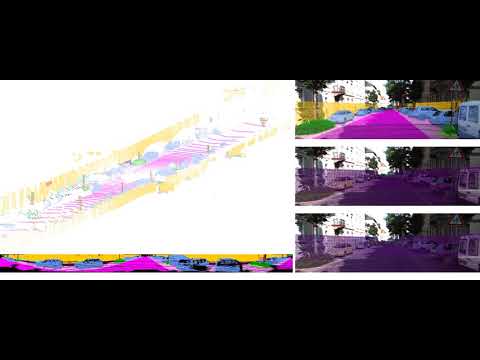
In this paper, we introduce SalsaNext for the uncertainty-aware semantic segmentation of a full 3D LiDAR point cloud in real-time. SalsaNext is the next version of SalsaNet which has an encoder-decoder architecture where the encoder unit has a set of ResNet blocks and the decoder part combines upsampled features from the residual blocks. In contrast to SalsaNet, we introduce a new context module, replace the ResNet encoder blocks with a new residual dilated convolution stack with gradually increasing receptive fields and add the pixel-shuffle layer in the decoder. Additionally, we switch from stride convolution to average pooling and also apply central dropout treatment. To directly optimize the Jaccard index, we further combine the weighted cross-entropy loss with Lovasz-Softmax loss . We finally inject a Bayesian treatment to compute the epistemic and aleatoric uncertainties for each point in the cloud. We provide a thorough quantitative evaluation on the Semantic-KITTI dataset, which demonstrates that the proposed SalsaNext outperforms other state-of-the-art semantic segmentation.

Examples

Example Gif

Video

Inference of Sequence 13

Semantic Kitti Segmentation Scores

The up-to-date scores can be found in the Semantic-Kitti page.

How to use the code

First create the anaconda env with: conda env create -f salsanext_cuda10.yml --name salsanext then activate the environment with conda activate salsanext.

To train/eval you can use the following scripts:

  • Training script (you might need to chmod +x the file)
    • We have the following options:
      • -d [String] : Path to the dataset
      • -a [String]: Path to the Architecture configuration file
      • -l [String]: Path to the main log folder
      • -n [String]: additional name for the experiment
      • -c [String]: GPUs to use (default no gpu)
      • -u [String]: If you want to train an Uncertainty version of SalsaNext (default false) [Experimental: tests done so with uncertainty far used pretrained SalsaNext with Deep Uncertainty Estimation]
    • For example if you have the dataset at /dataset the architecture config file in /salsanext.yml and you want to save your logs to /logs to train "salsanext" with 2 GPUs with id 3 and 4:
      • ./train.sh -d /dataset -a /salsanext.yml -m salsanext -l /logs -c 3,4


  • Eval script (you might need to chmod +x the file)
    • We have the following options:
      • -d [String]: Path to the dataset
      • -p [String]: Path to save label predictions
      • -m [String]: Path to the location of saved model
      • -s [String]: Eval on Validation or Train (standard eval on both separately)
      • -u [String]: If you want to infer using an Uncertainty model (default false)
      • -c [Int]: Number of MC sampling to do (default 30)
    • If you want to infer&evaluate a model that you saved to /salsanext/logs/[the desired run] and you want to infer$eval only the validation and save the label prediction to /pred:
      • ./eval.sh -d /dataset -p /pred -m /salsanext/logs/[the desired run] -s validation -n salsanext

Pretrained Model

SalsaNext

Disclamer

We based our code on RangeNet++, please go show some support!

Citation

@misc{cortinhal2020salsanext,
    title={SalsaNext: Fast, Uncertainty-aware Semantic Segmentation of LiDAR Point Clouds for Autonomous Driving},
    author={Tiago Cortinhal and George Tzelepis and Eren Erdal Aksoy},
    year={2020},
    eprint={2003.03653},
    archivePrefix={arXiv},
    primaryClass={cs.CV}
}
Official repository for Hierarchical Opacity Propagation for Image Matting

HOP-Matting Official repository for Hierarchical Opacity Propagation for Image Matting 🚧 🚧 🚧 Under Construction 🚧 🚧 🚧 🚧 🚧 🚧   Coming Soon   

Li Yaoyi 54 Dec 30, 2021
Apache Flink

Apache Flink Apache Flink is an open source stream processing framework with powerful stream- and batch-processing capabilities. Learn more about Flin

The Apache Software Foundation 20.4k Dec 30, 2022
Informer: Beyond Efficient Transformer for Long Sequence Time-Series Forecasting

Informer: Beyond Efficient Transformer for Long Sequence Time-Series Forecasting This is the origin Pytorch implementation of Informer in the followin

Haoyi 3.1k Dec 29, 2022
PyTorch implementation of Octave Convolution with pre-trained Oct-ResNet and Oct-MobileNet models

octconv.pytorch PyTorch implementation of Octave Convolution in Drop an Octave: Reducing Spatial Redundancy in Convolutional Neural Networks with Octa

Duo Li 273 Dec 18, 2022
MicroNet: Improving Image Recognition with Extremely Low FLOPs (ICCV 2021)

MicroNet: Improving Image Recognition with Extremely Low FLOPs (ICCV 2021) A pytorch implementation of MicroNet. If you use this code in your research

Yunsheng Li 293 Dec 28, 2022
Yolox-bytetrack-sample - Python sample of MOT (Multiple Object Tracking) using YOLOX and ByteTrack

yolox-bytetrack-sample YOLOXとByteTrackを用いたMOT(Multiple Object Tracking)のPythonサン

KazuhitoTakahashi 12 Nov 09, 2022
Assessing the Influence of Models on the Performance of Reinforcement Learning Algorithms applied on Continuous Control Tasks

Assessing the Influence of Models on the Performance of Reinforcement Learning Algorithms applied on Continuous Control Tasks This is the master thesi

Giacomo Arcieri 1 Mar 21, 2022
Lua-parser-lark - An out-of-box Lua parser written in Lark

An out-of-box Lua parser written in Lark Such parser handles a relaxed version o

Taine Zhao 2 Jul 19, 2022
Make a Turtlebot3 follow a figure 8 trajectory and create a robot arm and make it follow a trajectory

HW2 - ME 495 Overview Part 1: Makes the robot move in a figure 8 shape. The robot starts moving when launched on a real turtlebot3 and can be paused a

Devesh Bhura 0 Oct 21, 2022
TC-GNN with Pytorch integration

TC-GNN (Running Sparse GNN on Dense Tensor Core on Ampere GPU) Cite this project and paper. @inproceedings{TC-GNN, title={TC-GNN: Accelerating Spars

YUKE WANG 19 Dec 01, 2022
Face Mesh is a face geometry solution that estimates 468 3D face landmarks in real-time even on mobile devices

Face-Mesh Face Mesh is a face geometry solution that estimates 468 3D face landmarks in real-time even on mobile devices. It employs machine learning

Farnam Javadi 9 Dec 21, 2022
HairCLIP: Design Your Hair by Text and Reference Image

Overview This repository hosts the official PyTorch implementation of the paper: "HairCLIP: Design Your Hair by Text and Reference Image". Our single

322 Jan 06, 2023
A tool to estimate time varying instantaneous reproduction number during epidemics

EpiEstim A tool to estimate time varying instantaneous reproduction number during epidemics. It is described in the following paper: @article{Cori2013

MRC Centre for Global Infectious Disease Analysis 78 Dec 19, 2022
Visualize Camera's Pose Using Extrinsic Parameter by Plotting Pyramid Model on 3D Space

extrinsic2pyramid Visualize Camera's Pose Using Extrinsic Parameter by Plotting Pyramid Model on 3D Space Intro A very simple and straightforward modu

JEONG HYEONJIN 106 Dec 28, 2022
Pure python implementations of popular ML algorithms.

Minimal ML algorithms This repo includes minimal implementations of popular ML algorithms using pure python and numpy. The purpose of these notebooks

Alexis Gidiotis 3 Jan 10, 2022
The fastai deep learning library

Welcome to fastai fastai simplifies training fast and accurate neural nets using modern best practices Important: This documentation covers fastai v2,

fast.ai 23.2k Jan 07, 2023
Fashion Entity Classification

Fashion-Entity-Classification - Fashion-MNIST is a dataset of Zalando's article images—consisting of a training set of 60,000 examples and a test set of 10,000 examples. Each example is a 28x28 grays

ADITYA SHAH 1 Jan 04, 2022
Python library to receive live stream events like comments and gifts in realtime from TikTok LIVE.

TikTokLive A python library to connect to and read events from TikTok's LIVE service A python library to receive and decode livestream events such as

Isaac Kogan 277 Dec 23, 2022
Offical implementation of Shunted Self-Attention via Multi-Scale Token Aggregation

Shunted Transformer This is the offical implementation of Shunted Self-Attention via Multi-Scale Token Aggregation by Sucheng Ren, Daquan Zhou, Shengf

156 Dec 27, 2022
A framework for annotating 3D meshes using the predictions of a 2D semantic segmentation model.

Semantic Meshes A framework for annotating 3D meshes using the predictions of a 2D semantic segmentation model. Paper If you find this framework usefu

Florian 40 Dec 09, 2022