Variational autoencoder for anime face reconstruction

Overview

VAE animeface

Variational autoencoder for anime face reconstruction

Introduction

This repository is an exploratory example to train a variational autoencoder to extract meaningful feature representations of anime girl face images.

The code architecture is mostly borrowed and modified from Yann Dubois's disentangling-vae repository. It has nice summarization and comparison of the different VAE model proposed recently.

Dataset

Anime Face Dataset contains 63,632 anime faces. (all rescaled to 64x64 in training)
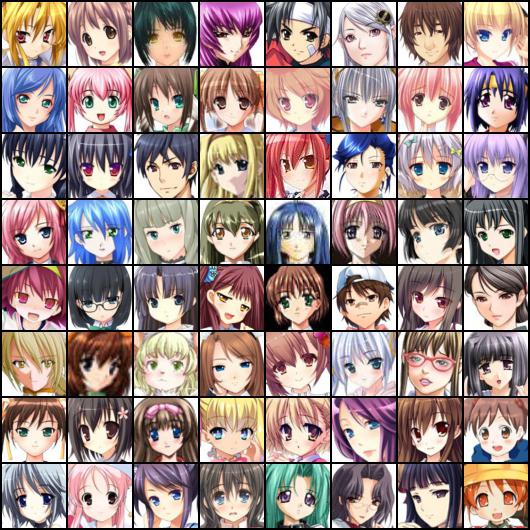
https://raw.githubusercontent.com/Mckinsey666/Anime-Face-Dataset/master/test.jpg

Model

The model used is the one proposed in the paper Understanding disentangling in β-VAE, which is summarized below:

https://github.com/YannDubs/disentangling-vae/raw/master/doc/imgs/architecture.png

I used laplace as the target distribution to calculate the reconstruction loss. From Yann's code, it suggests that bernoulli would generally a better choice, but it looks it converge slowly in my case. (I didn't do a fair comparison to be conclusive)

Loss function used is β-VAEH from β-VAE: Learning Basic Visual Concepts with a Constrained Variational Framework.

Result

Latent feature number is set to 20 (10 gaussian mean, 10 log gaussian variance). VAE model is trained for 100 epochs. All data is used for training, no validation and testing applied.

Face reconstruction

results/laplace_betaH_loss/test1_recons.png

results/laplace_betaH_loss/test2_recons.png

results/laplace_betaH_loss/test3_recons.png

Prior space traversal

Based on the face reconstruction result while traversing across the latent space, we may speculate the generative property of each latent as following:

  1. Hair shade
  2. Hair length
  3. Face orientation
  4. Hair color
  5. Face rotation
  6. Bangs, face color
  7. Hair glossiness
  8. Unclear
  9. Eye size & color
  10. Bangs

results/laplace_betaH_loss/test_prior_traversals.png

Original faces clustering

Original anime faces are clustered based on latent features (selected feature is either below 1% (left 5) or above 99% (right 5) among all data points, while the rest latent features are closeto each other). Visulization of the original images mostly confirms the speculation above.

results/laplace_betaH_loss/test_original_traversals.png

Latent feature diagnosis

Learned latent features are all close to standard normal distribution, and show minimum correlation.

results/laplace_betaH_loss/latent_diagnosis.png

Owner
Minzhe Zhang
Graduate student in UT Southwestern Medical Center. Bioinformatician. Computational biologist.
Minzhe Zhang
A computational block to solve entity alignment over textual attributes in a knowledge graph creation pipeline.

How to apply? Create your config.ini file following the example provided in config.ini Choose one of the options below to run: Run with Python3 pip in

Scientific Data Management Group 3 Jun 23, 2022
Fuzzification helps developers protect the released, binary-only software from attackers who are capable of applying state-of-the-art fuzzing techniques

About Fuzzification Fuzzification helps developers protect the released, binary-only software from attackers who are capable of applying state-of-the-

gts3.org (<a href=[email protected])"> 55 Oct 25, 2022
View model summaries in PyTorch!

torchinfo (formerly torch-summary) Torchinfo provides information complementary to what is provided by print(your_model) in PyTorch, similar to Tensor

Tyler Yep 1.5k Jan 05, 2023
Spectralformer: Rethinking hyperspectral image classification with transformers

The code in this toolbox implements the "Spectralformer: Rethinking hyperspectral image classification with transformers". More specifically, it is detailed as follow.

Danfeng Hong 104 Jan 04, 2023
Code for WECHSEL: Effective initialization of subword embeddings for cross-lingual transfer of monolingual language models.

WECHSEL Code for WECHSEL: Effective initialization of subword embeddings for cross-lingual transfer of monolingual language models. arXiv: https://arx

Institute of Computational Perception 45 Dec 29, 2022
Explainable Medical ImageSegmentation via GenerativeAdversarial Networks andLayer-wise Relevance Propagation

MedAI: Transparency in Medical Image Segmentation What is this repo This repo contains the code and experiments that are implemented to contribute in

Awadelrahman M. A. Ahmed 1 Nov 22, 2021
A fast python implementation of Ray Tracing in One Weekend using python and Taichi

ray-tracing-one-weekend-taichi A fast python implementation of Ray Tracing in One Weekend using python and Taichi. Taichi is a simple "Domain specific

157 Dec 26, 2022
PyTorch implementation of the wavelet analysis from Torrence & Compo

Continuous Wavelet Transforms in PyTorch This is a PyTorch implementation for the wavelet analysis outlined in Torrence and Compo (BAMS, 1998). The co

Tom Runia 262 Dec 21, 2022
Simple-Image-Classification - Simple Image Classification Code (PyTorch)

Simple-Image-Classification Simple Image Classification Code (PyTorch) Yechan Kim This repository contains: Python3 / Pytorch code for multi-class ima

Yechan Kim 8 Oct 29, 2022
Code to accompany the paper "Finding Bipartite Components in Hypergraphs", which is published in NeurIPS'21.

Finding Bipartite Components in Hypergraphs This repository contains code to accompany the paper "Finding Bipartite Components in Hypergraphs", publis

Peter Macgregor 5 May 06, 2022
This repo is official PyTorch implementation of MobileHumanPose: Toward real-time 3D human pose estimation in mobile devices(CVPRW 2021).

Github Code of "MobileHumanPose: Toward real-time 3D human pose estimation in mobile devices" Introduction This repo is official PyTorch implementatio

Choi Sang Bum 203 Jan 05, 2023
Fine-tune pretrained Convolutional Neural Networks with PyTorch

Fine-tune pretrained Convolutional Neural Networks with PyTorch. Features Gives access to the most popular CNN architectures pretrained on ImageNet. A

Alex Parinov 694 Nov 23, 2022
The repository offers the official implementation of our BMVC 2021 paper in PyTorch.

CrossMLP Cascaded Cross MLP-Mixer GANs for Cross-View Image Translation Bin Ren1, Hao Tang2, Nicu Sebe1. 1University of Trento, Italy, 2ETH, Switzerla

Bingoren 16 Jul 27, 2022
A PyTorch implementation of Mugs proposed by our paper "Mugs: A Multi-Granular Self-Supervised Learning Framework".

Mugs: A Multi-Granular Self-Supervised Learning Framework This is a PyTorch implementation of Mugs proposed by our paper "Mugs: A Multi-Granular Self-

Sea AI Lab 62 Nov 08, 2022
The Curious Layperson: Fine-Grained Image Recognition without Expert Labels (BMVC 2021)

The Curious Layperson: Fine-Grained Image Recognition without Expert Labels Subhabrata Choudhury, Iro Laina, Christian Rupprecht, Andrea Vedaldi Code

Subhabrata Choudhury 18 Dec 27, 2022
The implementation code for "DAGAN: Deep De-Aliasing Generative Adversarial Networks for Fast Compressed Sensing MRI Reconstruction"

DAGAN This is the official implementation code for DAGAN: Deep De-Aliasing Generative Adversarial Networks for Fast Compressed Sensing MRI Reconstruct

TensorLayer Community 159 Nov 22, 2022
Semantic Segmentation for Aerial Imagery using Convolutional Neural Network

This repo has been deprecated because whole things are re-implemented by using Chainer and I did refactoring for many codes. So please check this newe

Shunta Saito 27 Sep 23, 2022
KIND: an Italian Multi-Domain Dataset for Named Entity Recognition

KIND (Kessler Italian Named-entities Dataset) KIND is an Italian dataset for Named-Entity Recognition. It contains more than one million tokens with t

Digital Humanities 5 Jun 21, 2022
Melanoma Skin Cancer Detection using Convolutional Neural Networks and Transfer Learning🕵🏻‍♂️

This is a Kaggle competition in which we have to identify if the given lesion image is malignant or not for Melanoma which is a type of skin cancer.

Vipul Shinde 1 Jan 27, 2022
Analyzes your GitHub Profile and presents you with a report on how likely you are to become the next MLH Fellow!

Fellowship Prediction GitHub Profile Comparative Analysis Tool Built with BentoML Table of Contents: Features Disclaimer Technologies Used Contributin

Damir Temir 51 Dec 29, 2022