Predict halo masses from simulations via graph neural networks

Overview

HaloGraphNet

DOI arXiv

Predict halo masses from simulations via Graph Neural Networks.

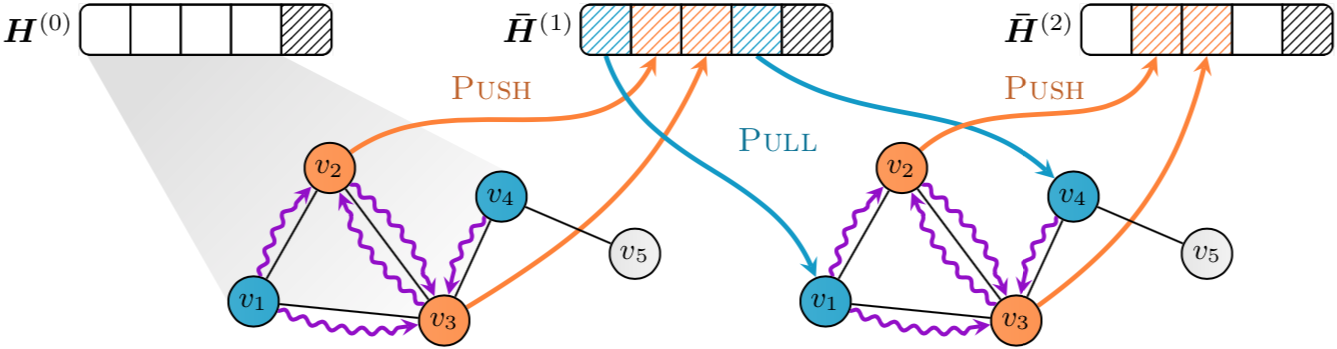
Given a dark matter halo and its galaxies, creates a graph with information about the 3D position, stellar mass and other properties. Then, it trains a Graph Neural Network to predict the mass of the host halo. Data are taken from the CAMELS hydrodynamic simulations, specially suited for Machine Learning purposes. Neural nets architectures are defined making use of the package PyTorch-geometric.

See the papers arXiv:2111.08683 for more details.

Scripts

Here is a brief description of the codes included:

  • main.py: main driver to train and test the network.

  • onlytest.py: tests a pre-trained model.

  • hyperparams_optimization.py: optimize the hyperparameters using optuna.

  • camelsplots.py: plot several features of the CAMELS data.

  • captumtest.py: studies interpretability of the model.

  • halomass.py: using models trained in CAMELS, predicts the mass of real halos, such as the Milky Way and Andromeda.

  • visualize_graphs.py: display several halos as graphs in 2D or 3D.

The folder Hyperparameters includes files with lists of default hyperparameters, to be modified by the user. The current files contain the best values for each CAMELS simulation suite and set separately, obtained from hyperparameter optimization.

The folder Models includes some pre-trained models for the hyperparameters defined in Hyperparameters.

In the folder Source, several auxiliary routines are defined:

  • constants.py: basic constants and initialization.

  • load_data.py: contains routines to load data from simulation files.

  • plotting.py: includes functions for displaying the loss evolution and the results from the neural nets.

  • networks.py: includes the definition of the Graph Neural Networks architectures.

  • training.py: includes routines for training and testing the net.

  • galaxies.py: contains data for galaxies from the Milky Way and Andromeda halos.

Requisites

The libraries required for training the models and compute some statistics are:

  • numpy
  • pytorch-geometric
  • matplotlib
  • scipy
  • sklearn
  • optuna (only for optimization in hyperparams_optimization.py)
  • astropy (only for MW and M31 data in Source/galaxies.py)
  • captum (only for interpretability in captumtest.py)

Usage

These are some advices to employ the scripts described above:

  1. To perform a search of the optimal hyperparameters, run hyperparams_optimization.py.
  2. To train a model with a given set of parameters defined in params.py, run main.py.
  3. Once a model is trained, run onlytest.py to test in the training simulation suite and cross test it in the other one included in CAMELS (IllustrisTNG and SIMBA).
  4. Run captumtest.py to study the interpretability of the models, feature importance and saliency graphs.
  5. Run halomass.py to infer the mass of the Milky Way and Andromeda, whose data are defined in Source/galaxies.py. For this, note that only models without the stellar mass radius as feature are considered.

Citation

If you use the code, please link this repository, and cite arXiv:2111.08683 and the DOI 10.5281/zenodo.5676528.

Contact

For comments, questions etc. you can contact me at [email protected].

You might also like...
[CIKM 2019] Code and dataset for "Fi-GNN: Modeling Feature Interactions via Graph Neural Networks for CTR Prediction"

FiGNN for CTR prediction The code and data for our paper in CIKM2019: Fi-GNN: Modeling Feature Interactions via Graph Neural Networks for CTR Predicti

Implementation of
Implementation of "GNNAutoScale: Scalable and Expressive Graph Neural Networks via Historical Embeddings" in PyTorch

PyGAS: Auto-Scaling GNNs in PyG PyGAS is the practical realization of our G NN A uto S cale (GAS) framework, which scales arbitrary message-passing GN

Source code of NeurIPS 2021 Paper ''Be Confident! Towards Trustworthy Graph Neural Networks via Confidence Calibration''

CaGCN This repo is for source code of NeurIPS 2021 paper "Be Confident! Towards Trustworthy Graph Neural Networks via Confidence Calibration". Paper L

Official Implementation of "LUNAR: Unifying Local Outlier Detection Methods via Graph Neural Networks"

LUNAR Official Implementation of "LUNAR: Unifying Local Outlier Detection Methods via Graph Neural Networks" Adam Goodge, Bryan Hooi, Ng See Kiong and

My published benchmark for a Kaggle Simulations Competition

Lux AI Working Title Bot Please refer to the Kaggle notebook for the comment section. The comment section contains my explanation on my code structure

Urban mobility simulations with Python3, RLlib (Deep Reinforcement Learning) and Mesa (Agent-based modeling)

Deep Reinforcement Learning for Smart Cities Documentation RLlib: https://docs.ray.io/en/master/rllib.html Mesa: https://mesa.readthedocs.io/en/stable

This project aims to be a handler for input creation and running of multiple RICEWQ simulations.

What is autoRICEWQ? This project aims to be a handler for input creation and running of multiple RICEWQ simulations. What is RICEWQ? From the descript

TUPÃ was developed to analyze electric field properties in molecular simulations

TUPÃ: Electric field analyses for molecular simulations What is TUPÃ? TUPÃ (pronounced as tu-pan) is a python algorithm that employs MDAnalysis engine

Complex-Valued Neural Networks (CVNN)Complex-Valued Neural Networks (CVNN)

Complex-Valued Neural Networks (CVNN) Done by @NEGU93 - J. Agustin Barrachina Using this library, the only difference with a Tensorflow code is that y

Releases(v1.0)
Owner
Pablo Villanueva Domingo
PhD in Physics at Instituto de Física Corpuscular (IFIC) - Universitat de València (UV), Spain. Researching on cosmology and deep learning.
Pablo Villanueva Domingo
MVFNet: Multi-View Fusion Network for Efficient Video Recognition (AAAI 2021)

MVFNet: Multi-View Fusion Network for Efficient Video Recognition (AAAI 2021) Overview We release the code of the MVFNet (Multi-View Fusion Network).

2 Jan 29, 2022
PCAM: Product of Cross-Attention Matrices for Rigid Registration of Point Clouds

PCAM: Product of Cross-Attention Matrices for Rigid Registration of Point Clouds PCAM: Product of Cross-Attention Matrices for Rigid Registration of P

valeo.ai 24 May 31, 2022
Official PyTorch code of DeepPanoContext: Panoramic 3D Scene Understanding with Holistic Scene Context Graph and Relation-based Optimization (ICCV 2021 Oral).

DeepPanoContext (DPC) [Project Page (with interactive results)][Paper] DeepPanoContext: Panoramic 3D Scene Understanding with Holistic Scene Context G

Cheng Zhang 66 Nov 16, 2022
Denoising Diffusion Implicit Models

Denoising Diffusion Implicit Models (DDIM) Jiaming Song, Chenlin Meng and Stefano Ermon, Stanford Implements sampling from an implicit model that is t

465 Jan 05, 2023
Concept drift monitoring for HA model servers.

{Fast, Correct, Simple} - pick three Easily compare training and production ML data & model distributions Goals Boxkite is an instrumentation library

98 Dec 15, 2022
Repositório para arquivos sobre o Módulo 1 do curso Top Coders da Let's Code + Safra

850-Safra-DS-ModuloI Repositório para arquivos sobre o Módulo 1 do curso Top Coders da Let's Code + Safra Para aprender mais Git https://learngitbranc

Brian Nunes 7 Dec 10, 2022
Consensus score for tripadvisor

ContripScore ContripScore is essentially a score that combines an Internet platform rating and a consensus rating from sentiment analysis (For instanc

Pepe 1 Jan 13, 2022
Python package for covariance matrices manipulation and Biosignal classification with application in Brain Computer interface

pyRiemann pyRiemann is a python package for covariance matrices manipulation and classification through Riemannian geometry. The primary target is cla

447 Jan 05, 2023
[MICCAI'20] AlignShift: Bridging the Gap of Imaging Thickness in 3D Anisotropic Volumes

AlignShift NEW: Code for our new MICCAI'21 paper "Asymmetric 3D Context Fusion for Universal Lesion Detection" will also be pushed to this repository

Medical 3D Vision 42 Jan 06, 2023
Implementation for Shape from Polarization for Complex Scenes in the Wild

sfp-wild Implementation for Shape from Polarization for Complex Scenes in the Wild project website | paper Code and dataset will be released soon. Int

Chenyang LEI 41 Dec 23, 2022
Semi-Autoregressive Transformer for Image Captioning

Semi-Autoregressive Transformer for Image Captioning Requirements Python 3.6 Pytorch 1.6 Prepare data Please use git clone --recurse-submodules to clo

YE Zhou 23 Dec 09, 2022
General Virtual Sketching Framework for Vector Line Art (SIGGRAPH 2021)

General Virtual Sketching Framework for Vector Line Art - SIGGRAPH 2021 Paper | Project Page Outline Dependencies Testing with Trained Weights Trainin

Haoran MO 118 Dec 27, 2022
Code for "Intra-hour Photovoltaic Generation Forecasting based on Multi-source Data and Deep Learning Methods."

pv_predict_unet-lstm Code for "Intra-hour Photovoltaic Generation Forecasting based on Multi-source Data and Deep Learning Methods." IEEE Transactions

FolkScientistInDL 8 Oct 08, 2022
PyQt6 configuration in yaml format providing the most simple script.

PyamlQt(ぴゃむるきゅーと) PyQt6 configuration in yaml format providing the most simple script. Requirements yaml PyQt6, ( PyQt5 ) Installation pip install Pya

Ar-Ray 7 Aug 15, 2022
PyTorch implementation of "Representing Shape Collections with Alignment-Aware Linear Models" paper.

deep-linear-shapes PyTorch implementation of "Representing Shape Collections with Alignment-Aware Linear Models" paper. If you find this code useful i

Romain Loiseau 27 Sep 24, 2022
An end-to-end PyTorch framework for image and video classification

What's New: March 2021: Added RegNetZ models November 2020: Vision Transformers now available, with training recipes! 2020-11-20: Classy Vision v0.5 R

Facebook Research 1.5k Dec 31, 2022
Rasterize with the least efforts for researchers.

utils3d Rasterize and do image-based 3D transforms with the least efforts for researchers. Based on numpy and OpenGL. It could be helpful when you wan

Ruicheng Wang 8 Dec 15, 2022
Annotate datasets with a semi-trained or fully trained YOLOv5 model

YOLOv5 Auto Annotator Annotate datasets with a semi-trained or fully trained YOLOv5 model Prerequisites Ubuntu =20.04 Python =3.7 System dependencie

Akash James 3 May 14, 2022
VoxHRNet - Whole Brain Segmentation with Full Volume Neural Network

VoxHRNet This is the official implementation of the following paper: Whole Brain Segmentation with Full Volume Neural Network Yeshu Li, Jonathan Cui,

Microsoft 12 Nov 24, 2022
Ranger - a synergistic optimizer using RAdam (Rectified Adam), Gradient Centralization and LookAhead in one codebase

Ranger-Deep-Learning-Optimizer Ranger - a synergistic optimizer combining RAdam (Rectified Adam) and LookAhead, and now GC (gradient centralization) i

Less Wright 1.1k Dec 21, 2022