Breast-Cancer-Classification - Using SKLearn breast cancer dataset which contains 569 examples and 32 features classifying has been made with 6 different algorithms

Overview

Breast Cancer Classification

  Using SKLearn breast cancer dataset which contains 569 examples and 32 features classifying has been made with 6 different algorithms. The metrics below have been used to determine these algorithms performance.

  • Accuracy
  • Precision
  • Recall
  • F Score

Accuracy may produce misleading results so because of that I also added some metrics which some of them are more reliable (e.g. F Score).

Algorithms

  Logistic regression, SVM (Support Vector Machines), decision trees, random forest, naive bayes, k-nearest neighbor algorithms have been used and for each of them metrics are calculated and results are shown.

Data Preprocessing

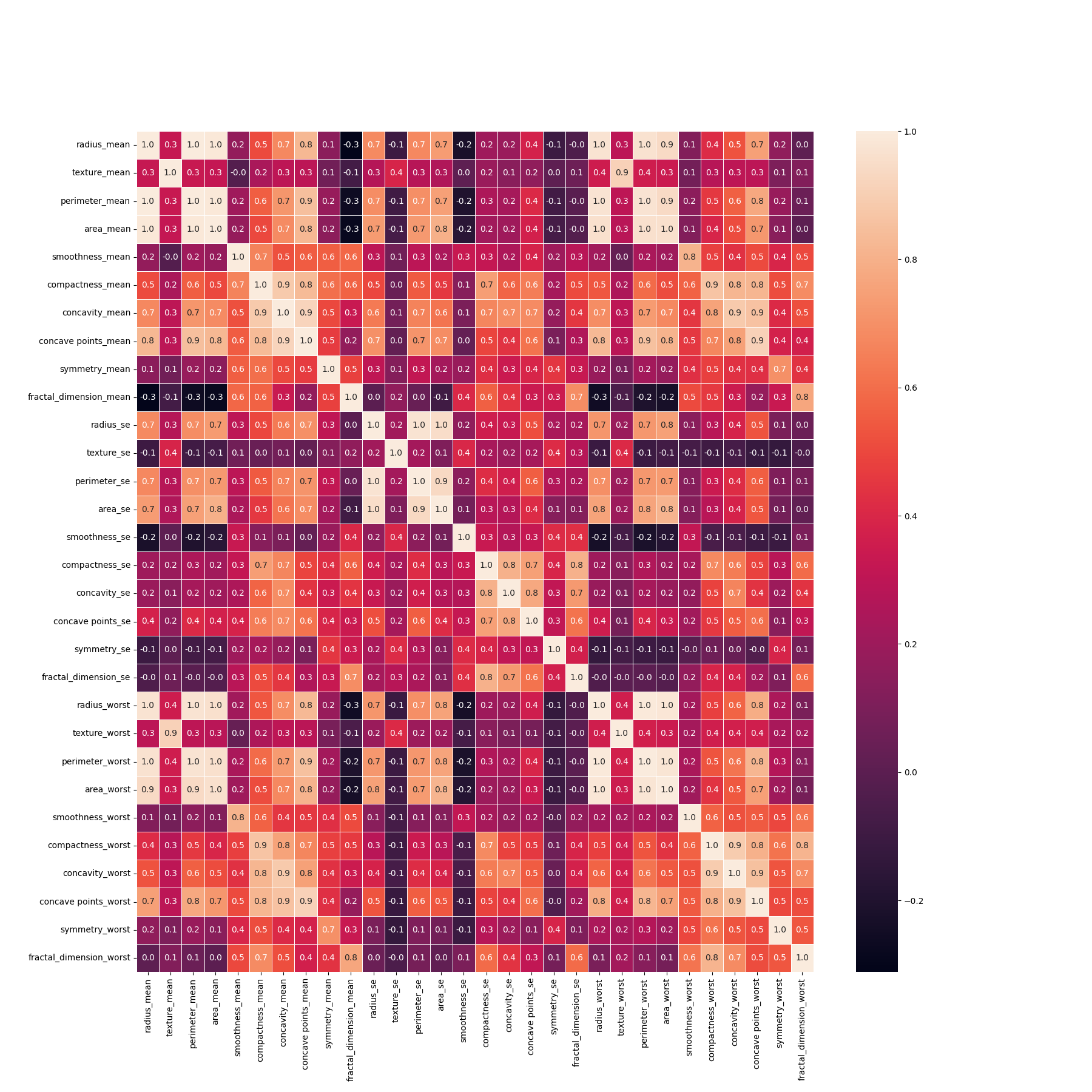
  The dataset contains no missing rows or columns so we can start feature selection. To do that I used correlation map to show the correlation between features. And I eliminated mostly correlated features like perimeter_mean and perimeter_worst. After this process we have 18 features.
image

Then we apply data normalization and our data is ready for classification.

# Data normalization
standardizer = StandardScaler()
X = standardizer.fit_transform(X)

Train and Test Split

I have split my dataset as %30 test, % 70 training and set random_state parameter to 0 as shown.

X_train, X_test, y_train, y_test = train_test_split(X, y, test_size=0.3, random_state=0)

After splitting dataset, I created dictionaries for algorithms and metrics. And in one for loop every model trained and tested.

models = {'Logistic Regression': LogisticRegression(), 'Support Vector Machines': LinearSVC(),
          'Decision Trees': DecisionTreeClassifier(), 'Random Forest': RandomForestClassifier(),
          'Naive Bayes': GaussianNB(), 'K-Nearest Neighbor': KNeighborsClassifier()}

accuracy, precision, recall, f_score = {}, {}, {}, {}

for key in models.keys():
    # Fit the classifier model
    models[key].fit(X_train, y_train)

    # Classification
    classification = models[key].predict(X_test)

    # Calculate Accuracy, Precision, Recall and F Score Metrics
    accuracy[key] = accuracy_score(classification, y_test)
    precision[key] = precision_score(classification, y_test)
    recall[key] = recall_score(classification, y_test)
    f_score[key] = f1_score(classification, y_test)

Results

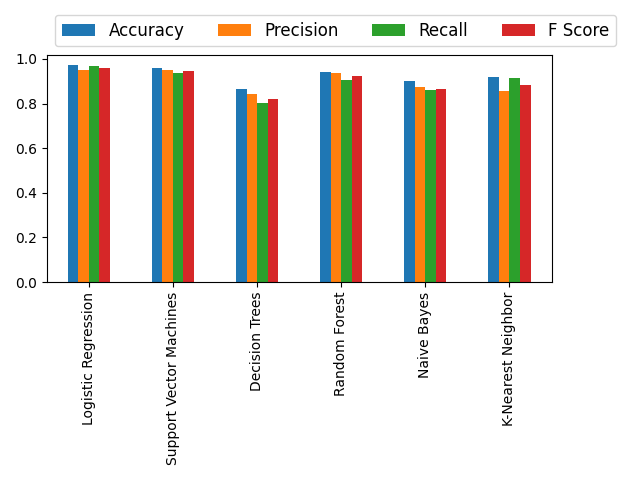
As you can see the figure below, most successful classification algorithm seems to logistic regression. And decision tress has the worst performance.
image

To see the values algorithms got for each metric see the table below.

Algorithm Accuracy Precision Recall F Score
Logistic Regression 0.97 0.95 0.96 0.96
SVM 0.95 0.95 0.93 0.94
Decision Trees 0.86 0.84 0.80 0.82
Random Forest 0.94 0.93 0.90 0.92
Naive Bayes 0.90 0.87 0.85 0.86
K-Nearest Neighbor 0.91 0.85 0.91 0.88

Conclusion

I have tuned few parameters for example training and test size, random state and most of the algorithms performed close enough to each other. For different datasets this code can be used. You may need to change feature selection part and if your dataset has missing values you should fill in these values as well. Other than these things you can perform classification with different kind of algorithms.

Owner
Mert Sezer Ardal
Mert Sezer Ardal
Simple, light-weight config handling through python data classes with to/from JSON serialization/deserialization.

Simple but maybe too simple config management through python data classes. We use it for machine learning.

Eren Gölge 67 Nov 29, 2022
Warren - Stock Price Predictor

Web app to predict closing stock prices in real time using Facebook's Prophet time series algorithm with a multi-variate, single-step time series forecasting strategy.

Kumar Nityan Suman 153 Jan 03, 2023
Can a machine learning project be implemented to estimate the salaries of baseball players whose salary information and career statistics for 1986 are shared?

END TO END MACHINE LEARNING PROJECT ON HITTERS DATASET Can a machine learning project be implemented to estimate the salaries of baseball players whos

Pinar Oner 7 Dec 18, 2021
Simple, fast, and parallelized symbolic regression in Python/Julia via regularized evolution and simulated annealing

Parallelized symbolic regression built on Julia, and interfaced by Python. Uses regularized evolution, simulated annealing, and gradient-free optimization.

Miles Cranmer 924 Jan 03, 2023
A comprehensive repository containing 30+ notebooks on learning machine learning!

A comprehensive repository containing 30+ notebooks on learning machine learning!

Jean de Dieu Nyandwi 3.8k Jan 09, 2023
ThunderSVM: A Fast SVM Library on GPUs and CPUs

What's new We have recently released ThunderGBM, a fast GBDT and Random Forest library on GPUs. add scikit-learn interface, see here Overview The miss

Xtra Computing Group 1.4k Dec 22, 2022
Reproducibility and Replicability of Web Measurement Studies

Reproducibility and Replicability of Web Measurement Studies This repository holds additional material to the paper "Reproducibility and Replicability

6 Dec 31, 2022
Python library for multilinear algebra and tensor factorizations

scikit-tensor is a Python module for multilinear algebra and tensor factorizations

Maximilian Nickel 394 Dec 09, 2022
Distributed Deep learning with Keras & Spark

Elephas: Distributed Deep Learning with Keras & Spark Elephas is an extension of Keras, which allows you to run distributed deep learning models at sc

Max Pumperla 1.6k Dec 29, 2022
Predicting diabetes over a five year period using logistic regression and the Pima First-Nation dataset

Diabetes This script uses the Pima First Nations dataset to create a model to predict whether or not an individual will develop Diabetes Mellitus Type

1 Mar 28, 2022
TIANCHI Purchase Redemption Forecast Challenge

TIANCHI Purchase Redemption Forecast Challenge

Haorui HE 4 Aug 26, 2022
healthy and lesion models for learning based on the joint estimation of stochasticity and volatility

health-lesion-stovol healthy and lesion models for learning based on the joint estimation of stochasticity and volatility Reference please cite this p

5 Nov 01, 2022
A library of sklearn compatible categorical variable encoders

Categorical Encoding Methods A set of scikit-learn-style transformers for encoding categorical variables into numeric by means of different techniques

2.1k Jan 07, 2023
Simple and flexible ML workflow engine.

This is a simple and flexible ML workflow engine. It helps to orchestrate events across a set of microservices and create executable flow to handle requests. Engine is designed to be configurable wit

Katana ML 295 Jan 06, 2023
A collection of Machine Learning Models To Web Api which are built on open source technologies/frameworks like Django, Flask.

Author Ibrahim Koné From-Machine-Learning-Models-To-WebAPI A collection of Machine Learning Models To Web Api which are built on open source technolog

Ibrahim Koné 2 May 24, 2022
Model Agnostic Confidence Estimator (MACEST) - A Python library for calibrating Machine Learning models' confidence scores

Model Agnostic Confidence Estimator (MACEST) - A Python library for calibrating Machine Learning models' confidence scores

Oracle 95 Dec 28, 2022
Evidently helps analyze machine learning models during validation or production monitoring

Evidently helps analyze machine learning models during validation or production monitoring. The tool generates interactive visual reports and JSON profiles from pandas DataFrame or csv files. Current

Evidently AI 3.1k Jan 07, 2023
MBTR is a python package for multivariate boosted tree regressors trained in parameter space.

MBTR is a python package for multivariate boosted tree regressors trained in parameter space.

SUPSI-DACD-ISAAC 61 Dec 19, 2022
This machine learning model was developed for House Prices

This machine learning model was developed for House Prices - Advanced Regression Techniques competition in Kaggle by using several machine learning models such as Random Forest, XGBoost and LightGBM.

serhat_derya 1 Mar 02, 2022