Neural Radiance Fields Using PyTorch

Overview

Neural Radiance Fields Using PyTorch

NeRF (Neural Radiance Fields) is a method for achieving outcomes for synthesizing novel views of complex scenes. Posted below are a few videos generated by this project.

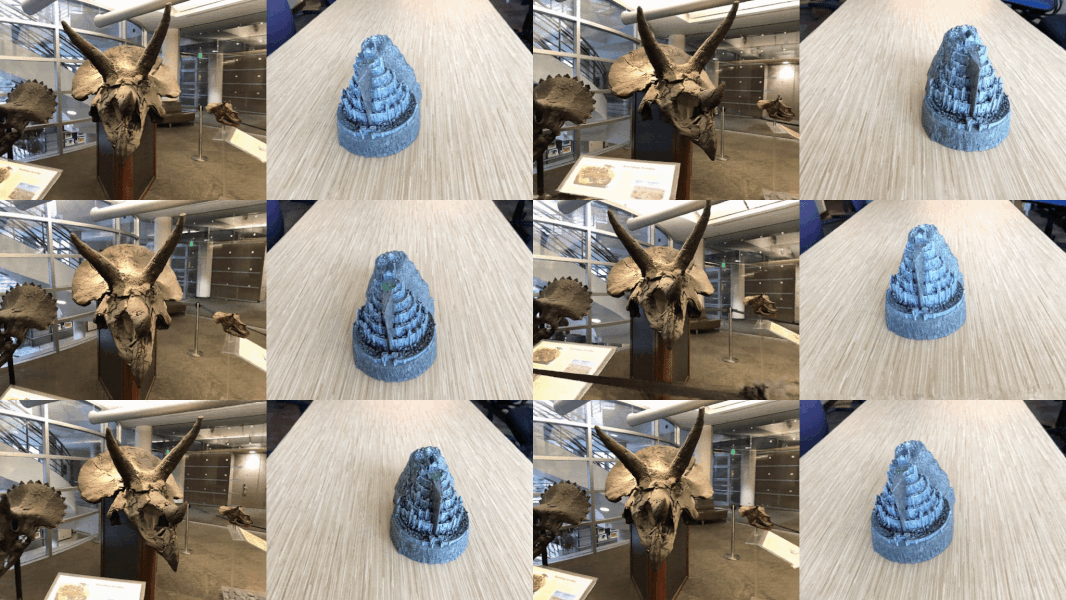
This project is a PyTorch implementation of NeRF that reproduces the results while running approximately 1.3x faster. The code is based on the TensorFlow implementation here of the author. PyTorch has been used for numerical testing and validation of the same.

Installation

git clone https://github.com/yenchenlin/nerf-pytorch.git
cd nerf-pytorch
pip install -r requirements.txt
cd torchsearchsorted
pip install .
cd ../
Dependencies (click to expand)

Dependencies

  • PyTorch 1.4
  • matplotlib
  • numpy
  • imageio
  • imageio-ffmpeg
  • configargparse

The LLFF data loader requires ImageMagick.

You will also need the LLFF code (and COLMAP) set up to compute poses if you want to run on your own real data.

How To Run?

Quick Start

Download data for two example datasets: lego and fern

bash download_example_data.sh

To train a low-res lego NeRF:

python run_nerf.py --config configs/config_lego.txt

After training for 100,000 iterations (~4 hours on a single 2080 Ti), you can find the following video at logs/lego_test/lego_test_spiral_100000_rgb.mp4.


To train a low-res fern NeRF:

python run_nerf.py --config configs/config_fern.txt

After training for 200k iterations (~8 hours on a single 2080 Ti), you can find the following video at logs/fern_test/fern_test_spiral_200000_rgb.mp4 and logs/fern_test/fern_test_spiral_200000_disp.mp4


More Datasets

To test out the other scenes presented in the paper, you can download the data here. Please place the downloaded dataset according to the following directory structure:

├── configs                                                                                                       
│   ├── ...                                                                                     
│                                                                                               
├── data                                                                                                                                                                                                       
│   ├── nerf_llff_data                                                                                                  
│   │   └── fern                                                                                                                             
│   │   └── flower  # downloaded llff dataset                                                                                  
│   │   └── horns   # downloaded llff dataset
|   |   └── ...
|   ├── nerf_synthetic
|   |   └── lego
|   |   └── ship    # downloaded synthetic dataset
|   |   └── ...

To train NeRF on different datasets:

python run_nerf.py --config configs/config_{DATASET}.txt

replace {DATASET} with trex | horns | flower | fortress | lego | etc.


To test NeRF trained on different datasets:

python run_nerf.py --config configs/config_{DATASET}.txt --render_only

replace {DATASET} with trex | horns | flower | fortress | lego | etc.

Pre-trained Models

You can download the pre-trained models here. Please place the downloaded directory in ./logs in order to test it later. Check the following directory structure for an example:

├── logs 
│   ├── fern_test
│   ├── flower_test  # downloaded logs
│   ├── trex_test    # downloaded logs

Reproducibility

The tests that ensure the results of all functions and training loop match the official implentation are contained in a different branch reproduce. One can check it out and run the tests:

git checkout reproduce
py.test

Method

NeRF: Representing Scenes as Neural Radiance Fields for View Synthesis
Ben Mildenhall*1, Pratul P. Srinivasan*1, Matthew Tancik*1, Jonathan T. Barron2, Ravi Ramamoorthi3, Ren Ng1
1UC Berkeley, 2Google Research, 3UC San Diego
*denotes equal contribution

A Neural Radiance Field is a simple fully connected network (weights are ~5MB) trained to reproduce input views of a single scene using a rendering loss. The network directly maps from spatial location and viewing direction (5D input) to color and opacity (4D output), acting as the "volume" so we can use volume rendering to differentiably render new views

Citation

A big thank-you to the authors (below) for their amazing work and results:

@misc{mildenhall2020nerf,
    title={NeRF: Representing Scenes as Neural Radiance Fields for View Synthesis},
    author={Ben Mildenhall and Pratul P. Srinivasan and Matthew Tancik and Jonathan T. Barron and Ravi Ramamoorthi and Ren Ng},
    year={2020},
    eprint={2003.08934},
    archivePrefix={arXiv},
    primaryClass={cs.CV}
}
Owner
Vedant Ghodke
Technical Undergraduate Intern At Cisco | Ex-AI Intern At Microsoft, India
Vedant Ghodke
Sdf sparse conv - Deep Learning on SDF for Classifying Brain Biomarkers

Deep Learning on SDF for Classifying Brain Biomarkers To reproduce the results f

1 Jan 25, 2022
Plenoxels: Radiance Fields without Neural Networks

Plenoxels: Radiance Fields without Neural Networks Alex Yu*, Sara Fridovich-Keil*, Matthew Tancik, Qinhong Chen, Benjamin Recht, Angjoo Kanazawa UC Be

Sara Fridovich-Keil 81 Dec 25, 2022
Official code base for the poster "On the use of Cortical Magnification and Saccades as Biological Proxies for Data Augmentation" published in NeurIPS 2021 Workshop (SVRHM)

Self-Supervised Learning (SimCLR) with Biological Plausible Image Augmentations Official code base for the poster "On the use of Cortical Magnificatio

Binxu 8 Aug 17, 2022
End-to-End Object Detection with Fully Convolutional Network

This project provides an implementation for "End-to-End Object Detection with Fully Convolutional Network" on PyTorch.

472 Dec 22, 2022
InterFaceGAN - Interpreting the Latent Space of GANs for Semantic Face Editing

InterFaceGAN - Interpreting the Latent Space of GANs for Semantic Face Editing Figure: High-quality facial attributes editing results with InterFaceGA

GenForce: May Generative Force Be with You 1.3k Jan 09, 2023
TabNet for fastai

TabNet for fastai This is an adaptation of TabNet (Attention-based network for tabular data) for fastai (=2.0) library. The original paper https://ar

Mikhail Grankin 116 Oct 21, 2022
Frequency Spectrum Augmentation Consistency for Domain Adaptive Object Detection

Frequency Spectrum Augmentation Consistency for Domain Adaptive Object Detection Main requirements torch = 1.0 torchvision = 0.2.0 Python 3 Environm

15 Apr 04, 2022
Compare outputs between layers written in Tensorflow and layers written in Pytorch

Compare outputs of Wasserstein GANs between TensorFlow vs Pytorch This is our testing module for the implementation of improved WGAN in Pytorch Prereq

Hung Nguyen 72 Dec 20, 2022
Predicting Student Attentiveness using OpenCV

Predicting-Student-Attentiveness-using-OpenCV The model will predict if a student is attentive or not through facial parameter received through the st

Johann Pinto 2 Aug 20, 2022
Official public repository of paper "Intention Adaptive Graph Neural Network for Category-Aware Session-Based Recommendation"

Intention Adaptive Graph Neural Network (IAGNN) This is the official repository of paper Intention Adaptive Graph Neural Network for Category-Aware Se

9 Nov 22, 2022
PyTorch implementation of SwAV (Swapping Assignments between Views)

Unsupervised Learning of Visual Features by Contrasting Cluster Assignments This code provides a PyTorch implementation and pretrained models for SwAV

Meta Research 1.7k Jan 04, 2023
This repository is an implementation of our NeurIPS 2021 paper (Stylized Dialogue Generation with Multi-Pass Dual Learning) in PyTorch.

MPDL---TODO This repository is an implementation of our NeurIPS 2021 paper (Stylized Dialogue Generation with Multi-Pass Dual Learning) in PyTorch. Ci

CodebaseLi 3 Nov 27, 2022
Clustering with variational Bayes and population Monte Carlo

pypmc pypmc is a python package focusing on adaptive importance sampling. It can be used for integration and sampling from a user-defined target densi

45 Feb 06, 2022
Video Background Music Generation with Controllable Music Transformer (ACM MM 2021 Oral)

CMT Code for paper Video Background Music Generation with Controllable Music Transformer (ACM MM 2021 Best Paper Award) [Paper] [Site] Directory Struc

Zhaokai Wang 198 Dec 27, 2022
Driller: augmenting AFL with symbolic execution!

Driller Driller is an implementation of the driller paper. This implementation was built on top of AFL with angr being used as a symbolic tracer. Dril

Shellphish 791 Jan 06, 2023
PerfFuzz: Automatically Generate Pathological Inputs for C/C++ programs

PerfFuzz Performance problems in software can arise unexpectedly when programs are provided with inputs that exhibit pathological behavior. But how ca

Caroline Lemieux 125 Nov 18, 2022
A simple PyTorch Implementation of Generative Adversarial Networks, focusing on anime face drawing.

AnimeGAN A simple PyTorch Implementation of Generative Adversarial Networks, focusing on anime face drawing. Randomly Generated Images The images are

Jie Lei 雷杰 1.2k Jan 03, 2023
Benchmark VAE - Library for Variational Autoencoder benchmarking

Documentation pythae This library implements some of the most common (Variational) Autoencoder models. In particular it provides the possibility to pe

1.1k Jan 02, 2023
IAUnet: Global Context-Aware Feature Learning for Person Re-Identification

IAUnet This repository contains the code for the paper: IAUnet: Global Context-Aware Feature Learning for Person Re-Identification Ruibing Hou, Bingpe

30 Jul 14, 2022
PyTorch implementation code for the paper MixCo: Mix-up Contrastive Learning for Visual Representation

How to Reproduce our Results This repository contains PyTorch implementation code for the paper MixCo: Mix-up Contrastive Learning for Visual Represen

opcrisis 46 Dec 15, 2022