K-means clustering is a method used for clustering analysis, especially in data mining and statistics.

Overview

K Means Algorithm

What is K Means

This algorithm is an iterative algorithm that partitions the dataset according to their features into K number of predefined non- overlapping distinct clusters or subgroups. It makes the data points of inter clusters as similar as possible and also tries to keep the clusters as far as possible. It allocates the data points to a cluster if the sum of the squared distance between the cluster’s centroid and the data points is at a minimum, where the cluster’s centroid is the arithmetic mean of the data points that are in the cluster. A less variation in the cluster results in similar or homogeneous data points within the cluster.

Sources :

  1. Nvidia
  2. Wikipedia

How K Means works

  1. Specify number of clusters K.
  2. Initialize centroids by first shuffling the dataset and then randomly selecting K data points for the centroids without replacement.
  3. Keep iterating until there is no change to the centroids. i.e assignment of data points to clusters isn’t changing.
  4. Compute the euclidean distance
  5. Assign each data point to the closest cluster (centroid).
  6. Compute the centroids for the clusters by taking the average of the all data points that belong to each cluster.
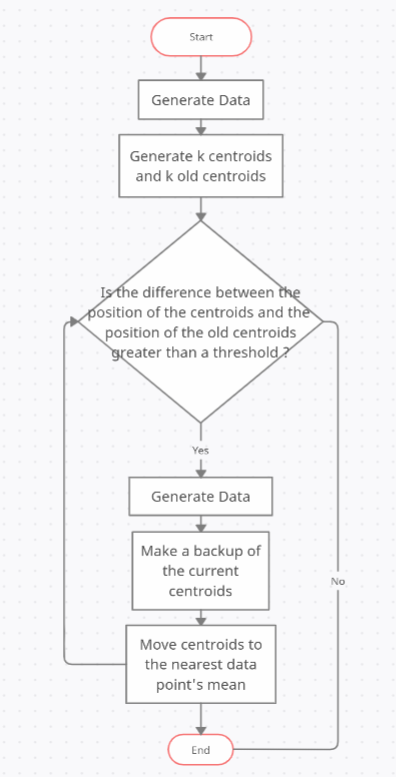
Flow Chart

picture alt


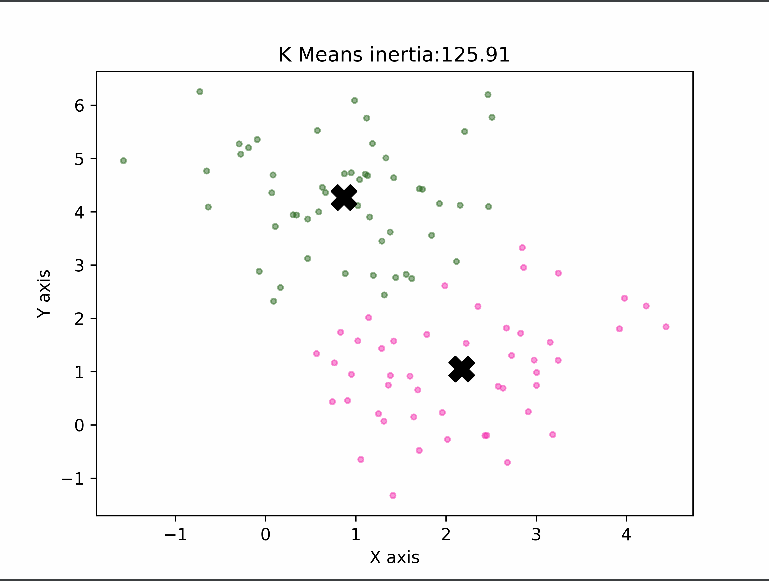
K Means in action

2D:

picture alt

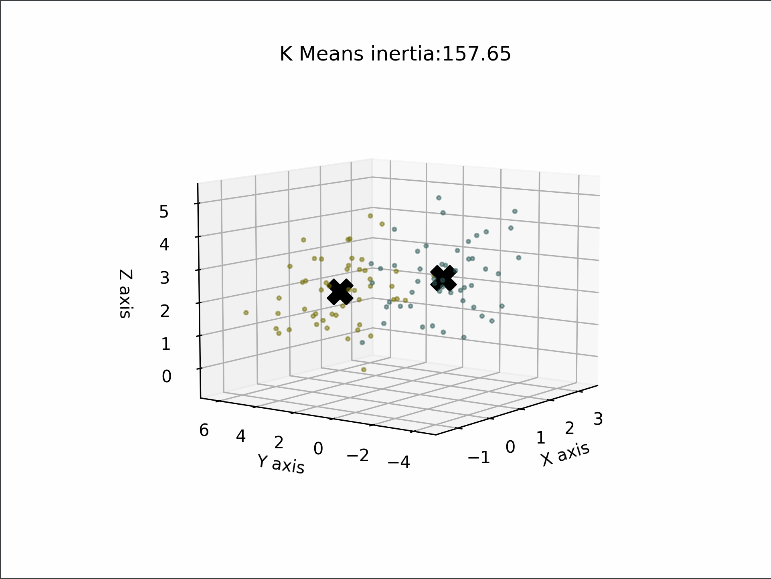
3D:

picture alt

A benchmark of data-centric tasks from across the machine learning lifecycle.

A benchmark of data-centric tasks from across the machine learning lifecycle.

61 Dec 28, 2022
Module for statistical learning, with a particular emphasis on time-dependent modelling

Operating system Build Status Linux/Mac Windows tick tick is a Python 3 module for statistical learning, with a particular emphasis on time-dependent

X - Data Science Initiative 410 Dec 14, 2022
Predict the demand for electricity (R) - FRENCH

06.demand-electricity Predict the demand for electricity (R) - FRENCH Prédisez la demande en électricité Prérequis Pour effectuer ce projet, vous devr

1 Feb 13, 2022
Fourier-Bayesian estimation of stochastic volatility models

fourier-bayesian-sv-estimation Fourier-Bayesian estimation of stochastic volatility models Code used to run the numerical examples of "Bayesian Approa

15 Jun 20, 2022
To design and implement the Identification of Iris Flower species using machine learning using Python and the tool Scikit-Learn.

To design and implement the Identification of Iris Flower species using machine learning using Python and the tool Scikit-Learn.

Astitva Veer Garg 1 Jan 11, 2022
The project's goal is to show a real world application of image segmentation using k means algorithm

The project's goal is to show a real world application of image segmentation using k means algorithm

2 Jan 22, 2022
A project based example of Data pipelines, ML workflow management, API endpoints and Monitoring.

MLOps template with examples for Data pipelines, ML workflow management, API development and Monitoring.

Utsav 33 Dec 03, 2022
A basic Ray Tracer that exploits numpy arrays and functions to work fast.

Python-Fast-Raytracer A basic Ray Tracer that exploits numpy arrays and functions to work fast. The code is written keeping as much readability as pos

Rafael de la Fuente 393 Dec 27, 2022
Data from "Datamodels: Predicting Predictions with Training Data"

Data from "Datamodels: Predicting Predictions with Training Data" Here we provid

Madry Lab 51 Dec 09, 2022
Customers Segmentation with RFM Scores and K-means

Customer Segmentation with RFM Scores and K-means RFM Segmentation table: K-Means Clustering: Business Problem Rule-based customer segmentation machin

5 Aug 10, 2022
CobraML: Completely Customizable A python ML library designed to give the end user full control

CobraML: Completely Customizable What is it? CobraML is a python library built on both numpy and numba. Unlike other ML libraries CobraML gives the us

Sriram Govindan 14 Dec 19, 2021
Summer: compartmental disease modelling in Python

Summer: compartmental disease modelling in Python Summer is a Python-based framework for the creation and execution of compartmental (or "state-based"

6 May 13, 2022
Simple and flexible ML workflow engine.

This is a simple and flexible ML workflow engine. It helps to orchestrate events across a set of microservices and create executable flow to handle requests. Engine is designed to be configurable wit

Katana ML 295 Jan 06, 2023
MiniTorch - a diy teaching library for machine learning engineers

This repo is the full student code for minitorch. It is designed as a single repo that can be completed part by part following the guide book. It uses

1.1k Jan 07, 2023
Pragmatic AI Labs 421 Dec 31, 2022
An implementation of Relaxed Linear Adversarial Concept Erasure (RLACE)

Background This repository contains an implementation of Relaxed Linear Adversarial Concept Erasure (RLACE). Given a dataset X of dense representation

Shauli Ravfogel 4 Apr 13, 2022
Meerkat provides fast and flexible data structures for working with complex machine learning datasets.

Meerkat makes it easier for ML practitioners to interact with high-dimensional, multi-modal data. It provides simple abstractions for data inspection, model evaluation and model training supported by

Robustness Gym 115 Dec 12, 2022
Scikit-Garden or skgarden is a garden for Scikit-Learn compatible decision trees and forests.

Scikit-Garden or skgarden (pronounced as skarden) is a garden for Scikit-Learn compatible decision trees and forests.

260 Dec 21, 2022
Simplify stop motion animation with machine learning.

Simplify stop motion animation with machine learning.

Nick Bild 25 Sep 15, 2022
GAM timeseries modeling with auto-changepoint detection. Inspired by Facebook Prophet and implemented in PyMC3

pm-prophet Pymc3-based universal time series prediction and decomposition library (inspired by Facebook Prophet). However, while Faceook prophet is a

Luca Giacomel 314 Dec 25, 2022