A Tensorfflow implementation of Attend, Infer, Repeat

Overview

Attend, Infer, Repeat: Fast Scene Understanding with Generative Models

This is an unofficial Tensorflow implementation of Attend, Infear, Repeat (AIR), as presented in the following paper: S. M. Ali Eslami et. al., Attend, Infer, Repeat: Fast Scene Understanding with Generative Models.

  • Author (of the implementation): Adam Kosiorek, Oxford Robotics Institue, University of Oxford
  • Email: adamk(at)robots.ox.ac.uk
  • Webpage: http://akosiorek.github.io/

I describe the implementation and the issues I run into while working on it in this blog post.

Installation

Install Tensorflow v1.1.0rc1, Sonnet v1.1 and the following dependencies (using pip install -r requirements.txt (preferred) or pip install [package]):

  • matplotlib==1.5.3
  • numpy==1.12.1
  • attrdict==2.0.0
  • scipy==0.18.1

Sample Results

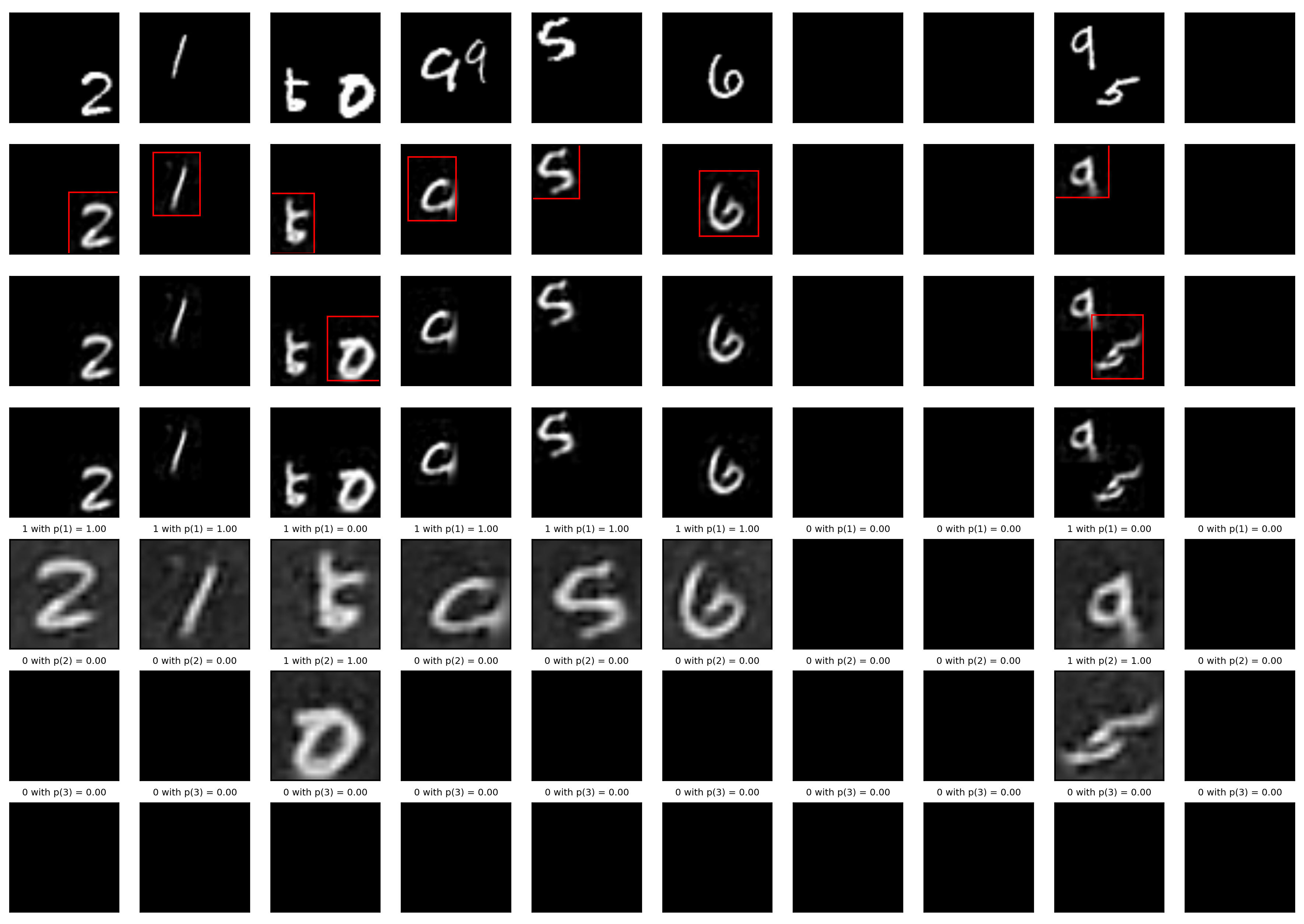
AIR learns to reconstruct objects by painting them one by one in a blank canvas. The below figure comes from a model trained for 175k iterations; the maximum number of steps is set to 3, but there are never more than 2 objects. The first row shows the input images, rows 2-4 are reconstructions at steps 1, 2 and 3 (with marked location of the attention glimpse in red, if it exists). Rows 4-7 are the reconstructed image crops, and above each crop is the probability of executing 1, 2 or 3 steps. If the reconstructed crop is black and there is "0 with ..." written above it, it means that this step was not used.
AIR results

Data

Run ./scripts/create_dataset.sh The script creates train and validation datasets of multi-digit MNIST.

Training

Run ./scripts/train_multi_mnist.sh The training script will run for 300k iteratios and will save model checkpoints and training progress figures every 10k iterations in results/multi_mnist. Tensorflow summaries are also stored in the same folder and Tensorboard can be used for monitoring.

The model seems to be very sensitive to initialisation. It might be necessary to run training multiple times before achieving count step accuracy close to the one reported in the paper.

Experimentation

The jupyter notebook available at attend_infer_repeat/experiment.ipynb can be used for experimentation.

Citation

If you find this repo useful in your research, please consider citing the original paper:

@incollection{Eslami2016,
    title = {Attend, Infer, Repeat: Fast Scene Understanding with Generative Models},
    author = {Eslami, S. M. Ali and Heess, Nicolas and Weber, Theophane and Tassa, Yuval and Szepesvari, David and kavukcuoglu, koray and Hinton, Geoffrey E},
    booktitle = {Advances in Neural Information Processing Systems 29},
    editor = {D. D. Lee and M. Sugiyama and U. V. Luxburg and I. Guyon and R. Garnett},
    pages = {3225--3233},
    year = {2016},
    publisher = {Curran Associates, Inc.},
    url = {http://papers.nips.cc/paper/6230-attend-infer-repeat-fast-scene-understanding-with-generative-models.pdf}
}

License

This program is free software; you can redistribute it and/or modify it under the terms of the GNU General Public License as published by the Free Software Foundation; either version 3 of the License, or (at your option) any later version.

This program is distributed in the hope that it will be useful, but WITHOUT ANY WARRANTY; without even the implied warranty of MERCHANTABILITY or FITNESS FOR A PARTICULAR PURPOSE. See the GNU General Public License for more details.

You should have received a copy of the GNU General Public License along with this program. If not, see http://www.gnu.org/licenses/.

Release Notes

Version 1.0

  • Original unofficial implementation; contains the multi-digit MNIST experiment.
Owner
Adam Kosiorek
I'm a PhD student at the Oxford Robotics Institute. I work on Machine Learning for perception - I'm looking into external memory and attention for RNNs.
Adam Kosiorek
Python code for loading the Aschaffenburg Pose Dataset.

Aschaffenburg Pose Dataset (APD) This repository contains Python code for loading and filtering the Aschaffenburg Pose Dataset. The dataset itself and

1 Nov 26, 2021
Stock-Prediction - prediction of stock market movements using sentiment analysis and deep learning.

Stock-Prediction- In this project, we aim to enhance the prediction of stock market movements using sentiment analysis and deep learning. We divide th

5 Jan 25, 2022
A tight inclusion function for continuous collision detection

Tight-Inclusion Continuous Collision Detection A conservative Continuous Collision Detection (CCD) method with support for minimum separation. You can

Continuous Collision Detection 89 Jan 01, 2023
Automatically Build Multiple ML Models with a Single Line of Code. Created by Ram Seshadri. Collaborators Welcome. Permission Granted upon Request.

Auto-ViML Automatically Build Variant Interpretable ML models fast! Auto_ViML is pronounced "auto vimal" (autovimal logo created by Sanket Ghanmare) N

AutoViz and Auto_ViML 397 Dec 30, 2022
All course materials for the Zero to Mastery Machine Learning and Data Science course.

Zero to Mastery Machine Learning Welcome! This repository contains all of the code, notebooks, images and other materials related to the Zero to Maste

Daniel Bourke 1.6k Jan 08, 2023
Implementation of Multistream Transformers in Pytorch

Multistream Transformers Implementation of Multistream Transformers in Pytorch. This repository deviates slightly from the paper, where instead of usi

Phil Wang 47 Jul 26, 2022
PyToch implementation of A Novel Self-supervised Learning Task Designed for Anomaly Segmentation

Self-Supervised Anomaly Segmentation Intorduction This is a PyToch implementation of A Novel Self-supervised Learning Task Designed for Anomaly Segmen

WuFan 2 Jan 27, 2022
Multi-Agent Reinforcement Learning for Active Voltage Control on Power Distribution Networks (MAPDN)

Multi-Agent Reinforcement Learning for Active Voltage Control on Power Distribution Networks (MAPDN) This is the implementation of the paper Multi-Age

Future Power Networks 83 Jan 06, 2023
Sudoku solver - A sudoku solver with python

sudoku_solver A sudoku solver What is Sudoku? Sudoku (Japanese: 数独, romanized: s

Sikai Lu 0 May 22, 2022
Code for this paper The Lottery Ticket Hypothesis for Pre-trained BERT Networks.

The Lottery Ticket Hypothesis for Pre-trained BERT Networks Code for this paper The Lottery Ticket Hypothesis for Pre-trained BERT Networks. [NeurIPS

VITA 122 Dec 14, 2022
CURL: Contrastive Unsupervised Representations for Reinforcement Learning

CURL Rainbow Status: Archive (code is provided as-is, no updates expected) This is an implementation of CURL: Contrastive Unsupervised Representations

Aravind Srinivas 46 Dec 12, 2022
Miscellaneous and lightweight network tools

Network Tools Collection of miscellaneous and lightweight network tools to simplify daily operations, administration, and troubleshooting of networks.

Nicholas Russo 22 Mar 22, 2022
[ICML 2021] "Graph Contrastive Learning Automated" by Yuning You, Tianlong Chen, Yang Shen, Zhangyang Wang

Graph Contrastive Learning Automated PyTorch implementation for Graph Contrastive Learning Automated [talk] [poster] [appendix] Yuning You, Tianlong C

Shen Lab at Texas A&M University 80 Nov 23, 2022
Official implementation of "An Image is Worth 16x16 Words, What is a Video Worth?" (2021 paper)

An Image is Worth 16x16 Words, What is a Video Worth? paper Official PyTorch Implementation Gilad Sharir, Asaf Noy, Lihi Zelnik-Manor DAMO Academy, Al

213 Nov 12, 2022
Sample code from the Neural Networks from Scratch book.

Neural Networks from Scratch (NNFS) book code Code from the NNFS book (https://nnfs.io) separated by chapter.

Harrison 172 Dec 31, 2022
This is the official released code for our paper, The Emergence of Objectness: Learning Zero-Shot Segmentation from Videos

The-Emergence-of-Objectness This is the official released code for our paper, The Emergence of Objectness: Learning Zero-Shot Segmentation from Videos

44 Oct 08, 2022
Robotics environments

Robotics environments Details and documentation on these robotics environments are available in OpenAI's blog post and the accompanying technical repo

Farama Foundation 121 Dec 28, 2022
Covid19-Forecasting - An interactive website that tracks, models and predicts COVID-19 Cases

Covid-Tracker This is an interactive website that tracks, models and predicts CO

Adam Lahmadi 1 Feb 01, 2022
PyTorch Implementation of Backbone of PicoDet

PicoDet-Backbone PyTorch Implementation of Backbone of PicoDet Original Implementation is implemented on PaddlePaddle. Example picodet_l_backbone = ES

Yonghye Kwon 7 Jul 12, 2022
Scalable Multi-Agent Reinforcement Learning

Scalable Multi-Agent Reinforcement Learning 1. Featured algorithms: Value Function Factorization with Variable Agent Sub-Teams (VAST) [1] 2. Implement

3 Aug 02, 2022