The code from the Machine Learning Bookcamp book and a free course based on the book

Overview

Machine Learning Bookcamp

The code from the Machine Learning Bookcamp book

Useful links:

Machine Learning Zoomcamp

Machine Learning Zoomcamp is a course based on the book

  • It's online and free
  • You can join at any moment
  • More information in the course-zoomcamp folder

Reading Plan

Chapters

Chapter 1: Introduction to Machine Learning

  • Understanding machine learning and the problems it can solve
  • CRISP-DM: Organizing a successful machine learning project
  • Training and selecting machine learning models
  • Performing model validation

No code

Chapter 2: Machine Learning for Regression

  • Creating a car-price prediction project with a linear regression model
  • Doing an initial exploratory data analysis with Jupyter notebooks
  • Setting up a validation framework
  • Implementing the linear regression model from scratch
  • Performing simple feature engineering for the model
  • Keeping the model under control with regularization
  • Using the model to predict car prices

Code: chapter-02-car-price/02-carprice.ipynb

Chapter 3: Machine Learning for Classification

  • Predicting customers who will churn with logistic regression
  • Doing exploratory data analysis for identifying important features
  • Encoding categorical variables to use them in machine learning models
  • Using logistic regression for classification

Code: chapter-03-churn-prediction/03-churn.ipynb

Chapter 4: Evaluation Metrics for Classification

  • Accuracy as a way of evaluating binary classification models and its limitations
  • Determining where our model makes mistakes using a confusion table
  • Deriving other metrics like precision and recall from the confusion table
  • Using ROC and AUC to further understand the performance of a binary classification model
  • Cross-validating a model to make sure it behaves optimally
  • Tuning the parameters of a model to achieve the best predictive performance

Code: chapter-03-churn-prediction/04-metrics.ipynb

Chapter 5: Deploying Machine Learning Models

  • Saving models with Pickle
  • Serving models with Flask
  • Managing dependencies with Pipenv
  • Making the service self-contained with Docker
  • Deploying it to the cloud using AWS Elastic Beanstalk

Code: chapter-05-deployment

Chapter 6: Decision Trees and Ensemble Learning

  • Predicting the risk of default with tree-based models
  • Decision trees and the decision tree learning algorithm
  • Random forest: putting multiple trees together into one model
  • Gradient boosting as an alternative way of combining decision trees

Code: chapter-06-trees/06-trees.ipynb

Chapter 7: Neural Networks and Deep Learning

  • Convolutional neural networks for image classification
  • TensorFlow and Keras — frameworks for building neural networks
  • Using pre-trained neural networks
  • Internals of a convolutional neural network
  • Training a model with transfer learning
  • Data augmentations — the process of generating more training data

Code: chapter-07-neural-nets/07-neural-nets-train.ipynb

Chapter 8: Serverless Deep Learning

  • Serving models with TensorFlow-Lite — a light-weight environment for applying TensorFlow models
  • Deploying deep learning models with AWS Lambda
  • Exposing the Lambda function as a web service via API Gateway

Code: chapter-08-serverless

Chapter 9: Kubernetes and Kubeflow

Kubernetes:

  • Understanding different methods of deploying and serving models in the cloud.
  • Serving Keras and TensorFlow models with TensorFlow-Serving
  • Deploying TensorFlow-Serving to Kubernetes

Code: chapter-09-kubernetes

Kubeflow:

  • Using Kubeflow and KFServing for simplifying the deployment process

Code: chapter-09-kubeflow

Articles from mlbookcamp.com:

Appendices

Appendix A: Setting up the Environment

  • Installing Anaconda, a Python distribution that includes most of the scientific libraries we need
  • Running a Jupyter Notebook service from a remote machine
  • Installing and configuring the Kaggle command line interface tool for accessing datasets from Kaggle
  • Creating an EC2 machine on AWS using the web interface and the command-line interface

Code: no code

Articles from mlbookcamp.com:

Appendix B: Introduction to Python

  • Basic python syntax: variables and control-flow structures
  • Collections: lists, tuples, sets, and dictionaries
  • List comprehensions: a concise way of operating on collections
  • Reusability: functions, classes and importing code
  • Package management: using pip for installing libraries
  • Running python scripts

Code: appendix-b-python.ipynb

Articles from mlbookcamp.com:

Appendix C: Introduction to NumPy and Linear Algebra

  • One-dimensional and two-dimensional NumPy arrays
  • Generating NumPy arrays randomly
  • Operations with NumPy arrays: element-wise operations, summarizing operations, sorting and filtering
  • Multiplication in linear algebra: vector-vector, matrix-vector and matrix-matrix multiplications
  • Finding the inverse of a matrix and solving the normal equation

Code: appendix-c-numpy.ipynb

Articles from mlbookcamp.com:

Appendix C: Introduction to Pandas

  • The main data structures in Pandas: DataFrame and Series
  • Accessing rows and columns of a DataFrame
  • Element-wise and summarizing operations
  • Working with missing values
  • Sorting and grouping

Code: appendix-d-pandas.ipynb

Appendix D: AWS SageMaker

  • Increasing the GPU quota limits
  • Renting a Jupyter notebook with GPU in AWS SageMaker
You might also like...
A fast, distributed, high performance gradient boosting (GBT, GBDT, GBRT, GBM or MART) framework based on decision tree algorithms, used for ranking, classification and many other machine learning tasks.

Light Gradient Boosting Machine LightGBM is a gradient boosting framework that uses tree based learning algorithms. It is designed to be distributed a

Examples and code for the Practical Machine Learning workshop series

Practical Machine Learning Workshop Series Practical Machine Learning for Quantitative Finance Post conference workshop at the WBS Spring Conference D

100 Days of Machine and Deep Learning Code

💯 Days of Machine Learning and Deep Learning Code MACHINE LEARNING TOPICS COVERED - FROM SCRATCH Linear Regression Logistic Regression K Means Cluste

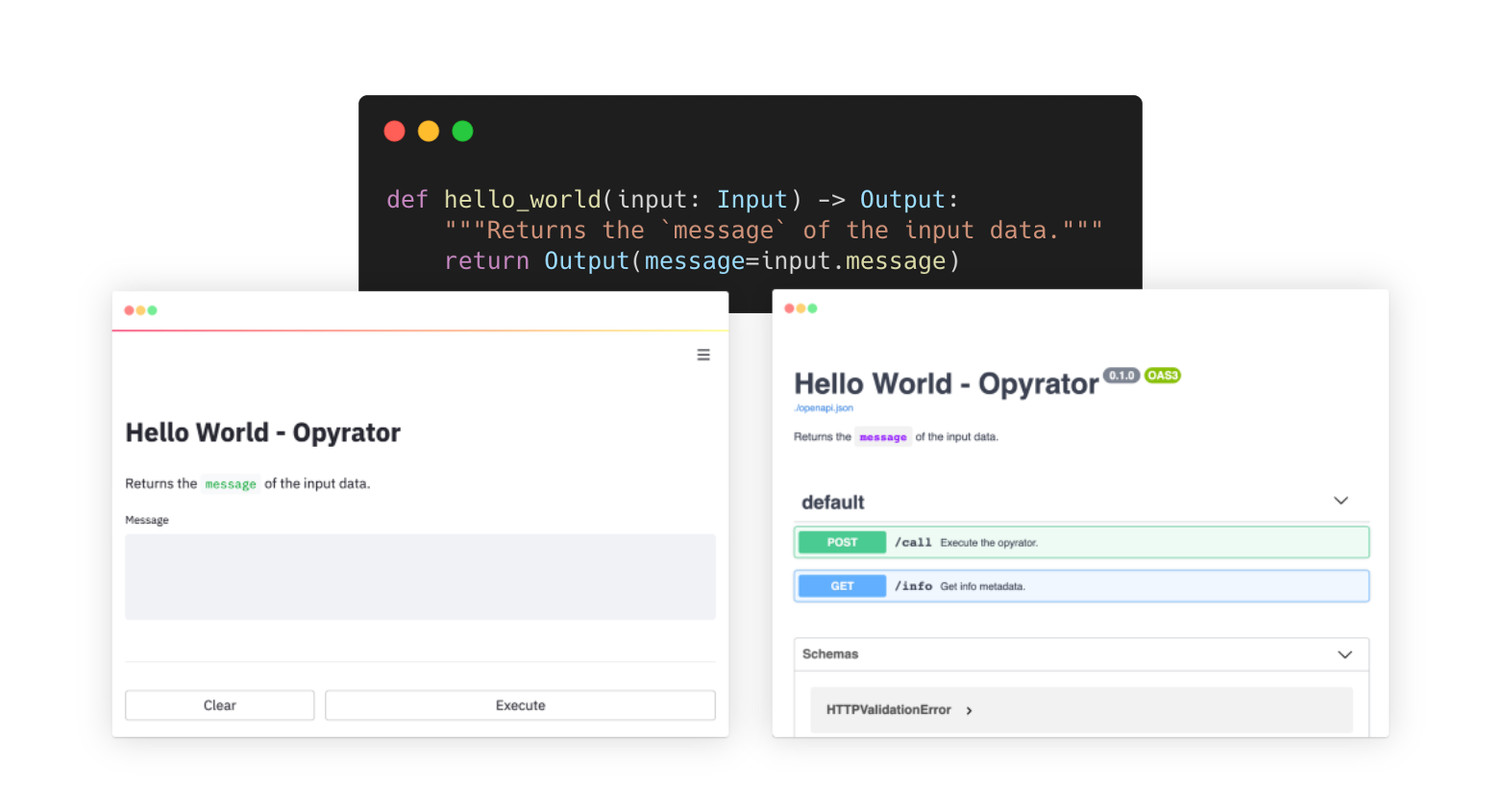
Turns your machine learning code into microservices with web API, interactive GUI, and more.

Turns your machine learning code into microservices with web API, interactive GUI, and more.

TorchDrug is a PyTorch-based machine learning toolbox designed for drug discovery

A powerful and flexible machine learning platform for drug discovery

Machine learning template for projects based on sklearn library.

Machine learning template for projects based on sklearn library.

Predico Disease Prediction system based on symptoms provided by patient- using Python-Django & Machine Learning

Predico Disease Prediction system based on symptoms provided by patient- using Python-Django & Machine Learning

Painless Machine Learning for python based on scikit-learn

PlainML Painless Machine Learning Library for python based on scikit-learn. Install pip install plainml Example from plainml import KnnModel, load_ir

Microsoft contributing libraries, tools, recipes, sample codes and workshop contents for machine learning & deep learning.

Microsoft contributing libraries, tools, recipes, sample codes and workshop contents for machine learning & deep learning.

Comments
  • Adding setup with docker

    Adding setup with docker

    Hi @alexeygrigorev ,

    I created a small guide for anyone who feels comfortable using Docker or might want to try it for setting up the environment.

    Since I saw a couple of questions today related to environment setup, I thought of sharing what I usually use when working on projects or courses, then it can be re-usable.

    Hoping is helpful :)

    Changelog:

    • Updated readme with link to guide to create docker container
    • Added new guide to build docker container and run it
    • Added Dockerfile and environment.yml
    opened by laurauzcategui 5
  • While converting keras to tflite error

    While converting keras to tflite error

    While converting keras to tflite error :

    raise ValueError('Unrecognized keyword arguments:', kwargs.keys()) ValueError: ('Unrecognized keyword arguments:', dict_keys(['ragged']))

    Traceback (most recent call last): File "convert.py", line 5, in <module> model = keras.models.load_model('xception_v4_large_08_0.894.h5')

    opened by saisubramani 5
  • notes correction in 06 Decision Trees...

    notes correction in 06 Decision Trees...

    Inside 02-data-prep.md , in the train/val/test split bullet note at the moment is : "Split the data with the distribution of 80% train, 20% validation, and 20% test sets with random seed to 11"

    should be:

    Split the data with the distribution of 60% train, 20% validation, and 20% test sets with random seed to 11

    opened by lucapug 4
  • Update homework.md

    Update homework.md

    Updated Question 4 text from "when one grows" to "when one grows up" and the F1 formula from "F1 = 2 * P * R / (P + R)" to "$$F1 = {2.}\frac{P . R}{P+R}$$"

    opened by ukokobili 3
Releases(chapter7-model)
Owner
Alexey Grigorev
Alexey Grigorev
A machine learning toolkit dedicated to time-series data

tslearn The machine learning toolkit for time series analysis in Python Section Description Installation Installing the dependencies and tslearn Getti

2.3k Dec 29, 2022
Predict the demand for electricity (R) - FRENCH

06.demand-electricity Predict the demand for electricity (R) - FRENCH Prédisez la demande en électricité Prérequis Pour effectuer ce projet, vous devr

1 Feb 13, 2022
Implemented four supervised learning Machine Learning algorithms

Implemented four supervised learning Machine Learning algorithms from an algorithmic family called Classification and Regression Trees (CARTs), details see README_Report.

Teng (Elijah) Xue 0 Jan 31, 2022
Conducted ANOVA and Logistic regression analysis using matplot library to visualize the result.

Intro-to-Data-Science Conducted ANOVA and Logistic regression analysis. Project ANOVA The main aim of this project is to perform One-Way ANOVA analysi

Chris Yuan 1 Feb 06, 2022
Optimal Randomized Canonical Correlation Analysis

ORCCA Optimal Randomized Canonical Correlation Analysis This project is for the python version of ORCCA algorithm. It depends on Numpy for matrix calc

Yinsong Wang 1 Nov 21, 2021
Book Recommender System Using Sci-kit learn N-neighbours

Model-Based-Recommender-Engine I created a book Recommender System using Sci-kit learn's N-neighbours algorithm for my model and the streamlit library

1 Jan 13, 2022
A fast, scalable, high performance Gradient Boosting on Decision Trees library, used for ranking, classification, regression and other machine learning tasks for Python, R, Java, C++. Supports computation on CPU and GPU.

Website | Documentation | Tutorials | Installation | Release Notes CatBoost is a machine learning method based on gradient boosting over decision tree

CatBoost 6.9k Jan 05, 2023
A Python Package to Tackle the Curse of Imbalanced Datasets in Machine Learning

imbalanced-learn imbalanced-learn is a python package offering a number of re-sampling techniques commonly used in datasets showing strong between-cla

6.2k Jan 01, 2023
Backtesting an algorithmic trading strategy using Machine Learning and Sentiment Analysis.

Trading Tesla with Machine Learning and Sentiment Analysis An interactive program to train a Random Forest Classifier to predict Tesla daily prices us

Renato Votto 31 Nov 17, 2022
使用数学和计算机知识投机倒把

偷鸡不成项目集锦 坦率地讲,涉及金融市场的好策略如果公开,必然导致使用的人多,最后策略变差。所以这个仓库只收集我目前失败了的案例。 加密货币组合套利 中国体育彩票预测 我赚不上钱的项目,也许可以帮助更有能力的人去赚钱。

Roy 28 Dec 29, 2022
CD) in machine learning projectsImplementing continuous integration & delivery (CI/CD) in machine learning projects

CML with cloud compute This repository contains a sample project using CML with Terraform (via the cml-runner function) to launch an AWS EC2 instance

Iterative 19 Oct 03, 2022
Cohort Intelligence used to solve various mathematical functions

Cohort-Intelligence-for-Mathematical-Functions About Cohort Intelligence : Cohort Intelligence ( CI ) is an optimization technique. It attempts to mod

Aayush Khandekar 2 Oct 25, 2021
A repository for collating all the resources such as articles, blogs, papers, and books related to Bayesian Statistics.

A repository for collating all the resources such as articles, blogs, papers, and books related to Bayesian Statistics.

Aayush Malik 80 Dec 12, 2022
ClearML - Auto-Magical Suite of tools to streamline your ML workflow. Experiment Manager, MLOps and Data-Management

ClearML - Auto-Magical Suite of tools to streamline your ML workflow Experiment Manager, MLOps and Data-Management ClearML Formerly known as Allegro T

ClearML 4k Jan 09, 2023
Combines MLflow with a database (PostgreSQL) and a reverse proxy (NGINX) into a multi-container Docker application

Combines MLflow with a database (PostgreSQL) and a reverse proxy (NGINX) into a multi-container Docker application (with docker-compose).

Philip May 2 Dec 03, 2021
Simple and flexible ML workflow engine.

This is a simple and flexible ML workflow engine. It helps to orchestrate events across a set of microservices and create executable flow to handle requests. Engine is designed to be configurable wit

Katana ML 295 Jan 06, 2023
EbookMLCB - ebook Machine Learning cơ bản

Mã nguồn cuốn ebook "Machine Learning cơ bản", Vũ Hữu Tiệp. ebook Machine Learning cơ bản pdf-black_white, pdf-color. Mọi hình thức sao chép, in ấn đề

943 Jan 02, 2023
ETNA – time series forecasting framework

ETNA Time Series Library Predict your time series the easiest way Homepage | Documentation | Tutorials | Contribution Guide | Release Notes ETNA is an

Tinkoff.AI 675 Jan 08, 2023
Decision Weights in Prospect Theory

Decision Weights in Prospect Theory It's clear that humans are irrational, but how irrational are they? After some research into behavourial economics

Cameron Davidson-Pilon 32 Nov 08, 2021
A visual dataflow programming language for sklearn

Persimmon What is it? Persimmon is a visual dataflow language for creating sklearn pipelines. It represents functions as blocks, inputs and outputs ar

Álvaro Bermejo 194 Jan 04, 2023