






UltraOpt : Distributed Asynchronous Hyperparameter Optimization better than HyperOpt.
UltraOpt is a simple and efficient library to minimize expensive and noisy black-box functions, it can be used in many fields, such as HyperParameter Optimization(HPO) and Automatic Machine Learning(AutoML).
After absorbing the advantages of existing optimization libraries such as HyperOpt[5], SMAC3[3], scikit-optimize[4] and HpBandSter[2], we develop UltraOpt , which implement a new bayesian optimization algorithm : Embedding-Tree-Parzen-Estimator(ETPE), which is better than HyperOpt' TPE algorithm in our experiments. Besides, The optimizer of UltraOpt is redesigned to adapt HyperBand & SuccessiveHalving Evaluation Strategies[6][7] and MapReduce & Async Communication Conditions. Finally, you can visualize Config Space and optimization process & results by UltraOpt's tool function. Enjoy it !
Other Language: 中文README
-
Documentation
-
English Documentation is not available now.
-
-
Tutorials
-
English Tutorials is not available now.
-
Table of Contents
Installation
UltraOpt requires Python 3.6 or higher.
You can install the latest release by pip:
pip install ultraopt
You can download the repository and manual installation:
git clone https://github.com/auto-flow/ultraopt.git && cd ultraopt
python setup.py install
Quick Start
Using UltraOpt in HPO
Let's learn what UltraOpt doing with several examples (you can try it on your Jupyter Notebook).
You can learn Basic-Tutorial in here, and HDL's Definition in here.
Before starting a black box optimization task, you need to provide two things:
- parameter domain, or the Config Space
- objective function, accept
config(configis sampled from Config Space), returnloss
Let's define a Random Forest's HPO Config Space by UltraOpt's HDL (Hyperparameter Description Language):
HDL = {
    "n_estimators": {"_type": "int_quniform","_value": [10, 200, 10], "_default": 100},
    "criterion": {"_type": "choice","_value": ["gini", "entropy"],"_default": "gini"},
    "max_features": {"_type": "choice","_value": ["sqrt","log2"],"_default": "sqrt"},
    "min_samples_split": {"_type": "int_uniform", "_value": [2, 20],"_default": 2},
    "min_samples_leaf": {"_type": "int_uniform", "_value": [1, 20],"_default": 1},
    "bootstrap": {"_type": "choice","_value": [True, False],"_default": True},
    "random_state": 42
}
And then define an objective function:
from sklearn.ensemble import RandomForestClassifier
from sklearn.datasets import load_digits
from sklearn.model_selection import cross_val_score, StratifiedKFold
from ultraopt.hdl import layering_config
X, y = load_digits(return_X_y=True)
cv = StratifiedKFold(5, True, 0)
def evaluate(config: dict) -> float:
    model = RandomForestClassifier(**layering_config(config))
    return 1 - float(cross_val_score(model, X, y, cv=cv).mean())
Now, we can start an optimization process:
from ultraopt import fmin
result = fmin(eval_func=evaluate, config_space=HDL, optimizer="ETPE", n_iterations=30)
result
100%|██████████| 30/30 [00:36<00:00,  1.23s/trial, best loss: 0.023]

+-----------------------------------+
| HyperParameters   | Optimal Value |
+-------------------+---------------+
| bootstrap         | True:bool     |
| criterion         | gini          |
| max_features      | log2          |
| min_samples_leaf  | 1             |
| min_samples_split | 2             |
| n_estimators      | 200           |
+-------------------+---------------+
| Optimal Loss      | 0.0228        |
+-------------------+---------------+
| Num Configs       | 30            |
+-------------------+---------------+
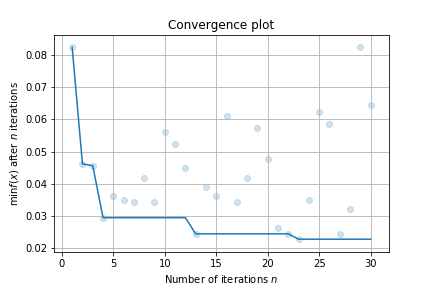
Finally, make a simple visualizaiton:
result.plot_convergence()
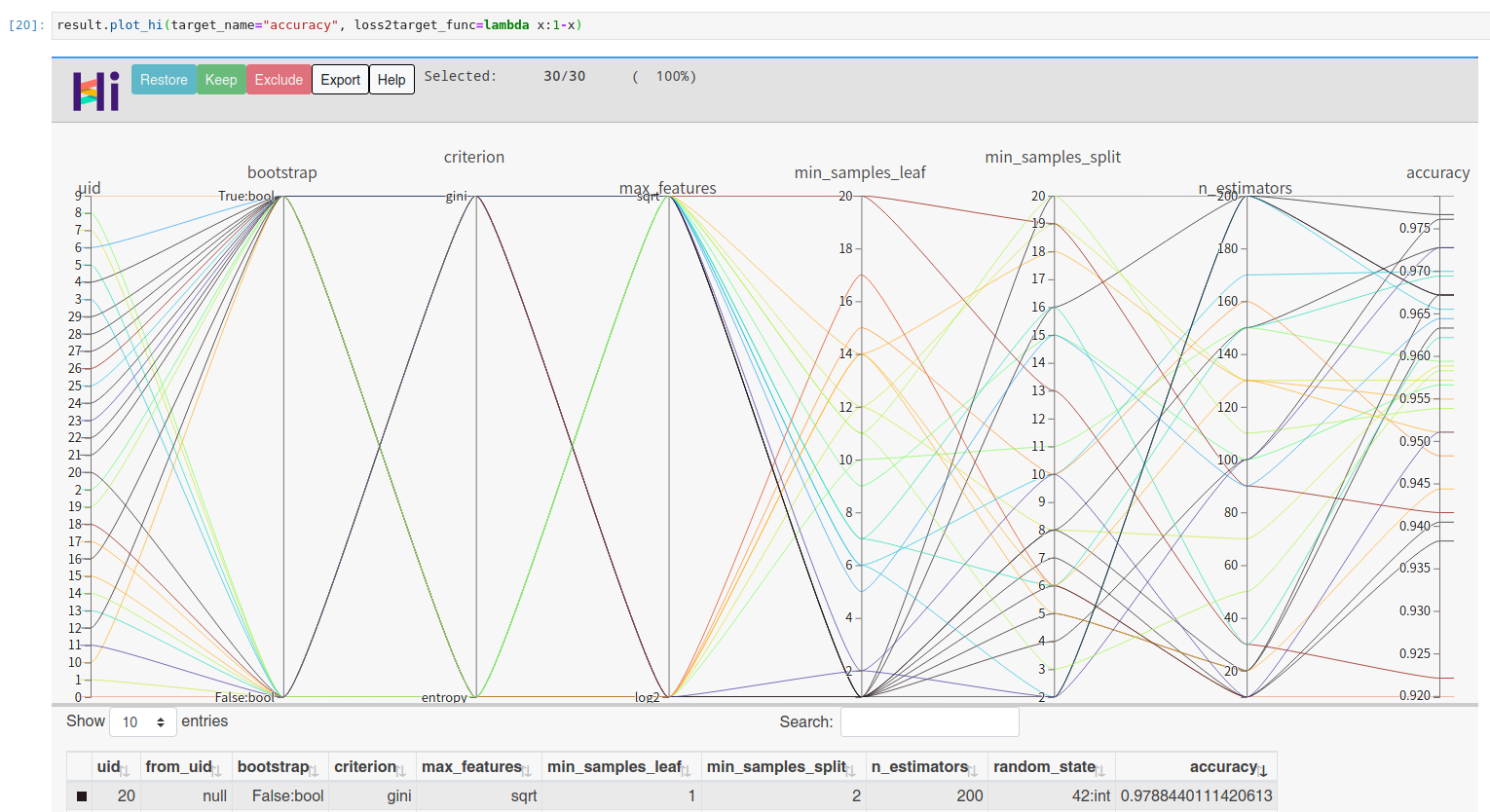
You can visualize high dimensional interaction by facebook's hiplot:
!pip install hiplot
result.plot_hi(target_name="accuracy", loss2target_func=lambda x:1-x)
Using UltraOpt in AutoML
Let's try a more complex example: solve AutoML's CASH Problem [1] (Combination problem of Algorithm Selection and Hyperparameter optimization) by BOHB algorithm[2] (Combine HyperBand[6] Evaluation Strategies with UltraOpt's ETPE optimizer) .
You can learn Conditional Parameter and complex HDL's Definition in here, AutoML implementation tutorial in here and Multi-Fidelity Optimization in here.
First of all, let's define a CASH HDL :
HDL = {
    'classifier(choice)':{
        "RandomForestClassifier": {
          "n_estimators": {"_type": "int_quniform","_value": [10, 200, 10], "_default": 100},
          "criterion": {"_type": "choice","_value": ["gini", "entropy"],"_default": "gini"},
          "max_features": {"_type": "choice","_value": ["sqrt","log2"],"_default": "sqrt"},
          "min_samples_split": {"_type": "int_uniform", "_value": [2, 20],"_default": 2},
          "min_samples_leaf": {"_type": "int_uniform", "_value": [1, 20],"_default": 1},
          "bootstrap": {"_type": "choice","_value": [True, False],"_default": True},
          "random_state": 42
        },
        "KNeighborsClassifier": {
          "n_neighbors": {"_type": "int_loguniform", "_value": [1,100],"_default": 3},
          "weights" : {"_type": "choice", "_value": ["uniform", "distance"],"_default": "uniform"},
          "p": {"_type": "choice", "_value": [1, 2],"_default": 2},
        },
    }
}
And then, define a objective function with an additional parameter budget to adapt to HyperBand[6] evaluation strategy:
from sklearn.neighbors import KNeighborsClassifier
import numpy as np
def evaluate(config: dict, budget: float) -> float:
   layered_dict = layering_config(config)
   AS_HP = layered_dict['classifier'].copy()
   AS, HP = AS_HP.popitem()
   ML_model = eval(AS)(**HP)
   scores = []
   for i, (train_ix, valid_ix) in enumerate(cv.split(X, y)):
       rng = np.random.RandomState(i)
       size = int(train_ix.size * budget)
       train_ix = rng.choice(train_ix, size, replace=False)
       X_train,y_train = X[train_ix, :],y[train_ix]
       X_valid,y_valid = X[valid_ix, :],y[valid_ix]
       ML_model.fit(X_train, y_train)
       scores.append(ML_model.score(X_valid, y_valid))
   score = np.mean(scores)
   return 1 - score
You should instance a multi_fidelity_iter_generator object for the purpose of using HyperBand[6] Evaluation Strategy :
from ultraopt.multi_fidelity import HyperBandIterGenerator
hb = HyperBandIterGenerator(min_budget=1/4, max_budget=1, eta=2)
hb.get_table()
| iter 0 | iter 1 | iter 2 | ||||
|---|---|---|---|---|---|---|
| stage 0 | stage 1 | stage 2 | stage 0 | stage 1 | stage 0 | |
| num_config | 4 | 2 | 1 | 2 | 1 | 3 |
| budget | 1/4 | 1/2 | 1 | 1/2 | 1 | 1 |
let's combine HyperBand Evaluation Strategies with UltraOpt's ETPE optimizer , and then start an optimization process:
result = fmin(eval_func=evaluate, config_space=HDL,
              optimizer="ETPE", # using bayesian optimizer: ETPE
              multi_fidelity_iter_generator=hb, # using HyperBand
              n_jobs=3,         # 3 threads
              n_iterations=20)
result
100%|██████████| 88/88 [00:11<00:00,  7.48trial/s, max budget: 1.0, best loss: 0.012]

+--------------------------------------------------------------------------------------------------------------------------+
| HyperParameters                                     | Optimal Value                                                      |
+-----------------------------------------------------+----------------------+----------------------+----------------------+
| classifier:__choice__                               | KNeighborsClassifier | KNeighborsClassifier | KNeighborsClassifier |
| classifier:KNeighborsClassifier:n_neighbors         | 4                    | 1                    | 3                    |
| classifier:KNeighborsClassifier:p                   | 2:int                | 2:int                | 2:int                |
| classifier:KNeighborsClassifier:weights             | distance             | uniform              | uniform              |
| classifier:RandomForestClassifier:bootstrap         | -                    | -                    | -                    |
| classifier:RandomForestClassifier:criterion         | -                    | -                    | -                    |
| classifier:RandomForestClassifier:max_features      | -                    | -                    | -                    |
| classifier:RandomForestClassifier:min_samples_leaf  | -                    | -                    | -                    |
| classifier:RandomForestClassifier:min_samples_split | -                    | -                    | -                    |
| classifier:RandomForestClassifier:n_estimators      | -                    | -                    | -                    |
| classifier:RandomForestClassifier:random_state      | -                    | -                    | -                    |
+-----------------------------------------------------+----------------------+----------------------+----------------------+
| Budgets                                             | 1/4                  | 1/2                  | 1 (max)              |
+-----------------------------------------------------+----------------------+----------------------+----------------------+
| Optimal Loss                                        | 0.0328               | 0.0178               | 0.0122               |
+-----------------------------------------------------+----------------------+----------------------+----------------------+
| Num Configs                                         | 28                   | 28                   | 32                   |
+-----------------------------------------------------+----------------------+----------------------+----------------------+
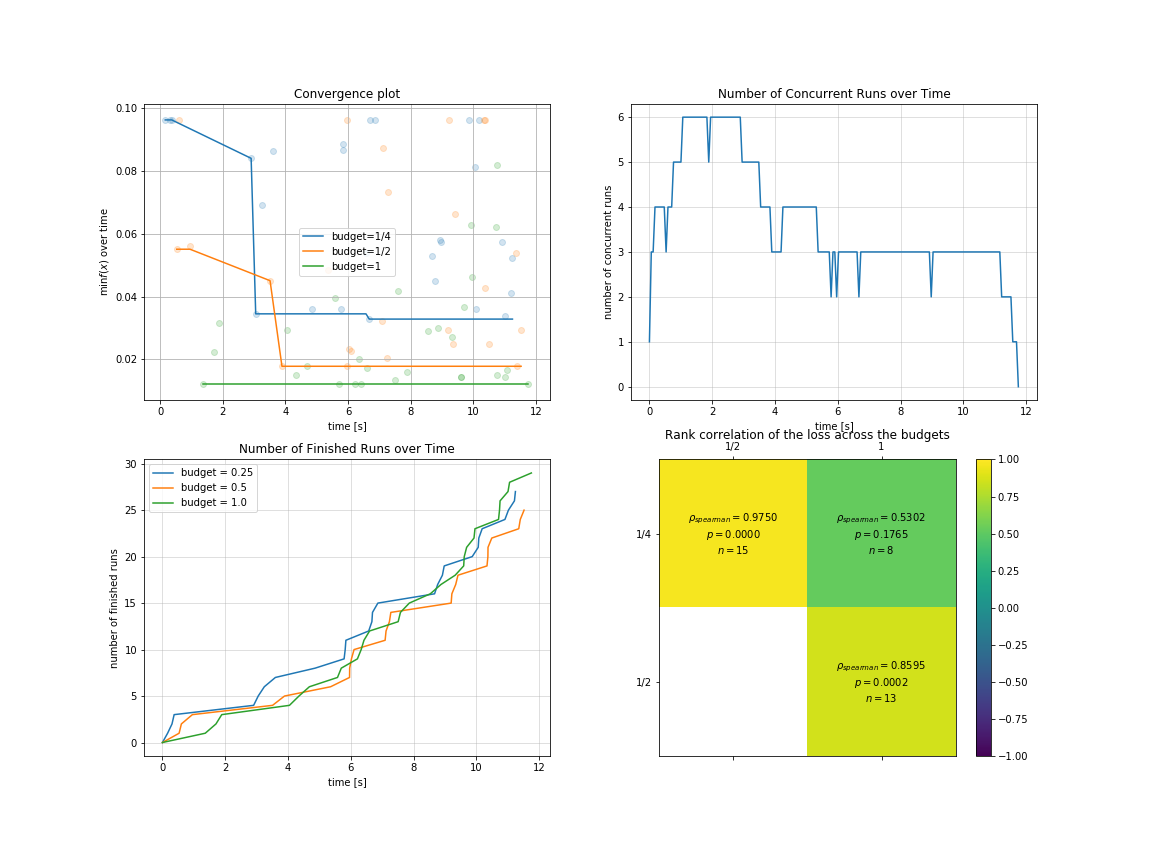
You can visualize optimization process in multi-fidelity scenarios:
import pylab as plt
plt.rcParams['figure.figsize'] = (16, 12)
plt.subplot(2, 2, 1)
result.plot_convergence_over_time();
plt.subplot(2, 2, 2)
result.plot_concurrent_over_time(num_points=200);
plt.subplot(2, 2, 3)
result.plot_finished_over_time();
plt.subplot(2, 2, 4)
result.plot_correlation_across_budgets();
Our Advantages
Advantage One: ETPE optimizer is more competitive
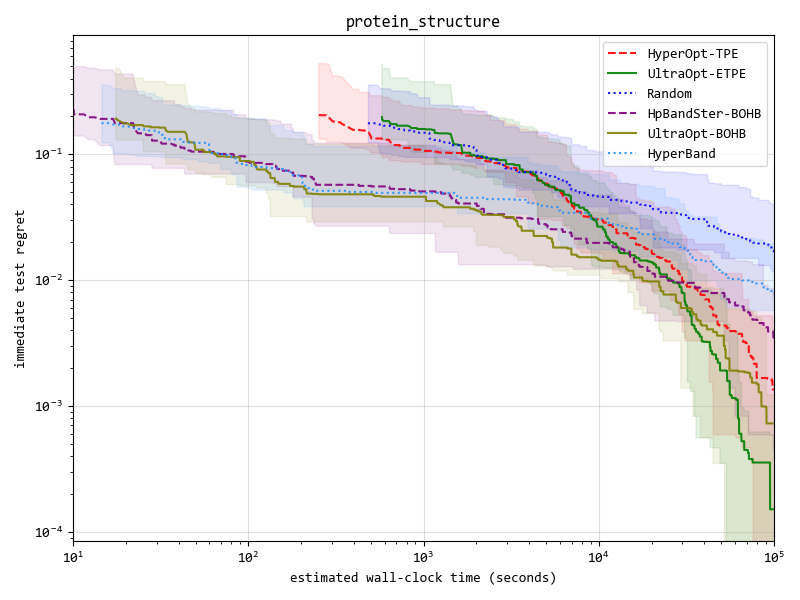
We implement 4 kinds of optimizers(listed in the table below), and ETPE optimizer is our original creation, which is proved to be better than other TPE based optimizers such as HyperOpt's TPE and HpBandSter's BOHB in our experiments.
Our experimental code is public available in here, experimental documentation can be found in here .
| Optimizer | Description |
|---|---|
| ETPE | Embedding-Tree-Parzen-Estimator, is our original creation, converting high-cardinality categorical variables to low-dimension continuous variables based on TPE algorithm, and some other aspects have also been improved, is proved to be better than HyperOpt's TPE in our experiments. |
| Forest | Bayesian Optimization based on Random Forest. Surrogate model import scikit-optimize 's skopt.learning.forest model, and integrate Local Search methods in SMAC3 |
| GBRT | Bayesian Optimization based on Gradient Boosting Resgression Tree. Surrogate model import scikit-optimize 's skopt.learning.gbrt model. |
| Random | Random Search for baseline or dummy model. |
Key result figure in experiment (you can see details in experimental documentation ) :
Advantage Two: UltraOpt is more adaptable to distributed computing
You can see this section in the documentation:
Advantage Three: UltraOpt is more function comlete and user friendly
UltraOpt is more function comlete and user friendly than other optimize library:
| UltraOpt | HyperOpt | Scikit-Optimize | SMAC3 | HpBandSter | |
|---|---|---|---|---|---|
Simple Usage like fmin function |
✓ | ✓ | ✓ | ✓ | × |
Simple Config Space Definition |
✓ | ✓ | ✓ | × | × |
Support Conditional Config Space |
✓ | ✓ | × | ✓ | ✓ |
Support Serializable Config Space |
✓ | × | × | × | × |
Support Visualizing Config Space |
✓ | ✓ | × | × | × |
| Can Analyse Optimization Process & Result | ✓ | × | ✓ | × | ✓ |
| Distributed in Cluster | ✓ | ✓ | × | × | ✓ |
| Support HyperBand[6] & SuccessiveHalving[7] | ✓ | × | × | ✓ | ✓ |
Citation
@misc{Tang_UltraOpt,
    author       = {Qichun Tang},
    title        = {UltraOpt : Distributed Asynchronous Hyperparameter Optimization better than HyperOpt},
    month        = January,
    year         = 2021,
    doi          = {10.5281/zenodo.4430148},
    version      = {v0.1.0},
    publisher    = {Zenodo},
    url          = {https://doi.org/10.5281/zenodo.4430148}
}
Reference
![[ICLR 2021] Is Attention Better Than Matrix Decomposition?](https://github.com/Gsunshine/Enjoy-Hamburger/raw/main/assets/Hamburger.jpg)
 271 Dec 29, 2022
 97 Dec 23, 2022

 1.3k Jan 4, 2023
![[NeurIPS 2021] Better Safe Than Sorry: Preventing Delusive Adversaries with Adversarial Training](https://github.com/TLMichael/Delusive-Adversary/raw/main/fig/Thumbnail.png)
 29 Sep 20, 2022
 220 Dec 31, 2022
 8.4k Jan 1, 2023

 163 Dec 26, 2022

 1.3k Nov 17, 2022
 3.7k Jan 3, 2023

 1 Feb 10, 2022
 5 Nov 10, 2022
 108 Dec 30, 2022
 1 Oct 10, 2022
 13 Dec 01, 2022
 128 Dec 25, 2022
 80 Jan 03, 2023
 15 May 23, 2022
 162 Dec 30, 2022
 156 Jan 09, 2023
 24 Oct 15, 2022
 11 Dec 19, 2022
 8 Apr 03, 2022
 8 Dec 08, 2022
 33 Dec 03, 2022
 139 Dec 29, 2022
 146 Dec 11, 2022
 7.1k Dec 29, 2022
 87 Dec 24, 2022
 7.8k Jan 03, 2023