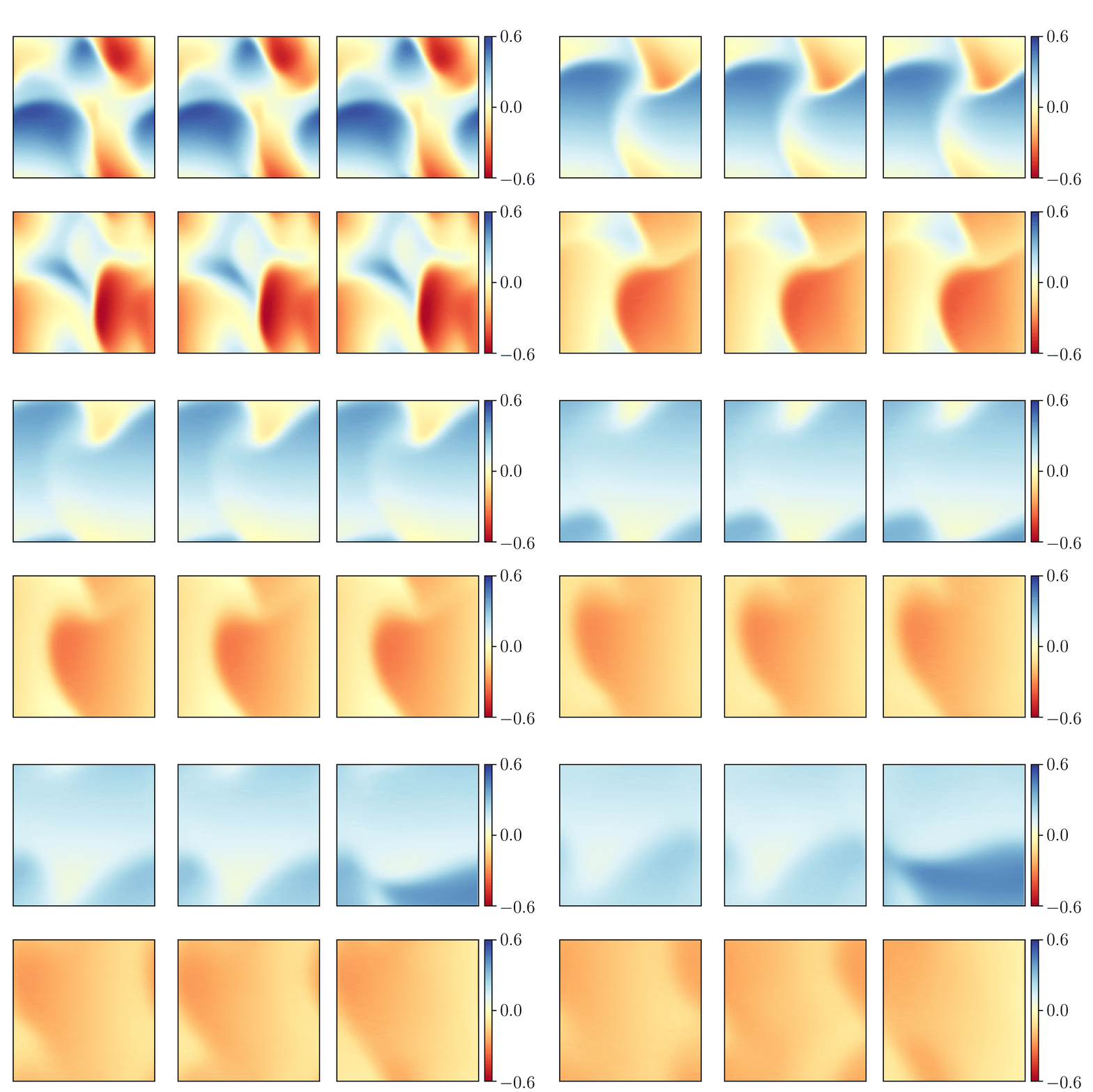
PyTorch code for Composing Partial Differential Equations with Physics-Aware Neural Networks

Related tags

Deep Learningfinn
Overview

FInite volume Neural Network (FINN)

This repository contains the PyTorch code for models, training, and testing, and Python code for data generation to conduct the experiments as reported in the work Composing Partial Differential Equations with Physics-Aware Neural Networks

If you find this repository helpful, please cite our work:

@article{karlbauer2021composing,
	author    = {Karlbauer, Matthias and Praditia, Timothy and Otte, Sebastian and Oladyshkin, Sergey and Nowak, Wolfgang and Butz, Martin V},
	title     = {Composing Partial Differential Equations with Physics-Aware Neural Networks},
	journal   = {arXiv preprint arXiv:2111.11798},
	year      = {2021},
}

Dependencies

We recommend setting up an (e.g. conda) environment with python 3.7 (i.e. conda create -n finn python=3.7). The required packages for data generation and model evaluation are

  • conda install -c anaconda numpy scipy
  • conda install -c pytorch pytorch==1.9.0
  • conda install -c jmcmurray json
  • conda install -c conda-forge matplotlib torchdiffeq jsmin

Models & Experiments

The code of the different pure machine learning models (TCN, ConvLSTM, DISTANA) and physics-aware models (PINN, PhyDNet, FINN) can be found in the models directory.

Each model directory contains a config.json file to specify model parameters, data, etc. Please modify the sections in the respective config.json files as detailed below (further information about data and model architectures is reported in the according data sections of the paper's appendices):

"training": {
	"t_stop": 150  // burger and allen-cahn 150, diff-sorp 400, diff-react 70
},

"validation": {
	"t_start": 150,  // burger and allen-cahn 150, diff-sorp 400, diff-react 70
	"t_stop": 200  // burger and allen-cahn 200, diff-sorp 500, diff-react 100
},

"data": {
	"type": "burger",  // "burger", "diffusion_sorption", "diffusion_reaction", "allen_cahn"
	"name": "data_ext",  // "data_train", "data_ext", "data_test"
}

"model": {
  	"name": "burger"  // "burger", "diff-sorp", "diff-react", "allen-cahn"
	"field_size": [49],  // burger and allen-cahn [49], diff-sorp [26], fhn [49, 49]
	... other settings to be specified according to the model architectures section in the paper's appendix
}

The actual models can be trained and tested by calling the according python train.py or python test.py scripts. Alternatively, python experiment.py can be used to either train or test n models (please consider the settings in the experiment.py script).

Data generation

The Python scripts to generate the burger, diffusion-sorption, diffusion-reaction, and allen-cahn data can be found in the data directory.

In each of the burger, diffusion_sorption, diffusion_reaction, and allen-cahn directories, a data_generation.py and simulator.py script can be found. The former is used to generate train, extrapolation (ext), or test data. For details about the according data generation settings of each dataset, please refer to the corresponding data sections in the paper's appendices.

You might also like...
Official implementation for the paper:
Official implementation for the paper: "Multi-label Classification with Partial Annotations using Class-aware Selective Loss"

Multi-label Classification with Partial Annotations using Class-aware Selective Loss Paper | Pretrained models Official PyTorch Implementation Emanuel

Must-read Papers on Physics-Informed Neural Networks.

PINNpapers Contributed by IDRL lab. Introduction Physics-Informed Neural Network (PINN) has achieved great success in scientific computing since 2017.

Physics-informed convolutional-recurrent neural networks for solving spatiotemporal PDEs

PhyCRNet Physics-informed convolutional-recurrent neural networks for solving spatiotemporal PDEs Paper link: [ArXiv] By: Pu Ren, Chengping Rao, Yang

 Physics-Aware Training (PAT) is a method to train real physical systems with backpropagation.
Physics-Aware Training (PAT) is a method to train real physical systems with backpropagation.

Physics-Aware Training (PAT) is a method to train real physical systems with backpropagation. It was introduced in Wright, Logan G. & Onodera, Tatsuhiro et al. (2021)1 to train Physical Neural Networks (PNNs) - neural networks whose building blocks are physical systems.

Pytorch Implementation of Interaction Networks for Learning about Objects, Relations and Physics

Interaction-Network-Pytorch Pytorch Implementraion of Interaction Networks for Learning about Objects, Relations and Physics. Interaction Network is a

IDRLnet, a Python toolbox for modeling and solving problems through Physics-Informed Neural Network (PINN) systematically.

IDRLnet IDRLnet is a machine learning library on top of PyTorch. Use IDRLnet if you need a machine learning library that solves both forward and inver

PINN(s): Physics-Informed Neural Network(s) for von Karman vortex street

PINN(s): Physics-Informed Neural Network(s) for von Karman vortex street This is

Implementation of "Scaled-YOLOv4: Scaling Cross Stage Partial Network" using PyTorch framwork.

YOLOv4-large This is the implementation of "Scaled-YOLOv4: Scaling Cross Stage Partial Network" using PyTorch framwork. YOLOv4-CSP YOLOv4-tiny YOLOv4-

Unofficial pytorch implementation of 'Image Inpainting for Irregular Holes Using Partial Convolutions'

pytorch-inpainting-with-partial-conv Official implementation is released by the authors. Note that this is an ongoing re-implementation and I cannot f

Releases(v1.0.0)
  • v1.0.0(Oct 28, 2022)

    This release contains the PyTorch code for models, training, and testing, and Python code for data generation to conduct the experiments.

    Source code(tar.gz)
    Source code(zip)
Owner
Cognitive Modeling
The chair of Cognitive Modeling addresses the question: "How does the mind work?", pursuing an integrative, interdisciplinary, computational approach.
Cognitive Modeling
AnimationKit: AI Upscaling & Interpolation using Real-ESRGAN+RIFE

ALPHA 2.5: Frostbite Revival (Released 12/23/21) Changelog: [ UI ] Chained design. All steps link to one another! Use the master override toggles to s

87 Nov 16, 2022
Running AlphaFold2 (from ColabFold) in Azure Machine Learning

Running AlphaFold2 (from ColabFold) in Azure Machine Learning Colby T. Ford, Ph.D. Companion repository for Medium Post: How to predict many protein s

Colby T. Ford 3 Feb 18, 2022
[CVPR 2022 Oral] TubeDETR: Spatio-Temporal Video Grounding with Transformers

TubeDETR: Spatio-Temporal Video Grounding with Transformers Website • STVG Demo • Paper This repository provides the code for our paper. This includes

Antoine Yang 108 Dec 27, 2022
High-Resolution Image Synthesis with Latent Diffusion Models

Latent Diffusion Models arXiv | BibTeX High-Resolution Image Synthesis with Latent Diffusion Models Robin Rombach*, Andreas Blattmann*, Dominik Lorenz

CompVis Heidelberg 5.6k Dec 30, 2022
An end-to-end framework for mixed-integer optimization with data-driven learned constraints.

OptiCL OptiCL is an end-to-end framework for mixed-integer optimization (MIO) with data-driven learned constraints. We address a problem setting in wh

Holly Wiberg 57 Dec 26, 2022
Official implementation of the paper Chunked Autoregressive GAN for Conditional Waveform Synthesis

PyEmits, a python package for easy manipulation in time-series data. Time-series data is very common in real life. Engineering FSI industry (Financial

Descript 150 Dec 06, 2022
Open source implementation of AceNAS: Learning to Rank Ace Neural Architectures with Weak Supervision of Weight Sharing

AceNAS This repo is the experiment code of AceNAS, and is not considered as an official release. We are working on integrating AceNAS as a built-in st

Yuge Zhang 6 Sep 07, 2022
Re-implementation of 'Grokking: Generalization beyond overfitting on small algorithmic datasets'

Re-implementation of the paper 'Grokking: Generalization beyond overfitting on small algorithmic datasets' Paper Original paper can be found here Data

Tom Lieberum 38 Aug 09, 2022
Datasets and source code for our paper Webly Supervised Fine-Grained Recognition: Benchmark Datasets and An Approach

Introduction Datasets and source code for our paper Webly Supervised Fine-Grained Recognition: Benchmark Datasets and An Approach Datasets: WebFG-496

21 Sep 30, 2022
Updated for TTS(CE) = Also Known as TTN V3. The code requires the first server to be 'ttn' protocol.

Updated Updated for TTS(CE) = Also Known as TTN V3. The code requires the first server to be 'ttn' protocol. Introduction This balenaCloud (previously

Remko 1 Oct 17, 2021
MILK: Machine Learning Toolkit

MILK: MACHINE LEARNING TOOLKIT Machine Learning in Python Milk is a machine learning toolkit in Python. Its focus is on supervised classification with

Luis Pedro Coelho 610 Dec 14, 2022
Differentiable Wavetable Synthesis

Differentiable Wavetable Synthesis

4 Feb 11, 2022
Conjugated Discrete Distributions for Distributional Reinforcement Learning (C2D)

Conjugated Discrete Distributions for Distributional Reinforcement Learning (C2D) Code & Data Appendix for Conjugated Discrete Distributions for Distr

1 Jan 11, 2022
The official GitHub repository for the Argoverse 2 dataset.

Argoverse 2 API Official GitHub repository for the Argoverse 2 family of datasets. If you have any questions or run into any problems with either the

Argo AI 156 Dec 23, 2022
A PyTorch implementation for PyramidNets (Deep Pyramidal Residual Networks)

A PyTorch implementation for PyramidNets (Deep Pyramidal Residual Networks) This repository contains a PyTorch implementation for the paper: Deep Pyra

Greg Dongyoon Han 262 Jan 03, 2023
Official implementation of CATs: Cost Aggregation Transformers for Visual Correspondence NeurIPS'21

CATs: Cost Aggregation Transformers for Visual Correspondence NeurIPS'21 For more information, check out the paper on [arXiv]. Training with different

Sunghwan Hong 120 Jan 04, 2023
You Only Sample (Almost) Once: Linear Cost Self-Attention Via Bernoulli Sampling

You Only Sample (Almost) Once: Linear Cost Self-Attention Via Bernoulli Sampling Transformer-based models are widely used in natural language processi

Zhanpeng Zeng 12 Jan 01, 2023
Pytorch implementation for "Distribution-Balanced Loss for Multi-Label Classification in Long-Tailed Datasets" (ECCV 2020 Spotlight)

Distribution-Balanced Loss [Paper] The implementation of our paper Distribution-Balanced Loss for Multi-Label Classification in Long-Tailed Datasets (

Tong WU 304 Dec 22, 2022
Bridging Composite and Real: Towards End-to-end Deep Image Matting

Bridging Composite and Real: Towards End-to-end Deep Image Matting Please note that the official repository of the paper Bridging Composite and Real:

Jizhizi_Li 30 Oct 31, 2022
[WWW 2021] Source code for "Graph Contrastive Learning with Adaptive Augmentation"

GCA Source code for Graph Contrastive Learning with Adaptive Augmentation (WWW 2021) For example, to run GCA-Degree under WikiCS, execute: python trai

Big Data and Multi-modal Computing Group, CRIPAC 97 Jan 07, 2023