GPT-2 Model for Leetcode Questions in python

Overview

Leetcode using AI πŸ€–

GPT-2 Model for Leetcode Questions in python New demo here: https://huggingface.co/spaces/gagan3012/project-code-py

Note: the Answers might not make sense in some cases because of the bias in GPT-2 Current accuracy is capped at 90%.

Contribtuions: If you would like to make the model/UI better contributions (Issues/PRs) are welcome Check out CONTRIBUTIONS

How I built this : Linkedin

πŸ“’ Favour:

It would be highly motivating, if you can STAR ⭐ this repo if you find it helpful. New improvements incoming!

Model

Two models have been developed for different use cases and they can be found at https://huggingface.co/gagan3012

The model weights can be found here: GPT-2 and DistilGPT-2

The model has been trained using Weights and Biases (Wandb) and PyTorch

GPT Neo model: https://huggingface.co/gagan3012/project-code-py-neo

Example usage:

from transformers import AutoTokenizer, AutoModelWithLMHead

tokenizer = AutoTokenizer.from_pretrained("gagan3012/project-code-py")

model = AutoModelWithLMHead.from_pretrained("gagan3012/project-code-py")

Demo

Streamlit App

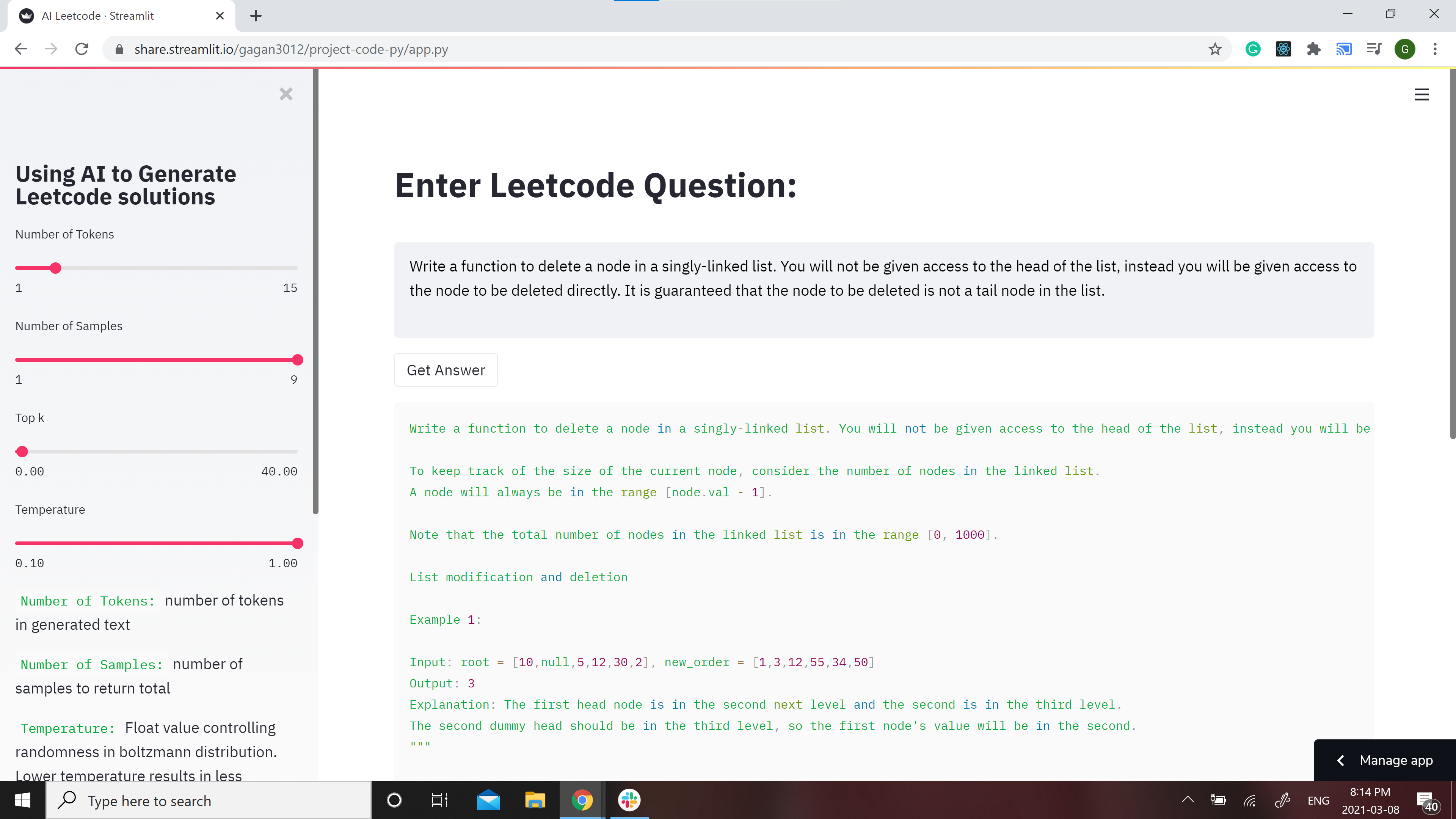
A streamlit webapp has been setup to use the model: https://share.streamlit.io/gagan3012/project-code-py/app.py
image

Please create an issue in this repo if the demo is not working

Example results:

Question:

Write a function to delete a node in a singly-linked list. You will not be given access to the head of the list, instead you will be given access to the node to be deleted directly. It is guaranteed that the node to be deleted is not a tail node in the list.

Answer:

2->3 b = 3->1->2 t = ListNode(-1, 1) Note: The lexicographic ordering of the nodes in a tree matters. Do not assign values to nodes in a tree. Example 1: Input: [1,2,3] Output: 1->2->5 Explanation: 1->2->3->3->4, then 1->2->5[2] and then 5->1->3->4. Note: The length of a linked list will be in the range [1, 1000]. Node.val must be a valid LinkedListNode type. Both the length and the value of the nodes in a linked list will be in the range [-1000, 1000]. All nodes are distinct. """ # Definition for singly-linked list. # class ListNode: # def __init__(self, x): # self.val = x # self.next = None class Solution: def deleteNode(self, head: ListNode, val: int) -> None: """ BFS Linked List :param head: ListNode :param val: int :return: ListNode """ if head is not None: return head dummy = ListNode(-1, 1) dummy.next = head dummy.next.val = val dummy.next.next = head dummy.val = "" s1 = Solution() print(s1.deleteNode(head)) print(s1.deleteNode(-1)) print(s1.deleteNode(-1)) ">
""" Write a function to delete a node in a singly-linked list. You will not be given access to the head of the list, instead you will be given access to the node to be deleted directly. It is guaranteed that the node to be deleted is not a tail node in the list.

For example,
a = 1->2->3
b = 3->1->2
t = ListNode(-1, 1)

Note: The lexicographic ordering of the nodes in a tree matters. Do not assign values to nodes in a tree.
Example 1:

Input: [1,2,3]
Output: 1->2->5
Explanation: 1->2->3->3->4, then 1->2->5[2] and then 5->1->3->4.


Note:

The length of a linked list will be in the range [1, 1000].
Node.val must be a valid LinkedListNode type.
Both the length and the value of the nodes in a linked list will be in the range [-1000, 1000].
All nodes are distinct.
"""
# Definition for singly-linked list.
# class ListNode:
#     def __init__(self, x):
#         self.val = x
#         self.next = None

class Solution:
    def deleteNode(self, head: ListNode, val: int) -> None:
        """
        BFS
        Linked List
        :param head: ListNode
        :param val: int
        :return: ListNode
        """
        if head is not None:
            return head
        dummy = ListNode(-1, 1)
        dummy.next = head
        dummy.next.val = val
        dummy.next.next = head
        dummy.val = ""


s1 = Solution()
print(s1.deleteNode(head))
print(s1.deleteNode(-1))
Owner
Gagan Bhatia
Software Developer | Machine Learning Enthusiast
Gagan Bhatia
BiQE: Code and dataset for the BiQE paper

BiQE: Bidirectional Query Embedding This repository includes code for BiQE and the datasets introduced in Answering Complex Queries in Knowledge Graph

Bhushan Kotnis 1 Oct 20, 2021
My implementation of Safaricom Machine Learning Codility test. The code has bugs, logical I guess I made errors and any correction will be appreciated.

Safaricom_Codility Machine Learning 2022 The test entails two questions. Question 1 was on Machine Learning. Question 2 was on SQL I ran out of time.

Lawrence M. 1 Mar 03, 2022
PhoNLP: A BERT-based multi-task learning toolkit for part-of-speech tagging, named entity recognition and dependency parsing

PhoNLP is a multi-task learning model for joint part-of-speech (POS) tagging, named entity recognition (NER) and dependency parsing. Experiments on Vietnamese benchmark datasets show that PhoNLP prod

VinAI Research 109 Dec 02, 2022
Train BPE with fastBPE, and load to Huggingface Tokenizer.

BPEer Train BPE with fastBPE, and load to Huggingface Tokenizer. Description The BPETrainer of Huggingface consumes a lot of memory when I am training

Lizhuo 1 Dec 23, 2021
MMDA - multimodal document analysis

MMDA - multimodal document analysis

AI2 75 Jan 04, 2023
KR-FinBert And KR-FinBert-SC

KR-FinBert & KR-FinBert-SC Much progress has been made in the NLP (Natural Language Processing) field, with numerous studies showing that domain adapt

5 Jul 29, 2022
DensePhrases provides answers to your natural language questions from the entire Wikipedia in real-time

DensePhrases provides answers to your natural language questions from the entire Wikipedia in real-time. While it efficiently searches the answers out of 60 billion phrases in Wikipedia, it is also v

Jinhyuk Lee 543 Jan 08, 2023
An assignment on creating a minimalist neural network toolkit for CS11-747

minnn by Graham Neubig, Zhisong Zhang, and Divyansh Kaushik This is an exercise in developing a minimalist neural network toolkit for NLP, part of Car

Graham Neubig 63 Dec 29, 2022
πŸ‘‘ spaCy building blocks and visualizers for Streamlit apps

spacy-streamlit: spaCy building blocks for Streamlit apps This package contains utilities for visualizing spaCy models and building interactive spaCy-

Explosion 620 Dec 29, 2022
Script to generate VAD dataset used in Asteroid recipe

About the dataset LibriVAD is an open source dataset for voice activity detection in noisy environments. It is derived from LibriSpeech signals (clean

11 Sep 15, 2022
Translators - is a library which aims to bring free, multiple, enjoyable translation to individuals and students in Python

Translators - is a library which aims to bring free, multiple, enjoyable translation to individuals and students in Python

UlionTse 907 Dec 27, 2022
λ‚΄λΆ€ μž‘μ—…μš© django + vue(vuetify) boilerplate. μ§  ν•˜λ©΄ λŒμ•„κ°.

Pocket Galaxy μ•„μ£Ό κ°„λ‹¨ν•œ 개인용, ν˜Ήμ€ λ‚΄λΆ€μš© νˆ΄μ„ λ§Œλ“€μ–΄μ•Όν•˜λŠ”λ° 이왕이면 웹이 νŽΈν•˜μ£ ? κ·ΈλŸ΄λ•Œλ₯Ό μœ„ν•΄ λ§Œλ“€μ–΄λ‘” django와 vue(vuetify)둜 이뀄진 boilerplate μž…λ‹ˆλ‹€. 각 폴더에 μžˆλŠ” μ„€λͺ…μ„œλŒ€λ‘œ 싀행을 μ‹œν‚€λ©΄ 일단 λ‹Ήμž₯ λ­”κ°€κ°€ λŒμ•„κ°‘λ‹ˆ

Jamie J. Seol 16 Dec 03, 2021
Document processing using transformers

Doc Transformers Document processing using transformers. This is still in developmental phase, currently supports only extraction of form data i.e (ke

Vishnu Nandakumar 13 Dec 21, 2022
A multi-voice TTS system trained with an emphasis on quality

TorToiSe Tortoise is a text-to-speech program built with the following priorities: Strong multi-voice capabilities. Highly realistic prosody and inton

James Betker 2.1k Jan 01, 2023
Large-scale open domain KNOwledge grounded conVERsation system based on PaddlePaddle

Knover Knover is a toolkit for knowledge grounded dialogue generation based on PaddlePaddle. Knover allows researchers and developers to carry out eff

606 Dec 28, 2022
Code for "Generative adversarial networks for reconstructing natural images from brain activity".

Reconstruct handwritten characters from brains using GANs Example code for the paper "Generative adversarial networks for reconstructing natural image

K. Seeliger 2 May 17, 2022
kochat

Kochat 챗봇 λΉŒλ”λŠ” 성에 μ•ˆμ°¨κ³ , μžμ‹ λ§Œμ˜ λ”₯λŸ¬λ‹ 챗봇 μ• ν”Œλ¦¬μΌ€μ΄μ…˜μ„ λ§Œλ“œμ‹œκ³  μ‹ΆμœΌμ‹ κ°€μš”? Kochat을 μ΄μš©ν•˜λ©΄ μ†μ‰½κ²Œ μžμ‹ λ§Œμ˜ λ”₯λŸ¬λ‹ 챗봇 μ• ν”Œλ¦¬μΌ€μ΄μ…˜μ„ λΉŒλ“œν•  수 μžˆμŠ΅λ‹ˆλ‹€. # 1. 데이터셋 객체 생성 dataset = Dataset(ood=True) #

1 Oct 25, 2021
The official code for β€œDocTr: Document Image Transformer for Geometric Unwarping and Illumination Correction”, ACM MM, Oral Paper, 2021.

Good news! Our new work exhibits state-of-the-art performances on DocUNet benchmark dataset: DocScanner: Robust Document Image Rectification with Prog

Hao Feng 231 Dec 26, 2022
Twitter bot that uses NLP models to summarize news articles referenced in a user's twitter timeline

Twitter-News-Summarizer Twitter bot that uses NLP models to summarize news articles referenced in a user's twitter timeline 1.) Extracts all tweets fr

Rohit Govindan 1 Jan 27, 2022
A benchmark for evaluation and comparison of various NLP tasks in Persian language.

Persian NLP Benchmark The repository aims to track existing natural language processing models and evaluate their performance on well-known datasets.

Mofid AI 68 Dec 19, 2022