Fast, general, and tested differentiable structured prediction in PyTorch

Overview

Torch-Struct: Structured Prediction Library

Tests Coverage Status

A library of tested, GPU implementations of core structured prediction algorithms for deep learning applications.

  • HMM / LinearChain-CRF
  • HSMM / SemiMarkov-CRF
  • Dependency Tree-CRF
  • PCFG Binary Tree-CRF
  • ...

Designed to be used as efficient batched layers in other PyTorch code.

Tutorial paper describing methodology.

Getting Started

!pip install -qU git+https://github.com/harvardnlp/pytorch-struct
# Optional CUDA kernels for FastLogSemiring
!pip install -qU git+https://github.com/harvardnlp/genbmm
# For plotting.
!pip install -q matplotlib
import torch
from torch_struct import DependencyCRF, LinearChainCRF
import matplotlib.pyplot as plt
def show(x): plt.imshow(x.detach())
# Make some data.
vals = torch.zeros(2, 10, 10) + 1e-5
vals[:, :5, :5] = torch.rand(5)
vals[:, 5:, 5:] = torch.rand(5) 
dist = DependencyCRF(vals.log())
show(dist.log_potentials[0])

png

# Compute marginals
show(dist.marginals[0])

png

# Compute argmax
show(dist.argmax.detach()[0])

png

# Compute scoring and enumeration (forward / inside)
log_partition = dist.partition
max_score = dist.log_prob(dist.argmax)
# Compute samples 
show(dist.sample((1,)).detach()[0, 0])

png

# Padding/Masking built into library.
dist = DependencyCRF(vals, lengths=torch.tensor([10, 7]))
show(dist.marginals[0])
plt.show()
show(dist.marginals[1])

png

png

# Many other structured prediction approaches
chain = torch.zeros(2, 10, 10, 10) + 1e-5
chain[:, :, :, :] = vals.unsqueeze(-1).exp()
chain[:, :, :, :] += torch.eye(10, 10).view(1, 1, 10, 10) 
chain[:, 0, :, 0] = 1
chain[:, -1,9, :] = 1
chain = chain.log()

dist = LinearChainCRF(chain)
show(dist.marginals.detach()[0].sum(-1))

png

Library

Full docs: http://nlp.seas.harvard.edu/pytorch-struct/

Current distributions implemented:

  • LinearChainCRF
  • SemiMarkovCRF
  • DependencyCRF
  • NonProjectiveDependencyCRF
  • TreeCRF
  • NeuralPCFG / NeuralHMM

Each distribution includes:

  • Argmax, sampling, entropy, partition, masking, log_probs, k-max

Extensions:

  • Integration with torchtext, pytorch-transformers, dgl
  • Adapters for generative structured models (CFG / HMM / HSMM)
  • Common tree structured parameterizations TreeLSTM / SpanLSTM

Low-level API:

Everything implemented through semiring dynamic programming.

  • Log Marginals
  • Max and MAP computation
  • Sampling through specialized backprop
  • Entropy and first-order semirings.

Examples
Citation

@misc{alex2020torchstruct,
    title={Torch-Struct: Deep Structured Prediction Library},
    author={Alexander M. Rush},
    year={2020},
    eprint={2002.00876},
    archivePrefix={arXiv},
    primaryClass={cs.CL}
}

This work was partially supported by NSF grant IIS-1901030.

Comments
  • add tests for CKY

    add tests for CKY

    This PR fixes several bugs in k-best parsing with dist.topk() and includes a simple test to test the function.

    I made incremental changes so that existing modules relying on the CKY will not be affected.

    opened by zhaoyanpeng 8
  • 1st order cky implementation

    1st order cky implementation

    Hi,

    I'd like to contribute this implementation of a first-order cky-style crf with anchored rule potentials: $\phi[i,j,k,A,B,C] := \phi(A_{i,j} \rightarrow B_{i,k}, C{k+1,j})$.

    I also added code to the _Struct class that allows calculating marginals even if input tensors don't require a gradient (i.e., after model.eval())

    Please let me know if you'd like to see any changes.

    Thanks, Tom

    opened by teffland 6
  • Mini-batch setting with Semi Markov CRF

    Mini-batch setting with Semi Markov CRF

    I encounter learning instability when using a batch size > 1 with the semi-markovian CRF (loss goes to very large negative number), even when explicitly providing "lengths". I think the bug comes from the masking. The model train well when setting batch size 1.

    opened by urchade 5
  • Release on PyPI?

    Release on PyPI?

    Is there any interest on releasing pytorch-struct (and genbmm) on the official Python Package Index?

    I ran into this because I distribute my constituency parser on PyPI, and I just recently pushed a new version that depends on pytorch-struct: https://pypi.org/project/benepar/0.2.0a0/

    It turns out that packages on PyPI aren't allowed to depend on packages only hosted on github, so users of my parser can't just pip install benepar and have it work right away.

    opened by nikitakit 5
  • up sweep and down sweep

    up sweep and down sweep

    I'm interested in the parallel scan algorithm for the linear-chain CRF.

    I read the related paper in the tutorial and found that there are two steps: up sweep and down sweep in order to obtain all-prefix-sum.

    I think in this case, we use that algorithm to obtain all Z(x) with different lengths in a batch. But seems I couldn't find out the down sweep code in the repo. Can you point me out there?

    opened by allanj 5
  • [Bug] Implementation of Eisner's algorithm does not restrict the root number to 1

    [Bug] Implementation of Eisner's algorithm does not restrict the root number to 1

    Hey, I found that your implementation of Eisner's algorithm admits arbitrary root number, which is a very severe bug since dependency parsing usually has only one root token.

    In your DepTree.dp() method, you make a conversion to let the root token as the first token in the sentence. Imagine that the root x{0} attacks word x_{i}, I_{0,0} + C_{1, i} = I_{0, i} and I_{0, i} + C_{i,j} = C_{0, j} for some j < L where L is the length of sentence. Now complete span C_{0, j} still have opportunity to attach a new word x_{k} for j< k<=L, making multiple root attachment possible.

    Fortunately, I made some changes to your codes to restrict the root number to 1.

    ` def _dp(self, arc_scores_in, lengths=None, force_grad=False, cache=True): if arc_scores_in.dim() not in (3, 4): raise ValueError("potentials must have dim of 3 (unlabeled) or 4 (labeled)")

        labeled = arc_scores_in.dim() == 4
        semiring = self.semiring
        # arc_scores_in = _convert(arc_scores_in)
        arc_scores_in, batch, N, lengths = self._check_potentials(
            arc_scores_in, lengths
        )
        arc_scores_in.requires_grad_(True)
        arc_scores = semiring.sum(arc_scores_in) if labeled else arc_scores_in
        alpha = [
            [
                [
                    Chart((batch, N, N), arc_scores, semiring, cache=cache)
                    for _ in range(2)
                ]
                for _ in range(2)
            ]
            for _ in range(2)
        ]
    
        semiring.one_(alpha[A][C][L].data[:, :, :, 0].data)
        semiring.one_(alpha[A][C][R].data[:, :, :, 0].data)
        semiring.one_(alpha[B][C][L].data[:, :, :, -1].data)
        semiring.one_(alpha[B][C][R].data[:, :, :, -1].data)
    
    
        for k in range(1, N):
            f = torch.arange(N - k), torch.arange(k, N)
            ACL = alpha[A][C][L][: N - k, :k]
            ACR = alpha[A][C][R][: N - k, :k]
            BCL = alpha[B][C][L][k:, N - k :]
            BCR = alpha[B][C][R][k:, N - k :]
            x = semiring.dot(ACR, BCL)
            arcs_l = semiring.times(x, arc_scores[:, :, f[1], f[0]])
            alpha[A][I][L][: N - k, k] = arcs_l
            alpha[B][I][L][k:N, N - k - 1] = arcs_l
            arcs_r = semiring.times(x, arc_scores[:, :, f[0], f[1]])
            alpha[A][I][R][:N - k, k] = arcs_r
            alpha[B][I][R][k:N, N - k - 1] = arcs_r
            AIR = alpha[A][I][R][: N - k, 1 : k + 1]
            BIL = alpha[B][I][L][k:, N - k - 1 : N - 1]
            new = semiring.dot(ACL, BIL)
            alpha[A][C][L][: N - k, k] = new
            alpha[B][C][L][k:N, N - k - 1] = new
            new = semiring.dot(AIR, BCR)
            alpha[A][C][R][: N - k, k] = new
            alpha[B][C][R][k:N, N - k - 1] = new
    
        root_incomplete_span = semiring.times(alpha[A][C][L][0, :], arc_scores[:, :, torch.arange(N), torch.arange(N)])
        root =  [ Chart((batch,), arc_scores, semiring, cache=cache) for _ in range(N)]
        for k in range(N):
            AIR = root_incomplete_span[:, :, :k+1]
            BCR = alpha[B][C][R][k, N - (k+1):]
            root[k] = semiring.dot(AIR, BCR)
        v = torch.stack([root[l-1][:,i] for i, l in enumerate(lengths)], dim=1)
        return v, [arc_scores_in], alpha
    

    `

    Basically, I don't treat the first token as root anymore. I handle the root token just after the for-loop, so you may need handle the length variable. (length = length-1, root no longer be treated as part of sentence) . I tested the modified code and found it bug-free

    opened by sustcsonglin 4
  • Inference for the HMM model

    Inference for the HMM model

    Hello! I was playing with the HMM distribution and I obtained some results that I don't really understand. More precisely, I've set the following parameters

    t = torch.tensor([[0.99, 0.01], [0.01, 0.99]]).log()
    e = torch.tensor([[0.50, 0.50], [0.50, 0.50]]).log()
    i = torch.tensor(np.array([0.99, 0.01])).log()
    x = torch.randint(0, 2, size=(1, 8))
    

    and I was expecting the model to stay in the hidden state 0 regardless of the observed data x – it starts in state 0 and the transition matrix makes it very likely to maintain it. But when plotting the argmax, it appears that the model jumps from one state to the other:

    def show_chain(chain):
        plt.imshow(chain.detach().sum(-1).transpose(0, 1))
    
    dist = torch_struct.HMM(t, e, i, x)
    show_chain(dist.argmax[0])
    

    image

    I must be missing something obvious; but shouldn't dist.argmax correspond to argmax_z p(z | x, Θ)? Thank you!

    opened by danoneata 4
  • DependencyCRF partition function broken

    DependencyCRF partition function broken

    Getting the following in-place operation error when using the DependencyCRF:

    B,N = 3,50
    phi = torch.randn(B,N,N)
    DependencyCRF(phi).partition
    
    /usr/local/lib/python3.7/dist-packages/torch_struct/deptree.py in _check_potentials(self, arc_scores, lengths)
        121         arc_scores = semiring.convert(arc_scores)
        122         for b in range(batch):
    --> 123             semiring.zero_(arc_scores[:, b, lengths[b] + 1 :, :])
        124             semiring.zero_(arc_scores[:, b, :, lengths[b] + 1 :])
        125 
    
    /usr/local/lib/python3.7/dist-packages/torch_struct/semirings/semirings.py in zero_(xs)
        124     @staticmethod
        125     def zero_(xs):
    --> 126         return xs.fill_(-1e5)
        127 
        128     @staticmethod
    
    RuntimeError: a view of a leaf Variable that requires grad is being used in an in-place operation.
    
    opened by teffland 3
  • [Question] How to compute a marginal probability over a (contiguous) set of nodes?

    [Question] How to compute a marginal probability over a (contiguous) set of nodes?

    Hi.

    Thank you for the great library. I have one question that I hope you could help with.

    How can I compute a marginal probability over a (contiguous) set of nodes? Right now, I am using your LinearChain-CRF to do NER. In addition to the best sequence itself, I also need to compute the model’s confidence in its predicted labeling over a segment of input. For example, what is the probability that a span of tokens constitute a person name?

    I read your example and see how you get the marginal prob for each individual node. But I was not quite sure how to compute the marginal prob over a subset of nodes. If you could give any hint, it would be great.

    Thank you.

    opened by kimdev95 3
  • Get the score of dist.topk()

    Get the score of dist.topk()

    The topk() function returns top k predictions from the distribution, how to easily get the corresponding score of each prediction?

    By the way, when sentence lengths are short and the k value of topk is large, how to know the number of predictions that are valid? For the example in DependencyCRF, when sentence length is 2 and k is 5, only the top 3 predictions are valid I think.

    opened by wangxinyu0922 3
  • Labeled projective dependency CRF

    Labeled projective dependency CRF

    This is work in progress and isn't ready to merge yet.

    This seems to work for partition, but argmax and marginals don't return as I expect. Both return tensor of shape (B, N, N); I'd expect them to return (B, N, N, L) tensors instead. Any advice?

    opened by kmkurn 3
  • [Question] How to apply pytorch-struct for 2 dimensional data?

    [Question] How to apply pytorch-struct for 2 dimensional data?

    I could find examples of pytorch struct usage for 1d sequence data like text or video frame. But I'm trying to parse tables structure in pdf documents.

    Could you provide some hints where to start?

    opened by YuriyPryyma 4
  • end_class support for Autoregressive

    end_class support for Autoregressive

    end_class is not used for the Autoregressive module: https://github.com/harvardnlp/pytorch-struct/blob/7146de5659ff17ad7be53023c025ffd099866412/torch_struct/autoregressive.py#L49

    opened by urchade 1
  • Update examples to use newer torchtext APIs

    Update examples to use newer torchtext APIs

    opened by erip 2
  • Instable learning with SemiMarkov CRF

    Instable learning with SemiMarkov CRF

    HI,

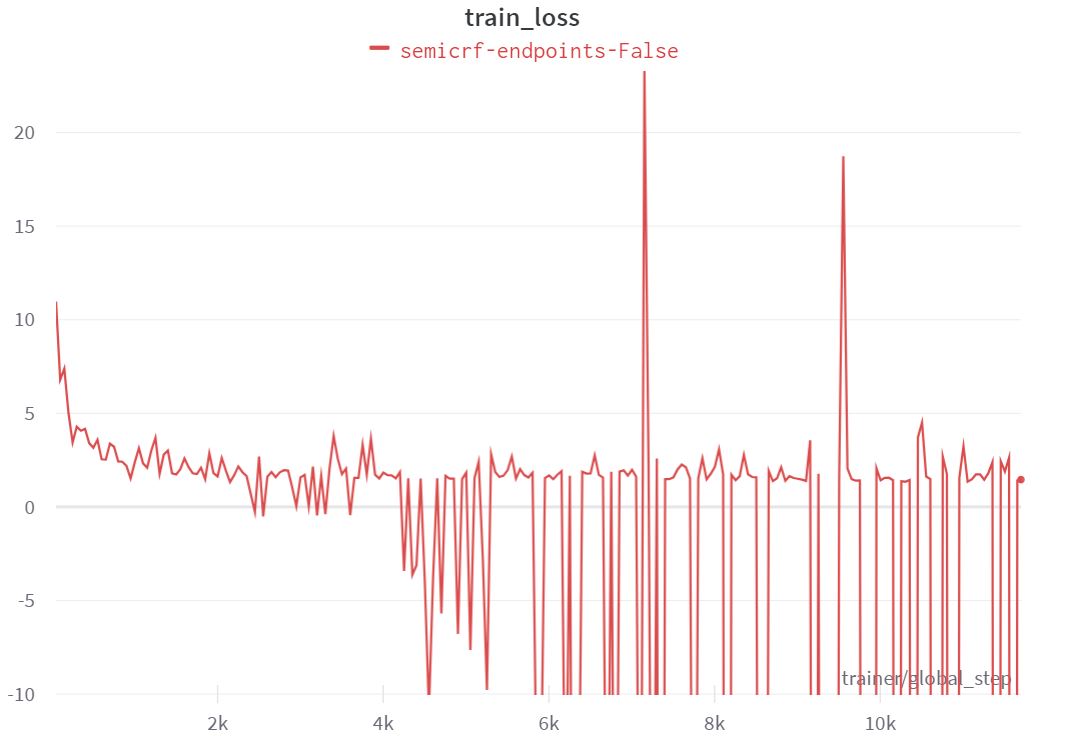
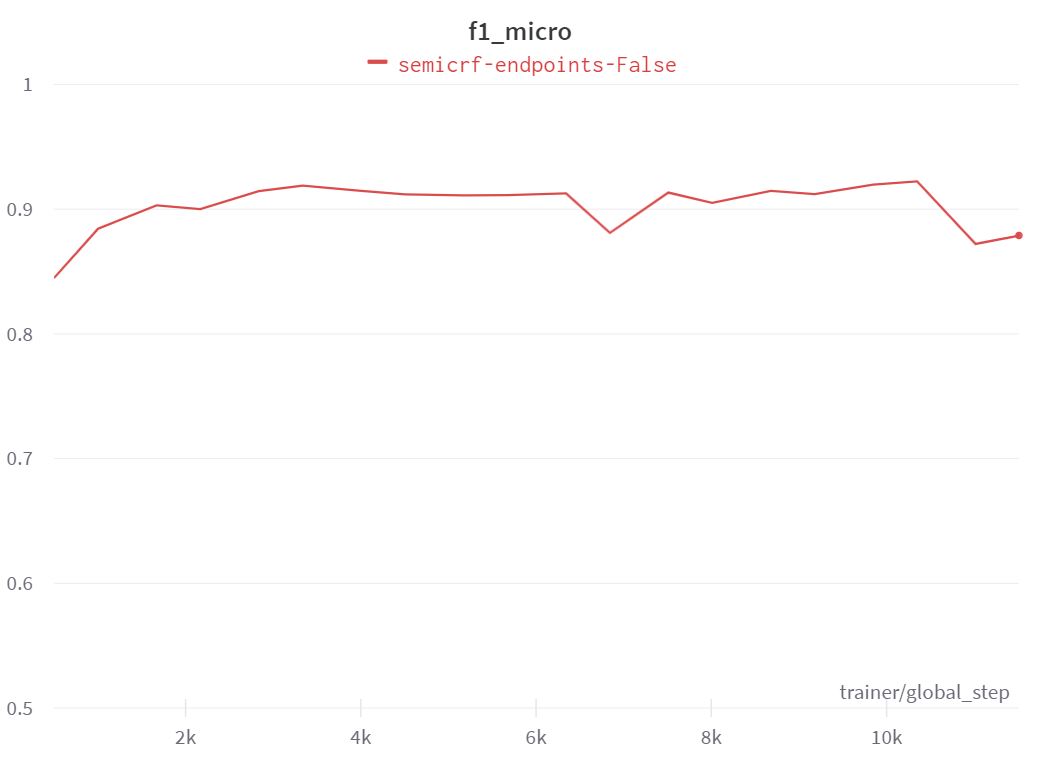
    First, thank you for fixing #110 (@da03), the SemiCRF works better now, I was able to get good results on span extraction tasks. However, I still encounter a learning instability where the loss (neg logprob) gets negative after several steps (and the accuracy starts to drop). The same problem occurs with batch_size = 1. Below I put the learning curve (f1_score and log loss).

    (Maybe the bug comes from the masking of spans where (length, length + span_with) and length + span_with > length, but I am not sure.)

    Edit: I created a test and it seems that the masking is good. Maybe the log_prob computation or the to_parts function ?

    train_loss score

    opened by urchade 0
  • fix bug- missing assignment of spans from sentCFG in documentation

    fix bug- missing assignment of spans from sentCFG in documentation

    Noticed a small bug in the documentation and example of SentCFG. The return of dist.argmax is (terms, rules, init, spans), but example in documentation only assigns (term, rules, init) and gives dim mismatch. As such when running the example it breaks. This fix resolves this issue.

    opened by jdegange 0
Releases(v0.5)
Python port of R's Comprehensive Dynamic Time Warp algorithm package

Welcome to the dtw-python package Comprehensive implementation of Dynamic Time Warping algorithms. DTW is a family of algorithms which compute the loc

Dynamic Time Warping algorithms 154 Dec 26, 2022
Joint parameterization and fitting of stroke clusters

StrokeStrip: Joint Parameterization and Fitting of Stroke Clusters Dave Pagurek van Mossel1, Chenxi Liu1, Nicholas Vining1,2, Mikhail Bessmeltsev3, Al

Dave Pagurek 44 Dec 01, 2022
Molecular AutoEncoder in PyTorch

MolEncoder Molecular AutoEncoder in PyTorch Install $ git clone https://github.com/cxhernandez/molencoder.git && cd molencoder $ python setup.py insta

Carlos Hernández 80 Dec 05, 2022
This is a work in progress reimplementation of Instant Neural Graphics Primitives

Neural Hash Encoding This is a work in progress reimplementation of Instant Neural Graphics Primitives Currently this can train an implicit representa

Penn 79 Sep 01, 2022
DRLib:A concise deep reinforcement learning library, integrating HER and PER for almost off policy RL algos.

DRLib:A concise deep reinforcement learning library, integrating HER and PER for almost off policy RL algos A concise deep reinforcement learning libr

329 Jan 03, 2023
Optimising chemical reactions using machine learning

Summit Summit is a set of tools for optimising chemical processes. We’ve started by targeting reactions. What is Summit? Currently, reaction optimisat

Sustainable Reaction Engineering Group 75 Dec 14, 2022
Code for ICCV2021 paper PARE: Part Attention Regressor for 3D Human Body Estimation

PARE: Part Attention Regressor for 3D Human Body Estimation [ICCV 2021] PARE: Part Attention Regressor for 3D Human Body Estimation, Muhammed Kocabas,

Muhammed Kocabas 277 Jan 03, 2023
A PyTorch implementation of the architecture of Mask RCNN

EDIT (AS OF 4th NOVEMBER 2019): This implementation has multiple errors and as of the date 4th, November 2019 is insufficient to be utilized as a reso

Sai Himal Allu 975 Dec 30, 2022
The Surprising Effectiveness of Visual Odometry Techniques for Embodied PointGoal Navigation

PointNav-VO The Surprising Effectiveness of Visual Odometry Techniques for Embodied PointGoal Navigation Project Page | Paper Table of Contents Setup

Xiaoming Zhao 41 Dec 15, 2022
CTRMs: Learning to Construct Cooperative Timed Roadmaps for Multi-agent Path Planning in Continuous Spaces

CTRMs: Learning to Construct Cooperative Timed Roadmaps for Multi-agent Path Planning in Continuous Spaces This is a repository for the following pape

17 Oct 13, 2022
NP DRAW paper released code

NP-DRAW: A Non-Parametric Structured Latent Variable Model for Image Generation This repo contains the official implementation for the NP-DRAW paper.

ZENG Xiaohui 22 Mar 13, 2022
This repository is for EMNLP 2021 paper: It is Not as Good as You Think! Evaluating Simultaneous Machine Translation on Interpretation Data

InterpretationData This repository is for our EMNLP 2021 paper: It is Not as Good as You Think! Evaluating Simultaneous Machine Translation on Interpr

4 Apr 21, 2022
Code for paper Novel View Synthesis via Depth-guided Skip Connections

Novel View Synthesis via Depth-guided Skip Connections Code for paper Novel View Synthesis via Depth-guided Skip Connections @InProceedings{Hou_2021_W

8 Mar 14, 2022
Code for approximate graph reduction techniques for cardinality-based DSFM, from paper

SparseCard Code for approximate graph reduction techniques for cardinality-based DSFM, from paper "Approximate Decomposable Submodular Function Minimi

Nate Veldt 1 Nov 25, 2022
Colab notebook and additional materials for Python-driven analysis of redlining data in Philadelphia

RedliningExploration The Google Colaboratory file contained in this repository contains work inspired by a project on educational inequality in the Ph

Benjamin Warren 1 Jan 20, 2022
Unofficial PyTorch implementation of TokenLearner by Google AI

tokenlearner-pytorch Unofficial PyTorch implementation of TokenLearner by Ryoo et al. from Google AI (abs, pdf) Installation You can install TokenLear

Rishabh Anand 46 Dec 20, 2022
JFB: Jacobian-Free Backpropagation for Implicit Models

JFB: Jacobian-Free Backpropagation for Implicit Models

Typal Research 28 Dec 11, 2022
Official repo for AutoInt: Automatic Integration for Fast Neural Volume Rendering in CVPR 2021

AutoInt: Automatic Integration for Fast Neural Volume Rendering CVPR 2021 Project Page | Video | Paper PyTorch implementation of automatic integration

Stanford Computational Imaging Lab 149 Dec 22, 2022
Library for fast text representation and classification.

fastText fastText is a library for efficient learning of word representations and sentence classification. Table of contents Resources Models Suppleme

Facebook Research 24.1k Jan 01, 2023
Defense-GAN: Protecting Classifiers Against Adversarial Attacks Using Generative Models (published in ICLR2018)

Defense-GAN: Protecting Classifiers Against Adversarial Attacks Using Generative Models Pouya Samangouei*, Maya Kabkab*, Rama Chellappa [*: authors co

Maya Kabkab 212 Dec 07, 2022