Official pytorch implementation of paper Dual-Level Collaborative Transformer for Image Captioning (AAAI 2021).

Overview

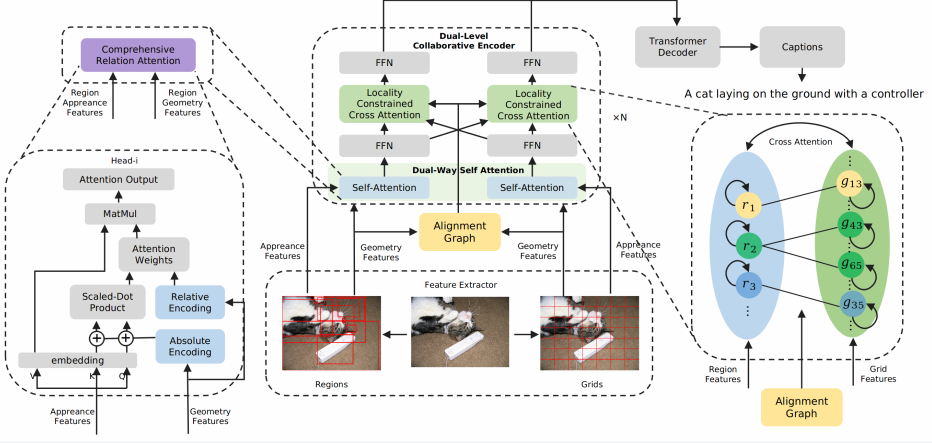
Dual-Level Collaborative Transformer for Image Captioning

This repository contains the reference code for the paper Dual-Level Collaborative Transformer for Image Captioning.
Experiment setup

please refer to m2 transformer

Data preparation

  • Annotation. Download the annotation file annotation.zip. Extarct and put it in the project root directory.
  • Feature. You can download our ResNeXt-101 feature (hdf5 file) here. Acess code: jcj6.
  • evaluation. Download the evaluation tools here. Acess code: jcj6. Extarct and put it in the project root directory.

There are five kinds of keys in our .hdf5 file. They are

  • ['%d_features' % image_id]: region features (N_regions, feature_dim)
  • ['%d_boxes' % image_id]: bounding box of region features (N_regions, 4)
  • ['%d_size' % image_id]: size of original image (for normalizing bounding box), (2,)
  • ['%d_grids' % image_id]: grid features (N_grids, feature_dim)
  • ['%d_mask' % image_id]: geometric alignment graph, (N_regions, N_grids)

We extract feature with the code in grid-feats-vqa.

The first three keys can be obtained when extracting region features with extract_region_feature.py. The forth key can be obtained when extracting grid features with code in grid-feats-vqa. The last key can be obtained with align.ipynb

Training

python train.py --exp_name dlct --batch_size 50 --head 8 --features_path ./data/coco_all_align.hdf5 --annotation annotation --workers 8 --rl_batch_size 100 --image_field ImageAllFieldWithMask --model DLCT --rl_at 17 --seed 118

Evaluation

python eval.py --annotation annotation --workers 4 --features_path ./data/coco_all_align.hdf5 --model_path path_of_model_to_eval --model DLCT --image_field ImageAllFieldWithMask --grid_embed --box_embed --dump_json gen_res.json --beam_size 5

Important args:

  • --features_path path to hdf5 file
  • --model_path
  • --dump_json dump generated captions to

Pretrained model is available here. Acess code: jcj6. By evaluating the pretrained model, you will get

{'BLEU': [0.8136727001615207, 0.6606095421082421, 0.5167535314080227, 0.39790755018790197], 'METEOR': 0.29522868252436046, 'ROUGE': 0.5914367650104326, 'CIDEr': 1.3382047139781112, 'SPICE': 0.22953477359195887}

References

[1] M2

[2] grid-feats-vqa

[3] butd

Acknowledgements

Thanks the original m2 and amazing work of grid-feats-vqa.

Owner
lyricpoem
lyricpoem
Anagram Generator in Python

Anagrams Generator This is a program for computing multiword anagrams. It makes no effort to come up with sentences that make sense; it only finds ana

Day Fundora 5 Nov 17, 2022
Geometry-Free View Synthesis: Transformers and no 3D Priors

Geometry-Free View Synthesis: Transformers and no 3D Priors Geometry-Free View Synthesis: Transformers and no 3D Priors Robin Rombach*, Patrick Esser*

CompVis Heidelberg 293 Dec 22, 2022
Losslandscapetaxonomy - Taxonomizing local versus global structure in neural network loss landscapes

Taxonomizing local versus global structure in neural network loss landscapes Int

Yaoqing Yang 8 Dec 30, 2022
Attention mechanism with MNIST dataset

[TensorFlow] Attention mechanism with MNIST dataset Usage $ python run.py Result Training Loss graph. Test Each figure shows input digit, attention ma

YeongHyeon Park 12 Jun 10, 2022
DeLiGAN - This project is an implementation of the Generative Adversarial Network

This project is an implementation of the Generative Adversarial Network proposed in our CVPR 2017 paper - DeLiGAN : Generative Adversarial Net

Video Analytics Lab -- IISc 110 Sep 13, 2022
MonoRCNN is a monocular 3D object detection method for automonous driving

MonoRCNN MonoRCNN is a monocular 3D object detection method for automonous driving, published at ICCV 2021. This project is an implementation of MonoR

87 Dec 27, 2022
Implements Gradient Centralization and allows it to use as a Python package in TensorFlow

Gradient Centralization TensorFlow This Python package implements Gradient Centralization in TensorFlow, a simple and effective optimization technique

Rishit Dagli 101 Nov 01, 2022
A library for uncertainty quantification based on PyTorch

Torchuq [logo here] TorchUQ is an extensive library for uncertainty quantification (UQ) based on pytorch. TorchUQ currently supports 10 representation

TorchUQ 96 Dec 12, 2022
Codes for building and training the neural network model described in Domain-informed neural networks for interaction localization within astroparticle experiments.

Domain-informed Neural Networks Codes for building and training the neural network model described in Domain-informed neural networks for interaction

DIDACTS 0 Dec 13, 2021
Re-implementation of the vector capsule with dynamic routing

VectorCapsule Re-implementation of the vector capsule with dynamic routing We implement the vector capsule and dynamic routing via graph neural networ

ZhenchaoTang 10 Feb 10, 2022
The coda and data for "Measuring Fine-Grained Domain Relevance of Terms: A Hierarchical Core-Fringe Approach" (ACL '21)

We propose a hierarchical core-fringe learning framework to measure fine-grained domain relevance of terms – the degree that a term is relevant to a broad (e.g., computer science) or narrow (e.g., de

Jie Huang 14 Oct 21, 2022
Contra is a lightweight, production ready Tensorflow alternative for solving time series prediction challenges with AI

Contra AI Engine A lightweight, production ready Tensorflow alternative developed by Styvio styvio.com » How to Use · Report Bug · Request Feature Tab

styvio 14 May 25, 2022
NeurIPS 2021, "Fine Samples for Learning with Noisy Labels"

[Official] FINE Samples for Learning with Noisy Labels This repository is the official implementation of "FINE Samples for Learning with Noisy Labels"

mythbuster 27 Dec 23, 2022
Project page of the paper 'Analyzing Perception-Distortion Tradeoff using Enhanced Perceptual Super-resolution Network' (ECCVW 2018)

EPSR (Enhanced Perceptual Super-resolution Network) paper This repo provides the test code, pretrained models, and results on benchmark datasets of ou

Subeesh Vasu 78 Nov 19, 2022
Official implementation for paper: Feature-Style Encoder for Style-Based GAN Inversion

Feature-Style Encoder for Style-Based GAN Inversion Official implementation for paper: Feature-Style Encoder for Style-Based GAN Inversion. Code will

InterDigital 63 Jan 03, 2023
This is implementation of AlexNet(2012) with 3D Convolution on TensorFlow (AlexNet 3D).

AlexNet_3dConv TensorFlow implementation of AlexNet(2012) by Alex Krizhevsky, with 3D convolutiional layers. 3D AlexNet Network with a standart AlexNe

Denis Timonin 41 Jan 16, 2022
Winners of DrivenData's Overhead Geopose Challenge

Winners of DrivenData's Overhead Geopose Challenge

DrivenData 22 Aug 04, 2022
Codes accompanying the paper "Learning Nearly Decomposable Value Functions with Communication Minimization" (ICLR 2020)

NDQ: Learning Nearly Decomposable Value Functions with Communication Minimization Note This codebase accompanies paper Learning Nearly Decomposable Va

Tonghan Wang 69 Nov 26, 2022
Watch faces morph into each other with StyleGAN 2, StyleGAN, and DCGAN!

FaceMorpher FaceMorpher is an innovative project to get a unique face morph (or interpolation for geeks) on a website. Yes, this means you can see fac

Anish 9 Jun 24, 2022
Specificity-preserving RGB-D Saliency Detection

Specificity-preserving RGB-D Saliency Detection Authors: Tao Zhou, Huazhu Fu, Geng Chen, Yi Zhou, Deng-Ping Fan, and Ling Shao. 1. Preface This reposi

Tao Zhou 35 Jan 08, 2023