Automatic 2D-to-3D Video Conversion with CNNs

Related tags

Deep Learningdeep3d
Overview

Deep3D: Automatic 2D-to-3D Video Conversion with CNNs

How To Run

To run this code. Please install MXNet following the official document. Deep3D requires MXNet to be built with Cuda 7.0 and Cudnn 4 or above. Please open mxnet/config.mk and set USE_CUDA and USE_CUDNN to 1. Then, append EXTRA_OPERATORS=path/to/deep3d/operators to path/to/mxnet/config.mk and recompile MXNet.
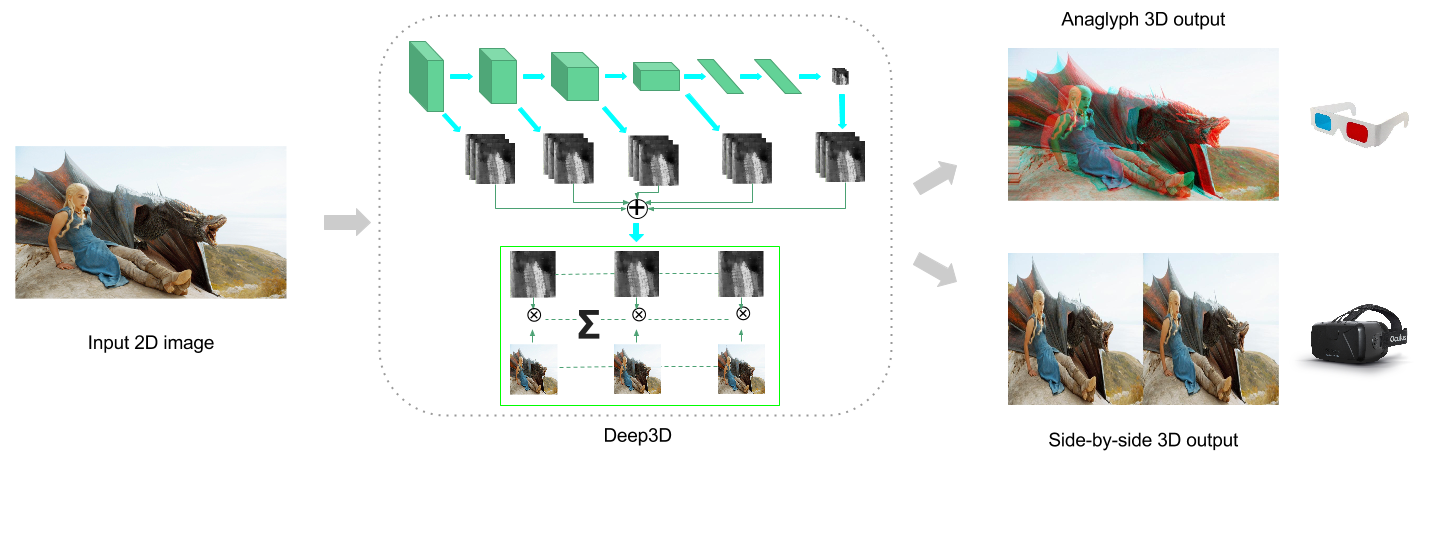
alt text

Motivation

Since the debut of Avatar in 2008, 3D movies has rapidly developed into mainstream technology. Roughly 10 to 20 3D movies are produced each year and the launch of Oculus Rift and other VR head set is only going to drive up the demand.

Producing 3D movies, however, is still hard. There are two ways of doing this and in practice they are about equally popular: shooting with a special 3D camera or shooting in 2D and manually convert to 3D. But 3D cameras are expensive and unwieldy while manual conversion involves an army of "depth artists" who sit there and draw depth maps for each frame.

Wouldn't it be cool if 2D-to-3D conversion can be done automatically, if you can take a 3D selfie with an ordinary phone?

Teaser

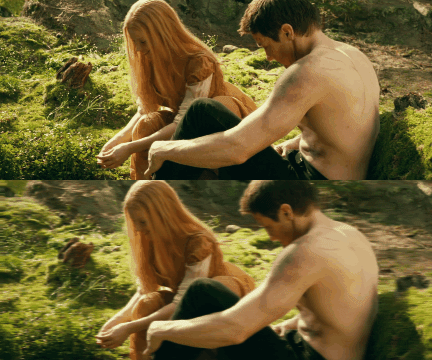
In case you are already getting sleepy, here are some cool 3D images converted from 2D ones by Deep3D. Normally you need 3D glasses or VR display to watch 3D images, but since most readers won't have these we show the 3D images as GIFs.

alt text alt text alt text alt text alt text alt text alt text alt text

Method

3D imagery has two views, one for the left eye and the other for the right. To convert an 2D image to 3D, you need to first estimate the distance from camera for each pixel (a.k.a depth map) and then wrap the image based on its depth map to create two views.

The difficult step is estimating the depth map. For automatic conversion, we would like to learn a model for it. There are several works on depth estimation from single 2D image with DNNs. However, they need to be trained on image-depth pairs which are hard to collect. As a result they can only use small datasets with a few hundred examples like NYU Depth and KITTI. Moreover, these datasets only has static scenes and it's hard to imagine they will generalize to photos with people in them.

In Contrast, Deep3D can be trained directly on 3D movies that have tens of millions frames in total. We do this by making the depth map an internal representation instead of the end prediction. Thus, instead of predicting an depth map and then use it to recreate the missing view with a separate algorithm, we train depth estimation and recreate end-to-end in the same neural network.

Here are some visualizations of our internal depth representation to help you understand how it works:


alt text alt text alt text alt text alt text alt text alt text alt text alt text

Following each image, there are 4-by-3 maps of depth layers, ordered from near to far. You can see that objects that are near to you appear in the first depth maps and objects that are far away appear in the last ones. This shows that the internal depth representation is learning to infer depth from 2D images without been directly trained on it.

Code

This work is done with MXNet, a flexible and efficient deep learning package. The trained model and a prediction script is in deep3d.ipynb. We will release the code for training shortly.

Owner
Eric Junyuan Xie
Software Engineer @ Bytedance
Eric Junyuan Xie
Async API for controlling Hue Lights

Hue API Async API for controlling Hue Lights Documentation: hue-api.nirantak.com Source: github.com/nirantak/hue-api Installation This is an async cli

Nirantak Raghav 4 Nov 16, 2022
Recognize numbers from an (28 x 28) image using neural networks

Number recognition Recognize numbers from a 28 x 28 image using neural networks Usage This is an example of a simple usage of number-recognition NOTE:

Mauro Baladés 2 Dec 29, 2021
U-Net implementation in PyTorch for FLAIR abnormality segmentation in brain MRI

U-Net for brain segmentation U-Net implementation in PyTorch for FLAIR abnormality segmentation in brain MRI based on a deep learning segmentation alg

562 Jan 02, 2023
SAS: Self-Augmentation Strategy for Language Model Pre-training

SAS: Self-Augmentation Strategy for Language Model Pre-training This repository

Alibaba 5 Nov 02, 2022
Sample code and notebooks for Vertex AI, the end-to-end machine learning platform on Google Cloud

Google Cloud Vertex AI Samples Welcome to the Google Cloud Vertex AI sample repository. Overview The repository contains notebooks and community conte

Google Cloud Platform 560 Dec 31, 2022
[2021 MultiMedia] CONQUER: Contextual Query-aware Ranking for Video Corpus Moment Retrieval

CONQUER: Contexutal Query-aware Ranking for Video Corpus Moment Retreival PyTorch implementation of CONQUER: Contexutal Query-aware Ranking for Video

Hou zhijian 23 Dec 26, 2022
Statistical and Algorithmic Investing Strategies for Everyone

Eiten - Algorithmic Investing Strategies for Everyone Eiten is an open source toolkit by Tradytics that implements various statistical and algorithmic

Tradytics 2.5k Jan 02, 2023
Code for ACL 21: Generating Query Focused Summaries from Query-Free Resources

marge This repository releases the code for Generating Query Focused Summaries from Query-Free Resources. Please cite the following paper [bib] if you

Yumo Xu 28 Nov 10, 2022
Improving Query Representations for DenseRetrieval with Pseudo Relevance Feedback:A Reproducibility Study.

APR The repo for the paper Improving Query Representations for DenseRetrieval with Pseudo Relevance Feedback:A Reproducibility Study. Environment setu

ielab 8 Nov 26, 2022
Code for paper 'Hand-Object Contact Consistency Reasoning for Human Grasps Generation' at ICCV 2021

GraspTTA Hand-Object Contact Consistency Reasoning for Human Grasps Generation (ICCV 2021). Project Page with Videos Demo Quick Results Visualization

Hanwen Jiang 47 Dec 09, 2022
Omniverse sample scripts - A guide for developing with Python scripts on NVIDIA Ominverse

Omniverse sample scripts ここでは、NVIDIA Omniverse ( https://www.nvidia.com/ja-jp/om

ft-lab (Yutaka Yoshisaka) 37 Nov 17, 2022
[ECCV 2020] Reimplementation of 3DDFAv2, including face mesh, head pose, landmarks, and more.

Stable Head Pose Estimation and Landmark Regression via 3D Dense Face Reconstruction Reimplementation of (ECCV 2020) Towards Fast, Accurate and Stable

Remilia Scarlet 221 Dec 30, 2022
Change Detection in SAR Images Based on Multiscale Capsule Network

SAR_CD_MS_CapsNet Code for the paper "Change Detection in SAR Images Based on Multiscale Capsule Network" , IEEE Geoscience and Remote Sensing Letters

Feng Gao 21 Nov 29, 2022
TCTrack: Temporal Contexts for Aerial Tracking (CVPR2022)

TCTrack: Temporal Contexts for Aerial Tracking (CVPR2022) Ziang Cao and Ziyuan Huang and Liang Pan and Shiwei Zhang and Ziwei Liu and Changhong Fu In

Intelligent Vision for Robotics in Complex Environment 100 Dec 19, 2022
Dialect classification

Dialect-Classification This repository presents the data that was used in a talk at ICKL-5 (5th International Conference on Kurdish Linguistics) at th

Kurdish-BLARK 0 Nov 12, 2021
This program was designed to detect whether someone is wearing a facemask through a live video stream.

This program was designed to detect whether someone is wearing a facemask through a live video stream. A custom lightweight CNN trained with TensorFlow on a public dataset provided by Kaggle is used

0 Apr 02, 2022
Tutoriais publicados nas nossas redes sociais para obtenção de dados, análises simples e outras tarefas relevantes no mercado financeiro.

Tutoriais Públicos Tutoriais publicados nas nossas redes sociais para obtenção de dados, análises simples e outras tarefas relevantes no mercado finan

Trading com Dados 68 Oct 15, 2022
[NeurIPS 2021] Large Scale Learning on Non-Homophilous Graphs: New Benchmarks and Strong Simple Methods

Large Scale Learning on Non-Homophilous Graphs: New Benchmarks and Strong Simple Methods Large Scale Learning on Non-Homophilous Graphs: New Benchmark

60 Jan 03, 2023
Tello Drone Trajectory Tracking

With this library you can track the trajectory of your tello drone or swarm of drones in real time.

Kamran Asgarov 2 Oct 12, 2022
Code for Multiple Instance Active Learning for Object Detection, CVPR 2021

Language: 简体中文 | English Introduction This is the code for Multiple Instance Active Learning for Object Detection, CVPR 2021. Installation A Linux pla

Tianning Yuan 269 Dec 21, 2022