A hybrid SOTA solution of LiDAR panoptic segmentation with C++ implementations of point cloud clustering algorithms. ICCV21, Workshop on Traditional Computer Vision in the Age of Deep Learning

Overview

ICCVW21-TradiCV-Survey-of-LiDAR-Cluster

Motivation

In contrast to popular end-to-end deep learning LiDAR panoptic segmentation solutions, we propose a hybrid method with an existing semantic segmentation network to extract semantic information and a traditional LiDAR point cloud cluster algorithm to split each instance object. We argue geometry-based traditional clustering algorithms are worth being considered by showing a state-of-the-art performance among all published end-to-end deep learning solutions on the panoptic segmentation leaderboard of the SemanticKITTI dataset. To our best knowledge, we are the first to attempt the point cloud panoptic segmentation with clustering algorithms. Therefore, instead of working on new models, we give a comprehensive technical survey in this paper by implementing four typical cluster methods and report their performances on the benchmark. Those four cluster methods are the most representative ones with real-time running speed. They are implemented with C++ in this paper and then wrapped as a python function for seamless integration with the existing deep learning frameworks.
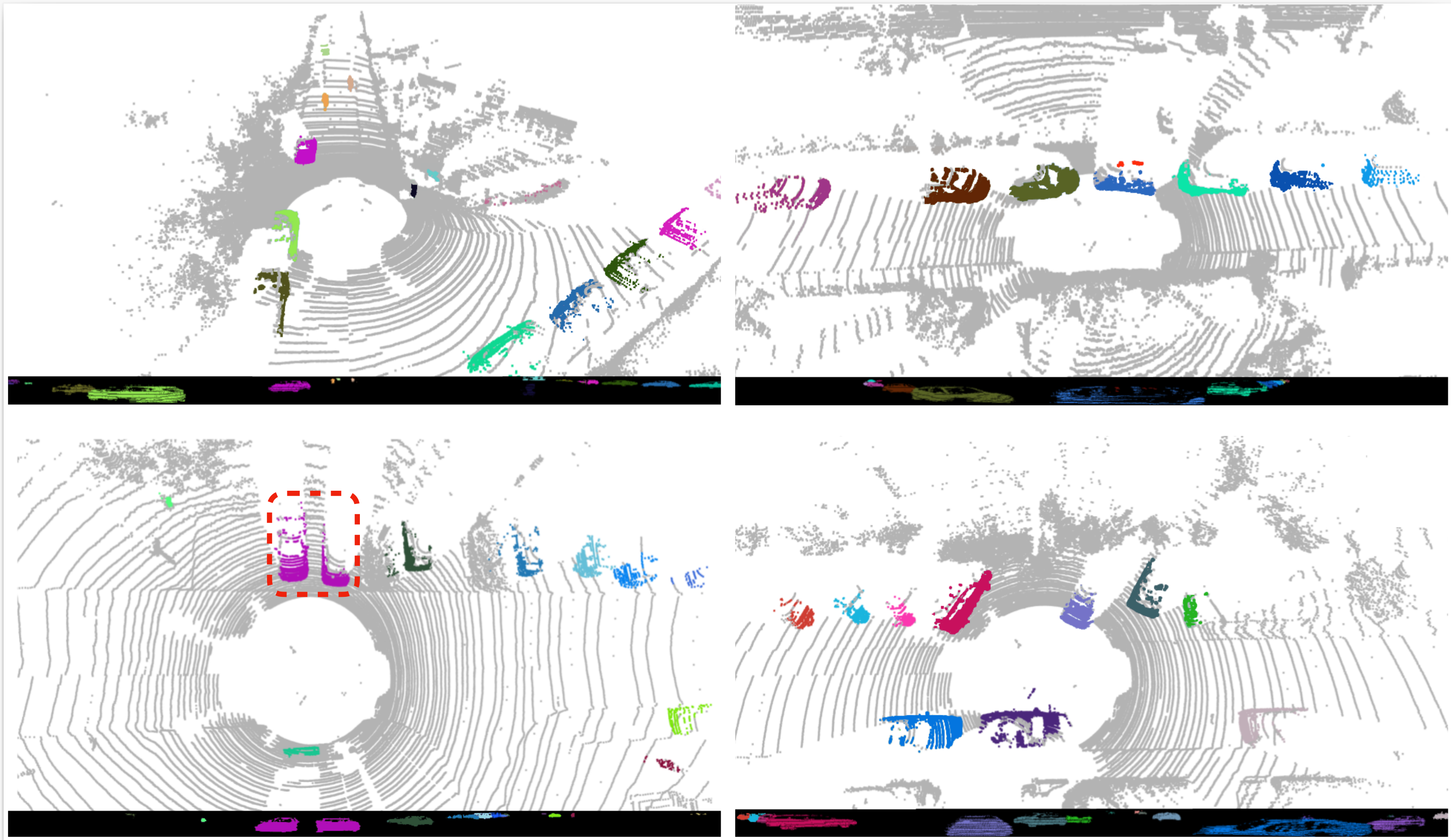

Figure


Dataset Organization

ICCVW21-LiDAR-Panoptic-Segmentation-TradiCV-Survey-of-Point-Cloud-Cluster
├──  Dataset
├        ├── semanticKITTI                 
├            ├── semantic-kitti-api-master         
├            ├── semantic-kitti.yaml
├            ├── data_odometry_velodyne ── dataset ── sequences ── train, val, test         # each folder contains the corresponding sequence folders 00,01...
├            ├── data_odometry_labels ── dataset ── sequences ── train, val, test           # each folder contains the corresponding sequence folders 00,01...
├            └── data_odometry_calib    
├──  method_predictions ── sequences

How to run

```
docker pull pytorch/pytorch:1.7.1-cuda11.0-cudnn8-runtime 
```

Install dependency packages:

```
bash install_dependency.sh
```

Compile specific clusters

```
cd PC_cluster
cd ScanLineRun_cluster/Euclidean_cluster/depth_cluster/SuperVoxel_cluster
bash prepare_packages.sh/prepare_pybind.sh
bash build.sh
```

Note, prepare_packages.sh may redundantly install packages as clusters are supposed to be used independently.

One can download the predicted validation results of Cylinder3D from here: https://drive.google.com/file/d/1QkV8zmRaOAgAZse5CGtlmijcLJVnh7XP/view?usp=sharing

We get the prediction of validation 08 sequence by using the provided checkpoint of Cylinder3D. Thanks for sharing the code!

After downloading, unzip the 08 file, put it inside ./method_predictions/sequences/

It looks like ./method_predictions/sequences/08/predictions/*.label

Run the cluster algorithm

```
python semantic_then_instance_post_inferece.py
```

It should keep updating the visualization figure output_example.png, and overwrite predicted labels in ./method_predictions/sequences/08/predictions/

One can unzip 08 again if wants to run the cluster algorithm again.

Some parameters can be tuned in args parser.

After generating the predicted panoptic label on validation set, one can simply run:

```
bash evaluation_panoptic.sh
```

Some changes of local path may need to be done. Just follow the error to change them, should be easy.

The reported numbers should be exactly the same as the paper since traditional methods have no randomness.

Publication

Please cite the paper if you use this code:

@inproceedings{zhao2021technical,
  title={A Technical Survey and Evaluation of Traditional Point Cloud Clustering Methods for LiDAR Panoptic Segmentation},
  author={Zhao, Yiming and Zhang, Xiao and Huang, Xinming},
  booktitle={Proceedings of the IEEE/CVF International Conference on Computer Vision},
  pages={2464--2473},
  year={2021}
}


Owner
YimingZhao
Job seeking at Shanghai. I'm a Ph.D. student at Worcester Polytechnic Institute, working on deep learning, autonomous driving, and general robotic vision.
YimingZhao
A framework for joint super-resolution and image synthesis, without requiring real training data

SynthSR This repository contains code to train a Convolutional Neural Network (CNN) for Super-resolution (SR), or joint SR and data synthesis. The met

83 Jan 01, 2023
PyTorch code of "SLAPS: Self-Supervision Improves Structure Learning for Graph Neural Networks"

SLAPS-GNN This repo contains the implementation of the model proposed in SLAPS: Self-Supervision Improves Structure Learning for Graph Neural Networks

60 Dec 22, 2022
The Official Implementation of the ICCV-2021 Paper: Semantically Coherent Out-of-Distribution Detection.

SCOOD-UDG (ICCV 2021) This repository is the official implementation of the paper: Semantically Coherent Out-of-Distribution Detection Jingkang Yang,

Jake YANG 62 Nov 21, 2022
PyTorch implementation for "Mining Latent Structures with Contrastive Modality Fusion for Multimedia Recommendation"

MIRCO PyTorch implementation for paper: Latent Structures Mining with Contrastive Modality Fusion for Multimedia Recommendation Dependencies Python 3.

Big Data and Multi-modal Computing Group, CRIPAC 9 Dec 08, 2022
Implement face detection, and age and gender classification, and emotion classification.

YOLO Keras Face Detection Implement Face detection, and Age and Gender Classification, and Emotion Classification. (image from wider face dataset) Ove

Chloe 10 Nov 14, 2022
Pytorch Lightning code guideline for conferences

Deep learning project seed Use this seed to start new deep learning / ML projects. Built in setup.py Built in requirements Examples with MNIST Badges

Pytorch Lightning 1k Jan 06, 2023
PyTorch implementation DRO: Deep Recurrent Optimizer for Structure-from-Motion

DRO: Deep Recurrent Optimizer for Structure-from-Motion This is the official PyTorch implementation code for DRO-sfm. For technical details, please re

Alibaba Cloud 56 Dec 12, 2022
Old Photo Restoration (Official PyTorch Implementation)

Bringing Old Photo Back to Life (CVPR 2020 oral)

Microsoft 11.3k Dec 30, 2022
Full Resolution Residual Networks for Semantic Image Segmentation

Full-Resolution Residual Networks (FRRN) This repository contains code to train and qualitatively evaluate Full-Resolution Residual Networks (FRRNs) a

Toby Pohlen 274 Oct 27, 2022
Dilated Convolution for Semantic Image Segmentation

Multi-Scale Context Aggregation by Dilated Convolutions Introduction Properties of dilated convolution are discussed in our ICLR 2016 conference paper

Fisher Yu 764 Dec 26, 2022
A PyTorch library and evaluation platform for end-to-end compression research

CompressAI CompressAI (compress-ay) is a PyTorch library and evaluation platform for end-to-end compression research. CompressAI currently provides: c

InterDigital 680 Jan 06, 2023
Pytorch implementation of Feature Pyramid Network (FPN) for Object Detection

fpn.pytorch Pytorch implementation of Feature Pyramid Network (FPN) for Object Detection Introduction This project inherits the property of our pytorc

Jianwei Yang 912 Dec 21, 2022
DPT: Deformable Patch-based Transformer for Visual Recognition (ACM MM2021)

DPT This repo is the official implementation of DPT: Deformable Patch-based Transformer for Visual Recognition (ACM MM2021). We provide code and model

CASIA-IVA-Lab 111 Dec 21, 2022
Happywhale - Whale and Dolphin Identification Silver🥈 Solution (26/1588)

Kaggle-Happywhale Happywhale - Whale and Dolphin Identification Silver 🥈 Solution (26/1588) 竞赛方案思路 图像数据预处理-标志性特征图片裁剪:首先根据开源的标注数据训练YOLOv5x6目标检测模型,将训练集

Franxx 20 Nov 14, 2022
A new video text spotting framework with Transformer

TransVTSpotter: End-to-end Video Text Spotter with Transformer Introduction A Multilingual, Open World Video Text Dataset and End-to-end Video Text Sp

weijiawu 67 Jan 03, 2023
Logistic Bandit experiments. Official code for the paper "Jointly Efficient and Optimal Algorithms for Logistic Bandits".

Code for the paper Jointly Efficient and Optimal Algorithms for Logistic Bandits, by Louis Faury, Marc Abeille, Clément Calauzènes and Kwang-Sun Jun.

Faury Louis 1 Jan 22, 2022
Just playing with getting CLIP Guided Diffusion running locally, rather than having to use colab.

CLIP-Guided-Diffusion Just playing with getting CLIP Guided Diffusion running locally, rather than having to use colab. Original colab notebooks by Ka

Nerdy Rodent 336 Dec 09, 2022
Range Image-based LiDAR Localization for Autonomous Vehicles Using Mesh Maps

Range Image-based 3D LiDAR Localization This repo contains the code for our ICRA2021 paper: Range Image-based LiDAR Localization for Autonomous Vehicl

Photogrammetry & Robotics Bonn 208 Dec 15, 2022
An implementation of shampoo

shampoo.pytorch An implementation of shampoo, proposed in Shampoo : Preconditioned Stochastic Tensor Optimization by Vineet Gupta, Tomer Koren and Yor

Ryuichiro Hataya 69 Sep 10, 2022
Code for ICCV2021 paper PARE: Part Attention Regressor for 3D Human Body Estimation

PARE: Part Attention Regressor for 3D Human Body Estimation [ICCV 2021] PARE: Part Attention Regressor for 3D Human Body Estimation, Muhammed Kocabas,

Muhammed Kocabas 277 Jan 03, 2023