Application of the L2HMC algorithm to simulations in lattice QCD.

Overview

l2hmc-qcd CodeFactor

📊 Slides

📒 Example Notebook


Overview

The L2HMC algorithm aims to improve upon HMC by optimizing a carefully chosen loss function which is designed to minimize autocorrelations within the Markov Chain, thereby improving the efficiency of the sampler.

This work is based on the original implementation: brain-research/l2hmc/.

A detailed description of the L2HMC algorithm can be found in the paper:

Generalizing Hamiltonian Monte Carlo with Neural Network

by Daniel Levy, Matt D. Hoffman and Jascha Sohl-Dickstein.

Broadly, given an analytically described target distribution, π(x), L2HMC provides a statistically exact sampler that:

  • Quickly converges to the target distribution (fast burn-in).
  • Quickly produces uncorrelated samples (fast mixing).
  • Is able to efficiently mix between energy levels.
  • Is capable of traversing low-density zones to mix between modes (often difficult for generic HMC).

L2HMC for LatticeQCD

Goal: Use L2HMC to efficiently generate gauge configurations for calculating observables in lattice QCD.

A detailed description of the (ongoing) work to apply this algorithm to simulations in lattice QCD (specifically, a 2D U(1) lattice gauge theory model) can be found in doc/main.pdf.

l2hmc-qcd poster

Organization

Dynamics / Network

The base class for the augmented L2HMC leapfrog integrator is implemented in the BaseDynamics (a tf.keras.Model object).

The GaugeDynamics is a subclass of BaseDynamics containing modifications for the 2D U(1) pure gauge theory.

The network is defined in l2hmc-qcd/network/functional_net.py.

Network Architecture

An illustration of the leapfrog layer updating (x, v) --> (x', v') can be seen below.

leapfrog layer

Lattice

Lattice code can be found in lattice.py, specifically the GaugeLattice object that provides the base structure on which our target distribution exists.

Additionally, the GaugeLattice object implements a variety of methods for calculating physical observables such as the average plaquette, ɸₚ, and the topological charge Q,

Training

The training loop is implemented in l2hmc-qcd/utils/training_utils.py .

To train the sampler on a 2D U(1) gauge model using the parameters specified in bin/train_configs.json:

$ python3 /path/to/l2hmc-qcd/l2hmc-qcd/train.py --json_file=/path/to/l2hmc-qcd/bin/train_configs.json

Or via the bin/train.sh script provided in bin/.

Features

  • Distributed training (via horovod): If horovod is installed, the model can be trained across multiple GPUs (or CPUs) by:

    #!/bin/bash
    
    TRAINER=/path/to/l2hmc-qcd/l2hmc-qcd/train.py
    JSON_FILE=/path/to/l2hmc-qcd/bin/train_configs.json
    
    horovodrun -np ${PROCS} python3 ${TRAINER} --json_file=${JSON_FILE}

Contact


Code author: Sam Foreman

Pull requests and issues should be directed to: saforem2

Citation

If you use this code or found this work interesting, please cite our work along with the original paper:

@misc{foreman2021deep,
      title={Deep Learning Hamiltonian Monte Carlo}, 
      author={Sam Foreman and Xiao-Yong Jin and James C. Osborn},
      year={2021},
      eprint={2105.03418},
      archivePrefix={arXiv},
      primaryClass={hep-lat}
}
@article{levy2017generalizing,
  title={Generalizing Hamiltonian Monte Carlo with Neural Networks},
  author={Levy, Daniel and Hoffman, Matthew D. and Sohl-Dickstein, Jascha},
  journal={arXiv preprint arXiv:1711.09268},
  year={2017}
}

Acknowledgement

This research used resources of the Argonne Leadership Computing Facility, which is a DOE Office of Science User Facility supported under contract DE_AC02-06CH11357. This work describes objective technical results and analysis. Any subjective views or opinions that might be expressed in the work do not necessarily represent the views of the U.S. DOE or the United States Government. Declaration of Interests - None.

Hits

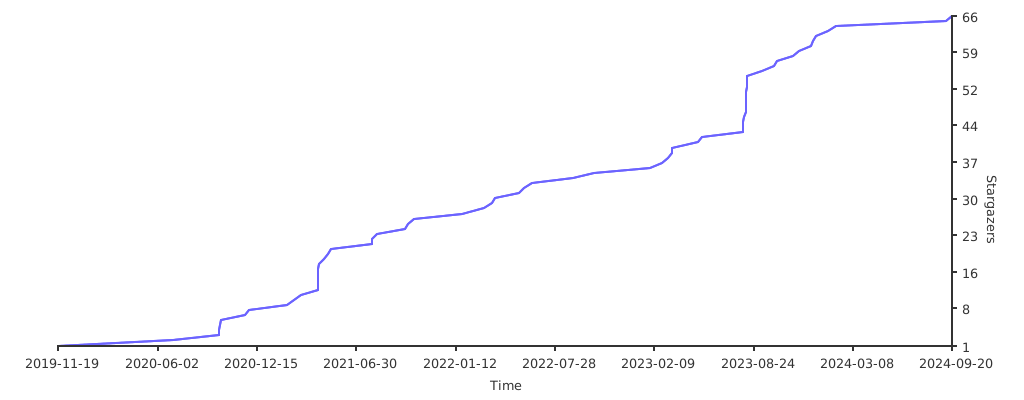
Stargazers over time

Comments
  • Remove upper bound on python_requires

    Remove upper bound on python_requires

    (I'm moving between meetings so can iterate on this more later, so excuse the very brief Issue for now).

    At the moment the project has an upper bound on python_requires

    https://github.com/saforem2/l2hmc-qcd/blob/2eb6ee63cc0c53b187e6d716f4c12f418c8b8515/setup.py#L165

    Assuming that you're intending l2hmc to be a library and not an application, then I would highly recommend removing this for the reasons summarized in Henry's detailed blog post on the subject.

    Congrats on getting l2hmc up on PyPI though! :snake: :rocket:

    opened by matthewfeickert 2
  • Alpha

    Alpha

    Pull upstream alpha branch into main

    Major changes

    • new src/ hierarchical module organization
    • Contains skeleton implementation of 4D SU(3) lattice gauge model
    • Framework independent configuration
      • Unified configuration system simplifies logic, same configs used for both tensorflow and pytorch experiments
      • Plan to be able to specify which backend to use through config option
    • Unified (and framework independent) configurations between tensorflow and pytorch implementations

    Note: This is still very much a WIP. Many existing features still need to be re-implemented / updated into new code in src/.

    Todo

    • [ ] Write unit tests
    • [ ] Use simple configs for end-to-end workflow test + integrate into CI
    • [ ] dynamic learning rate scheduling
    • [ ] Test 4D SU(3) numpy code
    • [ ] Write tensorflow and pytorch implementations of LatticeSU3 objects
    • [ ] Improved / simplified ( / trainable?) annealing schedule
    • [ ] Distributed training support
      • [ ] horovod
      • [ ] DDP for pytorch implementation
      • [ ] DeepSpeed from Microsoft??
    • [ ] Testing / inference logic
    • [ ] Automatic checkpointing
    • [ ] Metric logging
      • [ ] Tensorboard?
      • [ ] Sacred?
      • [ ] build custom dashboard? plot.ly?
    • [ ] Setup packaging / distribution through pip
    • [ ] Resolve issue
    opened by saforem2 1
  • Alpha

    Alpha

    opened by saforem2 1
  • Rich

    Rich

    General improvements, rewrote logging methods to use Rich for better formatting.

    • Adds dynamic (trainable) step size eps for each separate x and v updates, seems to generally increase the total energy towards the middle of the trajectory but it remains unclear if this corresponds to an improvement in the tunneling rate
    • Adds methods for calculating autocorrelations of the topological charge, as well as notebooks for generating the plots
    • Updates to the writeup in doc/main.pdf
    • Will likely be last changes to writeup before public release of official draft
    opened by saforem2 1
  • Dev

    Dev

    • Updates to README

    • Ability to load network with new training instance

    • Updates to doc/, removes old sections related to debugging the bias in the plaquette

    opened by saforem2 1
  • Saveable model

    Saveable model

    Complete rewrite of dynamics.xnet and dynamics.vnet models to use tf.keras.functional Models.

    Additional changes include:

    • Non-Compact Projection update for gauge fields
    • Ability to specify convolution structure to be prepended at beginning of gauge network
    opened by saforem2 1
  • Dev

    Dev

    Removes models/gauge_model.py entirely.

    Instead, a base dynamics class is implemented in dynamics/dynamics.py, and an example subclass is provided in dynamics/gauge_dynamics.py.

    opened by saforem2 1
  • Split networks

    Split networks

    Major rewrite of existing codebase.

    This pull request updates everything to be compatible with tensorflow >= 2.2 and removes a bunch of redundant legacy code.

    opened by saforem2 1
  • Dev

    Dev

    • Dynamics object is now compatible with tf >= 2.0
    • Running inference on trained model with tensorflow now creates identical graphs and summary files to numpy inference code
    • Inference with numpy now uses object oriented structure
    • Adds LaTeX + PDF documentation in doc/
    opened by saforem2 1
  • Cooley dev

    Cooley dev

    Adds new GaugeNetwork architecture as the default for training GaugeModel

    Additionally, replaces pickle with joblib for saving data as .z compressed files (as opposed to .pkl files).

    opened by saforem2 1
  • Testing

    Testing

    Implemented nnehmc_loss calculation for an alternative loss function using the approach suggested in https://infoscience.epfl.ch/record/264887/files/robust_parameter_estimation.pdf.

    This modified loss function can be chosen (instead of the standard loss described in the original paper) by passing --use_nnehmc_loss as a command line argument.

    opened by saforem2 1
  • Packaging and PyPI distribution?

    Packaging and PyPI distribution?

    As you've made a library and are using it as such:

    # snippet from toy_distributions.ipynb
    
    # append parent directory to `sys.path`
    # to load from modules in `../l2hmc-qcd/`
    module_path = os.path.join('..')
    if module_path not in sys.path:
        sys.path.append(module_path)
    
    # Local imports
    from utils.attr_dict import AttrDict
    from utils.training_utils import train_dynamics
    from dynamics.config import DynamicsConfig
    from dynamics.base_dynamics import BaseDynamics
    from dynamics.generic_dynamics import GenericDynamics
    from network.config import LearningRateConfig
    from config import (State, NetWeights, MonteCarloStates,
                        BASE_DIR, BIN_DIR, TF_FLOAT)
    
    from utils.distributions import (plot_samples2D, contour_potential,
                                     two_moons_potential, sin_potential,
                                     sin_potential1, sin_potential2)
    

    do you have any plans and/or interest in packaging it as a Python library so it can either be pip installed from GitHub or be distributed on PyPI?

    opened by matthewfeickert 5
Releases(0.12.0)
Owner
Sam Foreman
Computational science Postdoc at Argonne National Laboratory working on applying machine learning to simulations in lattice QCD.
Sam Foreman
Time Dependent DFT in Tamm-Dancoff Approximation

Density Function Theory Program - kspy-tddft(tda) This is an implementation of Time-Dependent Density Functional Theory(TDDFT) using the Tamm-Dancoff

Peter Borthwick 2 Nov 17, 2022
Codes of the paper Deformable Butterfly: A Highly Structured and Sparse Linear Transform.

Deformable Butterfly: A Highly Structured and Sparse Linear Transform DeBut Advantages DeBut generalizes the square power of two butterfly factor matr

Rui LIN 8 Jun 10, 2022
This is RFA-Toolbox, a simple and easy-to-use library that allows you to optimize your neural network architectures using receptive field analysis (RFA) and create graph visualizations of your architecture.

ReceptiveFieldAnalysisToolbox This is RFA-Toolbox, a simple and easy-to-use library that allows you to optimize your neural network architectures usin

84 Nov 23, 2022
Code of Adverse Weather Image Translation with Asymmetric and Uncertainty aware GAN

Adverse Weather Image Translation with Asymmetric and Uncertainty-aware GAN (AU-GAN) Official Tensorflow implementation of Adverse Weather Image Trans

Jeong-gi Kwak 36 Dec 26, 2022
A variational Bayesian method for similarity learning in non-rigid image registration (CVPR 2022)

A variational Bayesian method for similarity learning in non-rigid image registration We provide the source code and the trained models used in the re

daniel grzech 14 Nov 21, 2022
Parris, the automated infrastructure setup tool for machine learning algorithms.

README Parris, the automated infrastructure setup tool for machine learning algorithms. What Is This Tool? Parris is a tool for automating the trainin

Joseph Greene 319 Aug 02, 2022
Train the HRNet model on ImageNet

High-resolution networks (HRNets) for Image classification News [2021/01/20] Add some stronger ImageNet pretrained models, e.g., the HRNet_W48_C_ssld_

HRNet 866 Jan 04, 2023
Synthetic LiDAR sequential point cloud dataset with point-wise annotations

SynLiDAR dataset: Learning From Synthetic LiDAR Sequential Point Cloud This is official repository of the SynLiDAR dataset. For technical details, ple

78 Dec 27, 2022
pytorch implementation of openpose including Hand and Body Pose Estimation.

pytorch-openpose pytorch implementation of openpose including Body and Hand Pose Estimation, and the pytorch model is directly converted from openpose

Hzzone 1.4k Jan 07, 2023
Repository for the paper "PoseAug: A Differentiable Pose Augmentation Framework for 3D Human Pose Estimation", CVPR 2021.

PoseAug: A Differentiable Pose Augmentation Framework for 3D Human Pose Estimation Code repository for the paper: PoseAug: A Differentiable Pose Augme

Pyjcsx 328 Dec 17, 2022
Simple machine learning library / 簡單易用的機器學習套件

FukuML Simple machine learning library / 簡單易用的機器學習套件 Installation $ pip install FukuML Tutorial Lesson 1: Perceptron Binary Classification Learning Al

Fukuball Lin 279 Sep 15, 2022
TSIT: A Simple and Versatile Framework for Image-to-Image Translation

TSIT: A Simple and Versatile Framework for Image-to-Image Translation This repository provides the official PyTorch implementation for the following p

Liming Jiang 255 Nov 23, 2022
The missing CMake project initializer

cmake-init - The missing CMake project initializer Opinionated CMake project initializer to generate CMake projects that are FetchContent ready, separ

1k Jan 01, 2023
functorch is a prototype of JAX-like composable function transforms for PyTorch.

functorch is a prototype of JAX-like composable function transforms for PyTorch.

Facebook Research 1.2k Jan 09, 2023
Simple and Effective Few-Shot Named Entity Recognition with Structured Nearest Neighbor Learning

structshot Code and data for paper "Simple and Effective Few-Shot Named Entity Recognition with Structured Nearest Neighbor Learning", Yi Yang and Arz

ASAPP Research 47 Dec 27, 2022
This repo holds the code of TransFuse: Fusing Transformers and CNNs for Medical Image Segmentation

TransFuse This repo holds the code of TransFuse: Fusing Transformers and CNNs for Medical Image Segmentation Requirements Pytorch=1.6.0, 1.9.0 (=1.

Rayicer 93 Dec 19, 2022
This is an official implementation for the WTW Dataset in "Parsing Table Structures in the Wild " on table detection and table structure recognition.

WTW-Dataset This is an official implementation for the WTW Dataset in "Parsing Table Structures in the Wild " on ICCV 2021. Here, you can download the

109 Dec 29, 2022
Code for the paper "Training GANs with Stronger Augmentations via Contrastive Discriminator" (ICLR 2021)

Training GANs with Stronger Augmentations via Contrastive Discriminator (ICLR 2021) This repository contains the code for reproducing the paper: Train

Jongheon Jeong 174 Dec 29, 2022
Make Watson Assistant send messages to your Discord Server

Make Watson Assistant send messages to your Discord Server Prerequisites Sign up for an IBM Cloud account. Fill in the required information and press

1 Jan 10, 2022
[ICCV 2021 Oral] Mining Latent Classes for Few-shot Segmentation

Mining Latent Classes for Few-shot Segmentation Lihe Yang, Wei Zhuo, Lei Qi, Yinghuan Shi, Yang Gao. This codebase contains baseline of our paper Mini

Lihe Yang 66 Nov 29, 2022