ImageNet Adversarial Image Evaluation

Overview

ImageNet Adversarial Image Evaluation

This repository contains the code and some materials used in the experimental work presented in the following papers:

[1] Selection of Source Images Heavily Influences Effectiveness of Adversarial Attacks
British Machine Vision Conference (BMVC), 2021.

[2] Evaluating Adversarial Attacks on ImageNet: A Reality Check on Misclassification Classes
Conference on Neural Information Processing Systems (NeurIPS), Workshop on ImageNet: Past, Present, and Future, 2021.

Fragile Source images

Paper [1] TLDR: A number of source images easily become adversarial examples with relatively low perturbation levels and achieve high model-to-model transferability successes compared to other source images.

In src folder, we shared a number of cleaned source code that can be used to generate the figures used in the paper with the usage of adversarial examples generated with PGD, CW, and MI-FGSM. You can download the data here. Below are some of the visualizations used in the paper and their descriptions.

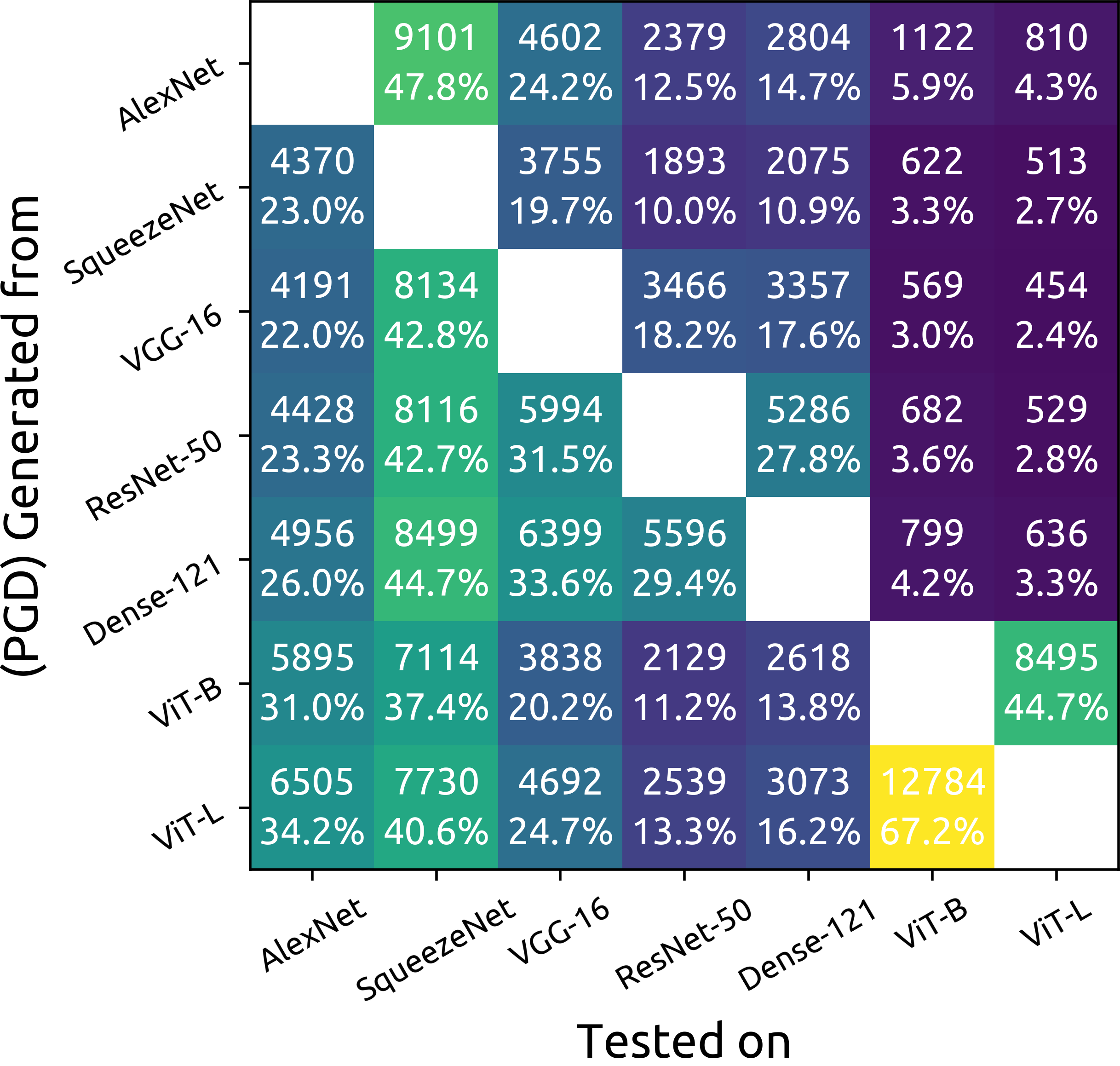
Model-to-model transferability matrix

Model-to-model transferability matrix can be generated with the usage of vis_m2m_transferability.py. This visualization has two modes, an overview one where only the transfer success percentage is shown and a detailed view where both the absolute amount and the percentage is shown. The visualization for this experiment is given below:
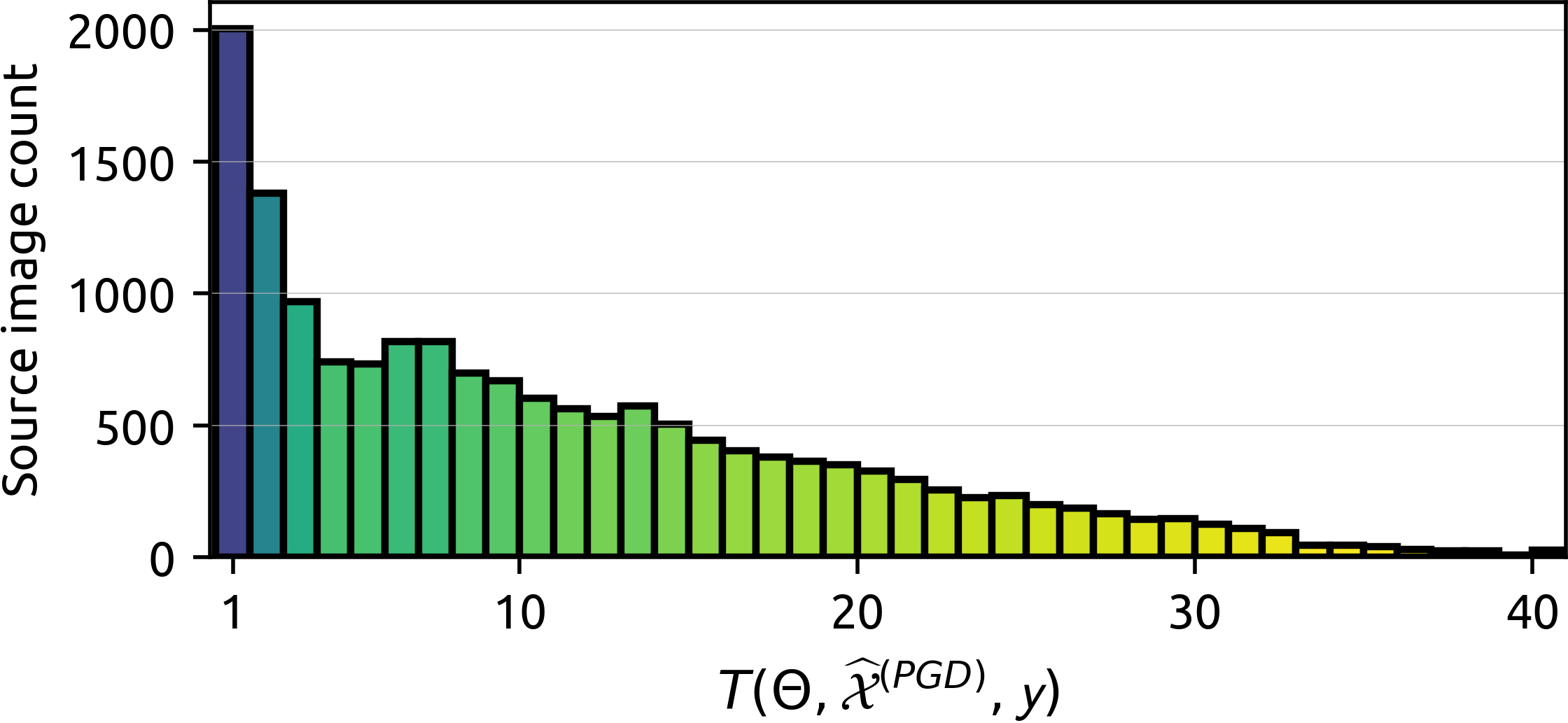
Source image transferability count

In the paper [1], we counted the model-to-model transferability of adversarial examples as they are generated from source images. This experiment can be reproduced with vis_transferability_cnt.py. The visualization for this experiment is given below:
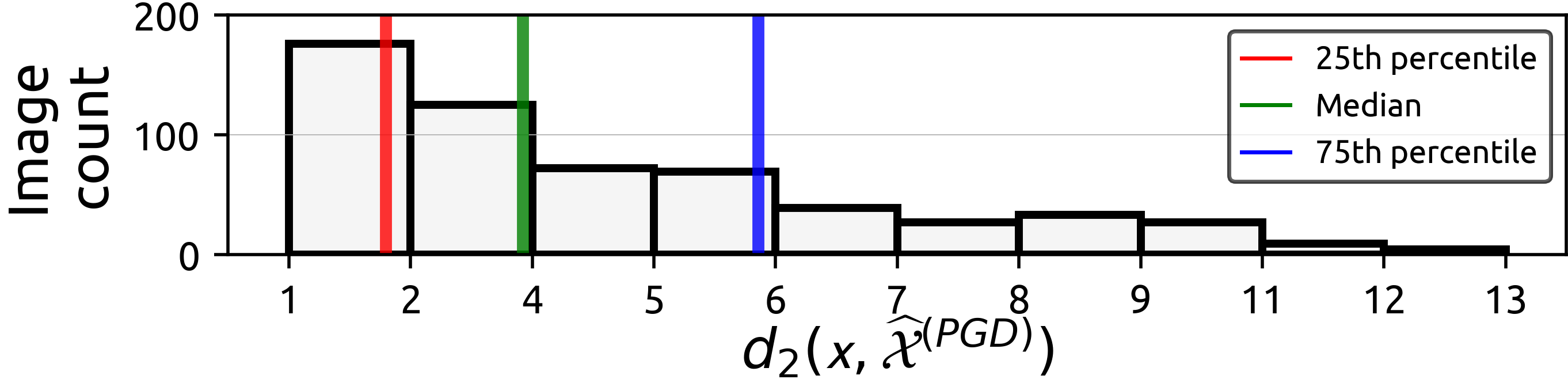
Perturbation distribution

In the paper [1], we counted the model-to-model transferability of adversarial examples as they are generated from source images. This experiment can be reproduced with vis_transferability_cnt.py. The visualization for this experiment is given below:
Untargeted misclassification for adversarial examples

Paper [2] TLDR: Adversarial examples that achieve untargeted model-to-model transferability are often misclassified into categories that are similar to the category of their origin.
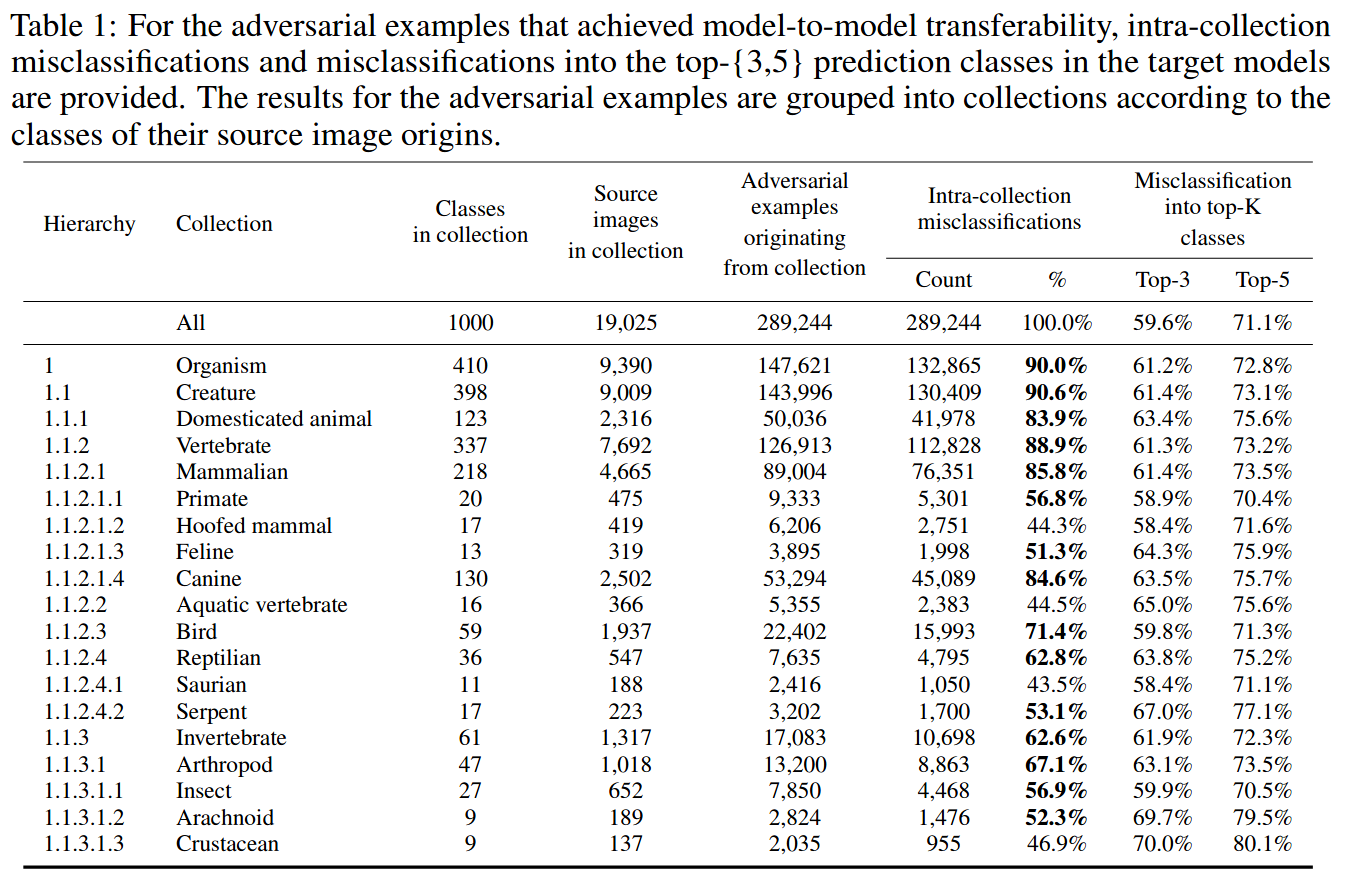
We share the imagenet hierarchy used in the paper in the dictionary format in imagenet_hier.py.

Citation

If you find the code in this repository useful for your research, consider citing our paper. Also, feel free to use any visuals available here.

@inproceedings{ozbulak2021selection,
    title={Selection of Source Images Heavily Influences the Effectiveness of Adversarial Attacks},
    author={Ozbulak, Utku and Timothy Anzaku, Esla and De Neve, Wesley and Van Messem, Arnout},
    booktitle={British Machine vision Conference (BMVC)},
    year={2021}
}

@inproceedings{ozbulak2021evaluating,
  title={Evaluating Adversarial Attacks on ImageNet: A Reality Check on Misclassification Classes},
  author={Ozbulak, Utku and Pintor, Maura and Van Messem, Arnout and De Neve, Wesley},
  booktitle={NeurIPS 2021 Workshop on ImageNet: Past, Present, and Future},
  year={2021}
}

Requirements

python > 3.5
torch >= 0.4.0
torchvision >= 0.1.9
numpy >= 1.13.0
PIL >= 1.1.7
Owner
Utku Ozbulak
Fourth-year doctoral student at Ghent University. Located in Ghent University Global Campus, South Korea.
Utku Ozbulak
SPLADE: Sparse Lexical and Expansion Model for First Stage Ranking

SPLADE 🍴 + 🥄 = 🔎 This repository contains the weights for four models as well as the code for running inference for our two papers: [v1]: SPLADE: S

NAVER 170 Dec 28, 2022
Official PyTorch implementation of MX-Font (Multiple Heads are Better than One: Few-shot Font Generation with Multiple Localized Experts)

Introduction Pytorch implementation of Multiple Heads are Better than One: Few-shot Font Generation with Multiple Localized Expert. | paper Song Park1

Clova AI Research 97 Dec 23, 2022
Label-Free Model Evaluation with Semi-Structured Dataset Representations

Label-Free Model Evaluation with Semi-Structured Dataset Representations Prerequisites This code uses the following libraries Python 3.7 NumPy PyTorch

8 Oct 06, 2022
YOLOX + ROS(1, 2) object detection package

YOLOX + ROS(1, 2) object detection package

Ar-Ray 158 Dec 21, 2022
A PyTorch implementation of the architecture of Mask RCNN

EDIT (AS OF 4th NOVEMBER 2019): This implementation has multiple errors and as of the date 4th, November 2019 is insufficient to be utilized as a reso

Sai Himal Allu 975 Dec 30, 2022
Hierarchical probabilistic 3D U-Net, with attention mechanisms (—𝘈𝘵𝘵𝘦𝘯𝘵𝘪𝘰𝘯 𝘜-𝘕𝘦𝘵, 𝘚𝘌𝘙𝘦𝘴𝘕𝘦𝘵) and a nested decoder structure with deep supervision (—𝘜𝘕𝘦𝘵++).

Hierarchical probabilistic 3D U-Net, with attention mechanisms (—𝘈𝘵𝘵𝘦𝘯𝘵𝘪𝘰𝘯 𝘜-𝘕𝘦𝘵, 𝘚𝘌𝘙𝘦𝘴𝘕𝘦𝘵) and a nested decoder structure with deep supervision (—𝘜𝘕𝘦𝘵++). Built in TensorFlow 2.5. Configured for vox

Diagnostic Image Analysis Group 32 Dec 08, 2022
[CVPR 2022] Deep Equilibrium Optical Flow Estimation

Deep Equilibrium Optical Flow Estimation This is the official repo for the paper Deep Equilibrium Optical Flow Estimation (CVPR 2022), by Shaojie Bai*

CMU Locus Lab 136 Dec 18, 2022
The official start-up code for paper "FFA-IR: Towards an Explainable and Reliable Medical Report Generation Benchmark."

FFA-IR The official start-up code for paper "FFA-IR: Towards an Explainable and Reliable Medical Report Generation Benchmark." The framework is inheri

Mingjie 28 Dec 16, 2022
Image Lowpoly based on Centroid Voronoi Diagram via python-opencv and taichi

CVTLowpoly: Image Lowpoly via Centroid Voronoi Diagram Image Sharp Feature Extraction using Guide Filter's Local Linear Theory via opencv-python. The

Pupa 4 Jul 29, 2022
[NeurIPS 2021] Garment4D: Garment Reconstruction from Point Cloud Sequences

Garment4D [PDF] | [OpenReview] | [Project Page] Overview This is the codebase for our NeurIPS 2021 paper Garment4D: Garment Reconstruction from Point

Fangzhou Hong 112 Dec 23, 2022
Code Impementation for "Mold into a Graph: Efficient Bayesian Optimization over Mixed Spaces"

Code Impementation for "Mold into a Graph: Efficient Bayesian Optimization over Mixed Spaces" This repo contains the implementation of GEBO algorithm.

Jaeyeon Ahn 2 Mar 22, 2022
Reference code for the paper CAMS: Color-Aware Multi-Style Transfer.

CAMS: Color-Aware Multi-Style Transfer Mahmoud Afifi1, Abdullah Abuolaim*1, Mostafa Hussien*2, Marcus A. Brubaker1, Michael S. Brown1 1York University

Mahmoud Afifi 36 Dec 04, 2022
The World of an Octopus: How Reporting Bias Influences a Language Model's Perception of Color

The World of an Octopus: How Reporting Bias Influences a Language Model's Perception of Color Overview Code and dataset for The World of an Octopus: H

1 Nov 13, 2021
Code for the paper "M2m: Imbalanced Classification via Major-to-minor Translation" (CVPR 2020)

M2m: Imbalanced Classification via Major-to-minor Translation This repository contains code for the paper "M2m: Imbalanced Classification via Major-to

79 Oct 13, 2022
MMdnn is a set of tools to help users inter-operate among different deep learning frameworks. E.g. model conversion and visualization. Convert models between Caffe, Keras, MXNet, Tensorflow, CNTK, PyTorch Onnx and CoreML.

MMdnn MMdnn is a comprehensive and cross-framework tool to convert, visualize and diagnose deep learning (DL) models. The "MM" stands for model manage

Microsoft 5.7k Jan 09, 2023
Diffusion Probabilistic Models for 3D Point Cloud Generation (CVPR 2021)

Diffusion Probabilistic Models for 3D Point Cloud Generation [Paper] [Code] The official code repository for our CVPR 2021 paper "Diffusion Probabilis

Shitong Luo 323 Jan 05, 2023
On-device speech-to-intent engine powered by deep learning

Rhino Made in Vancouver, Canada by Picovoice Rhino is Picovoice's Speech-to-Intent engine. It directly infers intent from spoken commands within a giv

Picovoice 510 Dec 30, 2022
Trajectory Prediction with Graph-based Dual-scale Context Fusion

DSP: Trajectory Prediction with Graph-based Dual-scale Context Fusion Introduction This is the project page of the paper Lu Zhang, Peiliang Li, Jing C

HKUST Aerial Robotics Group 103 Jan 04, 2023
Official implementation of VQ-Diffusion

Official implementation of VQ-Diffusion: Vector Quantized Diffusion Model for Text-to-Image Synthesis

Microsoft 592 Jan 03, 2023
My usage of Real-ESRGAN to upscale anime, some test and results in the test_img folder

anime upscaler My usage of Real-ESRGAN to upscale anime, I hope to use this on a proper GPU cuz doing this on CPU is completely shit 😂 , I even tried

Shangar Muhunthan 29 Jan 07, 2023