Latest news:
RADIal is available now! Check the download section. However, because we are currently working on the data anonymization, we provide for now a low resolution preview video stream. The full resolution will be provided once the anonymization is completed, planned by 2022, February.
RADIal dataset
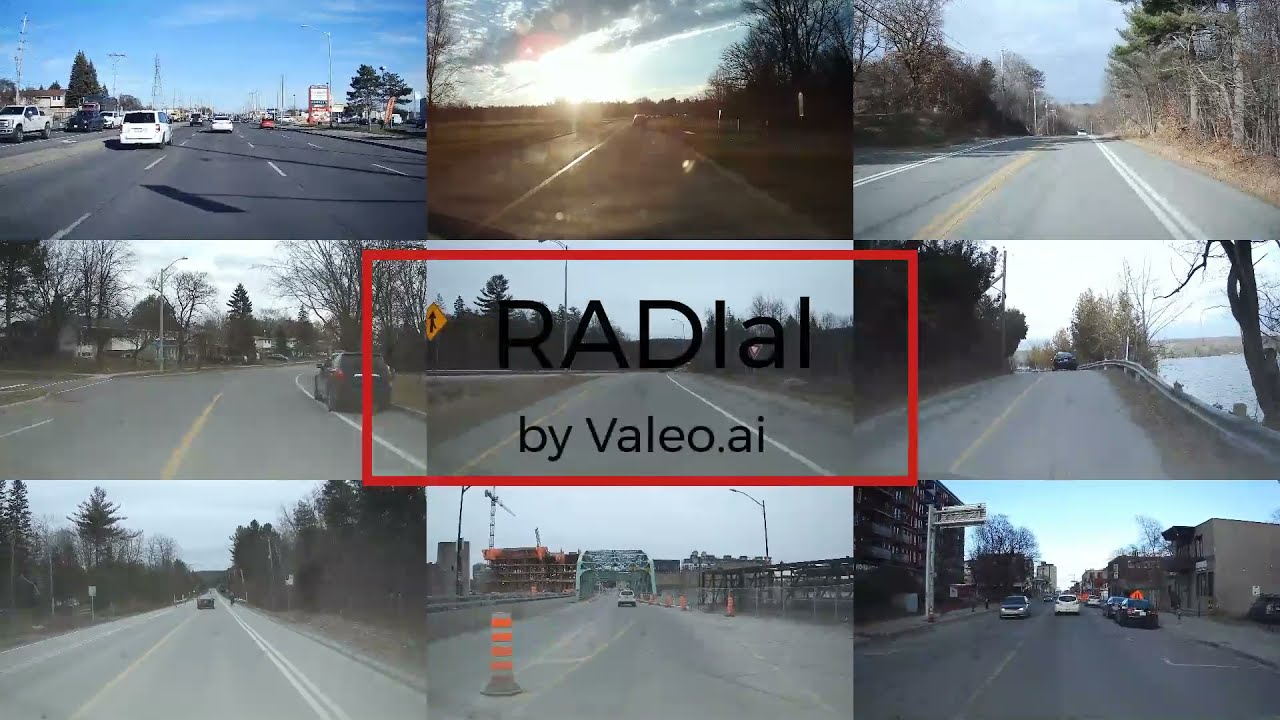
RADIal stands for “Radar, Lidar et al.” It's a collection of 2-hour of raw data from synchronized automotive-grade sensors (camera, laser, High Definition radar) in various environments (citystreet, highway, countryside road) and comes with GPS and vehicle’s CAN traces.
RADIal contains 91 sequences of 1 to 4 minutes in duration, for a total of 2 hours. These sequences are categorized in highway, country-side and city driving. The distribution of the sequences is indicated in the figure below. Each sequence contains raw sensor signals recorded with their native frame rate. There are approximately 25,000 frames with the three sensors synchronized, out of which 8,252 are labelled with a total of 9,550 vehicles.

Sensor specifications

Central to the RADIal dataset, our high-definition radar is composed of NRx=16 receiving antennas and NTx= 12 transmitting antennas, leading to NRx·NTx= 192 virtual antennas. This virtual-antenna array enables reaching a high azimuth angular resolution while estimating objects’ elevation angles as well. As the radar signal is difficult to interpret by annotators and practitioners alike, a 16-layer automotive-grade laser scanner (LiDAR) and a 5 Mpix RGB camera are also provided. The camera is placed below the interior mirror behind the windshield while the radar and the LiDAR are installed in the middle of the front ventilation grid, one above the other. The three sensors have parallel horizontallines of sight, pointing in the driving direction. Their extrinsic parameters are provided together with the dataset. RADIal also offers synchronized GPS and CAN traces which give access to the geo-referenced position of the vehicle as well as its driving information such as speed, steering wheelangle and yaw rate. The sensors’ specifications are detailed in the table below.

Dataset structure
RADIal is a unique folder containing all the recorded sequences. Each sequence is a folder containing:
- A preview video of the scene (low resolution);
- The camera data compressed in MJPEG format (will be released by 2022, February);
- The Laser Scanner point cloud data saved in a binary file;
- The ADC radar data saved in a binary file. There are 4 files in total, one file for each radar chip, each chip containing 4 Rx antennas;
- The GPS data saved in ASCII format
- The CAN traces of the vehicle saved in binary format
- And finally, a log file that provides the timestamp of each individual sensor event.
We provide in a Python library DBReader to read the data. Because all the radar data are recorded in a RAW format, that is to say the signal after the Analog to Digital Conversion (ADC), we provided too an optimized Python library SignalProcessing to process the Radar signal and generate either the Power Spectrums, the Point Cloud or the Range-Azimuth map.
Labels
Out of the 25,000 synchronized frames, 8,252 frames are labelled. Labels for vehicles are stored in a separated csv file. Each label containg the following information:
- numSample: number of the current synchronized sample between all the sensors. That is to say, this label can be projected in each individual sensor with a common dataset_index value. Note that there might be more than one line with the same numSample, one line per label;
- [x1_pix, y1_pix, x2_pix, y2_pix]: 2D coordinates of the vehicle' bouding boxes in the camera coordinates;
- [laser_X_m, laser_Y_m, laser_Z_m]: 3D coordinates of the vehicle in the laser scanner coordinates system. Note that this 3D point is the middle of either the back or front visible face of the vehicle;
- [radar_X_m, radar_Y_m, radar_R_m, radar_A_deg, radar_D, radar_P_db]: 2D coordinates (bird' eyes view) of the vehicle in the radar coordinates system either in cartesian (X,Y) or polar (R,A) coordinates. radar_D is the Doppler value and radar_P_db is the power of the reflected signal;
- dataset: name of sequence it belongs to;
- dataset_index: frame index in the current sequence;
- Difficult: either 0 or 1
Note that -1 in all field means a frame without any label.
Labels for the Free-driving-space is provided as a segmentaion mask saved in a png file.
Download instructions
To download the raw dataset, please follow these instructions.
$ wget -c -i download_urls.txt -P your_target_path
$ unzip 'your_target_path/*.zip' -d your_target_path
$ rm -Rf your_target_path/*.zip
You will have then to use the SignalProcessing library to generate data for each modalities uppon your need.
We provide too a "ready to use" dataset that can be loaded with the PyTorch data loader example provided in the Loader folder.
$ wget https://www.dropbox.com/s/bvbndch5rucyp97/RADIal.zip

 21 Nov 28, 2022
 4 May 26, 2022
 9 Jul 30, 2022
 3 Jul 14, 2021
 34 Nov 15, 2022
 1 Jan 23, 2022
 36 Feb 17, 2022
 35 Oct 19, 2022
 347 Nov 14, 2022
 3 Jan 29, 2022
 44 Nov 29, 2022
 89 Jan 04, 2023
 375 Dec 06, 2022
 55 Jun 18, 2022
 87 Dec 27, 2022
 4 Jul 15, 2022
 29 Dec 11, 2022
 173 Dec 30, 2022
 284 Dec 27, 2022