SphereFace: Deep Hypersphere Embedding for Face Recognition
By Weiyang Liu, Yandong Wen, Zhiding Yu, Ming Li, Bhiksha Raj and Le Song
License
SphereFace is released under the MIT License (refer to the LICENSE file for details).
Update
-
2018.8.14: We recommand an interesting ECCV 2018 paper that comprehensively evaluates SphereFace (A-Softmax) on current widely used face datasets and their proposed noise-controlled IMDb-Face dataset. Interested users can try to train SphereFace on their IMDb-Face dataset. Take a look here.
-
2018.5.23: A new SphereFace+ that explicitly enhances the inter-class separability has been introduced in our technical report. Check it out here. Code is released here.
-
2018.2.1: As requested, the prototxt files for SphereFace-64 are released.
-
2018.1.27: We updated the appendix of our SphereFace paper with useful experiments and analysis. Take a look here. The content contains:
- The intuition of removing the last ReLU;
- Why do we want to normalize the weights other than because we need more geometric interpretation?
- Empirical experiment of zeroing out the biases;
- More 2D visualization of A-Softmax loss on MNIST;
- Angular Fisher score for evaluating the angular feature discriminativeness, which is a new and straightforward evluation metric other than the final accuracy.
- Experiments of SphereFace on MegaFace with different convolutional layers;
- The annealing optimization strategy for A-Softmax loss;
- Details of the 3-patch ensemble strategy in MegaFace challenge;
-
2018.1.20: We updated some resources to summarize the current advances in angular margin learning. Take a look here.
Contents
- Introduction
- Citation
- Requirements
- Installation
- Usage
- Models
- Results
- Video Demo
- Note
- Third-party re-implementation
- Resources for angular margin learning
Introduction
The repository contains the entire pipeline (including all the preprocessings) for deep face recognition with SphereFace. The recognition pipeline contains three major steps: face detection, face alignment and face recognition.
SphereFace is a recently proposed face recognition method. It was initially described in an arXiv technical report and then published in CVPR 2017. The most up-to-date paper with more experiments can be found at arXiv or here. To facilitate the face recognition research, we give an example of training on CAISA-WebFace and testing on LFW using the 20-layer CNN architecture described in the paper (i.e. SphereFace-20).
In SphereFace, our network architecures use residual units as building blocks, but are quite different from the standrad ResNets (e.g., BatchNorm is not used, the prelu replaces the relu, different initializations, etc). We proposed 4-layer, 20-layer, 36-layer and 64-layer architectures for face recognition (details can be found in the paper and prototxt files). We provided the 20-layer architecure as an example here. If our proposed architectures also help your research, please consider to cite our paper.
SphereFace achieves the state-of-the-art verification performance (previously No.1) in MegaFace Challenge under the small training set protocol.
Citation
If you find SphereFace useful in your research, please consider to cite:
@InProceedings{Liu_2017_CVPR,
  title = {SphereFace: Deep Hypersphere Embedding for Face Recognition},
  author = {Liu, Weiyang and Wen, Yandong and Yu, Zhiding and Li, Ming and Raj, Bhiksha and Song, Le},
  booktitle = {The IEEE Conference on Computer Vision and Pattern Recognition (CVPR)},
  year = {2017}
}
Our another closely-related previous work in ICML'16 (more):
@InProceedings{Liu_2016_ICML,
  title = {Large-Margin Softmax Loss for Convolutional Neural Networks},
  author = {Liu, Weiyang and Wen, Yandong and Yu, Zhiding and Yang, Meng},
  booktitle = {Proceedings of The 33rd International Conference on Machine Learning},
  year = {2016}
}
Requirements
- Requirements for
Matlab - Requirements for
Caffeandmatcaffe(see: Caffe installation instructions) - Requirements for
MTCNN(see: MTCNN - face detection & alignment) andPdollar toolbox(see: Piotr's Image & Video Matlab Toolbox).
Installation
-
Clone the SphereFace repository. We'll call the directory that you cloned SphereFace as
SPHEREFACE_ROOT.git clone --recursive https://github.com/wy1iu/sphereface.git
-
Build Caffe and matcaffe
cd $SPHEREFACE_ROOT/tools/caffe-sphereface
# Now follow the Caffe installation instructions here:
# http://caffe.berkeleyvision.org/installation.html
make all -j8 && make matcaffe
Usage
After successfully completing the installation, you are ready to run all the following experiments.
Part 1: Preprocessing
Note: In this part, we assume you are in the directory $SPHEREFACE_ROOT/preprocess/
-
Download the training set (
CASIA-WebFace) and test set (LFW) and place them indata/.mv /your_path/CASIA_WebFace data/ ./code/get_lfw.sh tar xvf data/lfw.tgz -C data/
Please make sure that the directory of
data/contains two datasets. -
Detect faces and facial landmarks in CAISA-WebFace and LFW datasets using
MTCNN(see: MTCNN - face detection & alignment).# In Matlab Command Window run code/face_detect_demo.m
This will create a file
dataList.matin the directory ofresult/. -
Align faces to a canonical pose using similarity transformation.
# In Matlab Command Window
run code/face_align_demo.m
This will create two folders (
CASIA-WebFace-112X96/andlfw-112X96/) in the directory ofresult/, containing the aligned face images.
Part 2: Train
Note: In this part, we assume you are in the directory $SPHEREFACE_ROOT/train/
-
Get a list of training images and labels.
mv ../preprocess/result/CASIA-WebFace-112X96 data/
# In Matlab Command Window
run code/get_list.m
The aligned face images in folder
CASIA-WebFace-112X96/are moved from preprocess folder to train folder. A listCASIA-WebFace-112X96.txtis created in the directory ofdata/for the subsequent training. -
Train the sphereface model.
./code/sphereface_train.sh 0,1
After training, a model
sphereface_model_iter_28000.caffemodeland a corresponding log filesphereface_train.logare placed in the directory ofresult/sphereface/.
Part 3: Test
Note: In this part, we assume you are in the directory $SPHEREFACE_ROOT/test/
-
Get the pair list of LFW (view 2).
mv ../preprocess/result/lfw-112X96 data/
./code/get_pairs.sh
Make sure that the LFW dataset and
pairs.txtin the directory ofdata/ -
Extract deep features and test on LFW.
# In Matlab Command Window
run code/evaluation.m
Finally we have the
sphereface_model.caffemodel, extracted featurespairs.matin folderresult/, and accuracy on LFW like this:fold 1 2 3 4 5 6 7 8 9 10 AVE ACC 99.33% 99.17% 98.83% 99.50% 99.17% 99.83% 99.17% 98.83% 99.83% 99.33% 99.30%
Models
- Visualizations of network architecture (tools from ethereon):
- SphereFace-20: link
- Model file
- SphereFace-20: Google Drive | Baidu
- Third-party SphereFace-4 & SphereFace-6: here by zuoqing1988
Results
-
Following the instruction, we go through the entire pipeline for 5 times. The accuracies on LFW are shown below. Generally, we report the average but we release the model-3 here.
Experiment #1 #2 #3 (released) #4 #5 ACC 99.24% 99.20% 99.30% 99.27% 99.13% -
Other intermediate results:
- LFW features: Google Drive | Baidu
- Training log: Google Drive | Baidu
Video Demo
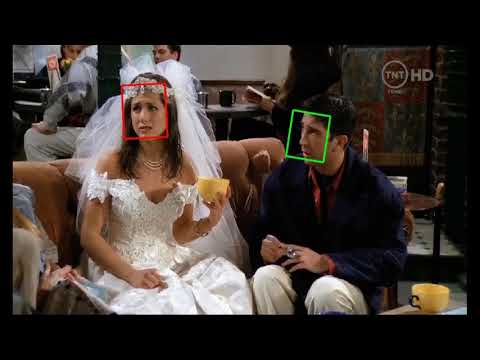
Please click the image to watch the Youtube video. For Youku users, click here.
Details:
- It is an open-set face recognition scenario. The video is processed frame by frame, following the same pipeline in this repository.
- Gallery set consists of 6 identities. Each main character has only 1 gallery face image. All the detected faces are included in probe set.
- There is no overlap between gallery set and training set (CASIA-WebFace).
- The scores between each probe face and gallery set are computed by cosine similarity. If the maximal score of a probe face is smaller than a pre-definded threshold, the probe face would be considered as an outlier.
- Main characters are labeled by boxes with different colors. (
Rachel,
Monica,
Phoebe,
Joey,
Chandler,
Ross)
Note
-
Backward gradient
- In this implementation, we did not strictly follow the equations in paper. Instead, we normalize the scale of gradient. It can be interpreted as a varying strategy for learning rate to help converge more stably. Similar idea and intuition also appear in normalized gradients and projected gradient descent.
- More specifically, if the original gradient of f w.r.t x can be written as df/dx = coeff_w * w + coeff_x * x, we use the normalized version [df/dx] = (coeff_w * w + coeff_x * x) / norm_wx to perform backward propragation, where norm_wx is sqrt(coeff_w^2 + coeff_x^2). The same operation is also applied to the gradient of f w.r.t w.
- In fact, you do not necessarily need to use the original gradient, since the original gradient sometimes is not an optimal design. One important criterion for modifying the backprop gradient is that the new "gradient" (strictly speaking, it is not a gradient anymore) need to make the objective value decrease stably and consistently. (In terms of some failure cases for gradient-based back-prop, I recommand a great talk by Shai Shalev-Shwartz)
- If you use the original gradient to do the backprop, you could still make it work but may need different lambda settings, iteration number and learning rate decay strategy.
-
Lambda and Note for training (When the loss becomes 87)
- Please refer to our previous note and explanation.
-
According to recent advances, using feature normalization with a tunable scaling parameter s can significantly improve the performance of SphereFace on MegaFace challenge
- This is supported by the experiments done by CosFace. Similar idea also appears in additive margin softmax.
-
Difficulties in convergence - When you encounter difficulties in convergence (it may appear if you use SphereFace in another dataset), usually there are a few easy ways to address it.
- First, try to use large mini-batch size.
- Second, try to use PReLU instead of ReLU.
- Third, increase the width and depth of our network.
- Fourth, try to use better initialization. For example, use the pretrained model from the original softmax loss (it is also equivalent to finetuning).
- Last and the most effective thing you could try is to change the hyper-parameters for lambda_min, lambda and its decay speed.
Third-party re-implementation
- PyTorch: code by clcarwin.
- PyTorch: code by Joyako.
- TensorFlow: code by pppoe.
- TensorFlow (with awesome animations): code by YunYang1994.
- TensorFlow: code by hujun100.
- TensorFlow: code by HiKapok.
- TensorFlow: code by andrewhuman.
- MXNet: code by deepinsight (by setting loss-type=1: SphereFace).
- Model compression for SphereFace: code by Siyang Liu (useful in practice)
- Caffe2: code by tpys.
- Trained on MS-1M: code by KaleidoZhouYN.
- System: A cool face demo system using SphereFace by tpys.
- Third-party pretrained models: code by goodluckcwl.
Resources for angular margin learning
L-Softmax loss and SphereFace present a promising framework for angular representation learning, which is shown very effective in deep face recognition. We are super excited that our works has inspired many well-performing methods (and loss functions). We list a few of them for your potential reference (not very up-to-date):
- Additive margin softmax: paper and code
- CosFace: paper
- ArcFace/InsightFace: paper and code
- NormFace: paper and code
- L2-Softmax: paper
- von Mises-Fisher Mixture Model: paper
- COCO loss: paper and code
- Angular Triplet Loss: code
To evaluate the effectiveness of the angular margin learning method, you may consider to use the angular Fisher score proposed in the Appendix E of our SphereFace Paper.
Disclaimer: Some of these methods may not necessarily be inspired by us, but we still list them due to its relevance and excellence.
Contact
Questions can also be left as issues in the repository. We will be happy to answer them.

 32 Nov 29, 2022
 38 Oct 20, 2022
 1 Jan 14, 2022
 647 Dec 27, 2022
 137 Dec 31, 2022
 160 Jan 04, 2023
 63 Dec 16, 2022
 146 Nov 29, 2022
 229 Dec 13, 2022
 236 Jan 01, 2023
 28 Dec 12, 2022
 2 Aug 11, 2022
 76 Dec 21, 2022
 18 Nov 12, 2022
 20 Dec 07, 2022
 58 Oct 26, 2022
 40 Aug 14, 2022
 123 Dec 28, 2022
 2.4k Dec 26, 2022
 7 Nov 09, 2022