Label-Efficient Semantic Segmentation with Diffusion Models
Official implementation of the paper Label-Efficient Semantic Segmentation with Diffusion Models
This code is based on datasetGAN and guided-diffusion.
Note: use --recurse-submodules when clone.
Overview
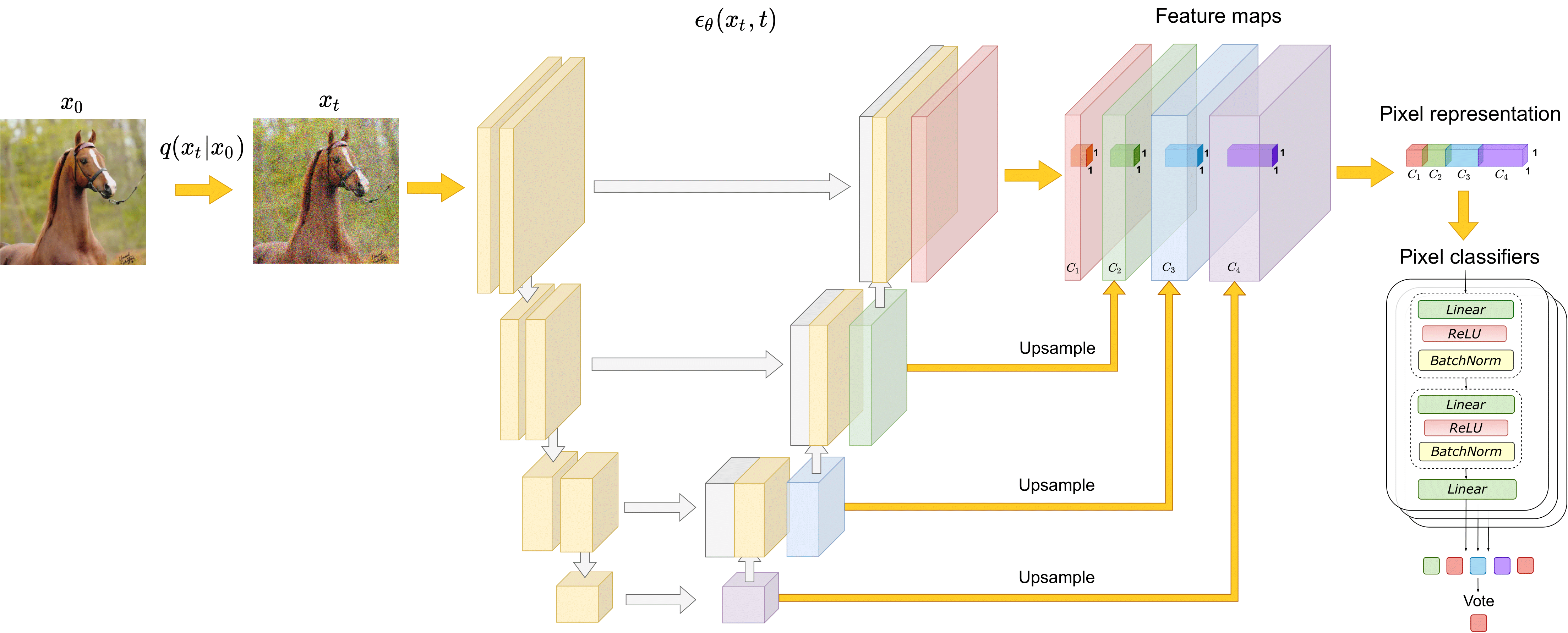
The paper investigates the representations learned by the state-of-the-art DDPMs and shows that they capture high-level semantic information valuable for downstream vision tasks. We design a simple segmentation approach that exploits these representations and outperforms the alternatives in the few-shot operating point in the context of semantic segmentation.
Dependencies
- Python >= 3.7
- Packages: see
requirements.txt
Datasets
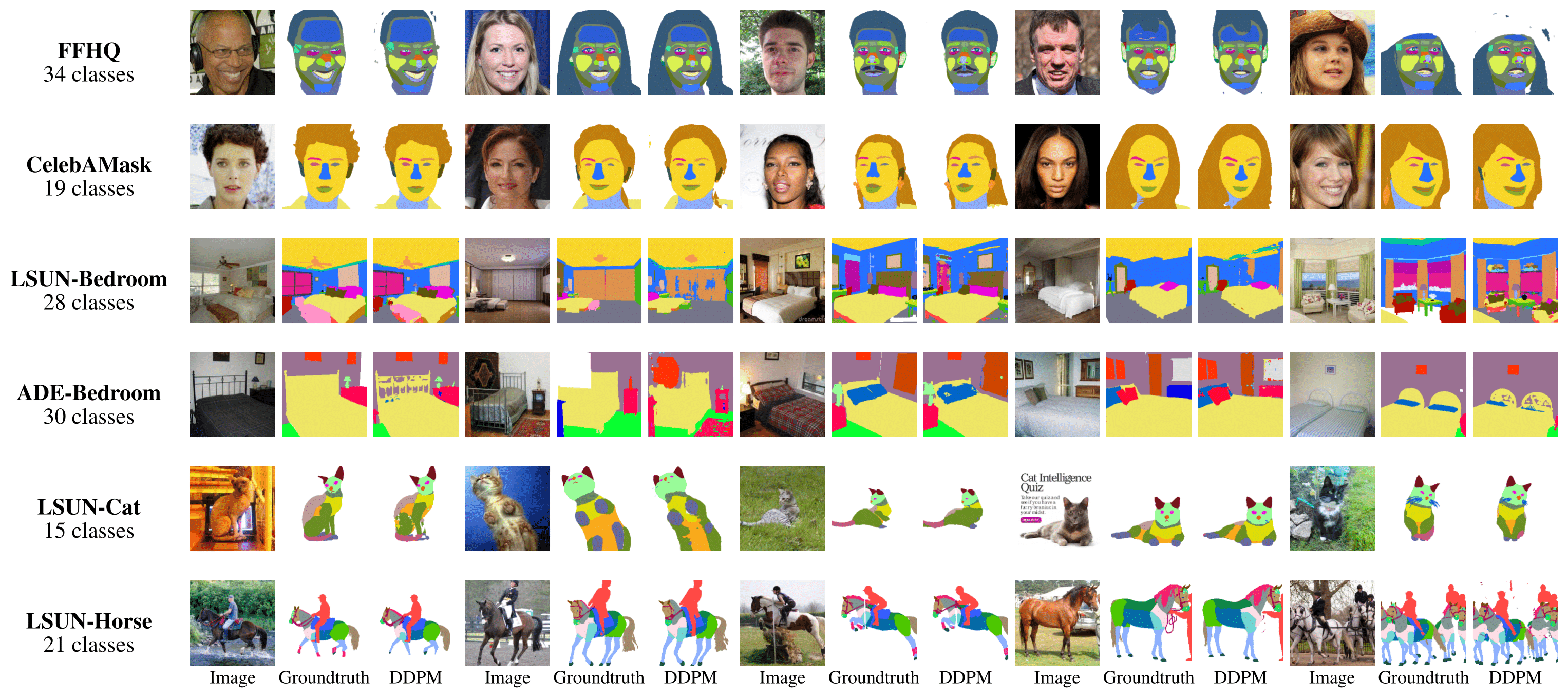
The evaluation is performed on 6 collected datasets with a few annotated images in the training set: Bedroom-18, FFHQ-34, Cat-15, Horse-21, CelebA-19 and ADE-Bedroom-30. The number corresponds to the number of semantic classes.
datasets.tar.gz (~47Mb)
DDPM
Pretrained DDPMs
The models trained on LSUN are adopted from guided-diffusion. FFHQ-256 is trained by ourselves using the same model parameters as for the LSUN models.
LSUN-Bedroom: lsun_bedroom.pt
FFHQ-256: ffhq.pt
LSUN-Cat: lsun_cat.pt
LSUN-Horse: lsun_horse.pt
Run
- Download the datasets:
bash datasets/download_datasets.sh - Download the DDPM checkpoint:
bash checkpoints/ddpm/download_checkpoint.sh - Check paths in
experiments//ddpm.json - Run:
bash scripts/ddpm/train_interpreter.sh
Available checkpoint names: lsun_bedroom, ffhq, lsun_cat, lsun_horse
Available dataset names: bedroom_28, ffhq_34, cat_15, horse_21, celeba_19, ade_bedroom_30
How to improve the performance
- Set input_activations=true in
experiments/./ddpm.json
In this case, the feature dimension is 18432. - Tune for a particular task what diffusion steps and UNet blocks to use.
DatasetDDPM
Synthetic datasets
To download DDPM-produced synthetic datasets (50000 samples, ~7Gb):
bash synthetic-datasets/gan/download_synthetic_dataset.sh
Run | Option #1
- Download the synthetic dataset:
bash synthetic-datasets/ddpm/download_synthetic_dataset.sh - Check paths in
experiments//datasetDDPM.json - Run:
bash scripts/datasetDDPM/train_deeplab.sh
Run | Option #2
-
Download the datasets:
bash datasets/download_datasets.sh -
Download the DDPM checkpoint:
bash checkpoints/ddpm/download_checkpoint.sh -
Check paths in
experiments//datasetDDPM.json -
Train an interpreter on a few DDPM-produced annotated samples:
bash scripts/datasetDDPM/train_interpreter.sh -
Generate a synthetic dataset:
bash scripts/datasetDDPM/generate_dataset.sh
Please specify the hyperparameters in this script for the available resources.
On 8xA100 80Gb, it takes about 12 hours to generate 10000 samples. -
Run:
bash scripts/datasetDDPM/train_deeplab.sh
One needs to specify the path to the generated data. See comments in the script.
Available checkpoint names: lsun_bedroom, ffhq, lsun_cat, lsun_horse
Available dataset names: bedroom_28, ffhq_34, cat_15, horse_21
SwAV
Pretrained SwAVs
We pretrain SwAV models using the official implementation on the LSUN and FFHQ-256 datasets:
LSUN-Bedroom: lsun_bedroom.pth
FFHQ-256: ffhq.pth
LSUN-Cat: lsun_cat.pth
LSUN-Horse: lsun_horse.pth
Training setup:
| Dataset | epochs | batch-size | multi-crop | num-prototypes |
|---|---|---|---|---|
| LSUN | 200 | 1792 | 2x256 + 6x10⁸ | 1000 |
| FFHQ-256 | 400 | 2048 | 2x224 + 6x96 | 200 |
Run
- Download the datasets:
bash datasets/download_datasets.sh - Download the SwAV checkpoint:
bash checkpoints/swav/download_checkpoint.sh - Check paths in
experiments//swav.json - Run:
bash scripts/swav/train_interpreter.sh
Available checkpoint names: lsun_bedroom, ffhq, lsun_cat, lsun_horse
Available dataset names: bedroom_28, ffhq_34, cat_15, horse_21, celeba_19, ade_bedroom_30
DatasetGAN
Opposed to the official implementation, more recent StyleGAN2(-ADA) models are used.
Synthetic datasets
To download GAN-produced synthetic datasets (50000 samples):
bash synthetic-datasets/gan/download_synthetic_dataset.sh
Run
Since we almost fully adopt the official implementation, we don't provide our reimplementation here. However, one can still reproduce our results:
- Download the synthetic dataset:
bash synthetic-datasets/gan/download_synthetic_dataset.sh - Change paths in
experiments//datasetDDPM.json - Change paths and run:
bash scripts/datasetDDPM/train_deeplab.sh
Available dataset names: bedroom_28, ffhq_34, cat_15, horse_21
Results
- Performance in terms of mean IoU:
| Method | Bedroom-28 | FFHQ-34 | Cat-15 | Horse-21 | CelebA-19 | ADE-Bedroom-30 |
|---|---|---|---|---|---|---|
| ALAE | 20.0 ± 1.0 | 48.1 ± 1.3 | -- | -- | 49.7 ± 0.7 | 15.0 ± 0.5 |
| VDVAE | -- | 57.3 ± 1.1 | -- | -- | 54.1 ± 1.0 | -- |
| GAN Inversion | 13.9 ± 0.6 | 51.7 ± 0.8 | 21.4 ± 1.7 | 17.7 ± 0.4 | 51.5 ± 2.3 | 11.1 ± 0.2 |
| GAN Encoder | 22.4 ± 1.6 | 53.9 ± 1.3 | 32.0 ± 1.8 | 26.7 ± 0.7 | 53.9 ± 0.8 | 15.7 ± 0.3 |
| SwAV | 41.0 ± 2.3 | 54.7 ± 1.4 | 44.1 ± 2.1 | 51.7 ± 0.5 | 53.2 ± 1.0 | 30.3 ± 1.5 |
| DatasetGAN | 31.3 ± 2.7 | 57.0 ± 1.0 | 36.5 ± 2.3 | 45.4 ± 1.4 | -- | -- |
| DatasetDDPM | 46.9 ± 2.8 | 56.0 ± 0.9 | 45.4 ± 2.8 | 60.4 ± 1.2 | -- | -- |
| DDPM | 46.1 ± 1.9 | 57.0 ± 1.4 | 52.3 ± 3.0 | 63.1 ± 0.9 | 57.0 ± 1.0 | 32.3 ± 1.5 |
- Examples of segmentation masks predicted by the DDPM-based method:
Cite
@misc{baranchuk2021labelefficient,
      title={Label-Efficient Semantic Segmentation with Diffusion Models},
      author={Dmitry Baranchuk and Ivan Rubachev and Andrey Voynov and Valentin Khrulkov and Artem Babenko},
      year={2021},
      eprint={2112.03126},
      archivePrefix={arXiv},
      primaryClass={cs.CV}
}

 232 Jan 04, 2023
 1.5k Jan 08, 2023
 8 Oct 06, 2022
 17 Aug 23, 2022
 1 Dec 26, 2021
 65 Dec 19, 2022
 6 Oct 17, 2022
 216 Jan 05, 2023
 83 Dec 23, 2022
 36 Dec 29, 2022
 3 Nov 15, 2022
 79 Nov 04, 2022
 7 Aug 24, 2022
 10 Oct 25, 2022
 15 Nov 08, 2022
 283 Dec 12, 2022
 1.1k Dec 23, 2022
 42 Nov 01, 2022
 23 Dec 02, 2022
 360 Dec 10, 2022