SAT: 2D Semantics Assisted Training for 3D Visual Grounding, ICCV 2021 (Oral)

Related tags

Deep LearningSAT
Overview

SAT: 2D Semantics Assisted Training for 3D Visual Grounding

SAT: 2D Semantics Assisted Training for 3D Visual Grounding

by Zhengyuan Yang, Songyang Zhang, Liwei Wang, and Jiebo Luo

IEEE International Conference on Computer Vision (ICCV), 2021, Oral

Introduction

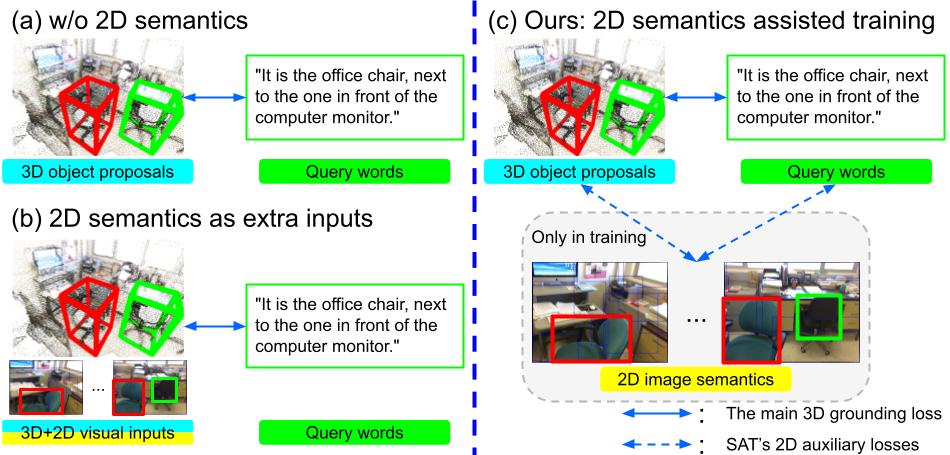
We propose 2D Semantics Assisted Training (SAT) that assists 3D visual grounding with 2D semantics. SAT helps 3D tasks with 2D semantics in training but does not require 2D inputs during inference. For more details, please refer to our paper.
Citation

@inproceedings{yang2021sat,
  title={SAT: 2D Semantics Assisted Training for 3D Visual Grounding},
  author={Yang, Zhengyuan and Zhang, Songyang and Wang, Liwei and Luo, Jiebo},
  booktitle={ICCV},
  year={2021}
}

Prerequisites

  • Python 3.6.9 (e.g., conda create -n sat_env python=3.6.9 cudatoolkit=10.0)
  • Pytorch 1.2.0 (e.g., conda install pytorch==1.2.0 cudatoolkit=10.0 -c pytorch)
  • Install other common packages (numpy, pytorch_transformers, etc.)
  • Please refer to setup.py (From ReferIt3D).

Installation

  • Clone the repository

    git clone https://github.com/zyang-ur/SAT.git
    cd SAT
    pip install -e .
    
  • To use a PointNet++ visual-encoder you need to compile its CUDA layers for PointNet++: Note: To do this compilation also need: gcc5.4 or later.

    cd external_tools/pointnet2
    python setup.py install
    

Data

ScanNet

First you should download the train/val scans of ScanNet if you do not have them locally. Please refer to the instructions from referit3d for more details. The output is the scanfile keep_all_points_00_view_with_global_scan_alignment.pkl/keep_all_points_with_global_scan_alignment.pkl.

Ref3D Linguistic Data

You can dowload the Nr3D and Sr3D/Sr3D+ from Referit3D, and send the file path to referit3D-file.

SAT Processed 2D Features

You can download the processed 2D object image features from here. The cached feature should be placed under the referit3d/data folder, or match the cache path in the dataloader. The feature extraction code will be cleaned and released in the future. Meanwhile, feel free to contact me if you need that before the official release.

Training

Please reference the following example command on Nr3D. Feel free to change the parameters. Please reference arguments for valid options.

cd referit3d/scripts
scanfile=keep_all_points_00_view_with_global_scan_alignment.pkl ## keep_all_points_with_global_scan_alignment if include Sr3D
python train_referit3d.py --patience 100 --max-train-epochs 100 --init-lr 1e-4 --batch-size 16 --transformer --model mmt_referIt3DNet -scannet-file $scanfile -referit3D-file $nr3dfile_csv --log-dir log/$exp_id --n-workers 2 --gpu 0 --unit-sphere-norm True --feat2d clsvecROI --context_2d unaligned --mmt_mask train2d --warmup

Evaluation

Please find the pretrained models here (clsvecROI on Nr3D). A known issue here.

cd referit3d/scripts
python train_referit3d.py --transformer --model mmt_referIt3DNet -scannet-file $scanfile -referit3D-file $nr3dfile --log-dir log/$exp_id --n-workers 2 --gpu $gpu --unit-sphere-norm True --feat2d clsvecROI --mode evaluate --pretrain-path $pretrain_path/best_model.pth

Credits

The project is built based on the following repository:

Part of the code or models are from ScanRef, MMF, TAP, and ViLBERT.

Owner
Zhengyuan Yang
Zhengyuan Yang
G-NIA model from "Single Node Injection Attack against Graph Neural Networks" (CIKM 2021)

Single Node Injection Attack against Graph Neural Networks This repository is our Pytorch implementation of our paper: Single Node Injection Attack ag

Shuchang Tao 18 Nov 21, 2022
Public implementation of the Convolutional Motif Kernel Network (CMKN) architecture

CMKN Implementation of the convolutional motif kernel network (CMKN) introduced in Ditz et al., "Convolutional Motif Kernel Network", 2021. Testing Yo

1 Nov 17, 2021
Semantic Segmentation Architectures Implemented in PyTorch

pytorch-semseg Semantic Segmentation Algorithms Implemented in PyTorch This repository aims at mirroring popular semantic segmentation architectures i

Meet Shah 3.3k Dec 29, 2022
Code for "Reconstructing 3D Human Pose by Watching Humans in the Mirror", CVPR 2021 oral

Reconstructing 3D Human Pose by Watching Humans in the Mirror Qi Fang*, Qing Shuai*, Junting Dong, Hujun Bao, Xiaowei Zhou CVPR 2021 Oral The videos a

ZJU3DV 178 Dec 13, 2022
(AAAI2020)Grapy-ML: Graph Pyramid Mutual Learning for Cross-dataset Human Parsing

Grapy-ML: Graph Pyramid Mutual Learning for Cross-dataset Human Parsing This repository contains pytorch source code for AAAI2020 oral paper: Grapy-ML

54 Aug 04, 2022
ICRA 2021 - Robust Place Recognition using an Imaging Lidar

Robust Place Recognition using an Imaging Lidar A place recognition package using high-resolution imaging lidar. For best performance, a lidar equippe

Tixiao Shan 293 Dec 27, 2022
As-ViT: Auto-scaling Vision Transformers without Training

As-ViT: Auto-scaling Vision Transformers without Training [PDF] Wuyang Chen, Wei Huang, Xianzhi Du, Xiaodan Song, Zhangyang Wang, Denny Zhou In ICLR 2

VITA 68 Sep 05, 2022
A PyTorch implementation of "Semi-Supervised Graph Classification: A Hierarchical Graph Perspective" (WWW 2019)

SEAL ⠀⠀⠀ A PyTorch implementation of Semi-Supervised Graph Classification: A Hierarchical Graph Perspective (WWW 2019) Abstract Node classification an

Benedek Rozemberczki 202 Dec 27, 2022
Individual Treatment Effect Estimation

CAPE Individual Treatment Effect Estimation Run CAPE python train_causal.py --loop 10 -m cape_cau -d NI --i_t 1 Run a baseline model python train_cau

S. Deng 4 Sep 02, 2022
A playable implementation of Fully Convolutional Networks with Keras.

keras-fcn A re-implementation of Fully Convolutional Networks with Keras Installation Dependencies keras tensorflow Install with pip $ pip install git

JihongJu 202 Sep 07, 2022
CAMPARI: Camera-Aware Decomposed Generative Neural Radiance Fields

CAMPARI: Camera-Aware Decomposed Generative Neural Radiance Fields Paper | Supplementary | Video | Poster If you find our code or paper useful, please

26 Nov 29, 2022
Parametric Contrastive Learning (ICCV2021)

Parametric-Contrastive-Learning This repository contains the implementation code for ICCV2021 paper: Parametric Contrastive Learning (https://arxiv.or

DV Lab 156 Dec 21, 2022
Extracts data from the database for a graph-node and stores it in parquet files

subgraph-extractor Extracts data from the database for a graph-node and stores it in parquet files Installation For developing, it's recommended to us

Cardstack 0 Jan 10, 2022
On the adaptation of recurrent neural networks for system identification

On the adaptation of recurrent neural networks for system identification This repository contains the Python code to reproduce the results of the pape

Marco Forgione 3 Jan 13, 2022
A scikit-learn-compatible module for estimating prediction intervals.

MAPIE - Model Agnostic Prediction Interval Estimator MAPIE allows you to easily estimate prediction intervals (or prediction sets) using your favourit

588 Jan 04, 2023
A Deep Reinforcement Learning Framework for Stock Market Trading

DQN-Trading This is a framework based on deep reinforcement learning for stock market trading. This project is the implementation code for the two pap

61 Jan 01, 2023
Python/Rust implementations and notes from Proofs Arguments and Zero Knowledge

What is this? This is where I'll be collecting resources related to the Study Group on Dr. Justin Thaler's Proofs Arguments And Zero Knowledge Book. T

Thor 66 Jan 04, 2023
CNN Based Meta-Learning for Noisy Image Classification and Template Matching

CNN Based Meta-Learning for Noisy Image Classification and Template Matching Introduction This master thesis used a few-shot meta learning approach to

Kumar Manas 2 Dec 09, 2021
This repository contains the source codes for the paper AtlasNet V2 - Learning Elementary Structures.

AtlasNet V2 - Learning Elementary Structures This work was build upon Thibault Groueix's AtlasNet and 3D-CODED projects. (you might want to have a loo

Théo Deprelle 123 Nov 11, 2022
Text-Based Ideal Points

Text-Based Ideal Points Source code for the paper: Text-Based Ideal Points by Keyon Vafa, Suresh Naidu, and David Blei (ACL 2020). Update (June 29, 20

Keyon Vafa 37 Oct 09, 2022