This code is a near-infrared spectrum modeling method based on PCA and pls

Overview

Nirs-Pls-Corn

This code is a near-infrared spectrum modeling method based on PCA and pls


近红外光谱分析技术属于交叉领域,需要化学、计算机科学、生物科学等多领域的合作。为此,在(北邮邮电大学杨辉华老师团队)指导下,近期准备开源传统的PLS,SVM,ANN,RF等经典算和SG,MSC,一阶导,二阶导等预处理以及GA等波长选择算法以及CNN、AE等最新深度学习算法,以帮助其他专业的更容易建立具有良好预测能力和鲁棒性的近红外光谱模型。代码仅供学术使用,如有问题,联系方式:QQ:1427950662,微信:Fu_siry

1.读取数据并显示光谱曲线

#载入数据
data_path = './/data//m5.csv' #数据
label_path = './/data//label.csv' #标签(反射率)

data = np.loadtxt(open(data_path, 'rb'), dtype=np.float64, delimiter=',', skiprows=0)
label = np.loadtxt(open(label_path, 'rb'), dtype=np.float64, delimiter=',', skiprows=0)

# 绘制原始后图片
plt.figure(500)
x_col = np.linspace(0,len(data[0,:]),len(data[0,:]))  #数组逆序
y_col = np.transpose(data)
plt.plot(x_col, y_col)
plt.xlabel("Wavenumber(nm)")
plt.ylabel("Absorbance")
plt.title("The spectrum of the corn dataset",fontweight= "semibold",fontsize='x-large')
plt.savefig('.//Result//MSC.png')
plt.show()
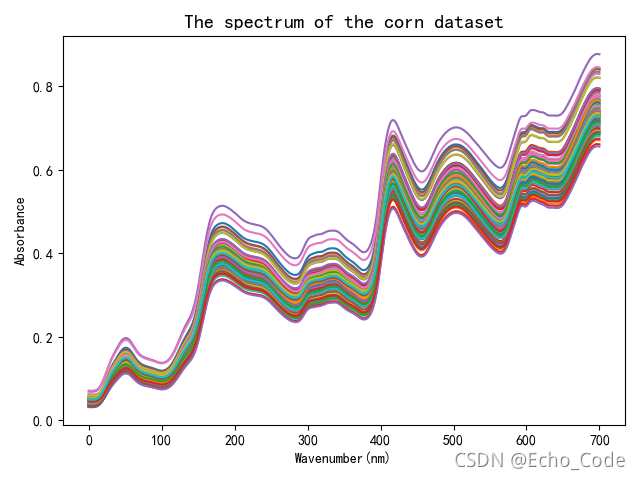
显示的光谱曲线

2.划分训练集和测试集

#随机划分数据集
x_data = np.array(data)
y_data = np.array(label[:,2])

test_ratio = 0.2
X_train,X_test,y_train,y_test = train_test_split(x_data,y_data,test_size=test_ratio,shuffle=True,random_state=2)

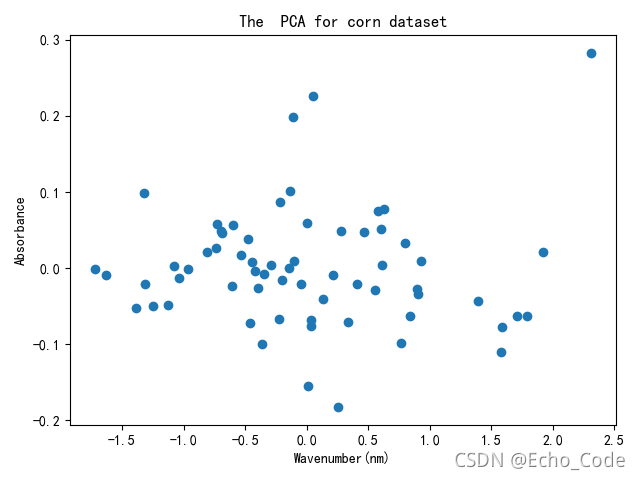
3.PCA降维并显示

#载入数据
#PCA降维到10个维度,测试该数据最好
pca=PCA(n_components=10)  #只保留2个特征
pca.fit(X_train)
X_train_reduction = pca.transform(X_train)
X_test_reduction = pca.transform(X_test)

# PCA降维后图片绘制
plt.figure(100)
plt.scatter(X_train_reduction[:, 0], X_train_reduction[:, 1],marker='o')
plt.xlabel("Wavenumber(nm)")
plt.ylabel("Absorbance")
plt.title("The  PCA for corn dataset",fontweight= "semibold",fontsize='large')
plt.savefig('.//Result//PCA.png')
plt.show()

PCA降维后的数据分布: PCA降维后的数据分布
4.建立校正模型(数据拟合)

#pls预测
pls2 = PLSRegression(n_components=3)
pls2.fit(X_train_reduction, y_train)

train_pred = pls2.predict(X_train_reduction)
pred = pls2.predict(X_test_reduction)

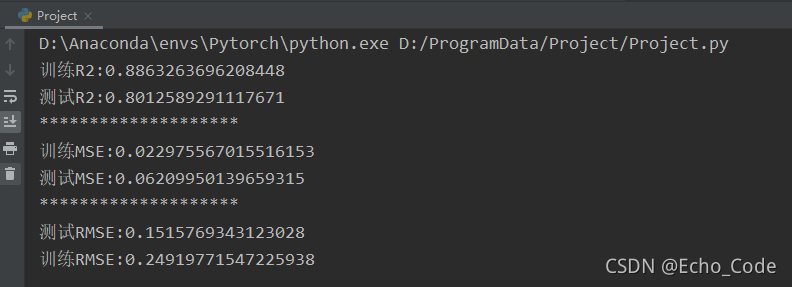
5.模型评估(使用R2、RMSE、MSE指标)

#计算R2
train_R2 = r2_score(train_pred,y_train)
R2 = r2_score(y_test,pred) #Y_true, Pred
print('训练R2:{}'.format(train_R2))
print('测试R2:{}'.format(R2))
#计算MSE
print('********************')
x_MSE = mean_squared_error(train_pred,y_train)
t_MSE = mean_squared_error(y_test,pred)
print('训练MSE:{}'.format(x_MSE))
print('测试MSE:{}'.format(t_MSE))

#计算RMSE
print('********************')
print('测试RMSE:{}'.format(sqrt(x_MSE)))
print('训练RMSE:{}'.format(sqrt(t_MSE)))

模型评估结果: 模型评估结果
6.绘制拟合差异曲线图

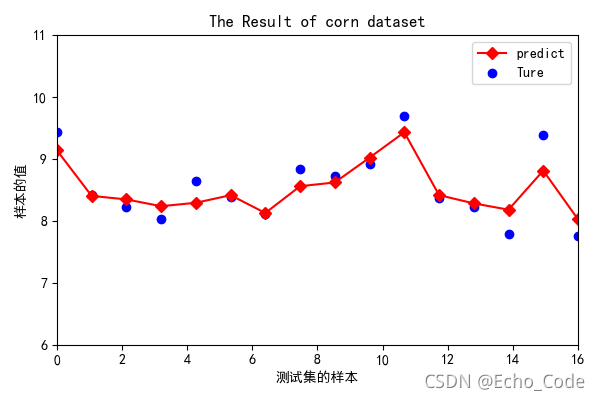
#绘制拟合图片
plt.figure(figsize=(6,4))
x_col = np.linspace(0,16,16)  #数组逆序
# y = [0,10,20,30,40,50,60,70,80]
# x_col = X_test
y_test = np.transpose(y_test)
ax = plt.gca()
ax.set_xlim(0,16)
ax.set_ylim(6,11)
# plt.yticks(y)
plt.scatter(x_col, y_test,label='Ture', color='blue')
plt.plot(x_col, pred,label='predict', marker='D',color='red')
plt.legend(loc='best')
plt.xlabel("测试集的样本")
plt.ylabel("样本的值")
plt.title("The Result of corn dataset",fontweight= "semibold",fontsize='large')
plt.savefig('.//Result//Reslut.png')
plt.show()

结果如图: 拟合差异曲线
Owner
Fu Pengyou
Computer graduate student, engaged in machine learning, data analysis
Fu Pengyou
Compute execution plan: A DAG representation of work that you want to get done. Individual nodes of the DAG could be simple python or shell tasks or complex deeply nested parallel branches or embedded DAGs themselves.

Hello from magnus Magnus provides four capabilities for data teams: Compute execution plan: A DAG representation of work that you want to get done. In

12 Feb 08, 2022
A Deep learning based streamlit web app which can tell with which bollywood celebrity your face resembles.

Project Name: Which Bollywood Celebrity You look like A Deep learning based streamlit web app which can tell with which bollywood celebrity your face

BAPPY AHMED 20 Dec 28, 2021
PyTorch implementation of a collections of scalable Video Transformer Benchmarks.

PyTorch implementation of Video Transformer Benchmarks This repository is mainly built upon Pytorch and Pytorch-Lightning. We wish to maintain a colle

Xin Ma 156 Jan 08, 2023
Based on the paper "Geometry-aware Instance-reweighted Adversarial Training" ICLR 2021 oral

Geometry-aware Instance-reweighted Adversarial Training This repository provides codes for Geometry-aware Instance-reweighted Adversarial Training (ht

Jingfeng 47 Dec 22, 2022
Code for "Steerable Pyramid Transform Enables Robust Left Ventricle Quantification"

Code for "Steerable Pyramid Transform Enables Robust Left Ventricle Quantification" This is an end-to-end framework for accurate and robust left ventr

2 Jul 09, 2022
SAT: 2D Semantics Assisted Training for 3D Visual Grounding, ICCV 2021 (Oral)

SAT: 2D Semantics Assisted Training for 3D Visual Grounding SAT: 2D Semantics Assisted Training for 3D Visual Grounding by Zhengyuan Yang, Songyang Zh

Zhengyuan Yang 22 Nov 30, 2022
Spectral Tensor Train Parameterization of Deep Learning Layers

Spectral Tensor Train Parameterization of Deep Learning Layers This repository is the official implementation of our AISTATS 2021 paper titled "Spectr

Anton Obukhov 12 Oct 23, 2022
A collection of Jupyter notebooks to play with NVIDIA's StyleGAN3 and OpenAI's CLIP for a text-based guided image generation.

StyleGAN3 CLIP-based guidance StyleGAN3 + CLIP StyleGAN3 + inversion + CLIP This repo is a collection of Jupyter notebooks made to easily play with St

Eugenio Herrera 176 Dec 30, 2022
GeneralOCR is open source Optical Character Recognition based on PyTorch.

Introduction GeneralOCR is open source Optical Character Recognition based on PyTorch. It makes a fidelity and useful tool to implement SOTA models on

57 Dec 29, 2022
Official code for the paper: Deep Graph Matching under Quadratic Constraint (CVPR 2021)

QC-DGM This is the official PyTorch implementation and models for our CVPR 2021 paper: Deep Graph Matching under Quadratic Constraint. It also contain

Quankai Gao 55 Nov 14, 2022
Configure SRX interfaces with Scrapli

Configure SRX interfaces with Scrapli Overview This example will show how to configure interfaces on Juniper's SRX firewalls. In addition to the Pytho

Calvin Remsburg 1 Jan 07, 2022
Deep RGB-D Saliency Detection with Depth-Sensitive Attention and Automatic Multi-Modal Fusion (CVPR'2021, Oral)

DSA^2 F: Deep RGB-D Saliency Detection with Depth-Sensitive Attention and Automatic Multi-Modal Fusion (CVPR'2021, Oral) This repo is the official imp

如今我已剑指天涯 46 Dec 21, 2022
Pre-Training Graph Neural Networks for Cold-Start Users and Items Representation.

Pretrain-Recsys This is our Tensorflow implementation for our WSDM 2021 paper: Bowen Hao, Jing Zhang, Hongzhi Yin, Cuiping Li, Hong Chen. Pre-Training

30 Nov 14, 2022
PyTorch implementation for "Sharpness-aware Quantization for Deep Neural Networks".

Sharpness-aware Quantization for Deep Neural Networks This is the official repository for our paper: Sharpness-aware Quantization for Deep Neural Netw

Zhuang AI Group 30 Dec 19, 2022
Source code for paper "ATP: AMRize Than Parse! Enhancing AMR Parsing with PseudoAMRs" @NAACL-2022

ATP: AMRize Then Parse! Enhancing AMR Parsing with PseudoAMRs Hi this is the source code of our paper "ATP: AMRize Then Parse! Enhancing AMR Parsing w

Chen Liang 13 Nov 23, 2022
Multi-layer convolutional LSTM with Pytorch

Convolution_LSTM_pytorch Thanks for your attention. I haven't got time to maintain this repo for a long time. I recommend this repo which provides an

Zijie Zhuang 733 Dec 30, 2022
《Rethinking Sptil Dimensions of Vision Trnsformers》(2021)

Rethinking Spatial Dimensions of Vision Transformers Byeongho Heo, Sangdoo Yun, Dongyoon Han, Sanghyuk Chun, Junsuk Choe, Seong Joon Oh | Paper NAVER

NAVER AI 224 Dec 27, 2022
Code repository for paper `Skeleton Merger: an Unsupervised Aligned Keypoint Detector`.

Skeleton Merger Skeleton Merger, an Unsupervised Aligned Keypoint Detector. The paper is available at https://arxiv.org/abs/2103.10814. A map of the r

北海若 48 Nov 14, 2022
Code for the paper "Ordered Neurons: Integrating Tree Structures into Recurrent Neural Networks"

ON-LSTM This repository contains the code used for word-level language model and unsupervised parsing experiments in Ordered Neurons: Integrating Tree

Yikang Shen 572 Nov 21, 2022
Machine learning notebooks in different subjects optimized to run in google collaboratory

Notebooks Name Description Category Link Training pix2pix This notebook shows a simple pipeline for training pix2pix on a simple dataset. Most of the

Zaid Alyafeai 363 Dec 06, 2022