Invertible conditional GANs for image editing

Related tags

Deep LearningIcGAN
Overview

Invertible Conditional GANs
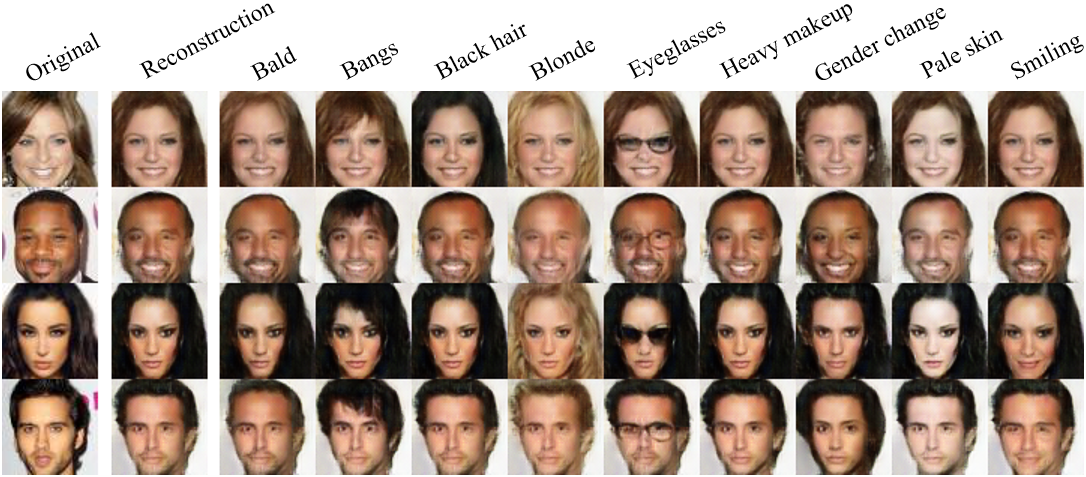
A real image is encoded into a latent representation z and conditional information y, and then decoded into a new image. We fix z for every row, and modify y for each column to obtain variations in real samples.

This is the implementation of the IcGAN model proposed in our paper:

Invertible Conditional GANs for image editing. November 2016.

This paper is a summarized and updated version of my master thesis, which you can find here:

Master thesis: Invertible Conditional Generative Adversarial Networks. September 2016.

The baseline used is the Torch implementation of the DCGAN by Radford et al.

  1. Training the model
    1. Face dataset: CelebA
    2. Digit dataset: MNIST
  2. Visualize the results
    1. Reconstruct and modify real images
    2. Swap attributes
    3. Interpolate between faces

Requisites

Please refer to DCGAN torch repository to know the requirements and dependencies to run the code. Additionally, you will need to install the threads and optnet package:

luarocks install threads

luarocks install optnet

In order to interactively display the results, follow these steps.

1. Training the model

Model overview

The IcGAN is trained in four steps.

  1. Train the generator.
  2. Create a dataset of generated images with the generator.
  3. Train the encoder Z to map an image x to a latent representation z with the dataset generated images.
  4. Train the encoder Y to map an image x to a conditional information vector y with the dataset of real images.

All the parameters of the training phase are located in cfg/mainConfig.lua.

There is already a pre-trained model for CelebA available in case you want to skip the training part. Here you can find instructions on how to use it.

1.1 Train with a face dataset: CelebA

Note: for speed purposes, the whole dataset will be loaded into RAM during training time, which requires about 10 GB of RAM. Therefore, 12 GB of RAM is a minimum requirement. Also, the dataset will be stored as a tensor to load it faster, make sure that you have around 25 GB of free space.

Preprocess

mkdir celebA; cd celebA

Download img_align_celeba.zip here under the link "Align&Cropped Images". Also, you will need to download list_attr_celeba.txt from the same link, which is found under Anno folder.

unzip img_align_celeba.zip; cd ..
DATA_ROOT=celebA th data/preprocess_celebA.lua

Now move list_attr_celeba.txt to celebA folder.

mv list_attr_celeba.txt celebA

Training

  • Conditional GAN: parameters are already configured to run CelebA (dataset=celebA, dataRoot=celebA).

     th trainGAN.lua
  • Generate encoder dataset:

     net=[GENERATOR_PATH] outputFolder=celebA/genDataset/ samples=182638 th data/generateEncoderDataset.lua

    (GENERATOR_PATH example: checkpoints/celebA_25_net_G.t7)

  • Train encoder Z:

     datasetPath=celebA/genDataset/ type=Z th trainEncoder.lua
    
  • Train encoder Y:

     datasetPath=celebA/ type=Y th trainEncoder.lua
    

1.2 Train with a digit dataset: MNIST

Preprocess

Download MNIST as a luarocks package: luarocks install mnist

Training

  • Conditional GAN:

     name=mnist dataset=mnist dataRoot=mnist th trainGAN.lua
  • Generate encoder dataset:

     net=[GENERATOR_PATH] outputFolder=mnist/genDataset/ samples=60000 th data/generateEncoderDataset.lua

    (GENERATOR_PATH example: checkpoints/mnist_25_net_G.t7)

  • Train encoder Z:

     datasetPath=mnist/genDataset/ type=Z th trainEncoder.lua
    
  • Train encoder Y:

     datasetPath=mnist type=Y th trainEncoder.lua
    

2 Pre-trained CelebA model:

CelebA model is available for download here. The file includes the generator and both encoders (encoder Z and encoder Y).

3. Visualize the results

For visualizing the results you will need an already trained IcGAN (i.e. a generator and two encoders). The parameters for generating results are in cfg/generateConfig.lua.

3.1 Reconstruct and modify real images

Reconstrucion example

decNet=celeba_24_G.t7 encZnet=celeba_encZ_7.t7 encYnet=celeba_encY_5.t7 loadPath=[PATH_TO_REAL_IMAGES] th generation/reconstructWithVariations.lua

3.2 Swap attributes

Swap attributes

Swap the attribute information between two pairs of faces.

decNet=celeba_24_G.t7 encZnet=celeba_encZ_7.t7 encYnet=celeba_encY_5.t7 im1Path=[IM1] im2Path=[IM2] th generation/attributeTransfer.lua

3.3 Interpolate between faces

Interpolation

decNet=celeba_24_G.t7 encZnet=celeba_encZ_7.t7 encYnet=celeba_encY_5.t7 im1Path=[IM1] im2Path=[IM2] th generation/interpolate.lua

Do you like or use our work? Please cite us as

@inproceedings{Perarnau2016,
  author    = {Guim Perarnau and
               Joost van de Weijer and
               Bogdan Raducanu and
               Jose M. \'Alvarez},
  title     = {{Invertible Conditional GANs for image editing}},
  booktitle   = {NIPS Workshop on Adversarial Training},
  year      = {2016},
}
Owner
Guim
Guim
Code release for "Making a Bird AI Expert Work for You and Me".

Making-a-Bird-AI-Expert-Work-for-You-and-Me Code release for "Making a Bird AI Expert Work for You and Me". arxiv (Coming soon...) Changelog 2021/12/6

PRIS-CV: Computer Vision Group 11 Dec 11, 2022
Solution of Kaggle competition: Sartorius - Cell Instance Segmentation

Sartorius - Cell Instance Segmentation https://www.kaggle.com/c/sartorius-cell-instance-segmentation Environment setup Build docker image bash .dev_sc

68 Dec 09, 2022
competitions-v2

Codabench (formerly Codalab Competitions v2) Installation $ cp .env_sample .env $ docker-compose up -d $ docker-compose exec django ./manage.py migrat

CodaLab 21 Dec 02, 2022
This app is a simple example of using Strealit to create a financial data web app.

Streamlit Demo: Finance Chart This app is a simple example of using Streamlit to create a financial data web app. This demo use streamlit, pandas and

91 Jan 02, 2023
A certifiable defense against adversarial examples by training neural networks to be provably robust

DiffAI v3 DiffAI is a system for training neural networks to be provably robust and for proving that they are robust. The system was developed for the

SRI Lab, ETH Zurich 202 Dec 13, 2022
L-Verse: Bidirectional Generation Between Image and Text

Far beyond learning long-range interactions of natural language, transformers are becoming the de-facto standard for many vision tasks with their power and scalabilty

Kim, Taehoon 102 Dec 21, 2022
Project Tugas Besar pertama Pengenalan Komputasi Institut Teknologi Bandung

Vending_Machine_(Mesin_Penjual_Minuman) Project Tugas Besar pertama Pengenalan Komputasi Institut Teknologi Bandung Raw Sketch untuk Essay Ringkasan P

QueenLy 1 Nov 08, 2021
Simulating Sycamore quantum circuits classically using tensor network algorithm.

Simulating the Sycamore quantum supremacy circuit This repo contains data we have obtained in simulating the Sycamore quantum supremacy circuits with

Feng Pan 46 Nov 17, 2022
Attention over nodes in Graph Neural Networks using PyTorch (NeurIPS 2019)

Intro This repository contains code to generate data and reproduce experiments from our NeurIPS 2019 paper: Boris Knyazev, Graham W. Taylor, Mohamed R

Boris Knyazev 242 Jan 06, 2023
Python package to add text to images, textures and different backgrounds

nider Python package for text images generation and watermarking Free software: MIT license Documentation: https://nider.readthedocs.io. nider is an a

Vladyslav Ovchynnykov 131 Dec 30, 2022
Genpass - A Passwors Generator App With Python3

Genpass Welcom again into another python3 App this is simply an Passwors Generat

Mal4D 1 Jan 09, 2022
Reference implementation for Structured Prediction with Deep Value Networks

Deep Value Network (DVN) This code is a python reference implementation of DVNs introduced in Deep Value Networks Learn to Evaluate and Iteratively Re

Michael Gygli 55 Feb 02, 2022
This repository contains the code for the paper Neural RGB-D Surface Reconstruction

Neural RGB-D Surface Reconstruction Paper | Project Page | Video Neural RGB-D Surface Reconstruction Dejan Azinović, Ricardo Martin-Brualla, Dan B Gol

Dejan 406 Jan 04, 2023
Polynomial-time Meta-Interpretive Learning

Louise - polynomial-time Program Learning Getting help with Louise Louise's author can be reached by email at Stassa Patsantzis 64 Dec 26, 2022

E2e music remastering system - End-to-end Music Remastering System Using Self-supervised and Adversarial Training

End-to-end Music Remastering System This repository includes source code and pre

Junghyun (Tony) Koo 37 Dec 15, 2022
Multi-objective gym environments for reinforcement learning.

MO-Gym: Multi-Objective Reinforcement Learning Environments Gym environments for multi-objective reinforcement learning (MORL). The environments follo

Lucas Alegre 74 Jan 03, 2023
LIVECell - A large-scale dataset for label-free live cell segmentation

LIVECell dataset This document contains instructions of how to access the data associated with the submitted manuscript "LIVECell - A large-scale data

Sartorius Corporate Research 112 Jan 07, 2023
Pytorch implementation of NEGEV method. Paper: "Negative Evidence Matters in Interpretable Histology Image Classification".

Pytorch 1.10.0 code for: Negative Evidence Matters in Interpretable Histology Image Classification (https://arxiv. org/abs/xxxx.xxxxx) Citation: @arti

Soufiane Belharbi 4 Dec 01, 2022
[ICLR 2021] HW-NAS-Bench: Hardware-Aware Neural Architecture Search Benchmark

HW-NAS-Bench: Hardware-Aware Neural Architecture Search Benchmark Accepted as a spotlight paper at ICLR 2021. Table of content File structure Prerequi

72 Jan 03, 2023
Companion repository to the paper accepted at the 4th ACM SIGSPATIAL International Workshop on Advances in Resilient and Intelligent Cities

Transfer learning approach to bicycle sharing systems station location planning using OpenStreetMap Companion repository to the paper accepted at the

Politechnika Wrocławska - repozytorium dla informatyków 4 Oct 24, 2022