
Apache MXNet (incubating) for Deep Learning
| Master | Docs | License |
|---|---|---|
 |
 |
 |
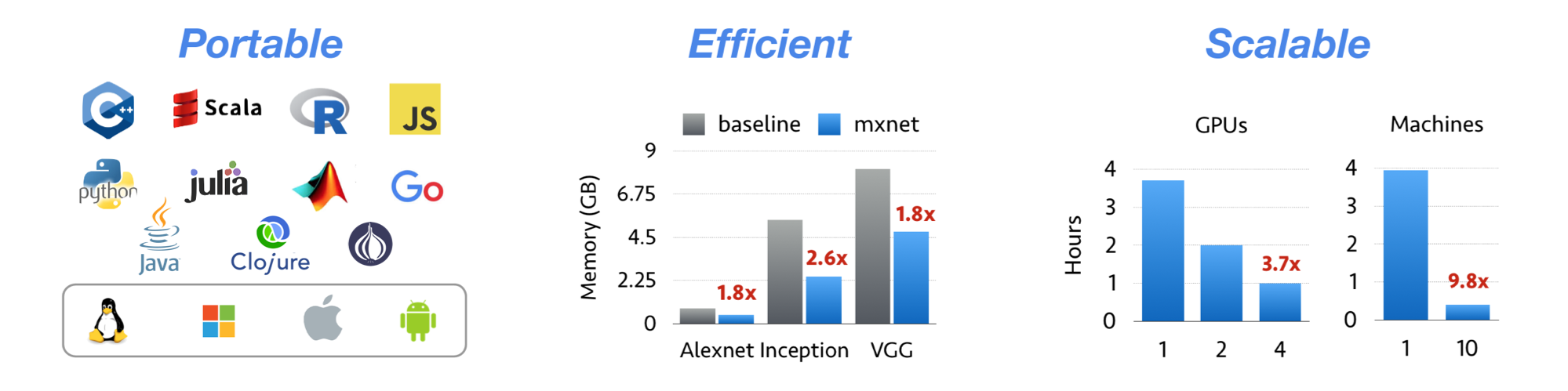
Apache MXNet (incubating) is a deep learning framework designed for both efficiency and flexibility. It allows you to mix symbolic and imperative programming to maximize efficiency and productivity. At its core, MXNet contains a dynamic dependency scheduler that automatically parallelizes both symbolic and imperative operations on the fly. A graph optimization layer on top of that makes symbolic execution fast and memory efficient. MXNet is portable and lightweight, scaling effectively to multiple GPUs and multiple machines.
MXNet is also more than a deep learning project. It is also a collection of blue prints and guidelines for building deep learning systems, and interesting insights of DL systems for hackers.
Installation Guide
Install Dependencies to build mxnet for HIP/ROCm
Install Dependencies to build mxnet for HIP/CUDA
-
Install CUDA following the NVIDIA’s installation guide to setup MXNet with GPU support
-
Make sure to add CUDA install path to LD_LIBRARY_PATH
-
Example - export LD_LIBRARY_PATH=/usr/local/cuda/lib64/:$LD_LIBRARY_PATH
Build the MXNet library
-
Step 1: Install build tools.
sudo apt-get update sudo apt-get install -y build-essential -
Step 2: Install OpenBLAS. MXNet uses BLAS and LAPACK libraries for accelerated numerical computations on CPU machine. There are several flavors of BLAS/LAPACK libraries - OpenBLAS, ATLAS and MKL. In this step we install OpenBLAS. You can choose to install ATLAS or MKL.
sudo apt-get install -y libopenblas-dev liblapack-dev libomp-dev libatlas-dev libatlas-base-dev
- Step 3: Install OpenCV. Install OpenCV here. MXNet uses OpenCV for efficient image loading and augmentation operations.
sudo apt-get install -y libopencv-dev
- Step 4: Download MXNet sources and build MXNet core shared library.
      git clone --recursive https://github.com/ROCmSoftwarePlatform/mxnet.git
      cd mxnet
      export PATH=/opt/rocm/bin:$PATH
- Step 5: To compile on HCC PLATFORM(HIP/ROCm):
export HIP_PLATFORM=hcc
To compile on NVCC PLATFORM(HIP/CUDA):
export HIP_PLATFORM=nvcc
-
Step 6: To enable MIOpen for higher acceleration :
USE_CUDNN=1 -
Step 7:
If building on CPU:
        make -jn(n=number of cores) USE_GPU=0 (For Ubuntu 16.04)
        make -jn(n=number of cores)  CXX=g++-6 USE_GPU=0 (For Ubuntu 18.04)
If building on GPU:
       make -jn(n=number of cores) USE_GPU=1 (For Ubuntu 16.04)
       make -jn(n=number of cores)  CXX=g++-6 USE_GPU=1 (For Ubuntu 18.04)
On succesfull compilation a library called libmxnet.so is created in mxnet/lib path.
NOTE: USE_CUDA, USE_CUDNN flags can be changed in make/config.mk.
To compile on HIP/CUDA make sure to set USE_CUDA_PATH to right CUDA installation path in make/config.mk. In most cases it is - /usr/local/cuda.
Install the MXNet Python binding
- Step 1: Install prerequisites - python, setup-tools, python-pip and numpy.
      sudo apt-get install -y python-dev python-setuptools python-numpy python-pip python-scipy
      sudo apt-get install python-tk
      sudo apt install -y fftw3 fftw3-dev pkg-config
- Step 2: Install the MXNet Python binding.
      cd python
      sudo python setup.py install
- Step 3: Execute sample example
       cd example/
       cd bayesian-methods/
To run on gpu change mx.cpu() to mx.gpu() in python script (Example- bdk_demo.py)
$ python bdk_demo.py
Ask Questions
- Please use mxnet/issues for reporting bugs.
What's New
- [Version 1.4.0 Release](to be created - https://github.com/apache/incubator-mxnet/releases/tag/1.4.0) - MXNet 1.4.0 Release.
Contents
Features
- Design notes providing useful insights that can re-used by other DL projects
- Flexible configuration for arbitrary computation graph
- Mix and match imperative and symbolic programming to maximize flexibility and efficiency
- Lightweight, memory efficient and portable to smart devices
- Scales up to multi GPUs and distributed setting with auto parallelism
- Support for Python, R, Scala, C++ and Julia
- Cloud-friendly and directly compatible with S3, HDFS, and Azure
License
Licensed under an Apache-2.0 license.
Reference Paper
Tianqi Chen, Mu Li, Yutian Li, Min Lin, Naiyan Wang, Minjie Wang, Tianjun Xiao, Bing Xu, Chiyuan Zhang, and Zheng Zhang. MXNet: A Flexible and Efficient Machine Learning Library for Heterogeneous Distributed Systems. In Neural Information Processing Systems, Workshop on Machine Learning Systems, 2015
History
MXNet emerged from a collaboration by the authors of cxxnet, minerva, and purine2. The project reflects what we have learned from the past projects. MXNet combines aspects of each of these projects to achieve flexibility, speed, and memory efficiency.

 200 Dec 15, 2022
 2.4k Dec 25, 2022
 5 Sep 15, 2022
 31 Nov 18, 2022
 241 May 07, 2022
 113 Dec 28, 2022
 151 Dec 26, 2022
 12 Nov 20, 2022
 873 Jan 09, 2023
 712 Dec 19, 2022
 12 Nov 24, 2022
 3 Sep 23, 2022
 1 Jul 31, 2022
 1 Feb 01, 2022
 32 Dec 30, 2022
 216 Dec 29, 2022
 73 Dec 28, 2022
 48 Dec 20, 2022
 40 Nov 03, 2022
 43 Jan 05, 2023