

PyDEns is a framework for solving Ordinary and Partial Differential Equations (ODEs & PDEs) using neural networks

Overview

License Python TensorFlow Run Status

PyDEns

PyDEns is a framework for solving Ordinary and Partial Differential Equations (ODEs & PDEs) using neural networks. With PyDEns one can solve

This page outlines main capabilities of PyDEns. To get an in-depth understanding we suggest you to also read the tutorial.

Getting started with PyDEns: solving common PDEs

Let's solve poisson equation

using simple feed-forward neural network with tanh-activations. The first step is to add a grammar of tokens - expressions used for writing down differential equations - to the current namespace:

from pydens import Solver, NumpySampler, add_tokens
import numpy as np

add_tokens()
# we've now got functions like sin, cos, D in our namespace. More on that later!

You can now set up a PyDEns-model for solving the task at hand using configuration dictionary. Note the use of differentiation token D and sin-token:

pde = {'n_dims': 2,
       'form': lambda u, x, y: D(D(u, x), x) + D(D(u, y), y) - 5 * sin(np.pi * (x + y)),
       'boundary_condition': 1}

body = {'layout': 'fa fa fa f',
        'units': [15, 25, 15, 1],
        'activation': [tf.nn.tanh, tf.nn.tanh, tf.nn.tanh]}

config = {'body': body,
          'pde': pde}

us = NumpySampler('uniform', dim=2) # procedure for sampling points from domain

and run the optimization procedure

dg = Solver(config)
dg.fit(batch_size=100, sampler=us, n_iters=1500)

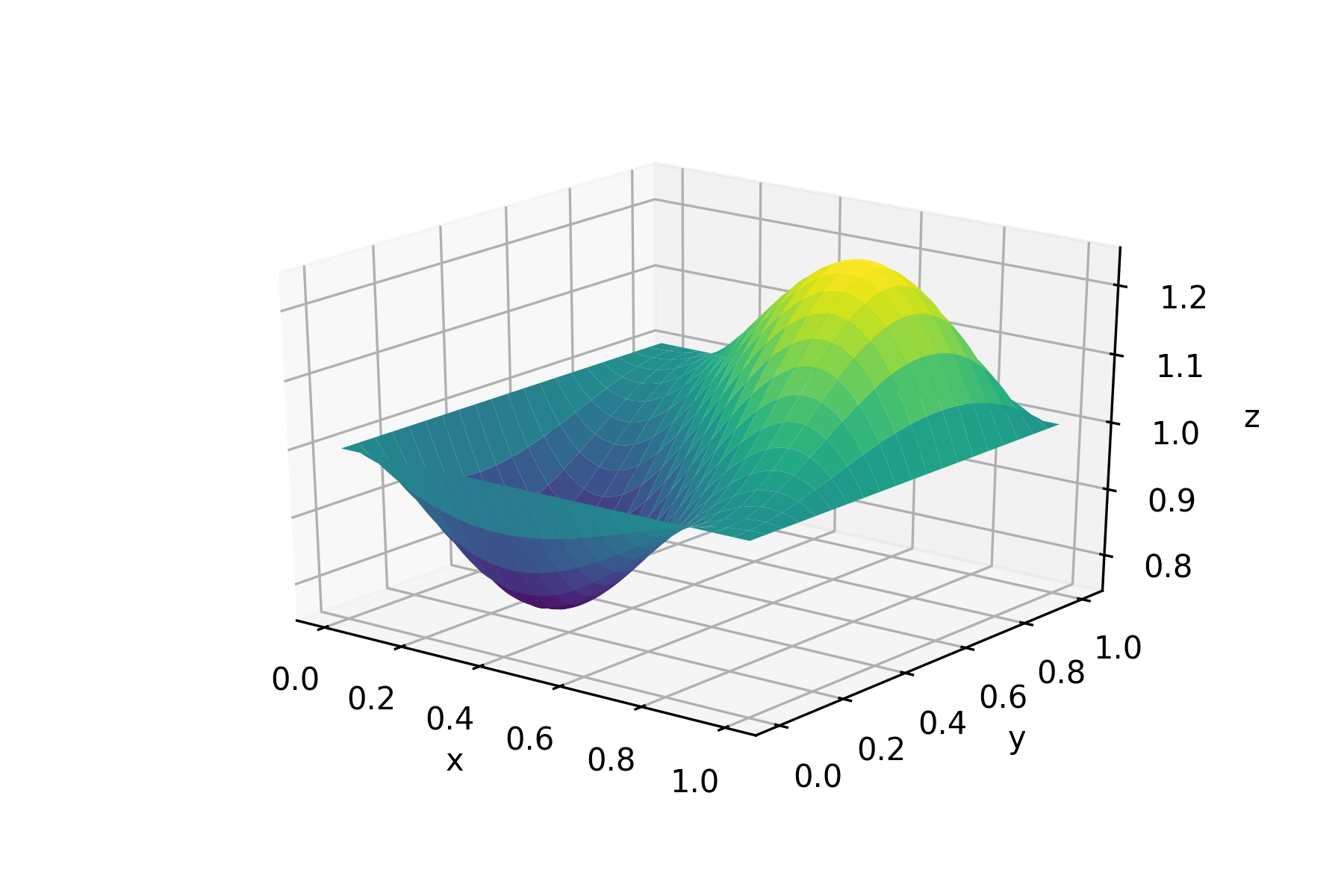
in a fraction of second we've got a mesh-free approximation of the solution on [0, 1]X[0, 1]-square:
Going deeper into PyDEns-capabilities

PyDEns allows to do much more than just solve common PDEs: it also deals with (i) parametric families of PDEs and (ii) PDEs with trainable coefficients.

Solving parametric families of PDEs

Consider a family of ordinary differential equations

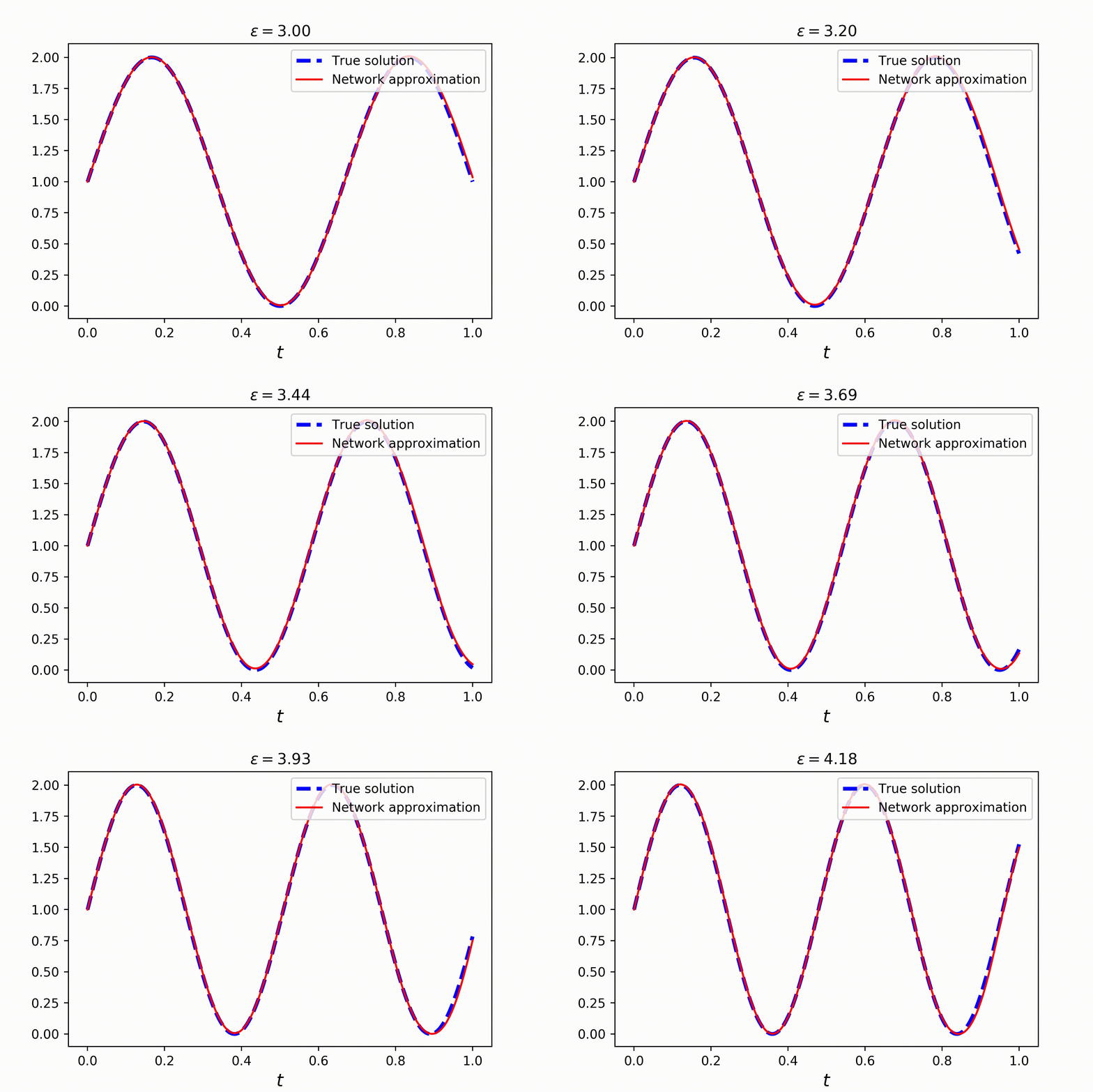
Clearly, the solution is a sin wave with a phase parametrized by ϵ:

Solving this problem is just as easy as solving common PDEs. You only need to introduce parameter in the equation, using token P:

pde = {'n_dims': 1,
       'form': lambda u, t, e: D(u, t) - P(e) * np.pi * cos(P(e) * np.pi * t),
       'initial_condition': 1}

config = {'pde': pde}
# One for argument, one for parameter
s = NumpySampler('uniform') & NumpySampler('uniform', low=1, high=5)

dg = Solver(config)
dg.fit(batch_size=1000, sampler=s, n_iters=5000)
# solving the whole family takes no more than a couple of seconds!

Check out the result:
Solving PDEs with trainable coefficients

With PyDEns things can get even more interesting! Assume that the initial state of the system is unknown and yet to be determined:

Of course, without additional information, the problem is undefined. To make things better, let's fix the state of the system at some other point:

Setting this problem requires a slightly more complex configuring. Note the use of V-token, that stands for trainable variable, in the initial condition of the problem. Also pay attention to train_steps-key of the config, where two train steps are configured: one for better solving the equation and the other for satisfying the additional constraint:

pde = {'n_dims': 1,
       'form': lambda u, t: D(u, t) - 2 * np.pi * cos(2 * np.pi * t),
       'initial_condition': lambda: V(3.0)}

config = {'pde': pde,
          'track': {'u05': lambda u, t: u - 2},
          'train_steps': {'initial_condition_step': {'scope': 'addendums',
                                                     'loss': {'name': 'mse', 'predictions': 'u05'}},
                          'equation_step': {'scope': '-addendums'}}}

s1 = NumpySampler('uniform')
s2 = ConstantSampler(0.5)

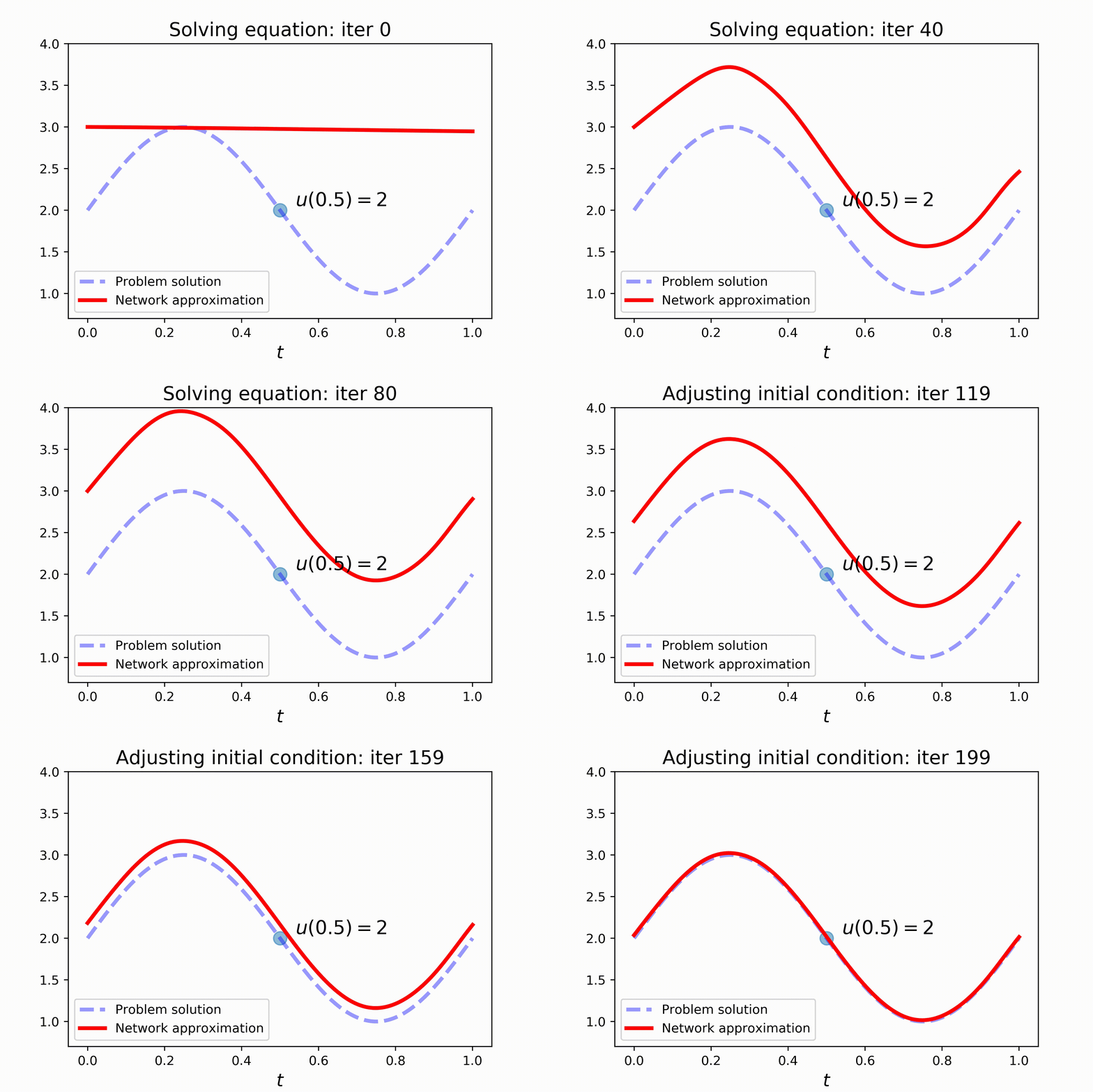
Model-fitting comes in two parts now: (i) solving the equation and (ii) adjusting initial condition to satisfy the additional constraint:

dg.fit(batch_size=150, sampler=s1, n_iters=2000, train_mode='equation_step')
dg.fit(batch_size=150, sampler=s2, n_iters=2000, train_mode='initial_condition_step')

Check out the results:
Installation

First of all, you have to manually install tensorflow, as you might need a certain version or a specific build for CPU / GPU.

Stable python package

With modern pipenv

pipenv install pydens

With old-fashioned pip

pip3 install pydens

Development version

pipenv install git+https://github.com/analysiscenter/pydens.git
pip3 install git+https://github.com/analysiscenter/pydens.git

Installation as a project repository:

Do not forget to use the flag --recursive to make sure that BatchFlow submodule is also cloned.

git clone --recursive https://github.com/analysiscenter/pydens.git

In this case you need to manually install the dependencies.

Citing PyDEns

Please cite PyDEns if it helps your research.

Roman Khudorozhkov, Sergey Tsimfer, Alexander Koryagin. PyDEns framework for solving differential equations with deep learning. 2019.
@misc{pydens_2019,
  author       = {Khudorozhkov R. and Tsimfer S. and Koryagin. A.},
  title        = {PyDEns framework for solving differential equations with deep learning},
  year         = 2019
}
Comments
  • compilation error in Google Collab

    compilation error in Google Collab

    I am getting compilation error in the coding line given below...Kindly tell me ....how to fix it.... I am using google collab for compilation

    dg = Solver(config) dg.fit(batch_size=50, sampler=s, n_iters=300, bar='notebook')

    OperatorNotAllowedInGraphError Traceback (most recent call last) in () ----> 1 dg = Solver(config) 2 dg.fit(batch_size=50, sampler=s, n_iters=300, bar='notebook')

    15 frames /usr/local/lib/python3.6/dist-packages/tensorflow_core/python/framework/ops.py in _disallow_in_graph_mode(self, task) 521 raise errors.OperatorNotAllowedInGraphError( 522 "{} is not allowed in Graph execution. Use Eager execution or decorate" --> 523 " this function with @tf.function.".format(task)) 524 525 def _disallow_bool_casting(self):

    OperatorNotAllowedInGraphError: iterating over tf.Tensor is not allowed in Graph execution. Use Eager execution or decorate this function with @tf.function.

    opened by sumantkrsoni 11
  • "No module named 'pydens.batchflow' "

    I'm using Spyder3 to run this code:

    ` import pydens as pde from pydens import D import numpy as np import tensorflow as tf

    pde.add_tokens()

    pde = {'n_dims': 2, 'form': lambda u, x, y: D(D(u, x), x) + D(D(u, y), y) - 5 * pde.sin(np.pi * (x + y)), 'boundary_condition': 1}

    body = {'layout': 'fa fa fa f', #estrutura da rede neural (layers) 'units': [15, 25, 15, 1], #neurônios por camada 'activation': [tf.nn.tanh, tf.nn.tanh, tf.nn.tanh]} #ativação advinda do TFlow

    config = {'body': body, 'pde': pde}

    us = pde.NumpySampler('uniform', dim=2)

    dg = pde.Solver(config) dg.fit(batch_size=100, sampler=us, n_iters=1500) ` ...and I'm getting this error:

    `File "C:\Users\my_user\Anaconda3\lib\site-packages\pydens\letters.py", line 20, in from .batchflow.models.tf.layers import conv_block

    ModuleNotFoundError: No module named 'pydens.batchflow'`

    My tersorflow are actualized and I got PyDEns and Batchflow with pip on conda terminal.

    opened by adsmendesdaniel 9
  • How can I change the interval of x

    How can I change the interval of x

    Hello Everyone I want to change the interval of x. Instead of using the default one [0,1], I want to have [1, 1.5] so I can define my boundary conditions in these two points? How could I modify the code?

    opened by katayooneshkofti 3
  • How to install easily with PIP command?

    How to install easily with PIP command?

    Dear Guys I am extremely interested in working with your product but I have a problem installing the packages. I installed using different ways but I faced "No module named 'pydens.batchflow'" and I do not have any idea to solve it. I will appreciate it if could do a favor of installing.

    Thanks in advanced

    opened by hossein-amini67 2
  • Compilation error

    Compilation error

    Hello, I want to code according to the pydens and during compilation I am using an error at "dg solver line". Kindly fix it ASAP so that I can move further to code my problem.

    I am using tensorflow 1.15 version ======================code================

    %tensorflow_version 1.x import os import sys

    Stop TF from showing unnecessary deprecation warnings

    import warnings warnings.filterwarnings('ignore') from tensorflow import logging logging.set_verbosity(logging.ERROR) os.environ['TF_CPP_MIN_LOG_LEVEL'] = '2'

    import numpy as np import tensorflow as tf from tqdm import tqdm_notebook import matplotlib.pyplot as plt

    sys.path.append('..') # this line is not needed if PyDEns is installed as package from pydens import Solver, NumpySampler, cart_prod, add_tokens from pydens import plot_loss, plot_pair_1d, plot_2d, plot_sections_2d, plot_sections_3d

    add_tokens()

    describing pde-problem in pde-dict

    pde = { 'n_dims': 1, 'form': lambda u, t: D(u, t) - 2 * np.pi * cos(2 * np.pi * t), 'initial_condition': 1 }

    put it together in model-config

    config = { 'pde': pde, 'track': {'dt': lambda u, t: D(u, t)} # allows to later fetch this value from the model }

    uniform sampling scheme

    s = NumpySampler('uniform')

    train the network on batches of 100 points

    dg = Solver(config) dg.fit(batch_size=100, sampler=s, n_iters=2000, bar='notebook')

    plot_loss(dg.loss, color='cornflowerblue')

    plot real solution and network approximation

    pts = np.linspace(0, 1, 200).reshape(-1, 1) sol = lambda t: np.sin(2 * np.pi * t) + 1 true = [sol(t[0]) for t in pts] approxs = dg.solve(pts)

    plt.plot(pts, true, 'b--', linewidth=3, label='True solution') plt.plot(pts, approxs, 'r', label='Network approximation') plt.xlabel(r'$t$', fontdict={'fontsize': 14}) plt.legend() plt.show()

    plot approximation of solution-derivative

    der = lambda t: 2 * np.pi * np.cos(2 * np.pi * t) true_der = [der(t[0]) for t in pts] ders = dg.solve(pts, fetches='dt')

    plt.plot(pts, true_der, 'b--', linewidth=3, label=r'True derivative') plt.plot(pts, ders, 'r', label=r'Network approximation of $\frac{d u}{d t}$') plt.xlabel(r'$t$', fontdict={'fontsize': 14}) plt.legend() plt.show()

    plot_pair_1d(model=dg, solution=lambda t: np.sin(2np.pit)+1, confidence=0.15, alpha=0.2)

    plot_pair_1d(model=dg, solution=lambda t: 2 * np.pi * np.cos(2 * np.pi * t), fetches='dt')


    ======================error is==================== OperatorNotAllowedInGraphError Traceback (most recent call last) in () 40 41 # train the network on batches of 100 points ---> 42 dg = Solver(config) 43 dg.fit(batch_size=100, sampler=s, n_iters=2000, bar='notebook') 44

    15 frames /tensorflow-1.15.2/python3.6/tensorflow_core/python/framework/ops.py in _disallow_in_graph_mode(self, task) 521 raise errors.OperatorNotAllowedInGraphError( 522 "{} is not allowed in Graph execution. Use Eager execution or decorate" --> 523 " this function with @tf.function.".format(task)) 524 525 def _disallow_bool_casting(self):

    OperatorNotAllowedInGraphError: iterating over tf.Tensor is not allowed in Graph execution. Use Eager execution or decorate this function with @tf.function.

    opened by sumantkrsoni 2
  • "SyntalxTreeNode" object not iterable error

    While running the solved example:

    import os
    import warnings
    import sys
    
    warnings.filterwarnings('ignore')
    from tensorflow import logging
    logging.set_verbosity(logging.ERROR)
    os.environ['TF_CPP_MIN_LOG_LEVEL'] = '3'
    
    import numpy as np
    import tensorflow as tf
    from tqdm import tqdm_notebook
    import matplotlib.pyplot as plt
    
    sys.path.append('..')
    from pydens import Solver, NumpySampler, cart_prod
    from pydens import plot_loss, plot_2d, plot_pair_1d, plot_sections_2d, plot_sections_3d
    
    from pydens import add_tokens
    add_tokens()
    
    # describing pde-problem in pde-dict
    pde = {'n_dims': 1,
           'form': lambda u, t: D(u, t) - 2 * np.pi * cos(2 * np.pi * t),
           'initial_condition': 1 # will be transformed into callable returning 1
          }
    
    # put it together in model-config
    config = {'pde': pde,
              'track': {'dt': lambda u, t: D(u, t)}}
    
    # uniform sampling scheme
    s = NumpySampler('uniform')
    
    #
    ## train the network on batches of 100 points
    dg = Solver(config)
    

    I run into the following error: TypeError: 'SyntaxTreeNode' object is not iterable

    The stacktrace is:

    File "<ipython-input-21-1b5c74329633>", line 1, in <module>
        runfile('/home/nirvik/Documents/neuronal_model_python/temp.py', wdir='/home/nirvik/Documents/neuronal_model_python')
    
      File "/usr/lib/python3/dist-packages/spyder/utils/site/sitecustomize.py", line 705, in runfile
        execfile(filename, namespace)
    
      File "/usr/lib/python3/dist-packages/spyder/utils/site/sitecustomize.py", line 102, in execfile
        exec(compile(f.read(), filename, 'exec'), namespace)
    
      File "/home/nirvik/Documents/neuronal_model_python/temp.py", line 38, in <module>
        dg = Solver(config)
    
      File "/home/nirvik/.local/lib/python3.6/site-packages/pydens/wrapper.py", line 21, in __init__
        self.model = model_class(config)
    
      File "/home/nirvik/.local/lib/python3.6/site-packages/pydens/batchflow/batchflow/models/tf/base.py", line 262, in __init__
        super().__init__(*args, **kwargs)
    
      File "/home/nirvik/.local/lib/python3.6/site-packages/pydens/batchflow/batchflow/models/base.py", line 38, in __init__
        self.build(*args, **kwargs)
    
      File "/home/nirvik/.local/lib/python3.6/site-packages/pydens/batchflow/batchflow/models/tf/base.py", line 331, in build
        config = self.build_config()
    
      File "/home/nirvik/.local/lib/python3.6/site-packages/pydens/model_tf.py", line 117, in build_config
        n_parameters = get_num_parameters(form[0])
    
      File "/home/nirvik/.local/lib/python3.6/site-packages/pydens/syntax_tree.py", line 77, in get_num_parameters
        tree = form(*[SyntaxTreeNode('_' + str(i)) for i in range(n_args)])
    
      File "/home/nirvik/Documents/neuronal_model_python/temp.py", line 25, in <lambda>
        'form': lambda u, t: D(u, t) - 2 * np.pi * 2 * t^3,
    
      File "/home/nirvik/.local/lib/python3.6/site-packages/pydens/tokens.py", line 63, in <lambda>
        if isinstance(args[0], SyntaxTreeNode) else method_(*args, **kwargs))
    
      File "/home/nirvik/.local/lib/python3.6/site-packages/pydens/letters.py", line 82, in D
        return np.stack([self.D(func, coordinate) for coordinate in coordinates],
    ```
    
    I am new to using this package...please help.
    opened by NirvikNU 2
  • Plotting problem

    Plotting problem

    pyDens not plotting after running solver.fit() on both Jupyter notebook and google colaboratory. Using the first example from Github solver.fit() seems to run fine but I was expecting a plot of the results to appear. What am i missing?

    opened by babycamel 1
  • Torch

    Torch

    This pr adds torch-based model and solver and removes tensorflow completely. Leaves only one tutorial covering wide range of examples; updates pylint to working state.

    Classes added by this pr:

    • TorchModel
    • Solver
    • ConvBlockModel - model based on conv_block from batchflow.

    NOTE: despite the diff looking complex, there are basically two files in the library: model_torch.py and the tutorial notebook.

    opened by akoryagin 1
  • Solver and loader

    Solver and loader

    Main addition

    • Add saving and loading capabilities to a PyDEns-Solver class. Saving is done via Solver.save-method, while loading is performed by adding path-argument to a Solver-initialization procedure.
    opened by akoryagin 1
  • There are some references so I can learn the body

    There are some references so I can learn the body "layout characters/symbols"?

    For example: """ body = {'layout': 'fa f', 'units': [10, 1], 'activation': [tf.nn.tanh,]} """ This means that there are one first full connected layer with 10 units and activation "tanh" ('fa') and a final full connected layer with no activation ('f').

    But what about: """ body = {'layout': 'faR fa fa+ f', 'units': [10, 25, 10, 1], 'activation': [tf.nn.tanh, tf.nn.tanh, tf.nn.tanh]} """ What does 'R' mean? And the character '+'?

    Thank you.

    opened by adsmendesdaniel 1
  • Plotutils update

    Plotutils update

    Main additions

    • update plot utils: now all plot funcs for 3d-problems allow for three different plot-modes: imshow, contourf and 3d-view
    • move file with plot utils into pydens-module for convenient usage in tutorials
    • update tutorials using plot-funcs thus making them shorter
    opened by akoryagin 1
  • LBFGS optimizer not working

    LBFGS optimizer not working

    The code block below results in error:

    solver = Solver(equation=pde, ndims=2,constraints=constraints,domain=domain,layout='fa fa f', units=(10,20,1), activation='Sigmoid')
    solver.fit(batch_size=100, niters=5000, lr=0.01,optimizer='LBFGS')
    

    Error:

      0%|                                                                                   | 0/5000 [00:00<?, ?it/s]
    ---------------------------------------------------------------------------
    TypeError                                 Traceback (most recent call last)
    File <timed exec>:8, in <module>
    
    File D:\anaconda3\envs\pydens_gpu\lib\site-packages\pydens\model_torch.py:461, in Solver.fit(self, niters, batch_size, sampler, loss_terms, optimizer, criterion, lr, **kwargs)
        459 # Optimizer step.
        460 loss.backward()
    --> 461 self.optimizer.step()
        463 # Gather and store training stats.
        464 self.losses.append(loss.detach().cpu().numpy())
    
    File D:\anaconda3\envs\pydens_gpu\lib\site-packages\torch\optim\optimizer.py:88, in Optimizer._hook_for_profile.<locals>.profile_hook_step.<locals>.wrapper(*args, **kwargs)
         86 profile_name = "Optimizer.step#{}.step".format(obj.__class__.__name__)
         87 with torch.autograd.profiler.record_function(profile_name):
    ---> 88     return func(*args, **kwargs)
    
    File D:\anaconda3\envs\pydens_gpu\lib\site-packages\torch\autograd\grad_mode.py:27, in _DecoratorContextManager.__call__.<locals>.decorate_context(*args, **kwargs)
         24 @functools.wraps(func)
         25 def decorate_context(*args, **kwargs):
         26     with self.clone():
    ---> 27         return func(*args, **kwargs)
    
    TypeError: step() missing 1 required positional argument: 'closure'
    

    Any idea on how to use LBFGS optimizer ?

    opened by pradhyumna85 0
  • Learning from Data

    Learning from Data

    Sorry if this is obvious of a question, but is there a way to learn the PDE from data? I don't have the PDE as is shown throughout the examples https://github.com/analysiscenter/pydens/blob/master/tutorials/1.%20Solving%20PDEs.ipynb to define a function for the solver.

    opened by cadop 0
  • How to solve if Parametric heat-equation in the example has 2 or 3 boundary conditions?

    How to solve if Parametric heat-equation in the example has 2 or 3 boundary conditions?

    Hi, Can Pydens handle the PDE with more than 2 boundary conditions? In the parametric heat-equation example, would you please show me how to change the boundary condition to: case 1: u(x,y,t=0)=1000 u(x=0, y=0, t)=200 case 2: u(x,y,t=0)=1000 u(x=0, y=0, t)=200 u(xe,0)=u(-xe,0)=u(0,ye)=u(ye,0)=1000 (e represents edge, which indicates all boundaries have same value)

    opened by jingfu9402 1
  • Pyden Installation Problem

    Pyden Installation Problem

    Dear all, I have a problem installing the packages. In Jypyter notebook , Python 3; I use pip install pydens and it has installed successfully. Next when writing from pydens import Solver, NumpySampler, add_tokens getting error "module 'tensorflow' has no attribute 'layers'" Plz fix it.

    opened by Arup-nit 1
Releases(v1.0.2)
Owner
Data Analysis Center
最新版本yolov5+deepsort目标检测和追踪,支持5.0版本可训练自己数据集

使用YOLOv5+Deepsort实现车辆行人追踪和计数,代码封装成一个Detector类,更容易嵌入到自己的项目中。

422 Dec 30, 2022
Official code for paper "ISNet: Costless and Implicit Image Segmentation for Deep Classifiers, with Application in COVID-19 Detection"

Official code for paper "ISNet: Costless and Implicit Image Segmentation for Deep Classifiers, with Application in COVID-19 Detection". LRPDenseNet.py

Pedro Ricardo Ariel Salvador Bassi 2 Sep 21, 2022
An open-source, low-cost, image-based weed detection device for fallow scenarios.

Welcome to the OpenWeedLocator (OWL) project, an opensource hardware and software green-on-brown weed detector that uses entirely off-the-shelf compon

Guy Coleman 145 Jan 05, 2023
Physics-informed Neural Operator for Learning Partial Differential Equation

PINO Physics-informed Neural Operator for Learning Partial Differential Equation Abstract: Machine learning methods have recently shown promise in sol

107 Jan 02, 2023
Code to reproduce the results for Compositional Attention

Compositional-Attention This repository contains the official implementation for the paper Compositional Attention: Disentangling Search and Retrieval

Sarthak Mittal 58 Nov 30, 2022
Weakly-Supervised Semantic Segmentation Network with Deep Seeded Region Growing (CVPR 2018).

Weakly-Supervised Semantic Segmentation Network with Deep Seeded Region Growing (CVPR2018) By Zilong Huang, Xinggang Wang, Jiasi Wang, Wenyu Liu and J

Zilong Huang 245 Dec 13, 2022
Towards Interpretable Deep Metric Learning with Structural Matching

DIML Created by Wenliang Zhao*, Yongming Rao*, Ziyi Wang, Jiwen Lu, Jie Zhou This repository contains PyTorch implementation for paper Towards Interpr

Wenliang Zhao 75 Nov 11, 2022
This thesis is mainly concerned with state-space methods for a class of deep Gaussian process (DGP) regression problems

Doctoral dissertation of Zheng Zhao This thesis is mainly concerned with state-space methods for a class of deep Gaussian process (DGP) regression pro

Zheng Zhao 21 Nov 14, 2022
code for paper -- "Seamless Satellite-image Synthesis"

Seamless Satellite-image Synthesis by Jialin Zhu and Tom Kelly. Project site. The code of our models borrows heavily from the BicycleGAN repository an

Light 14 Apr 05, 2022
Sibur challange 2021 competition - 6 place

sibur challange 2021 Решение на 6 место: https://sibur.ai-community.com/competitions/5/tasks/13 Скор 1.4066/1.4159 public/private. Архитектура - однос

Ivan 5 Jan 11, 2022
Python Tensorflow 2 scripts for detecting objects of any class in an image without knowing their label.

Tensorflow-Mobile-Generic-Object-Localizer Python Tensorflow 2 scripts for detecting objects of any class in an image without knowing their label. Ori

Ibai Gorordo 11 Nov 15, 2022
Cold Brew: Distilling Graph Node Representations with Incomplete or Missing Neighborhoods

Cold Brew: Distilling Graph Node Representations with Incomplete or Missing Neighborhoods Introduction Graph Neural Networks (GNNs) have demonstrated

37 Dec 15, 2022
Point Cloud Denoising input segmentation output raw point-cloud valid/clear fog rain de-noised Abstract Lidar sensors are frequently used in environme

Point Cloud Denoising input segmentation output raw point-cloud valid/clear fog rain de-noised Abstract Lidar sensors are frequently used in environme

75 Nov 24, 2022
(CVPR2021) DANNet: A One-Stage Domain Adaptation Network for Unsupervised Nighttime Semantic Segmentation

DANNet: A One-Stage Domain Adaptation Network for Unsupervised Nighttime Semantic Segmentation CVPR2021(oral) [arxiv] Requirements python3.7 pytorch==

W-zx-Y 85 Dec 07, 2022
STEAL - Learning Semantic Boundaries from Noisy Annotations (CVPR 2019)

STEAL This is the official inference code for: Devil Is in the Edges: Learning Semantic Boundaries from Noisy Annotations David Acuna, Amlan Kar, Sanj

469 Dec 26, 2022
Genpass - A Passwors Generator App With Python3

Genpass Welcom again into another python3 App this is simply an Passwors Generat

Mal4D 1 Jan 09, 2022
PyTorch implementation of the Deep SLDA method from our CVPRW-2020 paper "Lifelong Machine Learning with Deep Streaming Linear Discriminant Analysis"

Lifelong Machine Learning with Deep Streaming Linear Discriminant Analysis This is a PyTorch implementation of the Deep Streaming Linear Discriminant

Tyler Hayes 41 Dec 25, 2022
When are Iterative GPs Numerically Accurate?

When are Iterative GPs Numerically Accurate? This is a code repository for the paper "When are Iterative GPs Numerically Accurate?" by Wesley Maddox,

Wesley Maddox 1 Jan 06, 2022
PointCNN: Convolution On X-Transformed Points (NeurIPS 2018)

PointCNN: Convolution On X-Transformed Points Created by Yangyan Li, Rui Bu, Mingchao Sun, Wei Wu, Xinhan Di, and Baoquan Chen. Introduction PointCNN

Yangyan Li 1.3k Dec 21, 2022
Personals scripts using ageitgey/face_recognition

HOW TO USE pip3 install requirements.txt Add some pictures of known people in the folder 'people' : a) Create a folder called by the name of the perso

Antoine Bollengier 1 Jan 06, 2022