GP-UNIT - Official PyTorch Implementation
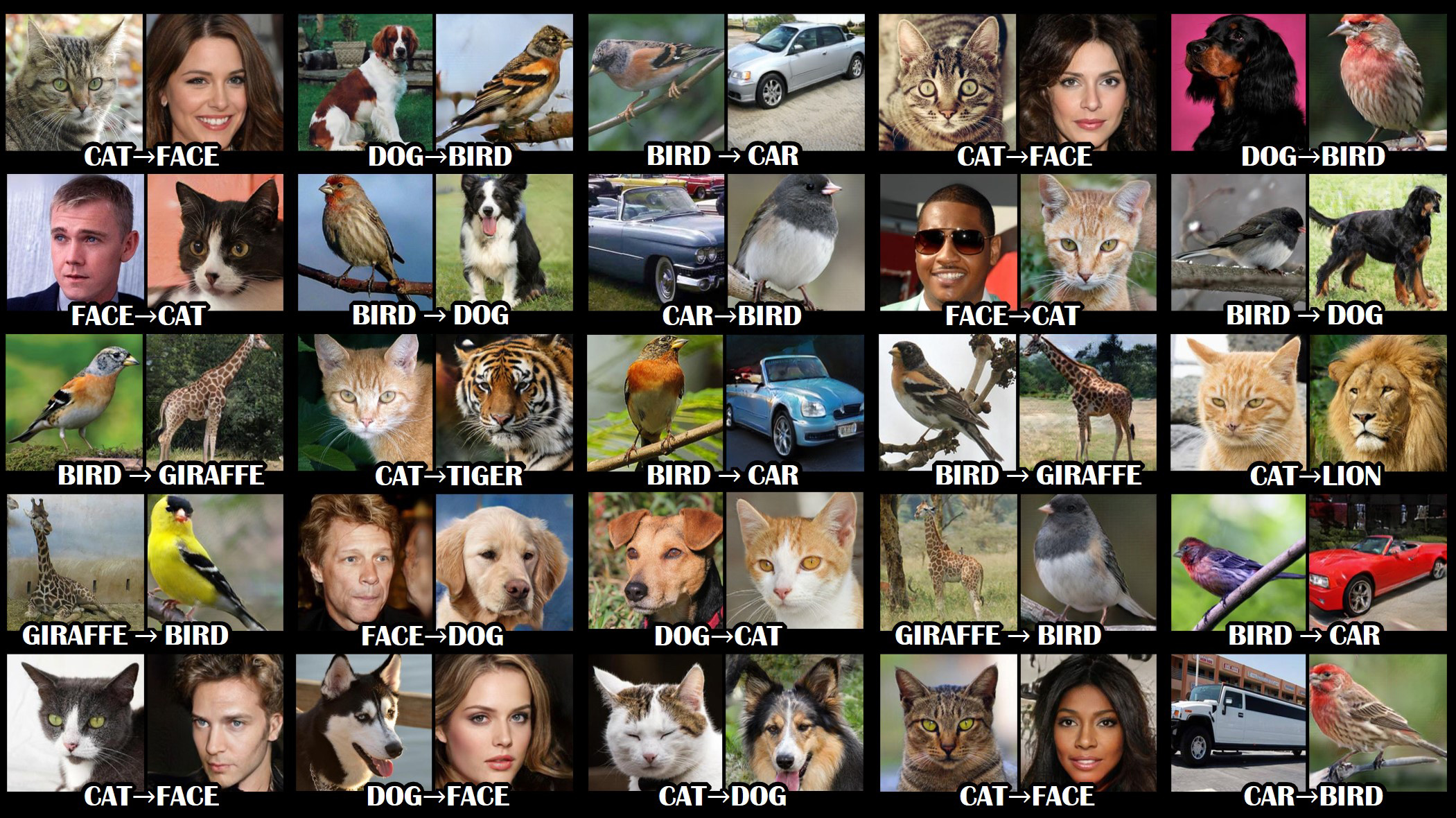
This repository provides the official PyTorch implementation for the following paper:
Unsupervised Image-to-Image Translation with Generative Prior
Shuai Yang, Liming Jiang, Ziwei Liu and Chen Change Loy
In CVPR 2022.
Project Page | Paper | Supplementary Video
Abstract: Unsupervised image-to-image translation aims to learn the translation between two visual domains without paired data. Despite the recent progress in image translation models, it remains challenging to build mappings between complex domains with drastic visual discrepancies. In this work, we present a novel framework, Generative Prior-guided UNsupervised Image-to-image Translation (GP-UNIT), to improve the overall quality and applicability of the translation algorithm. Our key insight is to leverage the generative prior from pre-trained class-conditional GANs (e.g., BigGAN) to learn rich content correspondences across various domains. We propose a novel coarse-to-fine scheme: we first distill the generative prior to capture a robust coarse-level content representation that can link objects at an abstract semantic level, based on which fine-level content features are adaptively learned for more accurate multi-level content correspondences. Extensive experiments demonstrate the superiority of our versatile framework over state-of-the-art methods in robust, high-quality and diversified translations, even for challenging and distant domains.
Updates
- [03/2022] Paper and supplementary video are released.
- [04/2022] Code and dataset are released.
- [03/2022] This website is created.
Installation
Clone this repo:
git clone https://github.com/williamyang1991/GP-UNIT.git
cd GP-UNIT
Dependencies:
We have tested on:
- CUDA 10.1
- PyTorch 1.7.0
- Pillow 8.0.1; Matplotlib 3.3.3; opencv-python 4.4.0; Faiss 1.7.0; tqdm 4.54.0
All dependencies for defining the environment are provided in environment/gpunit_env.yaml. We recommend running this repository using Anaconda:
conda env create -f ./environment/gpunit_env.yaml
We use CUDA 10.1 so it will install PyTorch 1.7.0 (corresponding to Line 16, Line 113, Line 120, Line 121 of gpunit_env.yaml). Please install PyTorch that matches your own CUDA version following https://pytorch.org/.
(1) Dataset Preparation
Human face dataset, animal face dataset and aristic human face dataset can be downloaded from their official pages. Bird, dog and car datasets can be built from ImageNet with our provided script.
| Task | Used Dataset |
|---|---|
| Male←→Female | CelebA-HQ: divided into male and female subsets by StarGANv2 |
| Dog←→Cat←→Wild | AFHQ provided by StarGANv2 |
| Face←→Cat or Dog | CelebA-HQ and AFHQ |
| Bird←→Dog | 4 classes of birds and 4 classes of dogs in ImageNet291. Please refer to dataset preparation for building ImageNet291 from ImageNet |
| Bird←→Car | 4 classes of birds and 4 classes of cars in ImageNet291. Please refer to dataset preparation for building ImageNet291 from ImageNet |
| Face→MetFace | CelebA-HQ and MetFaces |
(2) Inference for Latent-Guided and Exemplar-Guided Translation
Inference Notebook
To help users get started, we provide a Jupyter notebook at ./notebooks/inference_playground.ipynb that allows one to visualize the performance of GP-UNIT. The notebook will download the necessary pretrained models and run inference on the images in ./data/.

Web Demo
Try Replicate web demo here
Pretrained Models
Pretrained models can be downloaded from Google Drive or Baidu Cloud (access code: cvpr):
| Task | Pretrained Models |
|---|---|
| Prior Distillation | content encoder |
| Male←→Female | generators for male2female and female2male |
| Dog←→Cat←→Wild | generators for dog2cat, cat2dog, dog2wild, wild2dog, cat2wild and wild2cat |
| Face←→Cat or Dog | generators for face2cat, cat2face, dog2face and face2dog |
| Bird←→Dog | generators for bird2dog and dog2bird |
| Bird←→Car | generators for bird2car and car2bird |
| Face→MetFace | generator for face2metface |
The saved checkpoints are under the following folder structure:
checkpoint
|--content_encoder.pt     % Content encoder
|--bird2car.pt            % Bird-to-Car translation model
|--bird2dog.pt            % Bird-to-Dog translation model
...
Latent-Guided Translation
Translate a content image to the target domain with randomly sampled latent styles:
python inference.py --generator_path PRETRAINED_GENERATOR_PATH --content_encoder_path PRETRAINED_ENCODER_PATH \
                    --content CONTENT_IMAGE_PATH --batch STYLE_NUMBER --device DEVICE
By default, the script will use .\checkpoint\dog2cat.pt as PRETRAINED_GENERATOR_PATH, .\checkpoint\content_encoder.pt as PRETRAINED_ENCODER_PATH, and cuda as DEVICE for using GPU. For running on CPUs, use --device cpu.
Take Dog→Cat as an example, run:
python inference.py --content ./data/afhq/images512x512/test/dog/flickr_dog_000572.jpg --batch 6
Six results translation_flickr_dog_000572_N.jpg (N=0~5) are saved in the folder .\output\. An corresponding overview image translation_flickr_dog_000572_overview.jpg is additionally saved to illustrate the input content image and the six results:

Evaluation Metrics: We use the code of StarGANv2 to calculate FID and Diversity with LPIPS in our paper.
Exemplar-Guided Translation
Translate a content image to the target domain in the style of a style image by additionally specifying --style:
python inference.py --generator_path PRETRAINED_GENERATOR_PATH --content_encoder_path PRETRAINED_ENCODER_PATH \
                    --content CONTENT_IMAGE_PATH --style STYLE_IMAGE_PATH --device DEVICE
Take Dog→Cat as an example, run:
python inference.py --content ./data/afhq/images512x512/test/dog/flickr_dog_000572.jpg --style ./data/afhq/images512x512/test/cat/flickr_cat_000418.jpg
The result translation_flickr_dog_000572_to_flickr_cat_000418.jpg is saved in the folder .\output\. An corresponding overview image translation_flickr_dog_000572_to_flickr_cat_000418_overview.jpg is additionally saved to illustrate the input content image, the style image, and the result:

Another example of Cat→Wild, run:
python inference.py --generator_path ./checkpoint/cat2wild.pt --content ./data/afhq/images512x512/test/cat/flickr_cat_000418.jpg --style ./data/afhq/images512x512/test/wild/flickr_wild_001112.jpg
The overview image is as follows:

(3) Training GP-UNIT
Download the supporting models to the ./checkpoint/ folder:
| Model | Description |
|---|---|
| content_encoder.pt | Our pretrained content encoder which distills BigGAN prior from the synImageNet291 dataset. |
| model_ir_se50.pth | Pretrained IR-SE50 model taken from TreB1eN for ID loss. |
Train Image-to-Image Transaltion Network
python train.py --task TASK --batch BATCH_SIZE --iter ITERATIONS \
                --source_paths SPATH1 SPATH2 ... SPATHS --source_num SNUM1 SNUM2 ... SNUMS \
                --target_paths TPATH1 TPATH2 ... TPATHT --target_num TNUM1 TNUM2 ... TNUMT
where SPATH1~SPATHS are paths to S folders containing images from the source domain (e.g., S classes of ImageNet birds), SNUMi is the number of images in SPATHi used for training. TPATHi, TNUMi are similarily defined but for the target domain. By default, BATCH_SIZE=16 and ITERATIONS=75000. If --source_num/--target_num is not specified, all images in the folders are used.
The trained model is saved as ./checkpoint/TASK-ITERATIONS.pt. Intermediate results are saved in ./log/TASK/.
This training does not necessarily lead to the optimal results, which can be further customized with additional command line options:
--style_layer(default: 4): the discriminator layer to compute the feature matching loss. We found settingstyle_layer=5gives better performance on human faces.--use_allskip(default: False): whether using dynamic skip connections to compute the reconstruction loss. For tasks involving close domains like gender translation, season transfer and face stylization, usinguse_allskipgives better results.--use_idloss(default: False): whether using the identity loss. For Cat/Dog→Face and Face→MetFace tasks, we use this loss.--not_flip_style(default: False): whether not randomly flipping the style image when extracting the style feature. Random flipping prevents the network to learn position information from the style image.--mitigate_style_bias(default: False): whether resampling style features when training the sampling network. For imbalanced dataset that has minor groups,mitigate_style_biasoversamples those style features that are far from the mean style feature of the whole dataset. This leads to more diversified latent-guided translation at the cost of slight image quality degradation. We use it on CelebA-HQ and AFHQ-related tasks.
Here are some examples:
(Parts of our tasks require the ImageNet291 dataset. Please refer to data preparation)
Male→Female
python train.py --task male2female --source_paths ./data/celeba_hq/train/male --target_paths ./data/celeba_hq/train/female --style_layer 5 --mitigate_style_bias --use_allskip --not_flip_style
Cat→Dog
python train.py --task cat2dog --source_paths ./data/afhq/images512x512/train/cat --source_num 4000 --target_paths ./data/afhq/images512x512/train/dog --target_num 4000 --mitigate_style_bias
Cat→Face
python train.py --task cat2face --source_paths ./data/afhq/images512x512/train/cat --source_num 4000 --target_paths ./data/ImageNet291/train/1001_face/ --style_layer 5 --mitigate_style_bias --not_flip_style --use_idloss
Bird→Car (translating 4 classes of birds to 4 classes of cars)
python train.py --task bird2car --source_paths ./data/ImageNet291/train/10_bird/ ./data/ImageNet291/train/11_bird/ ./data/ImageNet291/train/12_bird/ ./data/ImageNet291/train/13_bird/ --source_num 600 600 600 600 --target_paths ./data/ImageNet291/train/436_vehicle/ ./data/ImageNet291/train/511_vehicle/ ./data/ImageNet291/train/627_vehicle/ ./data/ImageNet291/train/656_vehicle/ --target_num 600 600 600 600
Train Content Encoder of Prior Distillation
We provide our pretrained model content_encoder.pt at Google Drive or Baidu Cloud (access code: cvpr). This model is obtained by:
python prior_distillation.py --unpaired_data_root ./data/ImageNet291/train/ --paired_data_root ./data/synImageNet291/train/ --unpaired_mask_root ./data/ImageNet291_mask/train/ --paired_mask_root ./data/synImageNet291_mask/train/
The training requires ImageNet291 and synImageNet291 datasets. Please refer to data preparation.
Results
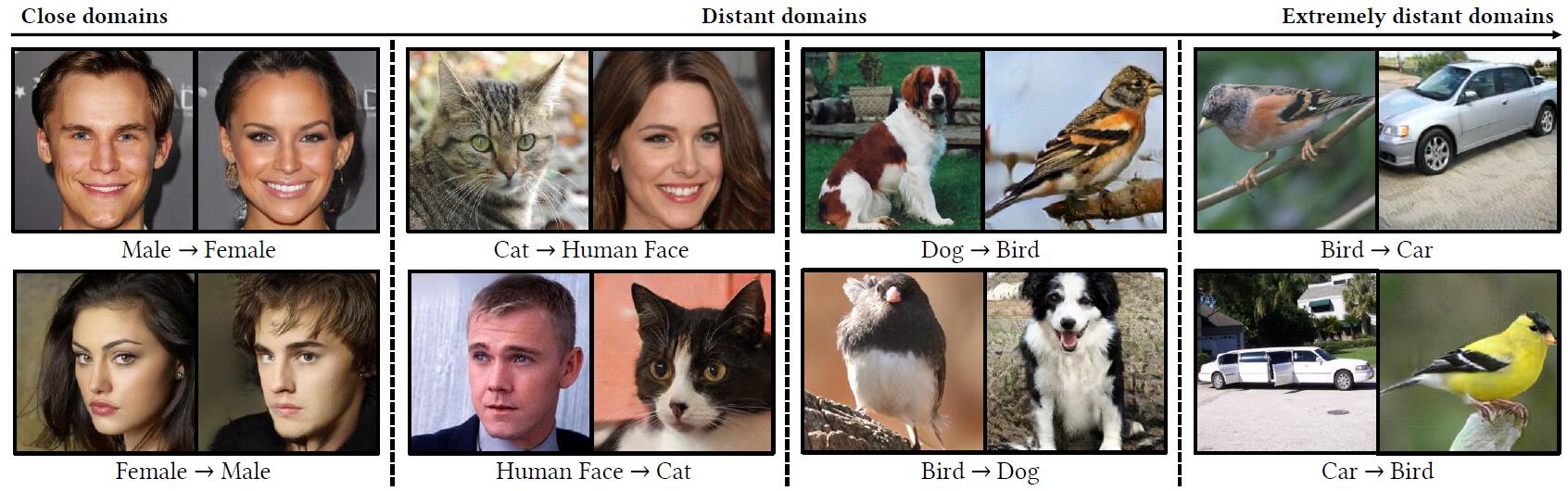
Male-to-Female: close domains

Cat-to-Dog: related domains

Dog-to-Human and Bird-to-Dog: distant domains


Bird-to-Car: extremely distant domains for stress testing

Citation
If you find this work useful for your research, please consider citing our paper:
@inproceedings{yang2022Unsupervised,
  title={Unsupervised Image-to-Image Translation with Generative Prior},
  author={Yang, Shuai and Jiang, Liming and Liu, Ziwei and Loy, Chen Change},
  booktitle={CVPR},
  year={2022}
}
Acknowledgments
The code is developed based on StarGAN v2, SPADE and Imaginaire.

 30 Dec 01, 2022
 43 Dec 25, 2022
 90 Dec 07, 2022
 3k Dec 29, 2022
 15 Nov 02, 2022
 1 Dec 08, 2021
 4.8k Jan 09, 2023
 3.1k Dec 29, 2022
 60 Dec 07, 2022
 1.6k Jan 04, 2023
 45 Jan 09, 2023
 1.2k Dec 29, 2022
 770 Jan 02, 2023
 121 Dec 17, 2022
 1 Jan 07, 2022
 74 Sep 22, 2021
 5 Nov 20, 2022
 551 Dec 31, 2022
 13 Dec 07, 2022
 116 Jan 03, 2023