A PyTorch port of the Neural 3D Mesh Renderer

Overview

Neural 3D Mesh Renderer (CVPR 2018)

This repo contains a PyTorch implementation of the paper Neural 3D Mesh Renderer by Hiroharu Kato, Yoshitaka Ushiku, and Tatsuya Harada. It is a port of the original Chainer implementation released by the authors. Currently the API is the same as in the original implementation with some smalls additions (e.g. render using a general 3x4 camera matrix, lens distortion coefficients etc.). However it is possible that it will change in the future.

The library is fully functional and it passes all the test cases supplied by the authors of the original library. Detailed documentation will be added in the near future.

Requirements

Python 2.7+ and PyTorch 0.4.0.

The code has been tested only with PyTorch 0.4.0, there are no guarantees that it is compatible with older versions. Currently the library has both Python 3 and Python 2 support.

Note: In some newer PyTorch versions you might see some compilation errors involving AT_ASSERT. In these cases you can use the version of the code that is in the branch at_assert_fix. These changes will be merged into master in the near future.

Installation

You can install the package by running

pip install neural_renderer_pytorch

Since running install.py requires PyTorch, make sure to install PyTorch before running the above command.

Running examples

python ./examples/example1.py
python ./examples/example2.py
python ./examples/example3.py
python ./examples/example4.py

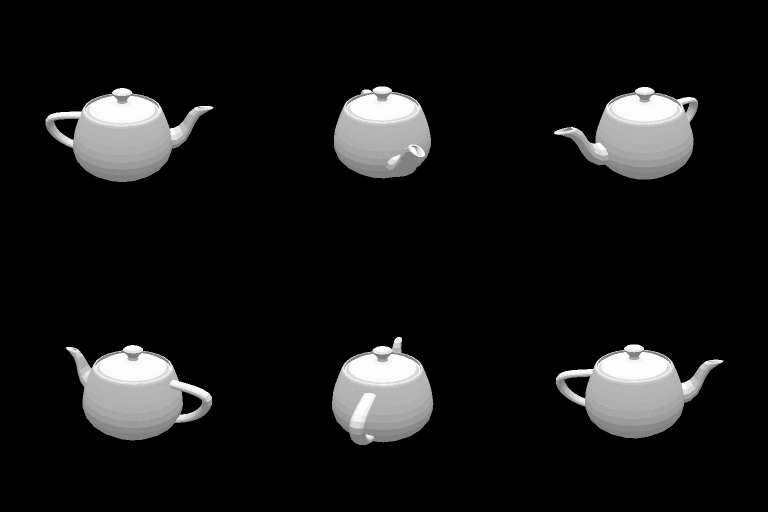
Example 1: Drawing an object from multiple viewpoints
Example 2: Optimizing vertices

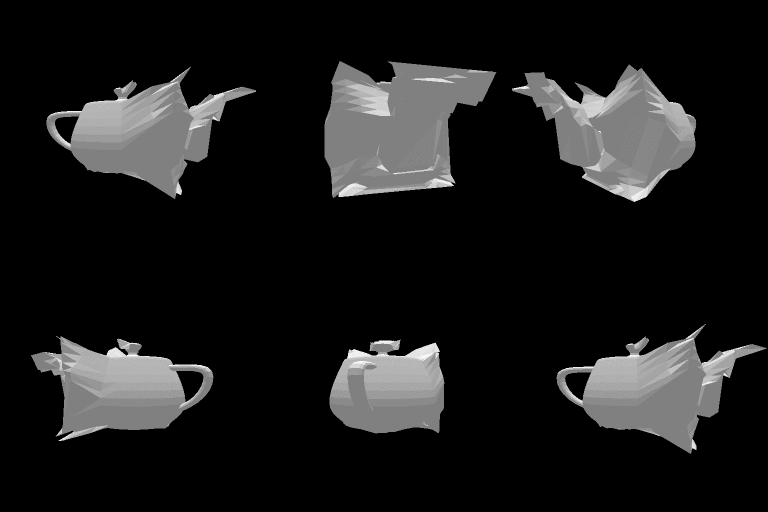
Transforming the silhouette of a teapot into a rectangle. The loss function is the difference between the rendered image and the reference image.

Reference image, optimization, and the result.

Example 3: Optimizing textures

Matching the color of a teapot with a reference image.

Reference image, result.

Example 4: Finding camera parameters

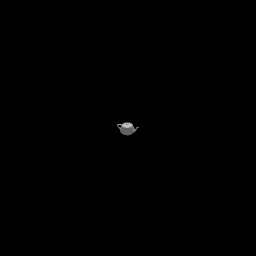
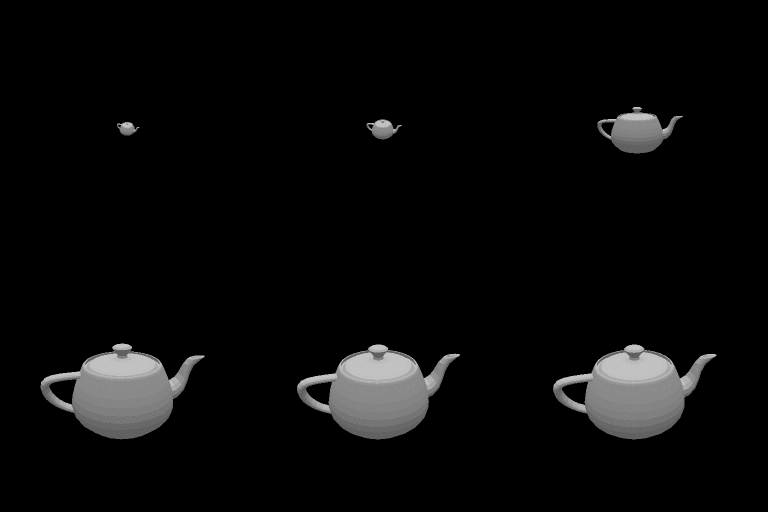
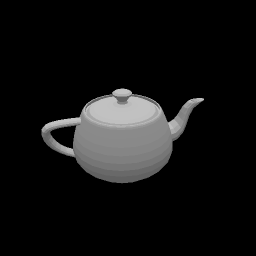
The derivative of images with respect to camera pose can be computed through this renderer. In this example the position of the camera is optimized by gradient descent.

From left to right: reference image, initial state, and optimization process.
Citation

@InProceedings{kato2018renderer
    title={Neural 3D Mesh Renderer},
    author={Kato, Hiroharu and Ushiku, Yoshitaka and Harada, Tatsuya},
    booktitle={The IEEE Conference on Computer Vision and Pattern Recognition (CVPR)},
    year={2018}
}
Owner
Daniilidis Group University of Pennsylvania
Research group of Prof. Kostas Daniilidis
Daniilidis Group University of Pennsylvania
This is a deep learning-based method to segment deep brain structures and a brain mask from T1 weighted MRI.

DBSegment This tool generates 30 deep brain structures segmentation, as well as a brain mask from T1-Weighted MRI. The whole procedure should take ~1

Luxembourg Neuroimaging (Platform OpNeuroImg) 2 Oct 25, 2022
Multiple-Object Tracking with Transformer

TransTrack: Multiple-Object Tracking with Transformer Introduction TransTrack: Multiple-Object Tracking with Transformer Models Training data Training

Peize Sun 537 Jan 04, 2023
This is the source code for generating the ASL-Skeleton3D and ASL-Phono datasets. Check out the README.md for more details.

ASL-Skeleton3D and ASL-Phono Datasets Generator The ASL-Skeleton3D contains a representation based on mapping into the three-dimensional space the coo

Cleison Amorim 5 Nov 20, 2022
Implementation of H-UCRL Algorithm

Implementation of H-UCRL Algorithm This repository is an implementation of the H-UCRL algorithm introduced in Curi, S., Berkenkamp, F., & Krause, A. (

Sebastian Curi 25 May 20, 2022
MG-GCN: Scalable Multi-GPU GCN Training Framework

MG-GCN MG-GCN: multi-GPU GCN training framework. For more information, please read our paper. After cloning our repository, run git submodule update -

Translational Data Analytics (TDA) Lab @GaTech 6 Oct 24, 2022
This is the official implementation of "One Question Answering Model for Many Languages with Cross-lingual Dense Passage Retrieval".

CORA This is the official implementation of the following paper: Akari Asai, Xinyan Yu, Jungo Kasai and Hannaneh Hajishirzi. One Question Answering Mo

Akari Asai 59 Dec 28, 2022
Linear algebra python - Number of operations and problems in Linear Algebra and Numerical Linear Algebra

Linear algebra in python Number of operations and problems in Linear Algebra and

Alireza 5 Oct 09, 2022
Unofficial implementation of "TTNet: Real-time temporal and spatial video analysis of table tennis" (CVPR 2020)

TTNet-Pytorch The implementation for the paper "TTNet: Real-time temporal and spatial video analysis of table tennis" An introduction of the project c

Nguyen Mau Dung 438 Dec 29, 2022
Byte-based multilingual transformer TTS for low-resource/few-shot language adaptation.

One model to speak them all 🌎 Audio Language Text ▷ Chinese 人人生而自由,在尊严和权利上一律平等。 ▷ English All human beings are born free and equal in dignity and rig

Mutian He 60 Nov 14, 2022
HMLLDB is a collection of LLDB commands to assist in the debugging of iOS apps.

HMLLDB is a collection of LLDB commands to assist in the debugging of iOS apps. 中文介绍 Features Non-intrusive. Your iOS project does not need to be modi

mao2020 47 Oct 22, 2022
E2VID_ROS - E2VID_ROS: E2VID to a real-time system

E2VID_ROS Introduce We extend E2VID to a real-time system. Because Python ROS ca

Robin Shaun 7 Apr 17, 2022
PyTorch implementation of Interpretable Explanations of Black Boxes by Meaningful Perturbation

PyTorch implementation of Interpretable Explanations of Black Boxes by Meaningful Perturbation The paper: https://arxiv.org/abs/1704.03296 What makes

Jacob Gildenblat 322 Dec 17, 2022
Procedural 3D data generation pipeline for architecture

Synthetic Dataset Generator Authors: Stanislava Fedorova Alberto Tono Meher Shashwat Nigam Jiayao Zhang Amirhossein Ahmadnia Cecilia bolognesi Dominik

Computational Design Institute 49 Nov 25, 2022
Adversarial vulnerability of powerful near out-of-distribution detection

Adversarial vulnerability of powerful near out-of-distribution detection by Stanislav Fort In this repository we're collecting replications for the ke

Stanislav Fort 9 Aug 30, 2022
Prototypical Cross-Attention Networks for Multiple Object Tracking and Segmentation, NeurIPS 2021 Spotlight

PCAN for Multiple Object Tracking and Segmentation This is the offical implementation of paper PCAN for MOTS. We also present a trailer that consists

ETH VIS Group 328 Dec 29, 2022
The aim of this project is to build an AI bot that can play the Wordle game, or more generally Squabble

Wordle RL The aim of this project is to build an AI bot that can play the Wordle game, or more generally Squabble I know there are more deterministic

Aditya Arora 3 Feb 22, 2022
Implementation of "GNNAutoScale: Scalable and Expressive Graph Neural Networks via Historical Embeddings" in PyTorch

PyGAS: Auto-Scaling GNNs in PyG PyGAS is the practical realization of our G NN A uto S cale (GAS) framework, which scales arbitrary message-passing GN

Matthias Fey 139 Dec 25, 2022
Code for "Searching for Efficient Multi-Stage Vision Transformers"

Searching for Efficient Multi-Stage Vision Transformers This repository contains the official Pytorch implementation of "Searching for Efficient Multi

Yi-Lun Liao 62 Oct 25, 2022
Physics-informed convolutional-recurrent neural networks for solving spatiotemporal PDEs

PhyCRNet Physics-informed convolutional-recurrent neural networks for solving spatiotemporal PDEs Paper link: [ArXiv] By: Pu Ren, Chengping Rao, Yang

Pu Ren 11 Aug 23, 2022
Code for the paper "Benchmarking and Analyzing Point Cloud Classification under Corruptions"

ModelNet-C Code for the paper "Benchmarking and Analyzing Point Cloud Classification under Corruptions". For the latest updates, see: sites.google.com

Jiawei Ren 45 Dec 28, 2022