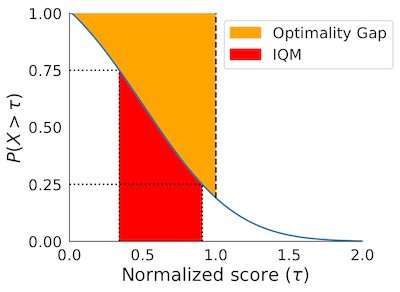
rliable is an open-source Python library for reliable evaluation, even with a handful of runs, on reinforcement learning and machine learnings benchmarks.

Overview

rliable

rliable is an open-source Python library for reliable evaluation, even with a handful of runs, on reinforcement learning and machine learnings benchmarks.

Desideratum Current evaluation approach Our Recommendation
Uncertainty in aggregate performance Point estimates:
  • Ignore statistical uncertainty
  • Hinder results reproducibility
Interval estimates using stratified bootstrap confidence intervals (CIs)
Performance variability across tasks and runs Tables with task mean scores:
  • Overwhelming beyond a few tasks
  • Standard deviations frequently omitted
  • Incomplete picture for multimodal and heavy-tailed distributions
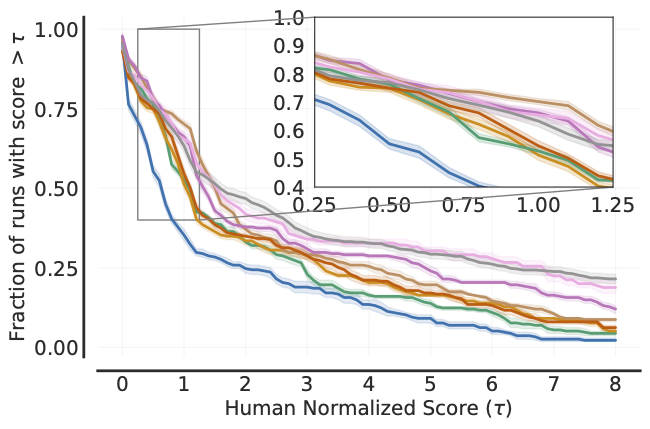
Score distributions (performance profiles):
  • Show tail distribution of scores on combined runs across tasks
  • Allow qualitative comparisons
  • Easily read any score percentile
Aggregate metrics for summarizing benchmark performance Mean:
  • Often dominated by performance on outlier tasks
  Median:
  • Statistically inefficient (requires a large number of runs to claim improvements)
  • Poor indicator of overall performance: 0 scores on nearly half the tasks doesn't change it
Interquartile Mean (IQM) across all runs:
  • Performance on middle 50% of combined runs
  • Robust to outlier scores but more statistically efficient than median
To show other aspects of performance gains, report Probability of improvement and Optimality gap

rliable provides support for:

  • Stratified Bootstrap Confidence Intervals (CIs)
  • Performance Profiles (with plotting functions)
  • Aggregate metrics
    • Interquartile Mean (IQM) across all runs
    • Optimality Gap
    • Probability of Improvement

Interactive colab

We provide a colab at bit.ly/statistical_precipice_colab, which shows how to use the library with examples of published algorithms on widely used benchmarks including Atari 100k, ALE, DM Control and Procgen.

Paper

For more details, refer to the accompanying NeurIPS 2021 paper (Oral): Deep Reinforcement Learning at the Edge of the Statistical Precipice.

Installation

To install rliable, run:

pip install -U rliable

To install latest version of rliable as a package, run:

pip install git+https://github.com/google-research/rliable

To import rliable, we suggest:

from rliable import library as rly
from rliable import metrics
from rliable import plot_utils

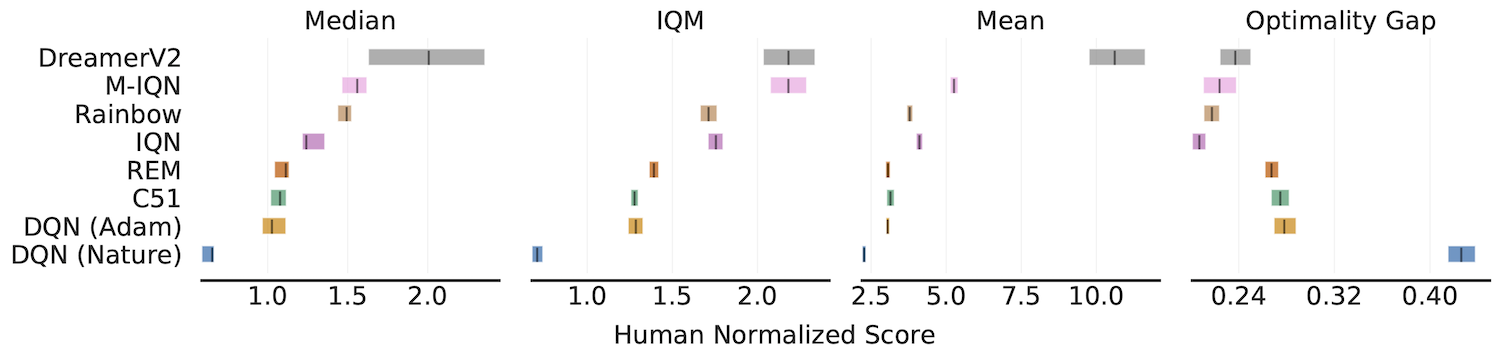
Aggregate metrics with 95% Stratified Bootstrap CIs

IQM, Optimality Gap, Median, Mean
algorithms = ['DQN (Nature)', 'DQN (Adam)', 'C51', 'REM', 'Rainbow',
              'IQN', 'M-IQN', 'DreamerV2']
# Load ALE scores as a dictionary mapping algorithms to their human normalized
# score matrices, each of which is of size `(num_runs x num_games)`.
atari_200m_normalized_score_dict = ...
aggregate_func = lambda x: np.array([
  metrics.aggregate_median(x),
  metrics.aggregate_iqm(x),
  metrics.aggregate_mean(x),
  metrics.aggregate_optimality_gap(x)])
aggregate_scores, aggregate_score_cis = rly.get_interval_estimates(
  atari_200m_normalized_score_dict, aggregate_func, reps=50000)
fig, axes = plot_utils.plot_interval_estimates(
  aggregate_scores, aggregate_score_cis,
  metric_names=['Median', 'IQM', 'Mean', 'Optimality Gap'],
  algorithms=algorithms, xlabel='Human Normalized Score')
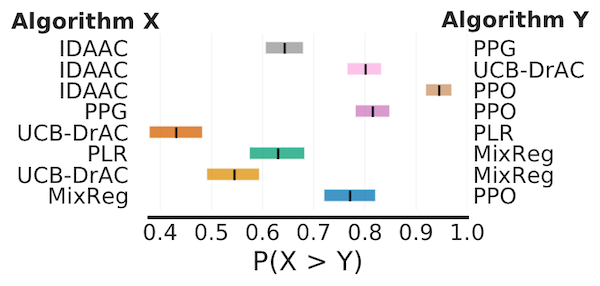
Probability of Improvement
# Load ProcGen scores as a dictionary containing pairs of normalized score
# matrices for pairs of algorithms we want to compare
procgen_algorithm_pairs = {.. , 'x,y': (score_x, score_y), ..}
average_probabilities, average_prob_cis = rly.get_interval_estimates(
  procgen_algorithm_pairs, metrics.probability_of_improvement, reps=50000)
plot_probability_of_improvement(average_probabilities, average_prob_cis)
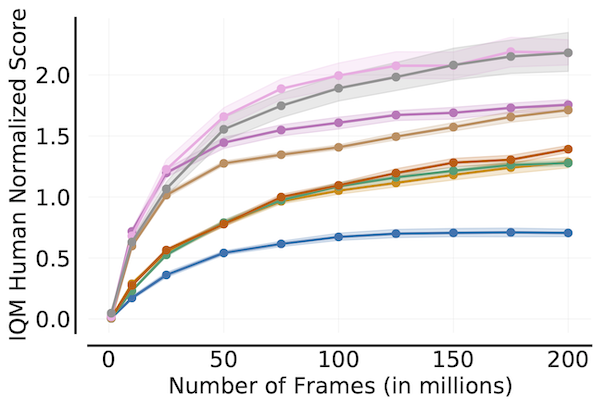
Sample Efficiency Curve

algorithms = ['DQN (Nature)', 'DQN (Adam)', 'C51', 'REM', 'Rainbow',
              'IQN', 'M-IQN', 'DreamerV2']
# Load ALE scores as a dictionary mapping algorithms to their human normalized
# score matrices across all 200 million frames, each of which is of size
# `(num_runs x num_games x 200)` where scores are recorded every million frame.
ale_all_frames_scores_dict = ...
frames = np.array([1, 10, 25, 50, 75, 100, 125, 150, 175, 200]) - 1
ale_frames_scores_dict = {algorithm: score[:, :, frames] for algorithm, score
                          in ale_all_frames_scores_dict.items()}
iqm = lambda scores: np.array([metrics.aggregate_iqm(scores[..., frame])
                               for frame in range(scores.shape[-1])])
iqm_scores, iqm_cis = rly.get_interval_estimates(
  ale_frames_scores_dict, iqm, reps=50000)
plot_utils.plot_sample_efficiency_curve(
    frames+1, iqm_scores, iqm_cis, algorithms=algorithms,
    xlabel=r'Number of Frames (in millions)',
    ylabel='IQM Human Normalized Score')

Performance Profiles

# Load ALE scores as a dictionary mapping algorithms to their human normalized
# score matrices, each of which is of size `(num_runs x num_games)`.
atari_200m_normalized_score_dict = ...
# Human normalized score thresholds
atari_200m_thresholds = np.linspace(0.0, 8.0, 81)
score_distributions, score_distributions_cis = rly.create_performance_profile(
    atari_200m_normalized_score_dict, atari_200m_thresholds)
# Plot score distributions
fig, ax = plt.subplots(ncols=1, figsize=(7, 5))
plot_utils.plot_performance_profiles(
  score_distributions, atari_200m_thresholds,
  performance_profile_cis=score_distributions_cis,
  colors=dict(zip(algorithms, sns.color_palette('colorblind'))),
  xlabel=r'Human Normalized Score $(\tau)$',
  ax=ax)
The above profile can also be plotted with non-linear scaling as follows:

plot_utils.plot_performance_profiles(
  perf_prof_atari_200m, atari_200m_tau,
  performance_profile_cis=perf_prof_atari_200m_cis,
  use_non_linear_scaling=True,
  xticks = [0.0, 0.5, 1.0, 2.0, 4.0, 8.0]
  colors=dict(zip(algorithms, sns.color_palette('colorblind'))),
  xlabel=r'Human Normalized Score $(\tau)$',
  ax=ax)

Dependencies

The code was tested under Python>=3.7 and uses these packages:

  • arch >= 4.19
  • scipy >= 1.7.0
  • numpy >= 0.9.0
  • absl-py >= 1.16.4

Citing

If you find this open source release useful, please reference in your paper:

@article{agarwal2021deep,
  title={Deep Reinforcement Learning at the Edge of the Statistical Precipice},
  author={Agarwal, Rishabh and Schwarzer, Max and Castro, Pablo Samuel
          and Courville, Aaron and Bellemare, Marc G},
  journal={Advances in Neural Information Processing Systems},
  year={2021}
}

Disclaimer: This is not an official Google product.

Comments
  • RAD results may be incorrect.

    RAD results may be incorrect.

    Hi @agarwl. I found that the 'step' in RAD's 'eval.log' refers to the policy step. But the 'step' in 'xxx--eval_scores.npy' refers to the environment step. We know that 'environment step = policy step * action_repreat'.

    Here comes a problem: if you use the results of 100k steps in 'eval.log', then you actually evaluate the scores at 100k*action_repeat steps. This will lead to the overestimation of RAD. And I wonder whether you do such incorrect evaluations, or you take the results in 'xxx--eval_scores.npy', which are correct in terms of 'steps'. You may refer to a similar question in https://github.com/MishaLaskin/rad/issues/15.

    I reproduced the results of RAD locally, and I found my results are much worse than the reported ones (in your paper). I list them in the following figure. QQ20211223-153829

    I compare the means of each task. Obviously, there is a huge gap, and my results are close to the ones reported by DrQ authors (see the Table in https://github.com/MishaLaskin/rad/issues/1). I guess you may evaluate scores at incorrect environment steps? So, could you please offer more details when evaluating RAD? Thanks :)

    opened by TaoHuang13 19
  • Installation fails on MacBook Pro with M1 chip

    Installation fails on MacBook Pro with M1 chip

    The installation fails on my MacBook Pro with M1 chip.

    I also tried on a MacBook Pro with an Intel chip (and the same OS version) and on a Linux system: the installation was successful on both configurations.

    $ cd rliable
    $ pip install -e .
    Obtaining file:///Users/quentingallouedec/rliable
      Preparing metadata (setup.py) ... done
    Collecting arch==5.0.1
      Using cached arch-5.0.1.tar.gz (937 kB)
      Installing build dependencies ... error
      error: subprocess-exited-with-error
    
    ... # Log too long for GitHub issue
    
    error: subprocess-exited-with-error
    
    × pip subprocess to install build dependencies did not run successfully.
    │ exit code: 1
    ╰─> See above for output.
    
    note: This error originates from a subprocess, and is likely not a problem with pip.
    

    System info

    • Python version: 3.9
    • System Version: macOS 12.4 (21F79)
    • Kernel Version: Darwin 21.5.0

    What I've tried

    Install only arch 5.0.1

    It seems to be related with the installation of arch. I've tried to pip install arch==5.0.1 and it also failed with the same logs.

    Install the last version of arch

    I've tried to pip install arch (current version: 5.2.0), and it worked.

    Use rliable with the last version of arch

    Since I can install arch==5.2.0, I've tried to make rliable work with arch 5.2.0 (by modifying manually setup.py). Pytest failed. Here is the logs for one of the failing unitest:

    _____________________________________________ LibraryTest.test_stratified_bootstrap_runs_and_tasks _____________________________________________
    
    self = <library_test.LibraryTest testMethod=test_stratified_bootstrap_runs_and_tasks>, task_bootstrap = True
    
        @parameterized.named_parameters(
            dict(testcase_name="runs_only", task_bootstrap=False),
            dict(testcase_name="runs_and_tasks", task_bootstrap=True))
        def test_stratified_bootstrap(self, task_bootstrap):
          """Tests StratifiedBootstrap."""
          bs = rly.StratifiedBootstrap(
              self._x, y=self._y, z=self._z, task_bootstrap=task_bootstrap)
    >     for data, kwdata in bs.bootstrap(5):
    
    tests/rliable/library_test.py:40: 
    _ _ _ _ _ _ _ _ _ _ _ _ _ _ _ _ _ _ _ _ _ _ _ _ _ _ _ _ _ _ _ _ _ _ _ _ _ _ _ _ _ _ _ _ _ _ _ _ _ _ _ _ _ _ _ _ _ _ _ _ _ _ _ _ _ _ _ _ _ _ _ _ 
    env/lib/python3.9/site-packages/arch/bootstrap/base.py:694: in bootstrap
        yield self._resample()
    _ _ _ _ _ _ _ _ _ _ _ _ _ _ _ _ _ _ _ _ _ _ _ _ _ _ _ _ _ _ _ _ _ _ _ _ _ _ _ _ _ _ _ _ _ _ _ _ _ _ _ _ _ _ _ _ _ _ _ _ _ _ _ _ _ _ _ _ _ _ _ _ 
    
    self = Stratified Bootstrap(no. pos. inputs: 1, no. keyword inputs: 2, ID: 0x15b353a00)
    
        def _resample(self) -> Tuple[Tuple[ArrayLike, ...], Dict[str, ArrayLike]]:
            """
            Resample all data using the values in _index
            """
            indices = self._index
    >       assert isinstance(indices, np.ndarray)
    E       AssertionError
    
    env/lib/python3.9/site-packages/arch/bootstrap/base.py:1294: AssertionError
    _______________________________________________ LibraryTest.test_stratified_bootstrap_runs_only ________________________________________________
    
    self = <library_test.LibraryTest testMethod=test_stratified_bootstrap_runs_only>, task_bootstrap = False
    
        @parameterized.named_parameters(
            dict(testcase_name="runs_only", task_bootstrap=False),
            dict(testcase_name="runs_and_tasks", task_bootstrap=True))
        def test_stratified_bootstrap(self, task_bootstrap):
          """Tests StratifiedBootstrap."""
          bs = rly.StratifiedBootstrap(
              self._x, y=self._y, z=self._z, task_bootstrap=task_bootstrap)
    >     for data, kwdata in bs.bootstrap(5):
    
    tests/rliable/library_test.py:40: 
    _ _ _ _ _ _ _ _ _ _ _ _ _ _ _ _ _ _ _ _ _ _ _ _ _ _ _ _ _ _ _ _ _ _ _ _ _ _ _ _ _ _ _ _ _ _ _ _ _ _ _ _ _ _ _ _ _ _ _ _ _ _ _ _ _ _ _ _ _ _ _ _ 
    env/lib/python3.9/site-packages/arch/bootstrap/base.py:694: in bootstrap
        yield self._resample()
    _ _ _ _ _ _ _ _ _ _ _ _ _ _ _ _ _ _ _ _ _ _ _ _ _ _ _ _ _ _ _ _ _ _ _ _ _ _ _ _ _ _ _ _ _ _ _ _ _ _ _ _ _ _ _ _ _ _ _ _ _ _ _ _ _ _ _ _ _ _ _ _ 
    
    self = Stratified Bootstrap(no. pos. inputs: 1, no. keyword inputs: 2, ID: 0x15b2ff1f0)
    
        def _resample(self) -> Tuple[Tuple[ArrayLike, ...], Dict[str, ArrayLike]]:
            """
            Resample all data using the values in _index
            """
            indices = self._index
    >       assert isinstance(indices, np.ndarray)
    E       AssertionError
    
    env/lib/python3.9/site-packages/arch/bootstrap/base.py:1294: AssertionError
    

    It seems like there are breaking changes between arch 5.0.1 and arch 5.2.0. Maybe this issue can be solved by updating this dependency to it's current version.

    opened by qgallouedec 10
  • Bug in plot_utils.py

    Bug in plot_utils.py

    Hi,

    In plot_utils.py, I think this line ought to be algorithms = list(point_estimates.keys()) https://github.com/google-research/rliable/blob/72fc16c31c4021b72e7b21f3ba915e1b38cff481/rliable/plot_utils.py#L245 Otherwise, algorithms cannot be indexed in the next line.

    opened by zhefan 2
  • Question about documentation in probability_of_improvement

    Question about documentation in probability_of_improvement

    Hi, I wonder if the documentation in probability_of_improvement function in metrics.py is wrong? Specifically,

    scores_x: A matrix of size (num_runs_x x num_tasks) where scores_x[m][n] represent the score on run n of task m for algorithm X. https://github.com/google-research/rliable/blob/cc5eff51cab488b34cfeb5c5e37eae7a6b4a92b2/rliable/metrics.py#L77)

    Should scores_x[n][m] be the score on run n of task m for algorithm X?

    Thanks.

    opened by zhefan 2
  • Downloading data set always stuck

    Downloading data set always stuck

    Thanks for sharing the repo. There is a problem that every time I download the dataset, it is always stuck somewhere at 9X% Do you know what might cause this?

    ...
    Copying gs://rl-benchmark-data/atari_100k/SimPLe.json...
    Copying gs://rl-benchmark-data/atari_100k/OTRainbow.json...
    [55/59 files][  2.9 MiB/  3.0 MiB]  98% Done
    
    opened by HYDesmondLiu 2
  • Fix dict_keys object -> list

    Fix dict_keys object -> list

    This fixes a downstream task where algorithms[0] in the following line fails because point_estimates.keys() returns a dict_keys object, not a subscriptable list.

    opened by jjshoots 1
  • How can I access the data directly without using gsutil?

    How can I access the data directly without using gsutil?

    I haven't got gsutil set up on my M1 MacBook and I'm not sure the steps are super streamlined. Can I somehow access the data from my browser or download it another way?

    documentation 
    opened by slerman12 1
  • Add installation of compatible arch version to notebook

    Add installation of compatible arch version to notebook

    Latest arch version raises an exception when calling create_performance_profile. Adding !pip install arch==5.0.1 to the notebook file resolves the issue. This change should be reflected in the hosted colab notebook.

    opened by Aladoro 1
  • Customisable linestyles in performance profile plots

    Customisable linestyles in performance profile plots

    The primary reason for this PR is an added option for customising linestyles in performance profile plots. It works in exactly the same way as the colors parameter it already had; a map, None by default which means all methods are plotted as solid lines, but a map can be passed in to change the linestyles of every method's plot.

    Here you can see, as an example, a plot I'm currently working on where I'm using this functionality to have some methods plotted as dotted lines instead of solid ones:

    afbeelding

    Additionally, I have added a .gitignore file to ignore some files that were automatically created when I installed rliable with pip from local source code in my own fork of the repo, and files created by working with rliable source code in the PyCharm IDE.

    opened by DennisSoemers 1
  • README image link broken: ale_score_distributions_new.png

    README image link broken: ale_score_distributions_new.png

    It seems that the file images/ale_score_distributions_new.png pointed to in the README (https://github.com/google-research/rliable#performance-profiles) was deleted in one of the recent commits.

    opened by nirbhayjm 1
  • Urgent question about data aggregates

    Urgent question about data aggregates

    Hi, we compiled the Atari 100k results from DrQ, CURL, and DER, and the mean/median human-norm scores are well below those reported in prior works, including from co-authors of the rliable paper.

    We have median human-norm scores all around 0.10 - 0.12.

    Is this accurate? Of all of these, DER (the oldest of the algs) has the highest mean human-norm score.

    opened by slerman12 1
Releases(v1.0)
Object tracking using YOLO and a tracker(KCF, MOSSE, CSRT) in openCV

Object tracking using YOLO and a tracker(KCF, MOSSE, CSRT) in openCV File YOLOv3 weight can be downloaded

Ngoc Quyen Ngo 2 Mar 27, 2022
Breast Cancer Detection 🔬 ITI "AI_Pro" Graduation Project

BreastCancerDetection - This program is designed to predict two severity of abnormalities associated with breast cancer cells: benign and malignant. Mammograms from MIAS is preprocessed and features

6 Nov 29, 2022
[ICML 2020] DrRepair: Learning to Repair Programs from Error Messages

DrRepair: Learning to Repair Programs from Error Messages This repo provides the source code & data of our paper: Graph-based, Self-Supervised Program

Michihiro Yasunaga 155 Jan 08, 2023
Unofficial TensorFlow implementation of the Keyword Spotting Transformer model

Keyword Spotting Transformer This is the unofficial TensorFlow implementation of the Keyword Spotting Transformer model. This model is used to train o

Intelligent Machines Limited 8 May 11, 2022
Code for Pose-Controllable Talking Face Generation by Implicitly Modularized Audio-Visual Representation (CVPR 2021)

Pose-Controllable Talking Face Generation by Implicitly Modularized Audio-Visual Representation (CVPR 2021) Hang Zhou, Yasheng Sun, Wayne Wu, Chen Cha

Hang_Zhou 628 Dec 28, 2022
[CVPR2021] Invertible Image Signal Processing

Invertible Image Signal Processing This repository includes official codes for "Invertible Image Signal Processing (CVPR2021)". Figure: Our framework

Yazhou XING 281 Dec 31, 2022
The Balloon Learning Environment - flying stratospheric balloons with deep reinforcement learning.

Balloon Learning Environment Docs The Balloon Learning Environment (BLE) is a simulator for stratospheric balloons. It is designed as a benchmark envi

Google 87 Dec 25, 2022
Xintao 1.4k Dec 25, 2022
Mscp jamf - Build compliance in jamf

mscp_jamf Build compliance in Jamf. This will build the following xml pieces to

Bob Gendler 3 Jul 25, 2022
Pytorch and Torch testing code of CartoonGAN

CartoonGAN-Test-Pytorch-Torch Pytorch and Torch testing code of CartoonGAN [Chen et al., CVPR18]. With the released pretrained models by the authors,

Yijun Li 642 Dec 27, 2022
Implementation of Deformable Attention in Pytorch from the paper "Vision Transformer with Deformable Attention"

Deformable Attention Implementation of Deformable Attention from this paper in Pytorch, which appears to be an improvement to what was proposed in DET

Phil Wang 128 Dec 24, 2022
U-2-Net: U Square Net - Modified for paired image training of style transfer

U2-Net: U Square Net Modified for paired image training of style transfer This is an unofficial repo making use of the code which was made available b

Doron Adler 43 Oct 03, 2022
Semi-Supervised Learning with Ladder Networks in Keras. Get 98% test accuracy on MNIST with just 100 labeled examples !

Semi-Supervised Learning with Ladder Networks in Keras This is an implementation of Ladder Network in Keras. Ladder network is a model for semi-superv

Divam Gupta 101 Sep 07, 2022
This is an official implementation of the High-Resolution Transformer for Dense Prediction.

High-Resolution Transformer for Dense Prediction Introduction This is the official implementation of High-Resolution Transformer (HRT). We present a H

HRNet 403 Dec 13, 2022
Multi-Person Extreme Motion Prediction

Multi-Person Extreme Motion Prediction Implementation for paper Wen Guo, Xiaoyu Bie, Xavier Alameda-Pineda, Francesc Moreno-Noguer, Multi-Person Extre

GUO-W 38 Nov 15, 2022
DCA - Official Python implementation of Delaunay Component Analysis algorithm

Delaunay Component Analysis (DCA) Official Python implementation of the Delaunay

Petra Poklukar 9 Sep 06, 2022
Keras community contributions

keras-contrib : Keras community contributions Keras-contrib is deprecated. Use TensorFlow Addons. The future of Keras-contrib: We're migrating to tens

Keras 1.6k Dec 21, 2022
[ICCV 2021 Oral] Just Ask: Learning to Answer Questions from Millions of Narrated Videos

Just Ask: Learning to Answer Questions from Millions of Narrated Videos Webpage • Demo • Paper This repository provides the code for our paper, includ

Antoine Yang 87 Jan 05, 2023
Github Traffic Insights as Prometheus metrics.

github-traffic Github Traffic collects your repository's traffic data and exposes it as Prometheus metrics. Grafana dashboard that displays the metric

Grafana Labs 34 Oct 27, 2022
use tensorflow 2.0 to tell a dog and cat from a specified picture

dog_or_cat use tensorflow 2.0 to tell a dog and cat from a specified picture This is one of the classic experiments for the introduction of deep learn

你这个代码我看不懂 1 Oct 22, 2021