A PyTorch implementation of a Factorization Machine module in cython.

Overview

fmpytorch

A library for factorization machines in pytorch. A factorization machine is like a linear model, except multiplicative interaction terms between the variables are modeled as well.

The input to a factorization machine layer is a vector, and the output is a scalar. Batching is fully supported.

This is a work in progress. Feedback and bugfixes welcome! Hopefully you find the code useful.

Usage

The factorization machine layers in fmpytorch can be used just like any other built-in module. Here's a simple feed-forward model using a factorization machine that takes in a 50-D input, and models interactions using k=5 factors.

import torch
from fmpytorch.second_order.fm import FactorizationMachine

class MyModel(torch.nn.Module):
    def __init__(self):
        super(MyModel, self).__init__()
        self.linear = torch.nn.Linear(100, 50)
        self.dropout = torch.nn.Dropout(.5)
	# This makes a fm layer mapping from 50-D to 1-D.
	# The number of factors is 5.
        self.fm = FactorizationMachine(50, 5)

    def forward(self, x):
        x = self.linear(x)
        x = self.dropout(x)
        x = self.fm(x)
        return x

See examples/toy.py or examples/regression.py for fuller examples.

Installation

This package requires pytorch, numpy, and cython.

To install, you can run:

cd fmpytorch
sudo python setup.py install

Factorization Machine brief intro

A linear model, given a vector x models its output y as
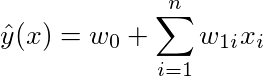
where w are the learnable weights of the model.

However, the interactions between the input variables x_i are purely additive. In some cases, it might be useful to model the interactions between your variables, e.g., x_i * x_j. You could add terms into your model like

However, this introduces a large number of w2 variables. Specifically, there are O(n^2) parameters introduced in this formulation, one for each interaction pair. A factorization machine approximates w2 using low dimensional factors, i.e.,

where each v_i is a low-dimensional vector. This is the forward pass of a second order factorization machine. This low-rank re-formulation has reduced the number of additional parameters for the factorization machine to O(k*n). Magically, the forward (and backward) pass can be reformulated so that it can be computed in O(k*n), rather than the naive O(k*n^2) formulation above.

Currently supported features

Currently, only a second order factorization machine is supported. The forward and backward passes are implemented in cython. Compared to the autodiff solution, the cython passes run several orders of magnitude faster. I've only tested it with python 2 at the moment.

TODOs

  1. Support for sparse tensors.
  2. More interesting useage examples
  3. More testing, e.g., with python 3, etc.
  4. Make sure all of the code plays nice with torch-specific stuff, e.g., GPUs
  5. Arbitrary order factorization machine support
  6. Better organization/code cleaning

Thanks to

Vlad Niculae (@vene) for his sage wisdom.

The original factorization machine citation, which this layer is based off of, is

@inproceedings{rendle2010factorization,
	       title={Factorization machines},
    	       author={Rendle, Steffen},
      	       booktitle={ICDM},
               pages={995--1000},
	       year={2010},
	       organization={IEEE}
}
Owner
Jack Hessel
Research Scientist @ AI2: PhD in CS previously from Cornell
Jack Hessel
Spectralformer: Rethinking hyperspectral image classification with transformers

The code in this toolbox implements the "Spectralformer: Rethinking hyperspectral image classification with transformers". More specifically, it is detailed as follow.

Danfeng Hong 104 Jan 04, 2023
Open source implementation of "A Self-Supervised Descriptor for Image Copy Detection" (SSCD).

A Self-Supervised Descriptor for Image Copy Detection (SSCD) This is the open-source codebase for "A Self-Supervised Descriptor for Image Copy Detecti

Meta Research 68 Jan 04, 2023
LAnguage Model Analysis

LAMA: LAnguage Model Analysis LAMA is a probe for analyzing the factual and commonsense knowledge contained in pretrained language models. The dataset

Meta Research 960 Jan 08, 2023
[ICCV 2021] Self-supervised Monocular Depth Estimation for All Day Images using Domain Separation

ADDS-DepthNet This is the official implementation of the paper Self-supervised Monocular Depth Estimation for All Day Images using Domain Separation I

LIU_LINA 52 Nov 24, 2022
IPATool-py: download ipa easily

IPATool-py Python version of IPATool! Installation pip3 install -r requirements.txt Usage Quickstart: download app with specific bundleId into DIR: p

159 Dec 30, 2022
Tensor-Based Quantum Machine Learning

TensorLy_Quantum TensorLy-Quantum is a Python library for Tensor-Based Quantum Machine Learning that builds on top of TensorLy and PyTorch. Website: h

TensorLy 85 Dec 03, 2022
transfer attack; adversarial examples; black-box attack; unrestricted Adversarial Attacks on ImageNet; CVPR2021 天池黑盒竞赛

transfer_adv CVPR-2021 AIC-VI: unrestricted Adversarial Attacks on ImageNet CVPR2021 安全AI挑战者计划第六期赛道2:ImageNet无限制对抗攻击 介绍 : 深度神经网络已经在各种视觉识别问题上取得了最先进的性能。

25 Dec 08, 2022
Duke Machine Learning Winter School: Computer Vision 2022

mlwscv2002 Welcome to the Duke Machine Learning Winter School: Computer Vision 2022! The MLWS-CV includes 3 hands-on training sessions on implementing

Duke + Data Science (+DS) 9 May 25, 2022
Neural network graphs and training metrics for PyTorch, Tensorflow, and Keras.

HiddenLayer A lightweight library for neural network graphs and training metrics for PyTorch, Tensorflow, and Keras. HiddenLayer is simple, easy to ex

Waleed 1.7k Dec 31, 2022
Official Implementation for HyperStyle: StyleGAN Inversion with HyperNetworks for Real Image Editing

HyperStyle: StyleGAN Inversion with HyperNetworks for Real Image Editing Yuval Alaluf*, Omer Tov*, Ron Mokady, Rinon Gal, Amit H. Bermano *Denotes equ

885 Jan 06, 2023
iris - Open Source Photos Platform Powered by PyTorch

Open Source Photos Platform Powered by PyTorch. Submission for PyTorch Annual Hackathon 2021.

Omkar Prabhu 137 Sep 10, 2022
dataset for ECCV 2020 "Motion Capture from Internet Videos"

Motion Capture from Internet Videos Motion Capture from Internet Videos Junting Dong*, Qing Shuai*, Yuanqing Zhang, Xian Liu, Xiaowei Zhou, Hujun Bao

ZJU3DV 98 Dec 07, 2022
Perception-aware multi-sensor fusion for 3D LiDAR semantic segmentation (ICCV 2021)

Perception-Aware Multi-Sensor Fusion for 3D LiDAR Semantic Segmentation (ICCV 2021) [中文|EN] 概述 本工作主要探索一种高效的多传感器(激光雷达和摄像头)融合点云语义分割方法。现有的多传感器融合方法主要将点云投影

ICE 126 Dec 30, 2022
An Unsupervised Graph-based Toolbox for Fraud Detection

An Unsupervised Graph-based Toolbox for Fraud Detection Introduction: UGFraud is an unsupervised graph-based fraud detection toolbox that integrates s

SafeGraph 99 Dec 11, 2022
Stratified Transformer for 3D Point Cloud Segmentation (CVPR 2022)

Stratified Transformer for 3D Point Cloud Segmentation Xin Lai*, Jianhui Liu*, Li Jiang, Liwei Wang, Hengshuang Zhao, Shu Liu, Xiaojuan Qi, Jiaya Jia

DV Lab 195 Jan 01, 2023
Code of paper Interact, Embed, and EnlargE (IEEE): Boosting Modality-specific Representations for Multi-Modal Person Re-identification.

Interact, Embed, and EnlargE (IEEE): Boosting Modality-specific Representations for Multi-Modal Person Re-identification We provide the codes for repr

12 Dec 12, 2022
UNAVOIDS: Unsupervised and Nonparametric Approach for Visualizing Outliers and Invariant Detection Scoring

UNAVOIDS: Unsupervised and Nonparametric Approach for Visualizing Outliers and Invariant Detection Scoring Code Summary aggregate.py: this script aggr

1 Dec 28, 2021
CycleTransGAN-EVC: A CycleGAN-based Emotional Voice Conversion Model with Transformer

CycleTransGAN-EVC CycleTransGAN-EVC: A CycleGAN-based Emotional Voice Conversion Model with Transformer Demo emotion CycleTransGAN CycleTransGAN Cycle

24 Dec 15, 2022
Apollo optimizer in tensorflow

Apollo Optimizer in Tensorflow 2.x Notes: Warmup is important with Apollo optimizer, so be sure to pass in a learning rate schedule vs. a constant lea

Evan Walters 1 Nov 09, 2021
ExCon: Explanation-driven Supervised Contrastive Learning

ExCon: Explanation-driven Supervised Contrastive Learning Contributors of this repo: Zhibo Zhang ( Zhibo (Darren) Zhang 18 Nov 01, 2022