Implementation of Memory-Compressed Attention, from the paper "Generating Wikipedia By Summarizing Long Sequences"

Overview

Memory Compressed Attention

Implementation of the Self-Attention layer of the proposed Memory-Compressed Attention, in Pytorch. This repository offers both the causal and non-causal variant, and will take care of the padding if the sequence length is not divisible by the compression ratio.

The code also resolves an edge-case where the very first query have no keys to attend to in the auto-regressive scenario. The solution is to use null key/values, appended to the final compressed set, so that there is always at least 1 key for all queries to attend to.

Install

$ pip install memory_compressed_attention

Usage

import torch
from memory_compressed_attention import MemoryCompressedAttention

attn = MemoryCompressedAttention(
    dim = 512,
    heads = 8,                 # number of heads
    causal = False,            # auto-regressive or not
    compression_factor = 3,    # compression ratio
    dropout = 0.1              # dropout post-attention
)

x = torch.randn(1, 1024, 512)
mask = torch.ones(1, 1024).bool()

attn(x, input_mask = mask) # (1, 1024, 512)

Citations

@misc{liu2018generating,
    title={Generating Wikipedia by Summarizing Long Sequences},
    author={Peter J. Liu and Mohammad Saleh and Etienne Pot and Ben Goodrich and Ryan Sepassi and Lukasz Kaiser and Noam Shazeer},
    year={2018},
    eprint={1801.10198},
    archivePrefix={arXiv},
    primaryClass={cs.CL}
}
You might also like...
Memory Efficient Attention (O(sqrt(n)) for Jax and PyTorch

Memory Efficient Attention This is unofficial implementation of Self-attention Does Not Need O(n^2) Memory for Jax and PyTorch. Implementation is almo

 Attention for PyTorch with Linear Memory Footprint
Attention for PyTorch with Linear Memory Footprint

Attention for PyTorch with Linear Memory Footprint Unofficially implements https://arxiv.org/abs/2112.05682 to get Linear Memory Cost on Attention (+

PyTorch code for our paper "Attention in Attention Network for Image Super-Resolution"

Under construction... Attention in Attention Network for Image Super-Resolution (A2N) This repository is an PyTorch implementation of the paper "Atten

Implementation of Transformer in Transformer, pixel level attention paired with patch level attention for image classification, in Pytorch

Transformer in Transformer Implementation of Transformer in Transformer, pixel level attention paired with patch level attention for image c

Implementation of STAM (Space Time Attention Model), a pure and simple attention model that reaches SOTA for video classification

STAM - Pytorch Implementation of STAM (Space Time Attention Model), yet another pure and simple SOTA attention model that bests all previous models in

Official Pytorch Implementation of Relational Self-Attention: What's Missing in Attention for Video Understanding

Relational Self-Attention: What's Missing in Attention for Video Understanding This repository is the official implementation of "Relational Self-Atte

Official implementation of cosformer-attention in cosFormer: Rethinking Softmax in Attention

cosFormer Official implementation of cosformer-attention in cosFormer: Rethinking Softmax in Attention Update log 2022/2/28 Add core code License This

This is a pytorch implementation of the NeurIPS paper GAN Memory with No Forgetting.

GAN Memory for Lifelong learning This is a pytorch implementation of the NeurIPS paper GAN Memory with No Forgetting. Please consider citing our paper

Official and maintained implementation of the paper
Official and maintained implementation of the paper "OSS-Net: Memory Efficient High Resolution Semantic Segmentation of 3D Medical Data" [BMVC 2021].

OSS-Net: Memory Efficient High Resolution Semantic Segmentation of 3D Medical Data Christoph Reich, Tim Prangemeier, Özdemir Cetin & Heinz Koeppl | Pr

Comments
  • The order of masking and softmax operation

    The order of masking and softmax operation

    Hi,

    In memory_compressed_attention.py, I'm wondering if we need to do softmax operation after masking? Btw, if the entry in the mask should be float('-inf') instead of -float('-inf')? If I make something wrong, please correct me.

    image

    Thanks!

    opened by cfeng16 3
  • mask error in attention

    mask error in attention

    Very grateful for your pioneering work! I want to use it in Standard Transformer released in http://nlp.seas.harvard.edu/2018/04/03/attention.html. but it mat a mask error in training. more detail information shown as follow, the code i use: image class ConvCompress(nn.Module): def init(self, dim, ratio = 2, groups = 1): super(ConvCompress, self).init() self.conv = nn.Conv1d(dim, dim, ratio, stride = ratio, groups = groups) #self.linear = nn.Linear(dim, dim)

    def forward(self, mem):
        mem = mem.transpose(1, 2)
        compressed_mem = self.conv(mem)
        return compressed_mem.transpose(1, 2)
    

    class MemoryCompressedAttention(nn.Module): def init(self, h, d_model, compression_factor = 2, dropout = 0.1): super(MemoryCompressedAttention, self).init() assert (d_model % h) == 0, 'dimension must be divisible by number of heads' self.h = h self.d_model = d_model self.d_k = d_model // h

        self.compression_factor = compression_factor
        self.compress_fn = ConvCompress(d_model, compression_factor, groups = h)
    
        #self.to_qkv = nn.Linear(dim, dim * 3, bias = False)
        self.wq = nn.Linear(d_model, d_model, bias = False)
        self.wk = nn.Linear(d_model, d_model, bias = False)
        self.wv = nn.Linear(d_model, d_model, bias = False)
    
        self.wo = nn.Linear(d_model, d_model)
    
        self.dropout = nn.Dropout(dropout)
    
        #self.null_k = nn.Parameter(torch.zeros(1, 1, d_model))
        #self.null_v = nn.Parameter(torch.zeros(1, 1, d_model))
    
    def forward(self, query, key, value, mask = None):
        
        if mask is not None:
            # Same mask applied to all h heads.
            mask = mask.unsqueeze(1)
        nbatches = query.size(0)
        t = query.size(1)
        cf = self.compression_factor
    
        query = self.wq(query)
        key = self.wk(key)
        value = self.wv(value)
    
        # make sure keys and values sequence lengths
        # are divisible by the compression factor
        padding = cf - (t % cf)
        if padding != 0:
            key, value = map(lambda t: F.pad(t, (0, 0, padding, 0)), (key, value))
    
    
        # compress keys and values
        key, value = map(self.compress_fn, (key, value))
    
        # attach a null key and value, in the case that the first query has no keys to pay attention to
        null_k = nn.Parameter(torch.zeros(key.size(0), 1, self.d_model)).cuda()
        null_v = nn.Parameter(torch.zeros(value.size(0), 1, self.d_model)).cuda()
    
        key = torch.cat((null_k, key), dim=1)
        value = torch.cat((null_v, value), dim=1)
        
        # merge heads
        #query, key, value = map(lambda t: t.reshape(*t.shape[:2], h, -1).transpose(1, 2), (query, key, value))
        # 1) Do all the linear projections in batch from d_model => h x d_k
        query = query.view(nbatches, -1, self.h, self.d_k).transpose(1, 2)
        key = key.view(nbatches, -1, self.h, self.d_k).transpose(1, 2)
        value = value.view(nbatches, -1, self.h, self.d_k).transpose(1, 2)
    
      
        # 2) Apply attention on all the projected vectors in batch.
        x, self.attn = attention(query, key, value, mask=mask,
                                 dropout=self.dropout)
    
        # 3) "Concat" using a view and apply a final linear.   # split heads and combine
        x = x.contiguous().view(nbatches, -1, self.d_model)
        out = self.wo(x)
    
        return out
    

    The error was show that image
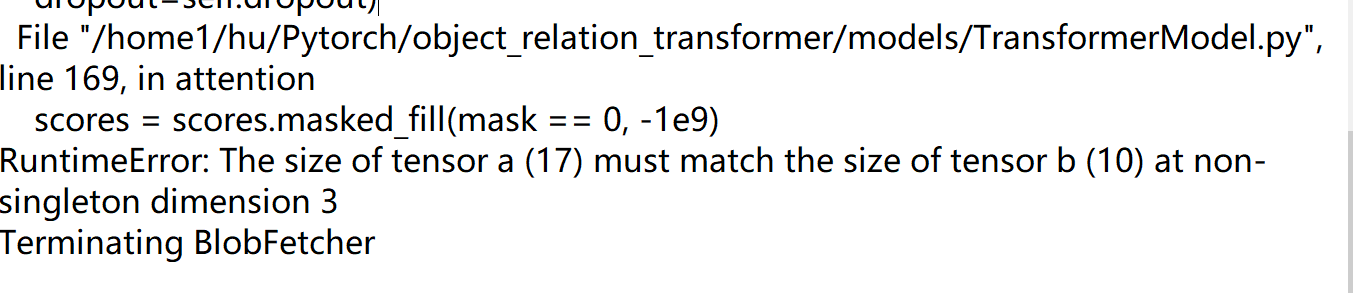
    I want to know how to fix it, and how to do mask for N*M matrix??

    opened by HN123-123 0
Releases(0.0.5)
Owner
Phil Wang
Working with Attention. It's all we need
Phil Wang
KITTI-360 Annotation Tool is a framework that developed based on python(cherrypy + jinja2 + sqlite3) as the server end and javascript + WebGL as the front end.

KITTI-360 Annotation Tool is a framework that developed based on python(cherrypy + jinja2 + sqlite3) as the server end and javascript + WebGL as the front end.

86 Dec 12, 2022
Realtime_Multi-Person_Pose_Estimation

Introduction Multi Person PoseEstimation By PyTorch Results Require Pytorch Installation git submodule init && git submodule update Demo Download conv

tensorboy 1.3k Jan 05, 2023
This project aims at providing a concise, easy-to-use, modifiable reference implementation for semantic segmentation models using PyTorch.

Semantic Segmentation on PyTorch (include FCN, PSPNet, Deeplabv3, Deeplabv3+, DANet, DenseASPP, BiSeNet, EncNet, DUNet, ICNet, ENet, OCNet, CCNet, PSANet, CGNet, ESPNet, LEDNet, DFANet)

2.4k Jan 08, 2023
WHENet - ONNX, OpenVINO, TFLite, TensorRT, EdgeTPU, CoreML, TFJS, YOLOv4/YOLOv4-tiny-3L

HeadPoseEstimation-WHENet-yolov4-onnx-openvino ONNX, OpenVINO, TFLite, TensorRT, EdgeTPU, CoreML, TFJS, YOLOv4/YOLOv4-tiny-3L 1. Usage $ git clone htt

Katsuya Hyodo 49 Sep 21, 2022
BitPack is a practical tool to efficiently save ultra-low precision/mixed-precision quantized models.

BitPack is a practical tool that can efficiently save quantized neural network models with mixed bitwidth.

Zhen Dong 36 Dec 02, 2022
Python library for loading and using triangular meshes.

Trimesh is a pure Python (2.7-3.4+) library for loading and using triangular meshes with an emphasis on watertight surfaces. The goal of the library i

Michael Dawson-Haggerty 2.2k Jan 07, 2023
Code for paper "Learning to Reweight Examples for Robust Deep Learning"

learning-to-reweight-examples Code for paper Learning to Reweight Examples for Robust Deep Learning. [arxiv] Environment We tested the code on tensorf

Uber Research 261 Jan 01, 2023
DAFNe: A One-Stage Anchor-Free Deep Model for Oriented Object Detection

DAFNe: A One-Stage Anchor-Free Deep Model for Oriented Object Detection Code for our Paper DAFNe: A One-Stage Anchor-Free Deep Model for Oriented Obje

Steven Lang 58 Dec 19, 2022
Chunkmogrify: Real image inversion via Segments

Chunkmogrify: Real image inversion via Segments Teaser video with live editing sessions can be found here This code demonstrates the ideas discussed i

David Futschik 112 Jan 04, 2023
Libtorch yolov3 deepsort

Overview It is for my undergrad thesis in Tsinghua University. There are four modules in the project: Detection: YOLOv3 Tracking: SORT and DeepSORT Pr

Xu Wei 226 Dec 13, 2022
DeepLM: Large-scale Nonlinear Least Squares on Deep Learning Frameworks using Stochastic Domain Decomposition (CVPR 2021)

DeepLM DeepLM: Large-scale Nonlinear Least Squares on Deep Learning Frameworks using Stochastic Domain Decomposition (CVPR 2021) Run Please install th

Jingwei Huang 130 Dec 02, 2022
Multi-Agent Reinforcement Learning (MARL) method to learn scalable control polices for multi-agent target tracking.

scalableMARL Scalable Reinforcement Learning Policies for Multi-Agent Control CD. Hsu, H. Jeong, GJ. Pappas, P. Chaudhari. "Scalable Reinforcement Lea

Christopher Hsu 17 Nov 17, 2022
This repository contains the source code of an efficient 1D probabilistic model for music time analysis proposed in ICASSP2022 venue.

Jump Reward Inference for 1D Music Rhythmic State Spaces An implementation of the probablistic jump reward inference model for music rhythmic informat

Mojtaba Heydari 25 Dec 16, 2022
Gym for multi-agent reinforcement learning

PettingZoo is a Python library for conducting research in multi-agent reinforcement learning, akin to a multi-agent version of Gym. Our website, with

Farama Foundation 1.6k Jan 09, 2023
A simple Tensorflow based library for deep and/or denoising AutoEncoder.

libsdae - deep-Autoencoder & denoising autoencoder A simple Tensorflow based library for Deep autoencoder and denoising AE. Library follows sklearn st

Rajarshee Mitra 147 Nov 18, 2022
Object DGCNN and DETR3D, Our implementations are built on top of MMdetection3D.

Object DGCNN & DETR3D This repo contains the implementations of Object DGCNN (https://arxiv.org/abs/2110.06923) and DETR3D (https://arxiv.org/abs/2110

Wang, Yue 539 Jan 07, 2023
Visual Memorability for Robotic Interestingness via Unsupervised Online Learning (ECCV 2020 Oral and TRO)

Visual Interestingness Refer to the project description for more details. This code based on the following paper. Chen Wang, Yuheng Qiu, Wenshan Wang,

Chen Wang 36 Sep 08, 2022
You Only Look Once for Panopitic Driving Perception

You Only 👀 Once for Panoptic 🚗 Perception You Only Look at Once for Panoptic driving Perception by Dong Wu, Manwen Liao, Weitian Zhang, Xinggang Wan

Hust Visual Learning Team 1.4k Jan 04, 2023
ReSSL: Relational Self-Supervised Learning with Weak Augmentation

ReSSL: Relational Self-Supervised Learning with Weak Augmentation This repository contains PyTorch evaluation code, training code and pretrained model

mingkai 45 Oct 25, 2022
Robot Hacking Manual (RHM). From robotics to cybersecurity. Papers, notes and writeups from a journey into robot cybersecurity.

RHM: Robot Hacking Manual Download in PDF RHM v0.4 ┃ Read online The Robot Hacking Manual (RHM) is an introductory series about cybersecurity for robo

Víctor Mayoral Vilches 233 Dec 30, 2022