
It is a forest of random projection trees

Overview

rpforest

rpforest

CircleCI

rpforest is a Python library for approximate nearest neighbours search: finding points in a high-dimensional space that are close to a given query point in a fast but approximate manner.

rpforest differs from alternative ANN packages such as annoy by not requiring the storage of all the vectors indexed in the model. Used in this way, rpforest serves to produce a list of candidate ANNs for use by a further service where point vectors are stored (for example, a relational database).

How it works

It works by building a forest of N binary random projection trees.

In each tree, the set of training points is recursively partitioned into smaller and smaller subsets until a leaf node of at most M points is reached. Each parition is based on the cosine of the angle the points make with a randomly drawn hyperplane: points whose angle is smaller than the median angle fall in the left partition, and the remaining points fall in the right partition.

The resulting tree has predictable leaf size (no larger than M) and is approximately balanced because of median splits, leading to consistent tree traversal times.

Querying the model is accomplished by traversing each tree to the query point's leaf node to retrieve ANN candidates from that tree, then merging them and sorting by distance to the query point.

Installation

  1. Install numpy first.
  2. Install rpforest using pip: pip install rpforest

Usage

Fitting

Model fitting is straightforward:

from rpforest import RPForest

model = RPForest(leaf_size=50, no_trees=10)
model.fit(X)

The speed-precision tradeoff is governed by the leaf_size and no_trees parameters. Increasing leaf_size leads the model to produce shallower trees with larger leaf nodes; increasing no_trees fits more trees.

In-memory queries

Where the entire set of points can be kept in memory, rpforest supports in-memory ANN queries. After fitting, ANNs can be obtained by calling:

nns = model.query(x_query, 10)

Return nearest neighbours for vector x by first retrieving candidate NNs from x's leaf nodes, then merging them and sorting by cosine similarity with x. At most no_trees * leaf_size NNs will can be returned.

Candidate queries

rpforest can support indexing and candidate ANN queries on datasets larger than would fit in available memory. This is accomplished by first fitting the model on a subset of the data, then indexing a larger set of data into the fitted model:

from rpforest import RPForest

model = RPForest(leaf_size=50, no_trees=10)
model.fit(X_train)

model.clear()  # Deletes X_train vectors

for point_id, x in get_x_vectors():
     model.index(point_id, x)

nns = model.get_candidates(x_query, 10)

Model persistence

Model persistence is achieved simply by pickling and unpickling.

model = pickle.loads(pickle.dumps(model))

Performance

Erik Bernhardsson, the author of annoy, maintains an ANN performance shootout repository, comparing a number of Python ANN packages.

On the GloVe cosine distance benchmark, rpforest is not as fast as highly optimised C and C++ packages like FLANN and annoy. However, it far outerpforms scikit-learn's LSHForest and panns.
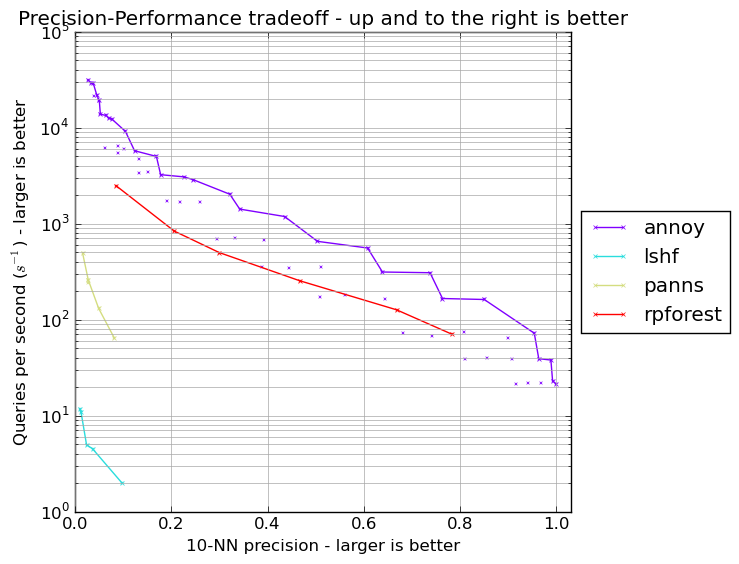
Performance

Development

Pull requests are welcome. To install for development:

  1. Clone the rpforest repository: git clone [email protected]:lyst/rpforest.git
  2. Install it for development using pip: cd rpforest && pip install -e .
  3. You can run tests by running python setupy.py test.

When making changes to the .pyx extension files, you'll need to run python setup.py cythonize in order to produce the extension .cpp files before running pip install -e ..

Comments
  • Is rpforest supports custom similarity/distance function

    Is rpforest supports custom similarity/distance function

    hi, @maciejkula , According to your paper titled "Metadata Embeddings for User and Item Cold-start Recommendations", lyst generate recommendation using lightfm and some kind of ANN algorithm. So I came to rpforest in lyst's repository and I think maybe that's exactly the ANN. Now Suppose that we have trained a lightfm model, include embeddings and bias. It seems that it is still hard to rapidly generate top-k recommendation using rpforest, Since as Readme said, rpforest is based on cosine similarity, however, the score for a user-item pair in lightfm is the sum of a dot product of two embeddings and two bias. So my question is:

    Is rpforest supports custom similarity/distance function, or some other way can achieve top-k recommendation?

    thanks jianyi

    opened by hiyijian 10
  • Compile error when installing rpforest

    Compile error when installing rpforest

    In file included from rpforest/rpforest_fast.cpp:271:
    
    In file included from /usr/local/lib/python2.7/site-packages/numpy/core/include/numpy/arrayobject.h:4:
    
    In file included from /usr/local/lib/python2.7/site-packages/numpy/core/include/numpy/ndarrayobject.h:17:
    
    In file included from /usr/local/lib/python2.7/site-packages/numpy/core/include/numpy/ndarraytypes.h:1804:
    
    /usr/local/lib/python2.7/site-packages/numpy/core/include/numpy/npy_1_7_deprecated_api.h:15:2: warning: "Using deprecated NumPy API, disable it by "          "#defining NPY_NO_DEPRECATED_API NPY_1_7_API_VERSION" [-W#warnings]
    
    #warning "Using deprecated NumPy API, disable it by " \
    
     ^
    
    rpforest/rpforest_fast.cpp:5727:28: error: no member named 'shrink_to_fit' in 'std::vector<int, std::allocator<int> >'
    
        __pyx_v_node->indices->shrink_to_fit();
    
        ~~~~~~~~~~~~~~~~~~~~~  ^
    
    rpforest/rpforest_fast.cpp:5940:28: error: no member named 'shrink_to_fit' in 'std::vector<int, std::allocator<int> >'
    
        __pyx_v_node->indices->shrink_to_fit();
    
        ~~~~~~~~~~~~~~~~~~~~~  ^
    
    1 warning and 2 errors generated.
    
    error: command 'gcc' failed with exit status 1
    
    opened by delip 10
  • Does windows support the libs

    Does windows support the libs

    In win7 environment, when i install rpforest ,i met the problem. i use vs2015. the complie error informatios: C:\Users\juine\AppData\Local\Programs\Common\Microsoft\Visual C++ for Python \9.0\VC\Bin\cl.exe /c logo /Ox /MD /W3 /GS- /DNDEBUG -ID:\Python27\lib\site-p ackages\numpy\core\include -ID:\Python27\include -ID:\Python27\PC /Tprpforest/rp forest_fast.cpp /Fobuild\temp.win32-2.7\Release\rpforest/rpforest_fast.obj -ffas t-math cl : Command line warning D9002 : ignoring unknown option '-ffast-math' rpforest_fast.cpp d:\python27\lib\site-packages\numpy\core\include\numpy\npy_1_7_deprecated_ap i.h(12) : Warning Msg: Using deprecated NumPy API, disable it by #defining NPY_N O_DEPRECATED_API NPY_1_7_API_VERSION rpforest/rpforest_fast.cpp(271) : fatal error C1083: Cannot open include fil e: 'stdint.h': No such file or directory error: command 'C:\Users\juine\AppData\Local\Programs\Common\Microsof t\Visual C++ for Python\9.0\VC\Bin\cl.exe' failed with exit status 2

    opened by juine 4
  • C++ error with python 3.5

    C++ error with python 3.5

    Hello, I'm trying to fir an rpforet module on a big matrix (3000000 x 300) in python 3.5 on OS X 10.11 and I get the following error:

    Traceback (most recent call last):
      File "rpforest_test.py", line 29, in <module>
        index.fit(model.syn0)
      File "/usr/local/lib/python3.5/site-packages/rpforest/rpforest.py", line 81, in fit
        tree.make_tree(self._X)
      File "rpforest/rpforest_fast.pyx", line 237, in rpforest.rpforest_fast.Tree.make_tree (rpforest/rpforest_fast.cpp:3896)
    ValueError: Buffer dtype mismatch, expected 'double' but got 'float'
    
    opened by w4nderlust 2
  • Errors installing rpforest in conda environment on Mac OS X

    Errors installing rpforest in conda environment on Mac OS X

    OS/compiler details:

    OS X version: 10.11.2 (El Capitan)

    $ clang --version
    Apple LLVM version 7.0.2 (clang-700.1.81)
    Target: x86_64-apple-darwin15.2.0
    Thread model: posix
    

    gcc is an alias for clang.

    Installing rpforest in a fresh virtualenv environment works fine:

    $ mkvirtualenv rpfenv
    ... python 3.4 env built ...
    (rpfenv)$ pip install numpy
    ... numpy 1.10.2 installed ...
    (rpfenv)$ pip install rpforest
    ... rpforest 1.1 installed ...
    

    rpforest_fast was compiled successfully with:

    clang -Wno-unused-result -fno-common -dynamic -DNDEBUG -g -fwrapv -O3 -Wall -Wstrict-prototypes -I/Users/dsc/.virtualenvs/rpfenv/lib/python3.4/site-packages/numpy/core/include -I/usr/local/Cellar/python3/3.4.3_2/Frameworks/Python.framework/Versions/3.4/include/python3.4m -c rpforest/rpforest_fast.cpp -o build/temp.macosx-10.10-x86_64-3.4/rpforest/rpforest_fast.o -std=c++11
    

    Trying to do the same in a conda environment results in compilation errors however:

    $ conda create -n rpfenv2 python=3.4
    ... python 3.4 env built ...
    $ source activate rpfenv2
    (rpfenv2)$ pip install numpy
    ... numpy 1.10.2 installed ...
    (rpfenv2)$ pip install rpforest
    

    rpforest 1.1 is downloaded, but compilation fails. Compilation command:

    clang -fno-strict-aliasing -DNDEBUG -g -fwrapv -O3 -Wall -Wstrict-prototypes -I/Users/dsc/miniconda3/envs/rpfenv2/include -arch x86_64 -I/Users/dsc/miniconda3/envs/rpfenv2/lib/python3.4/site-packages/numpy/core/include -I/Users/dsc/miniconda3/envs/rpfenv2/include/python3.4m -c rpforest/rpforest_fast.cpp -o build/temp.macosx-10.5-x86_64-3.4/rpforest/rpforest_fast.o -std=c++11
    

    Compiler errors:

      In file included from rpforest/rpforest_fast.cpp:271:
      In file included from /Users/dsc/miniconda3/envs/rpfenv2/lib/python3.4/site-packages/numpy/core/include/numpy/arrayobject.h:4:
      In file included from /Users/dsc/miniconda3/envs/rpfenv2/lib/python3.4/site-packages/numpy/core/include/numpy/ndarrayobject.h:18:
      In file included from /Users/dsc/miniconda3/envs/rpfenv2/lib/python3.4/site-packages/numpy/core/include/numpy/ndarraytypes.h:1781:
      /Users/dsc/miniconda3/envs/rpfenv2/lib/python3.4/site-packages/numpy/core/include/numpy/npy_1_7_deprecated_api.h:15:2: warning: "Using deprecated NumPy API, disable it by "          "#defining NPY_NO_DEPRECATED_API NPY_1_7_API_VERSION" [-W#warnings]
      #warning "Using deprecated NumPy API, disable it by " \
       ^
      rpforest/rpforest_fast.cpp:5727:28: error: no member named 'shrink_to_fit' in 'std::vector<int, std::allocator<int> >'
          __pyx_v_node->indices->shrink_to_fit();
          ~~~~~~~~~~~~~~~~~~~~~  ^
      rpforest/rpforest_fast.cpp:5940:28: error: no member named 'shrink_to_fit' in 'std::vector<int, std::allocator<int> >'
          __pyx_v_node->indices->shrink_to_fit();
          ~~~~~~~~~~~~~~~~~~~~~  ^
      1 warning and 2 errors generated.
      error: command 'clang' failed with exit status 1
    
    opened by davechallis 1
  • label points that are being fit()

    label points that are being fit()

    I'm not sure if the implementation already supports this, but is it possible assign a label with every point with fit(), so when there is a query, I can identify the neighbors by the labels?

    opened by delip 1
  • CircleCI 2.0, tox, py35+ tests and support

    CircleCI 2.0, tox, py35+ tests and support

    Decided to use tox, so that you can:

    • run tests locally in multiple python versions
    • have a consistent testing platform across CI and local environment

    Also:

    • updated readme
    • refactored setup.py ... made it not a fatal exception if python setup.py is run without an installed numpy
    • fixed flake8 issues
    • black-ified code
    • fixed tests code to support py35+
    • updated cpp library with the latest cython 0.29.14 (previously 0.23.4)
    opened by iserko 0
  • Reuse hyperplanes

    Reuse hyperplanes

    This PR makes all interior nodes of a tree at a given depth now use the same projection hyperplane. This drastically reduces the memory footprint of the tree without affecting the guarantees of the data structure (which relies on the hyperplanes being independently drawn _ between_ the trees in the forest).

    opened by maciejkula 0
  • Raising error when tree already exists

    Raising error when tree already exists

    Referencing https://github.com/lyst/rpforest/blob/master/rpforest/rpforest.py#L59

    The tree already exists, so is there a way to handle this gracefully instead of raising an error?

    opened by RitwikGupta 0
Owner
Lyst
Your World of Fashion
Lyst
Using Logistic Regression and classifiers of the dataset to produce an accurate recall, f-1 and precision score

Using Logistic Regression and classifiers of the dataset to produce an accurate recall, f-1 and precision score

Thines Kumar 1 Jan 31, 2022
Optuna is an automatic hyperparameter optimization software framework, particularly designed for machine learning

Optuna is an automatic hyperparameter optimization software framework, particularly designed for machine learning. It features an imperative, define-by-run style user API.

7.4k Jan 04, 2023
Simulate & classify transient absorption spectroscopy (TAS) spectral features for bulk semiconducting materials (Post-DFT)

PyTASER PyTASER is a Python (3.9+) library and set of command-line tools for classifying spectral features in bulk materials, post-DFT. The goal of th

Materials Design Group 4 Dec 27, 2022
MLBox is a powerful Automated Machine Learning python library.

MLBox is a powerful Automated Machine Learning python library. It provides the following features: Fast reading and distributed data preprocessing/cle

Axel 1.4k Jan 06, 2023
Summer: compartmental disease modelling in Python

Summer: compartmental disease modelling in Python Summer is a Python-based framework for the creation and execution of compartmental (or "state-based"

6 May 13, 2022
XAI - An eXplainability toolbox for machine learning

XAI - An eXplainability toolbox for machine learning XAI is a Machine Learning library that is designed with AI explainability in its core. XAI contai

The Institute for Ethical Machine Learning 875 Dec 27, 2022
A Python step-by-step primer for Machine Learning and Optimization

early-ML Presentation General Machine Learning tutorials A Python step-by-step primer for Machine Learning and Optimization This github repository gat

Dimitri Bettebghor 8 Dec 01, 2022
A collection of video resources for machine learning

Machine Learning Videos This is a collection of recorded talks at machine learning conferences, workshops, seminars, summer schools, and miscellaneous

Dustin Tran 1.5k Dec 29, 2022
neurodsp is a collection of approaches for applying digital signal processing to neural time series

neurodsp is a collection of approaches for applying digital signal processing to neural time series, including algorithms that have been proposed for the analysis of neural time series. It also inclu

NeuroDSP 224 Dec 02, 2022
Banpei is a Python package of the anomaly detection.

Banpei Banpei is a Python package of the anomaly detection. Anomaly detection is a technique used to identify unusual patterns that do not conform to

Hirofumi Tsuruta 282 Jan 03, 2023
Module for statistical learning, with a particular emphasis on time-dependent modelling

Operating system Build Status Linux/Mac Windows tick tick is a Python 3 module for statistical learning, with a particular emphasis on time-dependent

X - Data Science Initiative 410 Dec 14, 2022
PyCaret is an open-source, low-code machine learning library in Python that automates machine learning workflows.

An open-source, low-code machine learning library in Python 🚀 Version 2.3.5 out now! Check out the release notes here. Official • Docs • Install • Tu

PyCaret 6.7k Jan 08, 2023
Data Efficient Decision Making

Data Efficient Decision Making

Microsoft 197 Jan 06, 2023
LiuAlgoTrader is a scalable, multi-process ML-ready framework for effective algorithmic trading

LiuAlgoTrader is a scalable, multi-process ML-ready framework for effective algorithmic trading. The framework simplify development, testing, deployment, analysis and training algo trading strategies

Amichay Oren 458 Dec 24, 2022
Fundamentals of Machine Learning

Fundamentals-of-Machine-Learning This repository introduces the basics of machine learning algorithms for preprocessing, regression and classification

Happy N. Monday 3 Feb 15, 2022
A webpage that utilizes machine learning to extract sentiments from tweets.

Tweets_Classification_Webpage The goal of this project is to be able to predict what rating customers on social media platforms would give to products

Ayaz Nakhuda 1 Dec 30, 2021
hgboost - Hyperoptimized Gradient Boosting

hgboost is short for Hyperoptimized Gradient Boosting and is a python package for hyperparameter optimization for xgboost, catboost and lightboost using cross-validation, and evaluating the results o

Erdogan Taskesen 34 Jan 03, 2023
Decision tree is the most powerful and popular tool for classification and prediction

Diabetes Prediction Using Decision Tree Introduction Decision tree is the most powerful and popular tool for classification and prediction. A Decision

Arjun U 1 Jan 23, 2022
LibRerank is a toolkit for re-ranking algorithms. There are a number of re-ranking algorithms, such as PRM, DLCM, GSF, miDNN, SetRank, EGRerank, Seq2Slate.

LibRerank LibRerank is a toolkit for re-ranking algorithms. There are a number of re-ranking algorithms, such as PRM, DLCM, GSF, miDNN, SetRank, EGRer

126 Dec 28, 2022
Turns your machine learning code into microservices with web API, interactive GUI, and more.

Turns your machine learning code into microservices with web API, interactive GUI, and more.

Machine Learning Tooling 2.8k Jan 02, 2023