PyTorch code for the "Deep Neural Networks with Box Convolutions" paper

Overview

Box Convolution Layer for ConvNets


Single-box-conv network (from `examples/mnist.py`) learns patterns on MNIST

What This Is

This is a PyTorch implementation of the box convolution layer as introduced in the 2018 NeurIPS paper:

Burkov, E., & Lempitsky, V. (2018) Deep Neural Networks with Box Convolutions. Advances in Neural Information Processing Systems 31, 6214-6224.

How to Use

Installing

python3 -m pip install git+https://github.com/shrubb/box-convolutions.git
python3 -m box_convolution.test # if throws errors, please open a GitHub issue

To uninstall:

python3 -m pip uninstall box_convolution

Tested on Ubuntu 18.04.2, Python 3.6, PyTorch 1.0.0, GCC {4.9, 5.5, 6.5, 7.3}, CUDA 9.2. Other versions (e.g. macOS or Python 2.7 or CUDA 8 or CUDA 10) should work too, but I haven't checked. If something doesn't build, please open a Github issue.

Known issues (see this chat):

  • CUDA 9/9.1 + GCC 6 isn't supported due to a bug in NVCC.

You can specify a different compiler with CC environment variable:

CC=g++-7 python3 -m pip install git+https://github.com/shrubb/box-convolutions.git

Using

import torch
from box_convolution import BoxConv2d

box_conv = BoxConv2d(16, 8, 240, 320)
help(BoxConv2d)

Also, there are usage examples in examples/.

Quick Tour of Box convolutions

You may want to see our poster.

Why reinvent the old convolution?

3×3 convolutions are too small ⮕ receptive field grows too slow ⮕ ConvNets have to be very deep.

This is especially undesirable in dense prediction tasks (segmentation, depth estimation, object detection, ...).

Today people solve this by

  • dilated/deformable convolutions (can bring artifacts or degrade to 1×1 conv; almost always filter high-frequency);
  • "global" spatial pooling layers (usually too constrained, fixed size, not "fully convolutional").

How does it work?

Box convolution layer is a basic depthwise convolution (i.e. Conv2d with groups=in_channels) but with special kernels called box kernels.

A box kernel is a rectangular averaging filter. That is, filter values are fixed and unit! Instead, we learn four parameters per rectangle − its size and offset:
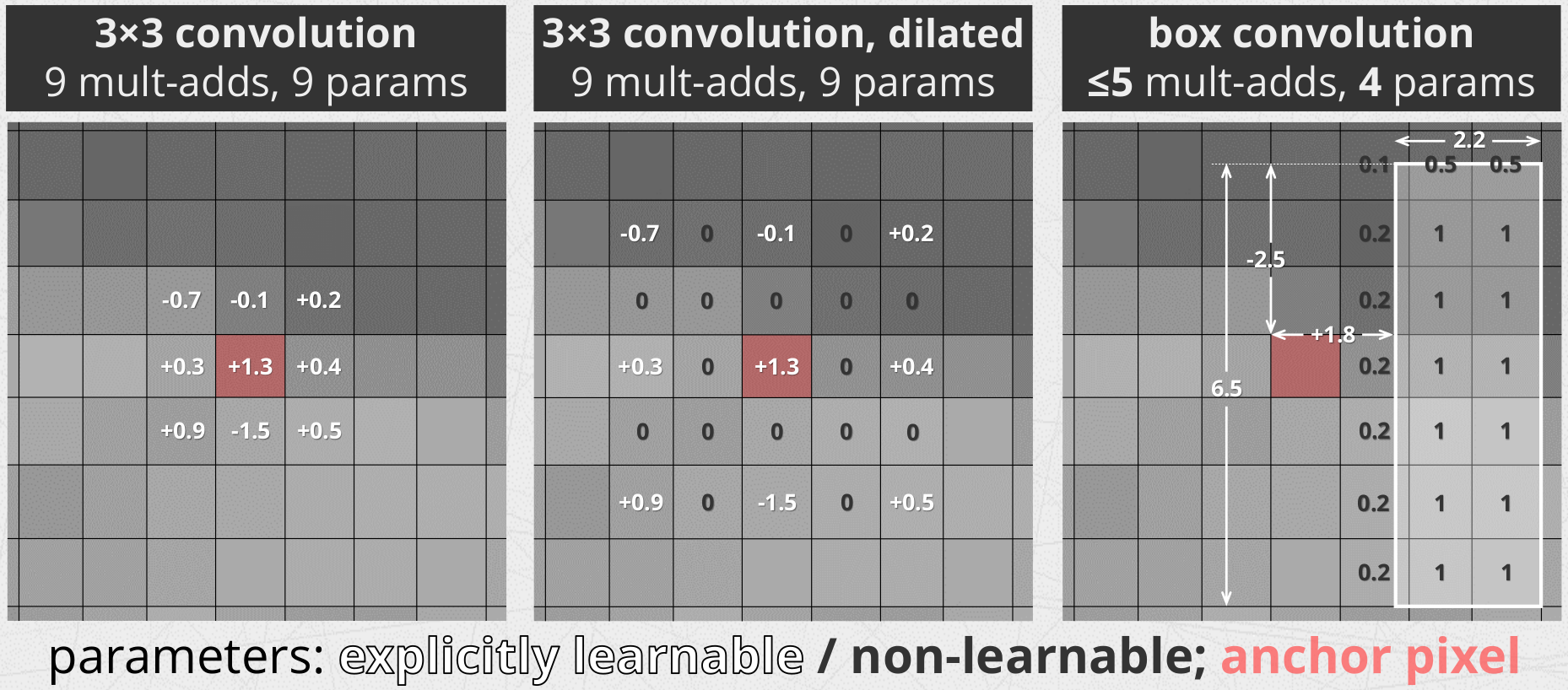

image

image

Any success stories?

One example: there is an efficient semantic segmentation model ENet. It's a classical hourglass architecture stacked of dozens ResNet-like blocks (left image).

Let's replace some of these blocks by our "box convolution block" (right image).

First we replaced every second block with a box convolution block (BoxENet in the paper). The model became

  • more accurate,
  • faster,
  • lighter
  • without dilated convolutions.

Then, we replaced every residual block (except the down- and up-sampling ones)! The result, BoxOnlyENet, is

  • a ConvNet almost without (traditional learnable weight) convolutions,
  • 2 times less operations,
  • 3 times less parameters,
  • still more accurate than ENet!
Comments
  • Build problem!

    Build problem!

    Hi! Can't compile pls see log https://drive.google.com/open?id=1U_0axWSgQGsvvdMWv5FclS1hHHihqx9M

    Command "/home/alex/anaconda3/bin/python -u -c "import setuptools, tokenize;file='/tmp/pip-req-build-n1eyvbz3/setup.py';f=getattr(tokenize, 'open', open)(file);code=f.read().replace('\r\n', '\n');f.close();exec(compile(code, file, 'exec'))" install --record /tmp/pip-record-p0dv1roq/install-record.txt --single-version-externally-managed --compile --user --prefix=" failed with error code 1 in /tmp/pip-req-build-n1eyvbz3/

    opened by aidonchuk 63
  • Implementation in VGG

    Implementation in VGG

    Hey,

    I am trying to implement box convolution for HED (Holistically-Nested Edge Detection) which uses VGG architecture. Here's the architecture with box convolution layer:

    class HED(nn.Module):
        def __init__(self):
            super(HED, self).__init__()
    
            # conv1
            self.conv1 = nn.Sequential(
                nn.Conv2d(3, 64, 3, padding=1),
                BoxConv2d(1, 64, 5, 5),
                nn.ReLU(inplace=True),
                nn.Conv2d(64, 64, 3, padding=1),
                #BoxConv2d(1, 64, 28, 28),
                nn.ReLU(inplace=True),
            )
    
            # conv2
            self.conv2 = nn.Sequential(
                nn.MaxPool2d(2, stride=2, ceil_mode=True),  # 1/2
                nn.Conv2d(64, 128, 3, padding=1),
                nn.ReLU(inplace=True),
                nn.Conv2d(128, 128, 3, padding=1),
                nn.ReLU(inplace=True),
            )
    
            # conv3
            self.conv3 = nn.Sequential(
                nn.MaxPool2d(2, stride=2, ceil_mode=True),  # 1/4
                nn.Conv2d(128, 256, 3, padding=1),
                nn.ReLU(inplace=True),
                nn.Conv2d(256, 256, 3, padding=1),
                nn.ReLU(inplace=True),
                nn.Conv2d(256, 256, 3, padding=1),
                nn.ReLU(inplace=True),
            )
    
            # conv4
            self.conv4 = nn.Sequential(
                nn.MaxPool2d(2, stride=2, ceil_mode=True),  # 1/8
                nn.Conv2d(256, 512, 3, padding=1),
                nn.ReLU(inplace=True),
                nn.Conv2d(512, 512, 3, padding=1),
                nn.ReLU(inplace=True),
                nn.Conv2d(512, 512, 3, padding=1),
                nn.ReLU(inplace=True),
            )
    
            # conv5
            self.conv5 = nn.Sequential(
                nn.MaxPool2d(2, stride=2, ceil_mode=True),  # 1/16
                nn.Conv2d(512, 512, 3, padding=1),
                nn.ReLU(inplace=True),
                nn.Conv2d(512, 512, 3, padding=1),
                nn.ReLU(inplace=True),
                nn.Conv2d(512, 512, 3, padding=1),
                nn.ReLU(inplace=True),
            )
    
            self.dsn1 = nn.Conv2d(64, 1, 1)
            self.dsn2 = nn.Conv2d(128, 1, 1)
            self.dsn3 = nn.Conv2d(256, 1, 1)
            self.dsn4 = nn.Conv2d(512, 1, 1)
            self.dsn5 = nn.Conv2d(512, 1, 1)
            self.fuse = nn.Conv2d(5, 1, 1)
    
        def forward(self, x):
            h = x.size(2)
            w = x.size(3)
    
            conv1 = self.conv1(x)
            conv2 = self.conv2(conv1)
            conv3 = self.conv3(conv2)
            conv4 = self.conv4(conv3)
            conv5 = self.conv5(conv4)
    
            ## side output
            d1 = self.dsn1(conv1)
            d2 = F.upsample_bilinear(self.dsn2(conv2), size=(h,w))
            d3 = F.upsample_bilinear(self.dsn3(conv3), size=(h,w))
            d4 = F.upsample_bilinear(self.dsn4(conv4), size=(h,w))
            d5 = F.upsample_bilinear(self.dsn5(conv5), size=(h,w))
    
            # dsn fusion output
            fuse = self.fuse(torch.cat((d1, d2, d3, d4, d5), 1))
    
            d1 = F.sigmoid(d1)
            d2 = F.sigmoid(d2)
            d3 = F.sigmoid(d3)
            d4 = F.sigmoid(d4)
            d5 = F.sigmoid(d5)
            fuse = F.sigmoid(fuse)
    
            return d1, d2, d3, d4, d5, fuse
    

    I get the following error: RuntimeError: BoxConv2d: all parameters must have as many rows as there are input channels (box_convolution_forward at src/box_convolution_interface.cpp:30)

    Can you help me with this?

    opened by Flock1 10
  • YOLO architecture

    YOLO architecture

    Hi,

    I want to know if there's some way I can create an architecture that'll work with YOLO. I've read a lot of implementations with pytorch but I don't know how should I modify the cfg file so that I can add box convolution layer.

    Let me know.

    opened by Flock1 9
  • Build Problem Windows 10 CUDA10.1 Python Bindings?

    Build Problem Windows 10 CUDA10.1 Python Bindings?

    Hi, I'm trying to compile the box-convolutions using Windows 10 with CUDA 10.1. This results in the following error:

    \python\python36\lib\site-packages\torch\lib\include\pybind11\cast.h(1439): error: expression must be a pointer to a complete object type
    
      1 error detected in the compilation of "C:/Users/CHRIST~1/AppData/Local/Temp/tmpxft_000010ec_00000000-8_integral_image_cuda.cpp4.ii".
      integral_image_cuda.cu
      error: command 'C:\\Program Files\\NVIDIA GPU Computing Toolkit\\CUDA\\v10.1\\bin\\nvcc.exe' failed with exit status 2
    
      ----------------------------------------
    Failed building wheel for box-convolution
    Running setup.py clean for box-convolution
    Failed to build box-convolution
    

    Any ideas? Thanks in advance

    opened by tom23141 6
  • Getting a cuda runtime error (9) : invalid configuration argument at src/box_convolution_cuda_forward.ci:250

    Getting a cuda runtime error (9) : invalid configuration argument at src/box_convolution_cuda_forward.ci:250

    Hello,

    I've been trying to implement your box convolution layer on a ResNet model by just substituting your BottleneckBoxConv layers for a typical ResNet Bottleneck layer.

    I was getting this error

    THCudaCheck FAIL file=src/box_convolution_cuda_forward.cu line=250 error=9 : invalid configuration argument
    Traceback (most recent call last):
      File "half_box_train.py", line 178, in <module>
        main()
      File "half_box_train.py", line 107, in main
        scores = res_net(x)
      File "/opt/anaconda3/lib/python3.7/site-packages/torch/nn/modules/module.py", line 493, in __call__
        result = self.forward(*input, **kwargs)
      File "/home/dkang/Project/cs231n_project_box_convolution/models/HalfBoxResNet.py", line 331, in forward
         x = self.layer3(x)
      File "/opt/anaconda3/lib/python3.7/site-packages/torch/nn/modules/module.py", line 493, in __call__
        result = self.forward(*input, **kwargs)
      File "/opt/anaconda3/lib/python3.7/site-packages/torch/nn/modules/container.py", line 92, in forward
           input = module(input)
      File "/opt/anaconda3/lib/python3.7/site-packages/torch/nn/modules/module.py", line 493, in __call__
        result = self.forward(*input, **kwargs)
      File "/home/dkang/Project/cs231n_project_box_convolution/models/HalfBoxResNet.py", line 66, in forward
        return F.relu(x + self.main_branch(x), inplace=True)
      File "/opt/anaconda3/lib/python3.7/site-packages/torch/nn/modules/module.py", line 493, in __call__
        result = self.forward(*input, **kwargs)
      File "/opt/anaconda3/lib/python3.7/site-packages/torch/nn/modules/container.py", line 92, in forward
    input = module(input)
      File "/opt/anaconda3/lib/python3.7/site-packages/torch/nn/modules/module.py", line 493, in __call__
        result = self.forward(*input, **kwargs)
      File "/opt/anaconda3/lib/python3.7/site-packages/box_convolution/box_convolution_module.py", line 222, in forward
        self.reparametrization_h, self.reparametrization_w, self.normalize, self.exact)
      File "/opt/anaconda3/lib/python3.7/site-packages/box_convolution/box_convolution_function.py", line 46, in forward
        input_integrated, x_min, x_max, y_min, y_max, normalize, exact)
    RuntimeError: cuda runtime error (9) : invalid configuration argument at src/box_convolution_cuda_forward.cu:250
    

    Thanks so much!

    opened by dkang9503 5
  • Speed and Efficiency of Depthwise separable operation?

    Speed and Efficiency of Depthwise separable operation?

    As far as modern libraries are concerned, there is not much support for depth-wise separable operations, i.e. we cannot write custom operations that can be done depthwise. Only convolutions are supported.

    How did you apply M box convolutions to each of the N input filters, to generate NM output filters? How is the different than using a for loop over the N input filters, applying M box convs on each one, and concatenating all the results?

    opened by kennyseb 5
  • Import Error

    Import Error

    Success build with ubuntu 16.04, cuda 10 and gcc 7.4. But import error encountered:

    In [1]: import torch
    
    In [2]: from box_convolution import BoxConv2d


    ImportError                               Traceback (most recent call last)
    <ipython-input-2-2424917dbf01> in <module>()
    ----> 1 from box_convolution import BoxConv2d
    
    ~/Software/pkgs/box-convolutions/box_convolution/__init__.py in <module>()
    ----> 1 from .box_convolution_module import BoxConv2d
    
    ~/Software/pkgs/box-convolutions/box_convolution/box_convolution_module.py in <module>()
          2 import random
          3 
    ----> 4 from .box_convolution_function import BoxConvolutionFunction, reparametrize
          5 import box_convolution_cpp_cuda as cpp_cuda
          6 
    
    ~/Software/pkgs/box-convolutions/box_convolution/box_convolution_function.py in <module>()
          1 import torch
          2 
    ----> 3 import box_convolution_cpp_cuda as cpp_cuda
          4 
          5 def reparametrize(
    
    ImportError: /usr/Software/anaconda3/lib/python3.6/site-packages/box_convolution_cpp_cuda.cpython-36m-x86_64-linux-gnu.so: undefined symbol: __cudaPopCallConfiguration
    

    @shrubb

    opened by the-butterfly 5
  • Error during forward pass

    Error during forward pass

         44         input_integrated = cpp_cuda.integral_image(input)
         45         output = cpp_cuda.box_convolution_forward(
    ---> 46             input_integrated, x_min, x_max, y_min, y_max, normalize, exact)
         47 
         48         ctx.save_for_backward(
    
    RuntimeError: cuda runtime error (9) : invalid configuration argument at src/box_convolution_cuda_forward.cu:249```
    opened by belskikh 5
  • Test script failed

    Test script failed

    Test script assertion failed:

    Random seed is 1546545757 Testing for device 'cpu' Running test_integral_image()... 100%|| 50/50 [00:00<00:00, 1491.15it/s] OK Running test_box_convolution_module()... 0%| python3: /pytorch/third_party/ideep/mkl-dnn/src/cpu/jit_avx2_conv_kernel_f32.cpp:567: static mkldnn::impl::status_t mkldnn::impl::cpu::jit_avx2_conv_fwd_kernel_f32::init_conf(mkldnn::impl::cpu::jit_conv_conf_t&, const convolution_desc_t&, const mkldnn::impl::memory_desc_wrapper&, const mkldnn::impl::memory_desc_wrapper&, const mkldnn::impl::memory_desc_wrapper&, const primitive_attr_t&): Assertion `jcp.ur_w * (jcp.nb_oc_blocking + 1) <= num_avail_regs' failed. Aborted (core dumped)

    Configuration: Ubuntu 16.04 LTS, CUDA 9.2, PyTorch 1.1.0, GCC 5.4.0.

    opened by vtereshkov 4
  • how box convolution works

    how box convolution works

    Hi,

    It is a nice work. In the first figure on your poster, you compared the 3x3 convolution layer and your box convolution layer. I am not clear how the box convolution works. Is it right that for each position (p,q) on the image, you use a box filter which has a relative position x, y to (p,q) and size w,h to calculate the value for (p,q) on the output? You learn the 4 parameters x, y, w, h for each box filter. For example, in the figure, the value for the red anchor pixel position on the output should be the sum of the values in the box. Is it correct? Thanks.

    opened by jiaozizhao 4
  • Multi-GPU Training: distributed error encountered

    Multi-GPU Training: distributed error encountered

    I am using https://github.com/facebookresearch/maskrcnn-benchmark for object detection, I want to use box convolutions, when I add a box convolution after some layer, training with 1 GPU is OK, while training with multiple GPUs in distributed mode failed, the error is very similar to this issue, I do not know how to fix, have some ideas? @shrubb

    2019-02-18 16:09:15,187 maskrcnn_benchmark.trainer INFO: Start training
    Traceback (most recent call last):
      File "tools/train_net.py", line 172, in <module>
        main()
      File "tools/train_net.py", line 165, in main
        model = train(cfg, args.local_rank, args.distributed)
      File "tools/train_net.py", line 74, in train
        arguments,
      File "/srv/data0/hzxubinbin/projects/maskrcnn_benchmark/maskrcnn-benchmark/maskrcnn_benchmark/engine/trainer.py", line 79, in do_train
        losses.backward()
      File "/home/hzxubinbin/anaconda3.1812/lib/python3.7/site-packages/torch/tensor.py", line 102, in backward
        torch.autograd.backward(self, gradient, retain_graph, create_graph)
      File "/home/hzxubinbin/anaconda3.1812/lib/python3.7/site-packages/torch/autograd/__init__.py", line 90, in backward
        allow_unreachable=True)  # allow_unreachable flag
      File "/home/hzxubinbin/anaconda3.1812/lib/python3.7/site-packages/torch/nn/parallel/distributed.py", line 445, in distributed_data_parallel_hook
        self._queue_reduction(bucket_idx)
      File "/home/hzxubinbin/anaconda3.1812/lib/python3.7/site-packages/torch/nn/parallel/distributed.py", line 475, in _queue_reduction
        self.device_ids)
    TypeError: _queue_reduction(): incompatible function arguments. The following argument types are supported:
        1. (process_group: torch.distributed.ProcessGroup, grads_batch: List[List[at::Tensor]], devices: List[int]) -> Tuple[torch.distributed.Work, at::Tensor]
    
    Invoked with: <torch.distributed.ProcessGroupNCCL object at 0x7f0d95248148>, [[tensor([[[[0.]],
    

    1 GPU is too slow, I want to use multiple GPUs

    opened by freesouls 4
  • How can I run Cityscapes example on a test set?

    How can I run Cityscapes example on a test set?

    Hello, collegues! I've trained BoxERFNet, and now I wanna run this model on a test set to evaluate it. I checked the source code(train.py) and established 'test' in place of 'test' in 80th string. But there was falure, the evaluated metrics were incorrect(e.g. 0.0 and 0.0). Can you explain me, what I need to do to evaluate model on a test set? I guess that problem is on 'validate' function(241th string), because confusion_matrix_update(268th string) tensors are really different in test and val sets.

    opened by mikhailkonyk 3
Releases(v1.0.0)
Owner
Egor Burkov
Egor Burkov
PyTorch code for training MM-DistillNet for multimodal knowledge distillation

There is More than Meets the Eye: Self-Supervised Multi-Object Detection and Tracking with Sound by Distilling Multimodal Knowledge MM-DistillNet is a

51 Dec 20, 2022
AI-UPV at IberLEF-2021 DETOXIS task: Toxicity Detection in Immigration-Related Web News Comments Using Transformers and Statistical Models

AI-UPV at IberLEF-2021 DETOXIS task: Toxicity Detection in Immigration-Related Web News Comments Using Transformers and Statistical Models Description

Angel de Paula 0 Jun 08, 2022
OpenMMLab Video Perception Toolbox. It supports Video Object Detection (VID), Multiple Object Tracking (MOT), Single Object Tracking (SOT), Video Instance Segmentation (VIS) with a unified framework.

English | 简体中文 Documentation: https://mmtracking.readthedocs.io/ Introduction MMTracking is an open source video perception toolbox based on PyTorch.

OpenMMLab 2.7k Jan 08, 2023
PyTorch implementation of MoCo v3 for self-supervised ResNet and ViT.

MoCo v3 for Self-supervised ResNet and ViT Introduction This is a PyTorch implementation of MoCo v3 for self-supervised ResNet and ViT. The original M

Facebook Research 887 Jan 08, 2023
A minimal implementation of face-detection models using flask, gunicorn, nginx, docker, and docker-compose

Face-Detection-flask-gunicorn-nginx-docker This is a simple implementation of dockerized face-detection restful-API implemented with flask, Nginx, and

Pooya-Mohammadi 30 Dec 17, 2022
CTF challenges from redpwnCTF 2021

redpwnCTF 2021 Challenges This repository contains challenges from redpwnCTF 2021 in the rCDS format; challenge information is in the challenge.yaml f

redpwn 27 Dec 07, 2022
DeepFashion2 is a comprehensive fashion dataset.

DeepFashion2 Dataset DeepFashion2 is a comprehensive fashion dataset. It contains 491K diverse images of 13 popular clothing categories from both comm

switchnorm 1.8k Jan 07, 2023
More than a hundred strange attractors

dysts Analyze more than a hundred chaotic systems. Basic Usage Import a model and run a simulation with default initial conditions and parameter value

William Gilpin 185 Dec 23, 2022
Image Fusion Transformer

Image-Fusion-Transformer Platform Python 3.7 Pytorch =1.0 Training Dataset MS-COCO 2014 (T.-Y. Lin, M. Maire, S. Belongie, J. Hays, P. Perona, D. Ram

Vibashan VS 68 Dec 23, 2022
Example-custom-ml-block-keras - Custom Keras ML block example for Edge Impulse

Custom Keras ML block example for Edge Impulse This repository is an example on

Edge Impulse 8 Nov 02, 2022
A Pytorch implementation of "LegoNet: Efficient Convolutional Neural Networks with Lego Filters" (ICML 2019).

LegoNet This code is the implementation of ICML2019 paper LegoNet: Efficient Convolutional Neural Networks with Lego Filters Run python train.py You c

YangZhaohui 140 Sep 26, 2022
Multiple-criteria decision-making (MCDM) with Electre, Promethee, Weighted Sum and Pareto

EasyMCDM - Quick Installation methods Install with PyPI Once you have created your Python environment (Python 3.6+) you can simply type: pip3 install

Labrak Yanis 6 Nov 22, 2022
(ICCV 2021) ProHMR - Probabilistic Modeling for Human Mesh Recovery

ProHMR - Probabilistic Modeling for Human Mesh Recovery Code repository for the paper: Probabilistic Modeling for Human Mesh Recovery Nikos Kolotouros

Nikos Kolotouros 209 Dec 13, 2022
Unsupervised Image-to-Image Translation

UNIT: UNsupervised Image-to-image Translation Networks Imaginaire Repository We have a reimplementation of the UNIT method that is more performant. It

Ming-Yu Liu 劉洺堉 1.9k Dec 26, 2022
All course materials for the Zero to Mastery Deep Learning with TensorFlow course.

All course materials for the Zero to Mastery Deep Learning with TensorFlow course.

Daniel Bourke 3.4k Jan 07, 2023
Repository for the Bias Benchmark for QA dataset.

BBQ Repository for the Bias Benchmark for QA dataset. Authors: Alicia Parrish, Angelica Chen, Nikita Nangia, Vishakh Padmakumar, Jason Phang, Jana Tho

ML² AT CILVR 18 Nov 18, 2022
This program automatically runs Python code copied in clipboard

CopyRun This program runs Python code which is copied in clipboard WARNING!! USE AT YOUR OWN RISK! NO GUARANTIES IF ANYTHING GETS BROKEN. DO NOT COPY

vertinski 4 Sep 10, 2021
A collection of resources, problems, explanations and concepts that are/were important during my Data Science journey

Data Science Gurukul List of resources, interview questions, concepts I use for my Data Science work. Topics: Basics of Programming with Python + Unde

Smaranjit Ghose 10 Oct 25, 2022
High dimensional black-box optimizer using Latent Action Monte Carlo Tree Search algorithm

LA-MCTS The code is based of paper Learning Search Space Partition for Black-box Optimization using Monte Carlo Tree Search. Component LA-MCTS has thr

Meta Research 18 Oct 24, 2022
[CVPR 2022 Oral] Balanced MSE for Imbalanced Visual Regression https://arxiv.org/abs/2203.16427

Balanced MSE Code for the paper: Balanced MSE for Imbalanced Visual Regression Jiawei Ren, Mingyuan Zhang, Cunjun Yu, Ziwei Liu CVPR 2022 (Oral) News

Jiawei Ren 267 Jan 01, 2023