A custom DeepStack model that has been trained detecting ONLY the USPS logo

Overview

DeepStack_USPS

This repository provides a custom DeepStack model that has been trained detecting ONLY the USPS logo. This was created after I discovered that the Deepstack OpenLogo custom model I was using did not contain USPS. The owner of that repo suggested that we create our own, so I decided to give it a shot!

In my use case, I have a Blue Iris clone of my main house cameras that is setup to NOT record. It's only set up to alert if it sees a car, truck, van or bus. The alert image is then sent over MQTT to node-red. It's then read in, and thrown against OpenLogo to see if it matches fedex, ups, amazon or dhl. If nothing is reported back, then I'll throw it against this USPS custom object end point. Essentially it's scanning each alert image multiple times, but its quick enough in processing that it should alert me when it sees the logo.

The main goal? My wife mails back her empty soda stream cannisters and then new ones are sent to us. Instead of having to head to a post office, its easier for us to catch our mail carrier and hand them the package when they're outside. Happy wife...

  • Create API and Detect Logos
  • Discover more Custom Models
  • Train your own Model

Create API and Detect Logos

The only logo in the model is "USPS". So this is a unique custom object endpoint that is only used for USPS detection. The way I understand it (which honestly, I just followed the directions), the AI training is based off of the images provided and the portion of the images that I tag with class names. So I could have done "truck" or "van" or "trailer" along with the USPS logo, but I wanted to keep things simple.

To start detecting, follow the steps below

  • Install DeepStack: Install DeepStack AI Server with instructions on DeepStack's documentation via https://docs.deepstack.cc

  • Download Custom Model: Download the trained custom model USPS.pt via this link. Create a folder on your machine and move the model to this folder.

    E.g A path on Windows Machine C\Users\MyUser\Documents\DeepStack-Models, which will make your model file path C\Users\MyUser\Documents\DeepStack-Models\USPS.pt

  • Run DeepStack: To run DeepStack AI Server with the custom USPS model, run the command that applies to your machine as detailed on DeepStack's documentation linked here.

    E.g

    For a Windows version, you run the command below

    deepstack --MODELSTORE-DETECTION "C\Users\MyUser\Documents\DeepStack-Models" --PORT 80

    For a Linux machine

    sudo docker run -v /home/MyUser/Documents/DeepStack-Models -p 80:5000 deepquestai/deepstack

    Once DeepStack runs, you will see a log like the one below in your Terminal/Console

    That means DeepStack is running your custom USPS model and now ready to start detecting logos in images via the API enpoint http://localhost:80/v1/vision/custom/USPS or http://your_machine_ip:80/v1/vision/custom/USPS

  • Detect Logo in image: You can detect logos in an image by sending a POST request to the url mentioned above with the paramater image set to an image using any proggramming language or with a tool like POSTMAN. For the purpose of this repository, we have provided a sample Python code below.

    • A sample image can be found in images/usps.jpg of this repository

    • Install Python and install the DeepStack Python SDK via the command below

      pip install deepstack_sdk
    • Run the Python file detect.py in this repository.

      python detect.py
    • After the code runs, you will find a new image in images/usps_new.jpg with the detection visualized, with the following results printed in the Terminal/Console.

      Name: USPS
      Confidence: 0.93151146
      x_min: 74
      x_max: 102
      y_min: 189
      y_max: 210
      -----------------------
      Name: USPS
      Confidence: 0.9639365
      x_min: 181
      x_max: 288
      y_min: 172
      y_max: 246
      -----------------------
      Name: USPS
      Confidence: 0.9687089
      x_min: 356
      x_max: 408
      y_min: 176
      y_max: 221
      -----------------------
      

Discover more Custom Models

Please visit the OpenLogo repository that started this whole thing. Almost all of this readme and code was copied from there. https://github.com/OlafenwaMoses/DeepStack_OpenLogo .

For more custom DeepStack models that has been trained and ready to use, visit the Custom Models sample page on DeepStack's documentation https://docs.deepstack.cc/custom-models-samples/ .

Train your own Model

If you will like to train a custom model yourself (this is what I did!), follow the instructions below.

  • Prepare and Annotate: Collect images on and annotate object(s) you plan to detect as detailed here
  • Train your Model: Train the model as detailed here
You might also like...
Example-custom-ml-block-keras - Custom Keras ML block example for Edge Impulse

Custom Keras ML block example for Edge Impulse This repository is an example on

Demonstrates how to divide a DL model into multiple IR model files (division) and introduce a simplest way to implement a custom layer works with OpenVINO IR models.

Demonstration of OpenVINO techniques - Model-division and a simplest-way to support custom layers Description: Model Optimizer in Intel(r) OpenVINO(tm

Only a Matter of Style: Age Transformation Using a Style-Based Regression Model

Only a Matter of Style: Age Transformation Using a Style-Based Regression Model The task of age transformation illustrates the change of an individual

naked is a Python tool which allows you to strip a model and only keep what matters for making predictions.

naked is a Python tool which allows you to strip a model and only keep what matters for making predictions. The result is a pure Python function with no third-party dependencies that you can simply copy/paste wherever you wish.

🍅🍅🍅YOLOv5-Lite: lighter, faster and easier to deploy. Evolved from yolov5 and the size of model is only 1.7M (int8) and 3.3M (fp16). It can reach 10+ FPS on the Raspberry Pi 4B when the input size is 320×320~

YOLOv5-Lite:lighter, faster and easier to deploy Perform a series of ablation experiments on yolov5 to make it lighter (smaller Flops, lower memory, a

Convert openmmlab (not only mmdetection) series model to tensorrt

MMDet to TensorRT This project aims to convert the mmdetection model to TensorRT model end2end. Focus on object detection for now. Mask support is exp

Repository to run object detection on a model trained on an autonomous driving dataset.

Autonomous Driving Object Detection on the Raspberry Pi 4 Description of Repository This repository contains code and instructions to configure the ne

Chinese clinical named entity recognition using pre-trained BERT model

Chinese clinical named entity recognition (CNER) using pre-trained BERT model Introduction Code for paper Chinese clinical named entity recognition wi

Pre-trained model, code, and materials from the paper
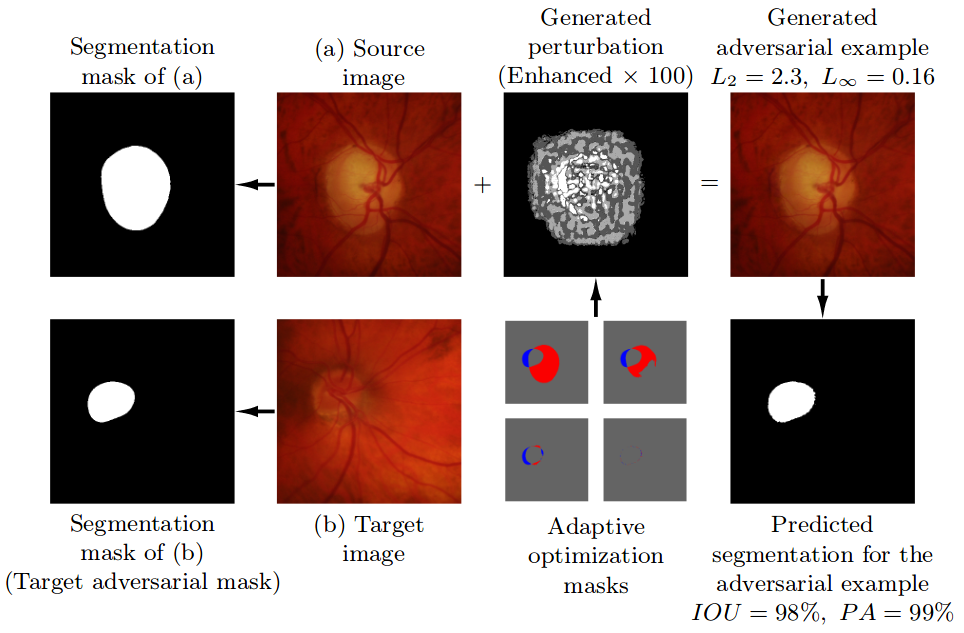
Pre-trained model, code, and materials from the paper "Impact of Adversarial Examples on Deep Learning Models for Biomedical Image Segmentation" (MICCAI 2019).

Adaptive Segmentation Mask Attack This repository contains the implementation of the Adaptive Segmentation Mask Attack (ASMA), a targeted adversarial

Comments
  • Question about image sources for training and image quality of camera

    Question about image sources for training and image quality of camera

    Hey man,

    hope you don't mind I open up an issue. I already opened an issue a couple of months ago at the @olafenwamoses, but never got an answer.

    I was able to set it up in the same way you did, using node red, an example image works just fine. All the images coming from my front camera (1920x1080) are not recognized though and therefore I'm wondering what your experience is.

    Also, how did you collect the USPS images for training and how many?

    Thanks in advance!

    opened by hillbicks 4
Releases(v1.1)
Owner
Stephen Stratoti
Stephen Stratoti
An open source library for face detection in images. The face detection speed can reach 1000FPS.

libfacedetection This is an open source library for CNN-based face detection in images. The CNN model has been converted to static variables in C sour

Shiqi Yu 11.4k Dec 27, 2022
This is the official implementation of the paper "Object Propagation via Inter-Frame Attentions for Temporally Stable Video Instance Segmentation".

[CVPRW 2021] - Object Propagation via Inter-Frame Attentions for Temporally Stable Video Instance Segmentation

Anirudh S Chakravarthy 6 May 03, 2022
zeus is a Python implementation of the Ensemble Slice Sampling method.

zeus is a Python implementation of the Ensemble Slice Sampling method. Fast & Robust Bayesian Inference, Efficient Markov Chain Monte Carlo (MCMC), Bl

Minas Karamanis 197 Dec 04, 2022
Solve a Rubiks Cube using Python Opencv and Kociemba module

Rubiks_Cube_Solver Solve a Rubiks Cube using Python Opencv and Kociemba module Main Steps Get the countours of the cube check whether there are tota

Adarsh Badagala 176 Jan 01, 2023
Attention mechanism with MNIST dataset

[TensorFlow] Attention mechanism with MNIST dataset Usage $ python run.py Result Training Loss graph. Test Each figure shows input digit, attention ma

YeongHyeon Park 12 Jun 10, 2022
[NeurIPS-2021] Mosaicking to Distill: Knowledge Distillation from Out-of-Domain Data

MosaicKD Code for NeurIPS-21 paper "Mosaicking to Distill: Knowledge Distillation from Out-of-Domain Data" 1. Motivation Natural images share common l

ZJU-VIPA 37 Nov 10, 2022
Hl classification bc - A Network-Based High-Level Data Classification Algorithm Using Betweenness Centrality

A Network-Based High-Level Data Classification Algorithm Using Betweenness Centr

Esteban Vilca 3 Dec 01, 2022
Source code for our Paper "Learning in High-Dimensional Feature Spaces Using ANOVA-Based Matrix-Vector Multiplication"

NFFT4ANOVA Source code for our Paper "Learning in High-Dimensional Feature Spaces Using ANOVA-Based Matrix-Vector Multiplication" This package uses th

Theresa Wagner 1 Aug 10, 2022
From Perceptron model to Deep Neural Network from scratch in Python.

Neural-Network-Basics Aim of this Repository: From Perceptron model to Deep Neural Network (from scratch) in Python. ** Currently working on a basic N

Aditya Kahol 1 Jan 14, 2022
Code for SyncTwin: Treatment Effect Estimation with Longitudinal Outcomes (NeurIPS 2021)

SyncTwin: Treatment Effect Estimation with Longitudinal Outcomes (NeurIPS 2021) SyncTwin is a treatment effect estimation method tailored for observat

Zhaozhi Qian 3 Nov 03, 2022
Face2webtoon - Despite its importance, there are few previous works applying I2I translation to webtoon.

Despite its importance, there are few previous works applying I2I translation to webtoon. I collected dataset from naver webtoon 연애혁명 and tried to transfer human faces to webtoon domain.

이상윤 64 Oct 19, 2022
这是一个利用facenet和retinaface实现人脸识别的库,可以进行在线的人脸识别。

Facenet+Retinaface:人脸识别模型在Pytorch当中的实现 目录 注意事项 Attention 所需环境 Environment 文件下载 Download 预测步骤 How2predict 参考资料 Reference 注意事项 该库中包含了两个网络,分别是retinaface和

Bubbliiiing 102 Dec 30, 2022
Official implementation of "Open-set Label Noise Can Improve Robustness Against Inherent Label Noise" (NeurIPS 2021)

Open-set Label Noise Can Improve Robustness Against Inherent Label Noise NeurIPS 2021: This repository is the official implementation of ODNL. Require

Hongxin Wei 12 Dec 07, 2022
Paper: De-rendering Stylized Texts

Paper: De-rendering Stylized Texts Wataru Shimoda1, Daichi Haraguchi2, Seiichi Uchida2, Kota Yamaguchi1 1CyberAgent.Inc, 2 Kyushu University Accepted

CyberAgent AI Lab 55 Dec 18, 2022
Sound Event Detection with FilterAugment

Sound Event Detection with FilterAugment Official implementation of Heavily Augmented Sound Event Detection utilizing Weak Predictions (DCASE2021 Chal

43 Aug 28, 2022
Automatically replace ONNX's RandomNormal node with Constant node.

onnx-remove-random-normal This is a script to replace RandomNormal node with Constant node. Example Imagine that we have something ONNX model like the

Masashi Shibata 1 Dec 11, 2021
Virtual Dance Reality Stage is a feature that offers you to share a stage with another user virtually.

Virtual Dance Reality Stage is a feature that offers you to share a stage with another user virtually. It uses the concept of Image Background Removal using DeepLab Architecture (based on Semantic Se

Devashi Choudhary 5 Aug 24, 2022
Posterior predictive distributions quantify uncertainties ignored by point estimates.

Posterior predictive distributions quantify uncertainties ignored by point estimates.

DeepMind 177 Dec 06, 2022
Speckle-free Holography with Partially Coherent Light Sources and Camera-in-the-loop Calibration

Speckle-free Holography with Partially Coherent Light Sources and Camera-in-the-loop Calibration Project Page | Paper Yifan Peng*, Suyeon Choi*, Jongh

Stanford Computational Imaging Lab 19 Dec 11, 2022
Classify bird species based on their songs using SIamese Networks and 1D dilated convolutions.

The goal is to classify different birds species based on their songs/calls. Spectrograms have been extracted from the audio samples and used as features for classification.

Aditya Dutt 9 Dec 27, 2022