Pre-trained model, code, and materials from the paper "Impact of Adversarial Examples on Deep Learning Models for Biomedical Image Segmentation" (MICCAI 2019).

Overview

Adaptive Segmentation Mask Attack

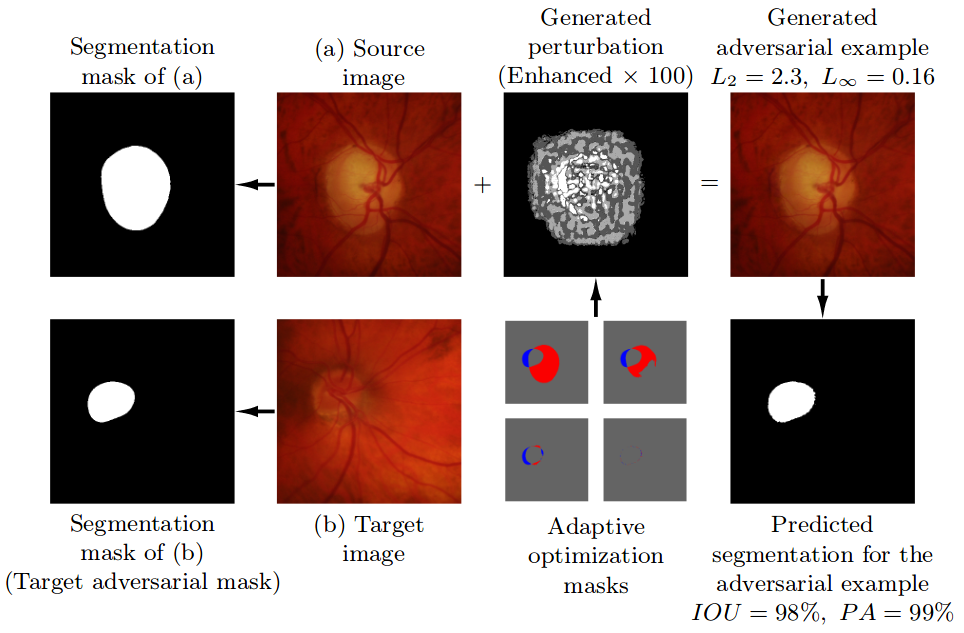
This repository contains the implementation of the Adaptive Segmentation Mask Attack (ASMA), a targeted adversarial example generation method for deep learning segmentation models. This attack was proposed in the paper "Impact of Adversarial Examples on Deep Learning Models for Biomedical Image Segmentation." published in the 22nd International Conference on Medical Image Computing and Computer Assisted Intervention, MICCAI-2019. (Link to the paper)
General Information

This repository is organized as follows:

  • Code - src/ folder contains necessary python files to perform the attack and calculate various stats (i.e., correctness and modification)

  • Data - data/ folder contains a couple of examples for testing purposes. The data we used in this study can be taken from [1].

  • Model - Example model used in this repository can be downloaded from https://www.dropbox.com/s/6ziz7s070kkaexp/eye_pretrained_model.pt . helper_functions.py contains a function to load this file and main.py contains an exaple that uses this model.

Frequently Asked Questions (FAQ)

  • How can I run the demo?

    1- Download the model from https://www.dropbox.com/s/6ziz7s070kkaexp/eye_pretrained_model.pt

    2- Create a folder called model on the same level as data and src, put the model under this (model) folder.

    3- Run main.py.

  • Would this attack work in multi-class segmentation models?

    Yes, given that you provide a proper target mask, model etc.

  • Does the code require any modifications in order to make it work for multi-class segmentation models?

    No (probably, depending on your model/input). At least the attack itself (adaptive_attack.py) should not require major modifications on its logic.

Citation

If you find the code in this repository useful for your research, consider citing our paper. Also, feel free to use any visuals available here.

@inproceedings{ozbulak2019impact,
    title={Impact of Adversarial Examples on Deep Learning Models for Biomedical Image Segmentation},
    author={Ozbulak, Utku and Van Messem, Arnout and De Neve, Wesley},
    booktitle={International Conference on Medical Image Computing and Computer-Assisted Intervention},
    pages={300--308},
    year={2019},
    organization={Springer}
}

Requirements

python > 3.5
torch >= 0.4.0
torchvision >= 0.1.9
numpy >= 1.13.0
PIL >= 1.1.7

References

[1] Pena-Betancor C., Gonzalez-Hernandez M., Fumero-Batista F., Sigut J., Medina-Mesa E., Alayon S., Gonzalez M. Estimation of the relative amount of hemoglobin in the cup and neuroretinal rim using stereoscopic color fundus images.

[2] Ronneberger, O., Fischer, P., Brox, T. U-Net: Convolutional networks for biomedical image segmentation.

Owner
Utku Ozbulak
Fourth-year doctoral student at Ghent University. Located in Ghent University Global Campus, South Korea.
Utku Ozbulak
Deep Learning Head Pose Estimation using PyTorch.

Hopenet is an accurate and easy to use head pose estimation network. Models have been trained on the 300W-LP dataset and have been tested on real data with good qualitative performance.

Nataniel Ruiz 1.3k Dec 26, 2022
Implementation of the state-of-the-art vision transformers with tensorflow

ViT Tensorflow This repository contains the tensorflow implementation of the state-of-the-art vision transformers (a category of computer vision model

Mohammadmahdi NouriBorji 2 Mar 16, 2022
A Python library for Deep Probabilistic Modeling

Abstract DeeProb-kit is a Python library that implements deep probabilistic models such as various kinds of Sum-Product Networks, Normalizing Flows an

DeeProb-org 46 Dec 26, 2022
Codes for our IJCAI21 paper: Dialogue Discourse-Aware Graph Model and Data Augmentation for Meeting Summarization

DDAMS This is the pytorch code for our IJCAI 2021 paper Dialogue Discourse-Aware Graph Model and Data Augmentation for Meeting Summarization [Arxiv Pr

xcfeng 55 Dec 27, 2022
GPU Programming with Julia - course at the Swiss National Supercomputing Centre (CSCS), ETH Zurich

Course Description The programming language Julia is being more and more adopted in High Performance Computing (HPC) due to its unique way to combine

Samuel Omlin 192 Jan 03, 2023
CoMoGAN: continuous model-guided image-to-image translation. CVPR 2021 oral.

CoMoGAN: Continuous Model-guided Image-to-Image Translation Official repository. Paper CoMoGAN: continuous model-guided image-to-image translation [ar

166 Dec 31, 2022
Ensemble Learning Priors Driven Deep Unfolding for Scalable Snapshot Compressive Imaging [PyTorch]

Ensemble Learning Priors Driven Deep Unfolding for Scalable Snapshot Compressive Imaging [PyTorch] Abstract Snapshot compressive imaging (SCI) can rec

integirty 6 Nov 01, 2022
BarcodeRattler - A Raspberry Pi Powered Barcode Reader to load a game on the Mister FPGA using MBC

Barcode Rattler A Raspberry Pi Powered Barcode Reader to load a game on the Mist

Chrissy 29 Oct 31, 2022
Pytorch-3dunet - 3D U-Net model for volumetric semantic segmentation written in pytorch

pytorch-3dunet PyTorch implementation 3D U-Net and its variants: Standard 3D U-Net based on 3D U-Net: Learning Dense Volumetric Segmentation from Spar

Adrian Wolny 1.3k Dec 28, 2022
RLMeta is a light-weight flexible framework for Distributed Reinforcement Learning Research.

RLMeta rlmeta - a flexible lightweight research framework for Distributed Reinforcement Learning based on PyTorch and moolib Installation To build fro

Meta Research 281 Dec 22, 2022
Code and models for "Rethinking Deep Image Prior for Denoising" (ICCV 2021)

DIP-denosing This is a code repo for Rethinking Deep Image Prior for Denoising (ICCV 2021). Addressing the relationship between Deep image prior and e

Computer Vision Lab. @ GIST 36 Dec 29, 2022
DeepMoCap: Deep Optical Motion Capture using multiple Depth Sensors and Retro-reflectors

DeepMoCap: Deep Optical Motion Capture using multiple Depth Sensors and Retro-reflectors By Anargyros Chatzitofis, Dimitris Zarpalas, Stefanos Kollias

tofis 24 Oct 08, 2022
ImageNet Adversarial Image Evaluation

ImageNet Adversarial Image Evaluation This repository contains the code and some materials used in the experimental work presented in the following pa

Utku Ozbulak 11 Dec 26, 2022
Exposure Time Calculator (ETC) and radial velocity precision estimator for the Near InfraRed Planet Searcher (NIRPS) spectrograph

NIRPS-ETC Exposure Time Calculator (ETC) and radial velocity precision estimator for the Near InfraRed Planet Searcher (NIRPS) spectrograph February 2

Nolan Grieves 2 Sep 15, 2022
Balancing Principle for Unsupervised Domain Adaptation

Blancing Principle for Domain Adaptation NeurIPS 2021 Paper Abstract We address the unsolved algorithm design problem of choosing a justified regulari

Marius-Constantin Dinu 4 Dec 15, 2022
This is the first released system towards complex meters` detection and recognition, which is implemented by computer vision techniques.

A three-stage detection and recognition pipeline of complex meters in wild This is the first released system towards detection and recognition of comp

Yan Shu 19 Nov 28, 2022
The code for paper "Learning Implicit Fields for Generative Shape Modeling".

implicit-decoder The tensorflow code for paper "Learning Implicit Fields for Generative Shape Modeling", Zhiqin Chen, Hao (Richard) Zhang. Project pag

Zhiqin Chen 353 Dec 30, 2022
Implementation for paper LadderNet: Multi-path networks based on U-Net for medical image segmentation

Implementation for paper LadderNet: Multi-path networks based on U-Net for medical image segmentation This implementation is based on orobix implement

Juntang Zhuang 116 Sep 06, 2022
Single-Stage 6D Object Pose Estimation, CVPR 2020

Overview This repository contains the code for the paper Single-Stage 6D Object Pose Estimation. Yinlin Hu, Pascal Fua, Wei Wang and Mathieu Salzmann.

CVLAB @ EPFL 89 Dec 26, 2022