Efficient and Scalable Physics-Informed Deep Learning and Scientific Machine Learning on top of Tensorflow for multi-worker distributed computing

Overview

TensorDiffEq logo

Package Build Package Release pypi downloads python versions

Notice: Support for Python 3.6 will be dropped in v.0.2.1, please plan accordingly!

Efficient and Scalable Physics-Informed Deep Learning

Collocation-based PINN PDE solvers for prediction and discovery methods on top of Tensorflow 2.X for multi-worker distributed computing.

Use TensorDiffEq if you require:

  • A meshless PINN solver that can distribute over multiple workers (GPUs) for forward problems (inference) and inverse problems (discovery)
  • Scalable domains - Iterated solver construction allows for N-D spatio-temporal support
    • support for N-D spatial domains with no time element is included
  • Self-Adaptive Collocation methods for forward and inverse PINNs
  • Intuitive user interface allowing for explicit definitions of variable domains, boundary conditions, initial conditions, and strong-form PDEs

What makes TensorDiffEq different?

  • Completely open-source

  • Self-Adaptive Solvers for forward and inverse problems, leading to increased accuracy of the solution and stability in training, resulting in less overall training time

  • Multi-GPU distributed training for large or fine-grain spatio-temporal domains

  • Built on top of Tensorflow 2.0 for increased support in new functionality exclusive to recent TF releases, such as XLA support, autograph for efficent graph-building, and grappler support for graph optimization* - with no chance of the source code being sunset in a further Tensorflow version release

  • Intuitive interface - defining domains, BCs, ICs, and strong-form PDEs in "plain english"

*In development

If you use TensorDiffEq in your work, please cite it via:

@article{mcclenny2021tensordiffeq,
  title={TensorDiffEq: Scalable Multi-GPU Forward and Inverse Solvers for Physics Informed Neural Networks},
  author={McClenny, Levi D and Haile, Mulugeta A and Braga-Neto, Ulisses M},
  journal={arXiv preprint arXiv:2103.16034},
  year={2021}
}

Thanks to our additional contributors:

@marcelodallaqua, @ragusa, @emiliocoutinho

Comments
  • Latest version of package

    Latest version of package

    The examples in the doc use the latest code of master branch but the library on Pypi is still the version in May. Can you build the lib and update the version on Pypi?

    opened by devzhk 5
  • ADAM training on batches

    ADAM training on batches

    It is possible to define a batch size and this will be applied to the calculation of the residual loss function, in splitting the collocation points in batches during the training.

    opened by emiliocoutinho 3
  • Pull Request using PyCharm

    Pull Request using PyCharm

    Dear Levi,

    I tried to make a Pull Request on this repository using PyCharm, and I received the following message:

    Although you appear to have the correct authorization credentials, the tensordiffeq organization has enabled OAuth App access restrictions, meaning that data access to third-parties is limited. For more information on these restrictions, including how to whitelist this app, visit https://help.github.com/articles/restricting-access-to-your-organization-s-data/

    I would kindly ask you to authorize PyCharm to access your organization data to use the GUI to make future pull requests.

    Best Regards

    opened by emiliocoutinho 1
  • Update method def get_sizes of utils.py

    Update method def get_sizes of utils.py

    Fix bug on the method def get_sizes(layer_sizes) of utils.py. The method was only allowing neural nets with an identical number of nodes in each hidden layer. Which was making the L- BFGS optimization to crash.

    opened by marcelodallaqua 1
  • model.save ?

    model.save ?

    Sometimes, it's useful to save the model for later use. I couldn't find a .save method and pickle (and dill) didn't let me dump the object for later re-use. (example of error with pickle: Can't pickle local object 'make_gradient_clipnorm_fn..').

    Is it currently possible to save the model? Thanks!

    opened by ragusa 1
  • add model.save and model.load_model

    add model.save and model.load_model

    Add model.save and model.load_model to CollocationSolverND class ref #3

    Will be released in the next stable.

    currently this can be done by using the Keras integration via running model.u_model.save("path/to/file"). This change will allow a direct save by calling model.save() on the CollocationSolverND class. Same with load_model().

    The docs will be updated to reflect this change.

    opened by levimcclenny 0
  • 2D Burgers Equation

    2D Burgers Equation

    Hello @levimcclenny and thanks for recommending this library!

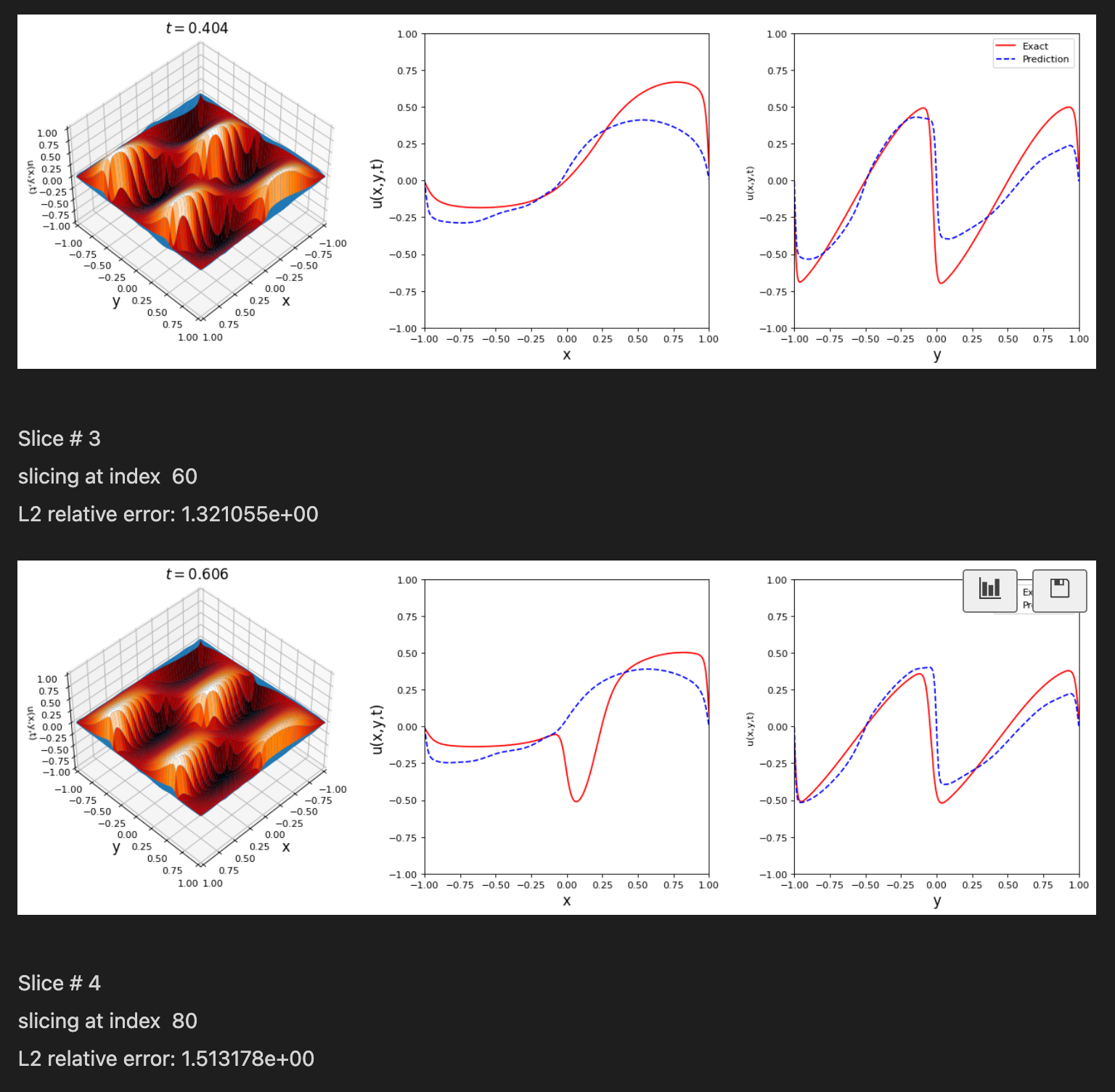
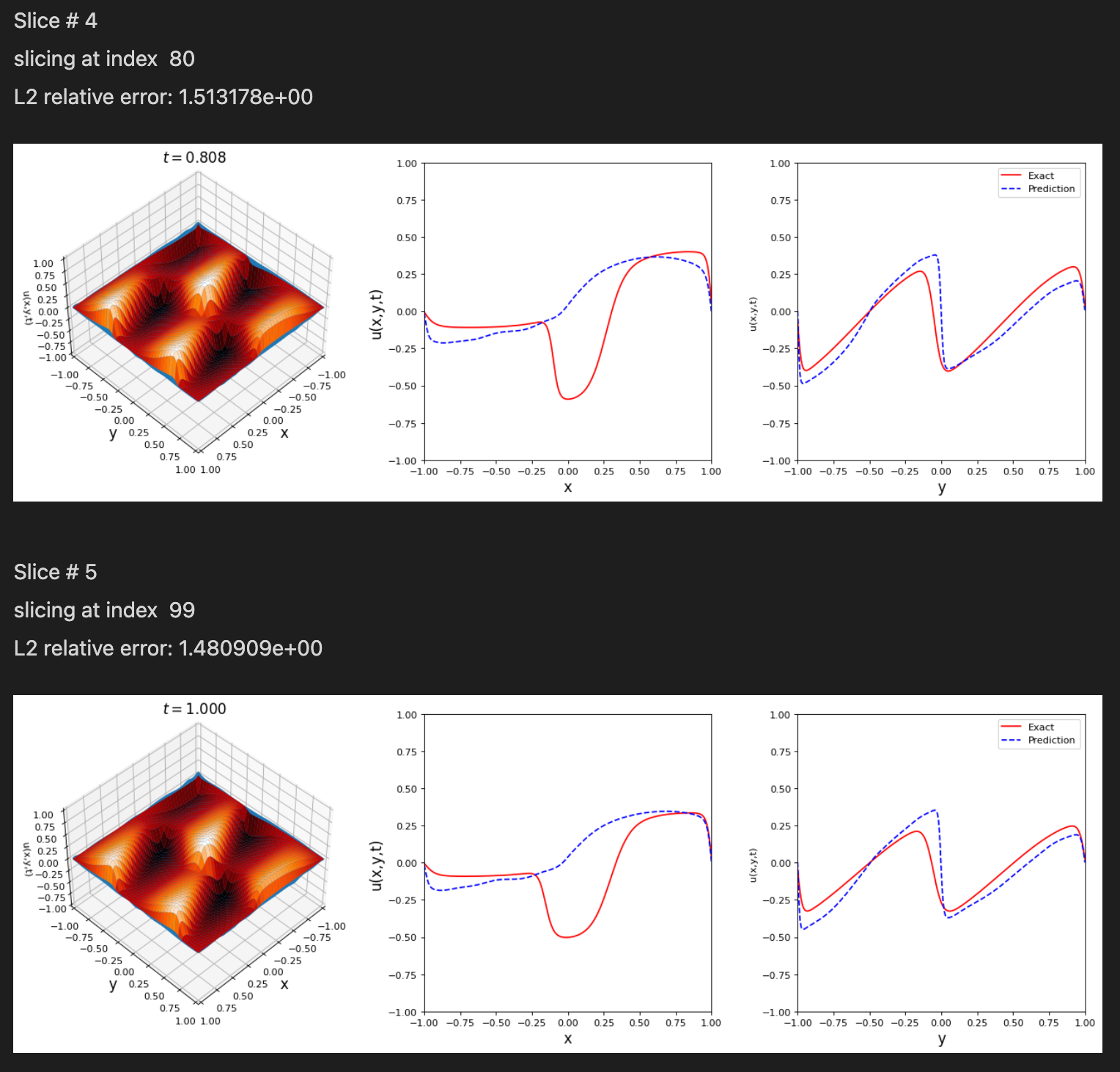
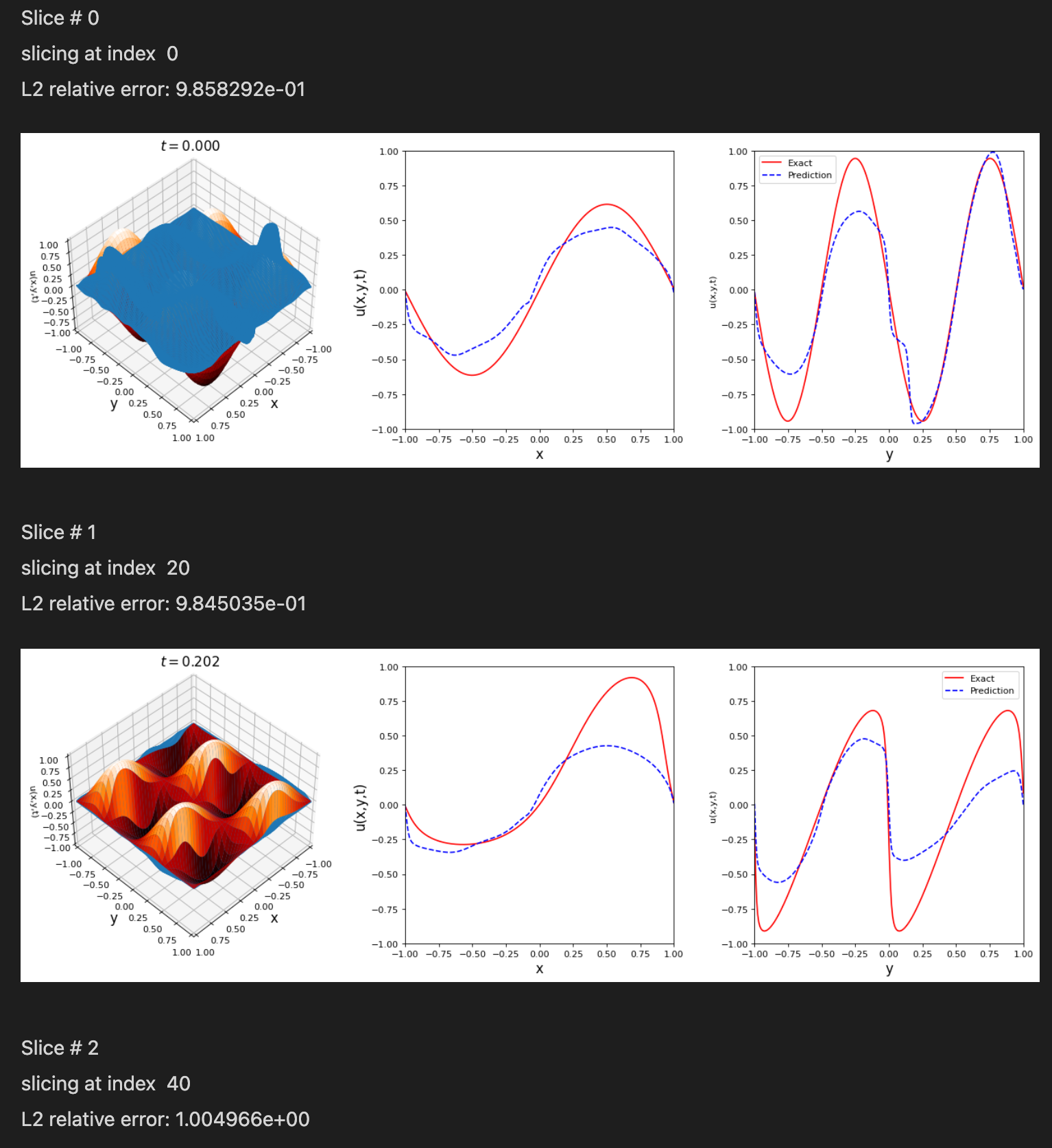
    I have modified the 1D burger example to be in 2D, but I did not get good comparison results. Any suggestions?

    import math
    import scipy.io
    import tensordiffeq as tdq
    from tensordiffeq.boundaries import *
    from tensordiffeq.models import CollocationSolverND
    
    Domain = DomainND(["x", "y", "t"], time_var='t')
    
    Domain.add("x", [-1.0, 1.0], 256)
    Domain.add("y", [-1.0, 1.0], 256)
    Domain.add("t", [0.0, 1.0], 100)
    
    N_f = 10000
    Domain.generate_collocation_points(N_f)
    
    
    def func_ic(x,y):
        p =2
        q =1
        return np.sin (p * math.pi * x) * np.sin(q * math.pi * y)
        
    
    init = IC(Domain, [func_ic], var=[['x','y']])
    upper_x = dirichletBC(Domain, val=0.0, var='x', target="upper")
    lower_x = dirichletBC(Domain, val=0.0, var='x', target="lower")
    upper_y = dirichletBC(Domain, val=0.0, var='y', target="upper")
    lower_y = dirichletBC(Domain, val=0.0, var='y', target="lower")
    
    BCs = [init, upper_x, lower_x, upper_y, lower_y]
    
    
    def f_model(u_model, x, y, t):
        u = u_model(tf.concat([x, y, t], 1))
        u_x = tf.gradients(u, x)
        u_xx = tf.gradients(u_x, x)
        u_y = tf.gradients(u, y)
        u_yy = tf.gradients(u_y, y)
        u_t = tf.gradients(u, t)
        f_u = u_t + u * (u_x + u_y) - (0.01 / tf.constant(math.pi)) * (u_xx+u_yy)
        return f_u
    
    
    layer_sizes = [3, 20, 20, 20, 20, 20, 20, 20, 20, 1]
    
    model = CollocationSolverND()
    model.compile(layer_sizes, f_model, Domain, BCs)
    
    # to reproduce results from Raissi and the SA-PINNs paper, train for 10k newton and 10k adam
    model.fit(tf_iter=10000, newton_iter=10000)
    
    model.save("burger2D_Training_Model")
    #model.load("burger2D_Training_Model")
    
    #######################################################
    #################### PLOTTING #########################
    #######################################################
    
    data = np.load('py-pde_2D_burger_data.npz')
    
    Exact = data['u_output']
    Exact_u = np.real(Exact)
    
    x = Domain.domaindict[0]['xlinspace']
    y = Domain.domaindict[1]['ylinspace']
    t = Domain.domaindict[2]["tlinspace"]
    
    X, Y, T = np.meshgrid(x, y, t)
    
    X_star = np.hstack((X.flatten()[:, None], Y.flatten()[:, None], T.flatten()[:, None]))
    u_star = Exact_u.T.flatten()[:, None]
    
    u_pred, f_u_pred = model.predict(X_star)
    
    error_u = tdq.helpers.find_L2_error(u_pred, u_star)
    print('Error u: %e' % (error_u))
    
    lb = np.array([-1.0, -1.0, 0.0])
    ub = np.array([1.0, 1.0, 1])
    
    tdq.plotting.plot_solution_domain2D(model, [x, y, t], ub=ub, lb=lb, Exact_u=Exact_u.T)
    
    
    Screen Shot 2022-03-04 at 11 15 31 PM Screen Shot 2022-03-04 at 11 15 44 PM Screen Shot 2022-03-04 at 11 15 18 PM
    opened by engsbk 3
  • 2D Wave Equation

    2D Wave Equation

    Thank you for the great contribution!

    I'm trying to extend the 1D example problems to 2D, but I want to make sure my changes are in the correct place:

    1. Dimension variables. I changed them like so:

    Domain = DomainND(["x", "y", "t"], time_var='t')

    Domain.add("x", [0.0, 5.0], 100) Domain.add("y", [0.0, 5.0], 100) Domain.add("t", [0.0, 5.0], 100)

    1. My IC is zero, but for the BCs I'm not sure how to define the left and right borders, please let me know if my implementation is correct:
    
    def func_ic(x,y):
        return 0
    
    init = IC(Domain, [func_ic], var=[['x','y']])
    upper_x = dirichletBC(Domain, val=0.0, var='x', target="upper")
    lower_x = dirichletBC(Domain, val=0.0, var='x', target="lower")
    upper_y = dirichletBC(Domain, val=0.0, var='y', target="upper")
    lower_y = dirichletBC(Domain, val=0.0, var='y', target="lower")
            
    BCs = [init, upper_x, lower_x, upper_y, lower_y]
    

    All of my BCs and ICs are zero. And my equation has a (forcing) time-dependent source term as such:

    
    def f_model(u_model, x, y, t):
        c = tf.constant(1, dtype = tf.float32)
        Amp = tf.constant(2, dtype = tf.float32)
        freq = tf.constant(1, dtype = tf.float32)
        sigma = tf.constant(0.2, dtype = tf.float32)
    
        source_x = tf.constant(0.5, dtype = tf.float32)
        source_y = tf.constant(2.5, dtype = tf.float32)
    
        GP = Amp * tf.exp(-0.5*( ((x-source_x)/sigma)**2 + ((y-source_y)/sigma)**2 ))
        
        S = GP * tf.sin( 2 * tf.constant(math.pi)  * freq * t )
        u = u_model(tf.concat([x,y,t], 1))
        u_x = tf.gradients(u,x)
        u_xx = tf.gradients(u_x, x)
        u_y = tf.gradients(u,y)
        u_yy = tf.gradients(u_y, y)
        u_t = tf.gradients(u,t)
        u_tt = tf.gradients(u_t,t)
    
    
        f_u = u_xx + u_yy - (1/c**2) * u_tt + S
        
        return f_u
    

    Please advise.

    Looking forward to your reply!

    opened by engsbk 13
  • Reproducibility

    Reproducibility

    Dear @levimcclenny,

    Have you considered in adapt TensorDiffEq to be deterministic? In the way the code is implemented, we can find two sources of randomness:

    • The function Domain.generate_collocation_points has a random number generation
    • The TensorFlow training procedure (weights initialization and possibility of the use o random batches)

    Both sources of randomness can be solved with not much effort. We can define a random state for the first one that can be passed to the function Domain.generate_collocation_points. For the second, we can use the implementation provided on Framework Determinism. I have used the procedures suggested by this code, and the results of TensorFlow are always reproducible (CPU or GPU, serial or distributed).

    If you want, I can implement these two features.

    Best Regards

    opened by emiliocoutinho 3
Releases(v0.2.0)
Owner
tensordiffeq
Scalable PINN solvers for PDE Inference and Discovery
tensordiffeq
A Free and Open Source Python Library for Multiobjective Optimization

Platypus What is Platypus? Platypus is a framework for evolutionary computing in Python with a focus on multiobjective evolutionary algorithms (MOEAs)

Project Platypus 424 Dec 18, 2022
Official Implementation of "Third Time's the Charm? Image and Video Editing with StyleGAN3" https://arxiv.org/abs/2201.13433

Third Time's the Charm? Image and Video Editing with StyleGAN3 Yuval Alaluf*, Or Patashnik*, Zongze Wu, Asif Zamir, Eli Shechtman, Dani Lischinski, Da

531 Dec 20, 2022
ESL: Event-based Structured Light

ESL: Event-based Structured Light Video (click on the image) This is the code for the 2021 3DV paper ESL: Event-based Structured Light by Manasi Mugli

Robotics and Perception Group 29 Oct 24, 2022
Implementation of Analyzing and Improving the Image Quality of StyleGAN (StyleGAN 2) in PyTorch

Implementation of Analyzing and Improving the Image Quality of StyleGAN (StyleGAN 2) in PyTorch

Kim Seonghyeon 2.2k Jan 01, 2023
The official repository for Deep Image Matting with Flexible Guidance Input

FGI-Matting The official repository for Deep Image Matting with Flexible Guidance Input. Paper: https://arxiv.org/abs/2110.10898 Requirements easydict

Hang Cheng 51 Nov 10, 2022
Supercharging Imbalanced Data Learning WithCausal Representation Transfer

ECRT: Energy-based Causal Representation Transfer Code for Supercharging Imbalanced Data Learning With Energy-basedContrastive Representation Transfer

Zidi Xiu 11 May 02, 2022
This repository contains the implementation of the following paper: Cross-Descriptor Visual Localization and Mapping

Cross-Descriptor Visual Localization and Mapping This repository contains the implementation of the following paper: "Cross-Descriptor Visual Localiza

Mihai Dusmanu 81 Oct 06, 2022
GoodNews Everyone! Context driven entity aware captioning for news images

This is the code for a CVPR 2019 paper, called GoodNews Everyone! Context driven entity aware captioning for news images. Enjoy! Model preview: Huge T

117 Dec 19, 2022
Minimal implementation of Denoised Smoothing: A Provable Defense for Pretrained Classifiers in TensorFlow.

Denoised-Smoothing-TF Minimal implementation of Denoised Smoothing: A Provable Defense for Pretrained Classifiers in TensorFlow. Denoised Smoothing is

Sayak Paul 19 Dec 11, 2022
JAX bindings to the Flatiron Institute Non-uniform Fast Fourier Transform (FINUFFT) library

JAX bindings to FINUFFT This package provides a JAX interface to (a subset of) the Flatiron Institute Non-uniform Fast Fourier Transform (FINUFFT) lib

Dan Foreman-Mackey 32 Oct 15, 2022
Pytorch port of Google Research's LEAF Audio paper

leaf-audio-pytorch Pytorch port of Google Research's LEAF Audio paper published at ICLR 2021. This port is not completely finished, but the Leaf() fro

Dennis Fedorishin 80 Oct 31, 2022
Pytorch re-implementation of Paper: SwinTextSpotter: Scene Text Spotting via Better Synergy between Text Detection and Text Recognition (CVPR 2022)

SwinTextSpotter This is the pytorch implementation of Paper: SwinTextSpotter: Scene Text Spotting via Better Synergy between Text Detection and Text R

mxin262 183 Jan 03, 2023
Zero-shot Synthesis with Group-Supervised Learning (ICLR 2021 paper)

GSL - Zero-shot Synthesis with Group-Supervised Learning Figure: Zero-shot synthesis performance of our method with different dataset (iLab-20M, RaFD,

Andy_Ge 62 Dec 21, 2022
Local Multi-Head Channel Self-Attention for FER2013

LHC-Net Local Multi-Head Channel Self-Attention This repository is intended to provide a quick implementation of the LHC-Net and to replicate the resu

12 Jan 04, 2023
docTR by Mindee (Document Text Recognition) - a seamless, high-performing & accessible library for OCR-related tasks powered by Deep Learning.

docTR by Mindee (Document Text Recognition) - a seamless, high-performing & accessible library for OCR-related tasks powered by Deep Learning.

Mindee 1.5k Jan 01, 2023
Convert game ISO and archives to CD CHD for emulation on Linux.

tochd Convert game ISO and archives to CD CHD for emulation. Author: Tuncay D. Source: https://github.com/thingsiplay/tochd Releases: https://github.c

Tuncay 20 Jan 02, 2023
Code for Dual Contrastive Learning for Unsupervised Image-to-Image Translation, NTIRE, CVPRW 2021.

arXiv Dual Contrastive Learning Adversarial Generative Networks (DCLGAN) We provide our PyTorch implementation of DCLGAN, which is a simple yet powerf

119 Dec 04, 2022
An implementation of EWC with PyTorch

EWC.pytorch An implementation of Elastic Weight Consolidation (EWC), proposed in James Kirkpatrick et al. Overcoming catastrophic forgetting in neural

Ryuichiro Hataya 166 Dec 22, 2022
Intrusion Test Tool with Python

P3ntsT00L Uma ferramenta escrita em Python, feita para Teste de intrusão. Requisitos ter o python 3.9.8 instalado em sua máquina. ter a git instalada

josh washington 2 Dec 27, 2021
yolov5 deepsort 行人 车辆 跟踪 检测 计数

yolov5 deepsort 行人 车辆 跟踪 检测 计数 实现了 出/入 分别计数。 默认是 南/北 方向检测,若要检测不同位置和方向,可在 main.py 文件第13行和21行,修改2个polygon的点。 默认检测类别:行人、自行车、小汽车、摩托车、公交车、卡车。 检测类别可在 detect

554 Dec 30, 2022