Nested Named Entity Recognition for Chinese Biomedical Text

Overview

CBio-NAMER

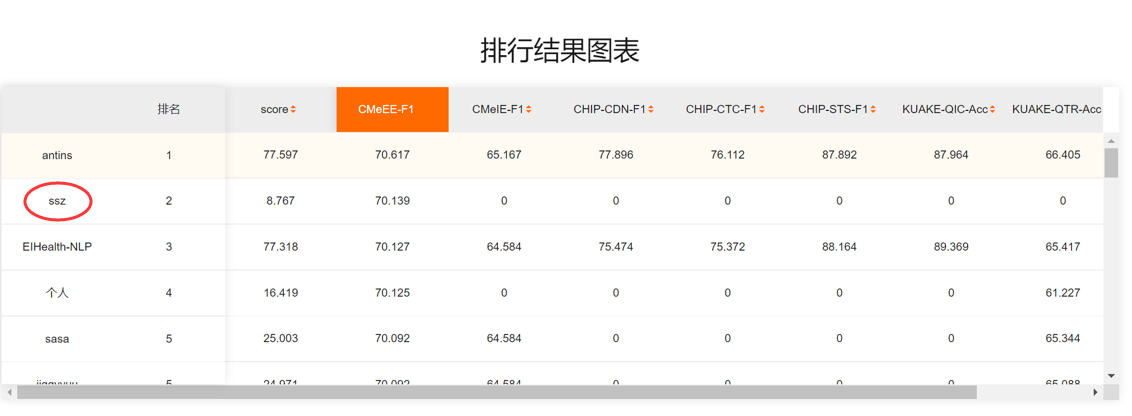
CBioNAMER (Nested nAMed Entity Recognition for Chinese Biomedical Text) is our method used in CBLUE (Chinese Biomedical Language Understanding Evaluation), a benchmark of Nested Named Entity Recognition. We got the 2nd price of the benchmark by 2021/12/07. Single model CBioNAMER also achieves top20 in CBLUE. The score of CBioNAMER has surpassed human(67.0 in F1-score​).

Result

Results of our method:

ensemble

Results of our single model CBioNAMER:
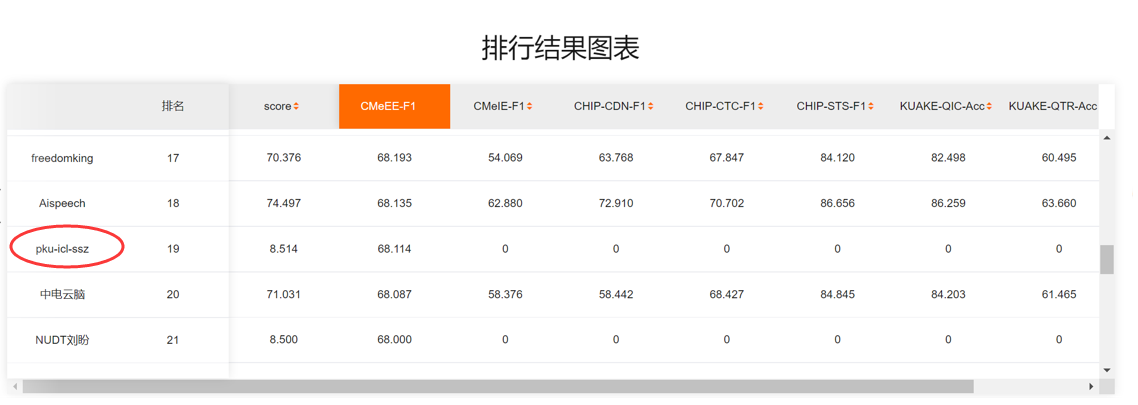
single

Approach

CBioNAMER is a sub-model in our result, which is based on GlobalPointer (a powerful open-source model, thanks for author, we rewrite it with Pytorch) and MacBert.

Usage

First, install PyTorch>=1.7.0. There's no restriction on GPU or CUDA.

Then, install this repo as a Python package:

$ pip install CBioNAMER

Python package transformers==4.6.1 would be automatically installed as well.

API

The CBioNAMER package provides the following methods:

CBioNAMER.load_NER(model_save_path='./checkpoint/macbert-large_dict.pth', maxlen=512, c_size=9, id2c=_id2c, c2c=_c2c)

Returns the pretrained model. It will download the model as necessary. The model would use the first CUDA device if there's any, otherwise using CPU instead.

The model_save_path argument specifies the path of the pretrained model weight.

The maxlen argument specifies the max length of input sentences. The sentences longer than maxlen would be cut off.

The c_size argument specifies the number of entity class. Here is 9 for CBLUE.

The id2c argument specifies the mapping between id and entity class. By default, the id2c argument for CBLUE is:

_id2c = {0: 'dis', 1: 'sym', 2: 'pro', 3: 'equ', 4: 'dru', 5: 'ite', 6: 'bod', 7: 'dep', 8: 'mic'}

The c2c argument specifies the mapping between entity class and its Chinese meaning. By default, the c2c argument for CBLUE is:

_c2c = {'dis': "疾病", 'sym': "临床表现", 'pro': "医疗程序", 'equ': "医疗设备", 'dru': "药物", 'ite': "医学检验项目", 'bod': "身体", 'dep': "科室", 'mic': "微生物类"}


The model returned by CBioNAMER.load_NER() supports the following methods:

model.recognize(text: str, threshold=0)

Given a sentence, returns a list of dictionaries with recognized entity, the format of the dictionary is {'start_idx': entity's starting index, 'end_idx': entity's ending index, 'type': entity class, 'Chinese_type': Chinese meaning of entity class, 'entity': recognized entity}. The threshold argument specifies that the returned list only contains the recognized entity with confidence score higher than threshold.

model.predict_to_file(in_file: str, out_file: str)

Given input and output .json file path, the model would do inference according in_file, and the recognized entity would be saved in out_file. The output file can be submitted to CBLUE. The format of input file is like:

[
  {
    "text": "该技术的应用使某些遗传病的诊治水平得到显著提高。"
  },
    ...
  {
    "text": "There is a sentence."
  }
]

Examples

import CBioNAMER

NER = CBioNAMER.load_NER()
in_file = './CMeEE_test.json'
out_file = './CMeEE_test_answer.json'
NER.predict_to_file(in_file, out_file)
import CBioNAMER

NER = CBioNAMER.load_NER()
text = "该技术的应用使某些遗传病的诊治水平得到显著提高。"
recognized_entity = NER.recognize(text)
print(recognized_entity)
# output:[{'start_idx': 9, 'end_idx': 11, 'type': 'dis', 'Chinese_type': '疾病', 'entity': '遗传病'}]
You might also like...
Bidirectional LSTM-CRF and ELMo for Named-Entity Recognition, Part-of-Speech Tagging and so on.

anaGo anaGo is a Python library for sequence labeling(NER, PoS Tagging,...), implemented in Keras. anaGo can solve sequence labeling tasks such as nam

Named-entity recognition using neural networks. Easy-to-use and state-of-the-art results.

NeuroNER NeuroNER is a program that performs named-entity recognition (NER). Website: neuroner.com. This page gives step-by-step instructions to insta

Pytorch-Named-Entity-Recognition-with-BERT

BERT NER Use google BERT to do CoNLL-2003 NER ! Train model using Python and Inference using C++ ALBERT-TF2.0 BERT-NER-TENSORFLOW-2.0 BERT-SQuAD Requi

Tool to add main subject to items on Wikidata using a WMFs CirrusSearch for named entity recognition or a manually supplied list of QIDs

ItemSubjector Tool made to add main subject statements to items based on the title using a home-brewed CirrusSearch-based Named Entity Recognition alg

Implemented shortest-circuit disambiguation, maximum probability disambiguation, HMM-based lexical annotation and BiLSTM+CRF-based named entity recognition

Implemented shortest-circuit disambiguation, maximum probability disambiguation, HMM-based lexical annotation and BiLSTM+CRF-based named entity recognition

Use Google's BERT for named entity recognition (CoNLL-2003 as the dataset).

For better performance, you can try NLPGNN, see NLPGNN for more details. BERT-NER Version 2 Use Google's BERT for named entity recognition (CoNLL-2003

Named Entity Recognition API used by TEI Publisher

TEI Publisher Named Entity Recognition API This repository contains the API used by TEI Publisher's web-annotation editor to detect entities in the in

RoNER is a Named Entity Recognition model based on a pre-trained BERT transformer model trained on RONECv2

RoNER RoNER is a Named Entity Recognition model based on a pre-trained BERT transformer model trained on RONECv2. It is meant to be an easy to use, hi

Spacy-ginza-ner-webapi - Named Entity Recognition API with spaCy and GiNZA

Named Entity Recognition API with spaCy and GiNZA I wrote a blog post about this

Releases(v0.0.1)
It analyze the sentiment of the user, whether it is postive or negative.

Sentiment-Analyzer-Tool It analyze the sentiment of the user, whether it is postive or negative. It uses streamlit library for creating this sentiment

Paras Patidar 18 Dec 17, 2022
Knowledge Management for Humans using Machine Learning & Tags

HyperTag helps humans intuitively express how they think about their files using tags and machine learning. Represent how you think using tags. Find what you look for using semantic search for your t

Ravn Tech, Inc. 166 Jan 07, 2023
Top2Vec is an algorithm for topic modeling and semantic search.

Top2Vec is an algorithm for topic modeling and semantic search. It automatically detects topics present in text and generates jointly embedded topic, document and word vectors.

Dimo Angelov 2.4k Jan 06, 2023
Bpe algorithm can finetune tokenizer - Bpe algorithm can finetune tokenizer

"# bpe_algorithm_can_finetune_tokenizer" this is an implyment for https://github

张博 1 Feb 02, 2022
A music comments dataset, containing 39,051 comments for 27,384 songs.

Music Comments Dataset A music comments dataset, containing 39,051 comments for 27,384 songs. For academic research use only. Introduction This datase

Zhang Yixiao 2 Jan 10, 2022
Code for EMNLP 2021 main conference paper "Text AutoAugment: Learning Compositional Augmentation Policy for Text Classification"

Code for EMNLP 2021 main conference paper "Text AutoAugment: Learning Compositional Augmentation Policy for Text Classification"

LancoPKU 105 Jan 03, 2023
Code for producing Japanese GPT-2 provided by rinna Co., Ltd.

japanese-gpt2 This repository provides the code for training Japanese GPT-2 models. This code has been used for producing japanese-gpt2-medium release

rinna Co.,Ltd. 491 Jan 07, 2023
Various Algorithms for Short Text Mining

Short Text Mining in Python Introduction This package shorttext is a Python package that facilitates supervised and unsupervised learning for short te

Kwan-Yuet 466 Dec 06, 2022
Yes it's true :broken_heart:

Information WARNING: No longer hosted If you would like to be on this repo's readme simply fork or star it! Forks 1 - Flowzii 2 - Errorcrafter 3 - vk-

Dropout 66 Dec 31, 2022
LV-BERT: Exploiting Layer Variety for BERT (Findings of ACL 2021)

LV-BERT Introduction In this repo, we introduce LV-BERT by exploiting layer variety for BERT. For detailed description and experimental results, pleas

Weihao Yu 14 Aug 24, 2022
LSTC: Boosting Atomic Action Detection with Long-Short-Term Context

LSTC: Boosting Atomic Action Detection with Long-Short-Term Context This Repository contains the code on AVA of our ACM MM 2021 paper: LSTC: Boosting

Tencent YouTu Research 9 Oct 11, 2022
Paradigm Shift in NLP - "Paradigm Shift in Natural Language Processing".

Paradigm Shift in NLP Welcome to the webpage for "Paradigm Shift in Natural Language Processing". Some resources of the paper are constantly maintaine

Tianxiang Sun 41 Dec 30, 2022
Prompt tuning toolkit for GPT-2 and GPT-Neo

mkultra mkultra is a prompt tuning toolkit for GPT-2 and GPT-Neo. Prompt tuning injects a string of 20-100 special tokens into the context in order to

61 Jan 01, 2023
Levenshtein and Hamming distance computation

distance - Utilities for comparing sequences This package provides helpers for computing similarities between arbitrary sequences. Included metrics ar

112 Dec 22, 2022
NumPy String-Indexed is a NumPy extension that allows arrays to be indexed using descriptive string labels

NumPy String-Indexed NumPy String-Indexed is a NumPy extension that allows arrays to be indexed using descriptive string labels, rather than conventio

Aitan Grossman 1 Jan 08, 2022
DeLighT: Very Deep and Light-Weight Transformers

DeLighT: Very Deep and Light-weight Transformers This repository contains the source code of our work on building efficient sequence models: DeFINE (I

Sachin Mehta 440 Dec 18, 2022
A curated list of efficient attention modules

awesome-fast-attention A curated list of efficient attention modules

Sepehr Sameni 891 Dec 22, 2022
A spaCy wrapper of OpenTapioca for named entity linking on Wikidata

spaCyOpenTapioca A spaCy wrapper of OpenTapioca for named entity linking on Wikidata. Table of contents Installation How to use Local OpenTapioca Vizu

Universitätsbibliothek Mannheim 80 Jan 03, 2023
Code for the project carried out fulfilling the course requirements for Fall 2021 NLP at NYU

Introduction Fairseq(-py) is a sequence modeling toolkit that allows researchers and developers to train custom models for translation, summarization,

Sai Himal Allu 1 Apr 25, 2022
SDL: Synthetic Document Layout dataset

SDL is the project that synthesizes document images. It facilitates multiple-level labeling on document images and can generate in multiple languages.

Sơn Nguyễn 0 Oct 07, 2021