GLNet for Memory-Efficient Segmentation of Ultra-High Resolution Images

Overview

GLNet for Memory-Efficient Segmentation of Ultra-High Resolution Images

Language grade: Python License: MIT

Collaborative Global-Local Networks for Memory-Efficient Segmentation of Ultra-High Resolution Images

Wuyang Chen*, Ziyu Jiang*, Zhangyang Wang, Kexin Cui, and Xiaoning Qian

In CVPR 2019 (Oral). [Youtube]

Overview

Segmentation of ultra-high resolution images is increasingly demanded in a wide range of applications (e.g. urban planning), yet poses significant challenges for algorithm efficiency, in particular considering the (GPU) memory limits.

We propose collaborative Global-Local Networks (GLNet) to effectively preserve both global and local information in a highly memory-efficient manner.

  • Memory-efficient: training w. only one 1080Ti and inference w. less than 2GB GPU memory, for ultra-high resolution images of up to 30M pixels.

  • High-quality: GLNet outperforms existing segmentation models on ultra-high resolution images.
Acc_vs_Mem
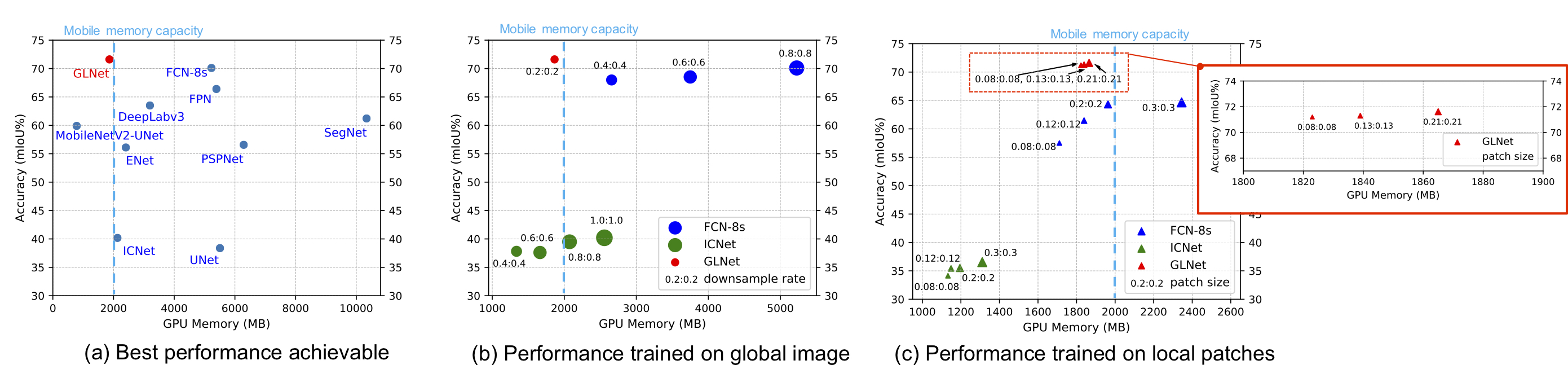
Inference memory v.s. mIoU on the DeepGlobe dataset.
GLNet (red dots) integrates both global and local information in a compact way, contributing to a well-balanced trade-off between accuracy and memory usage.
Examples
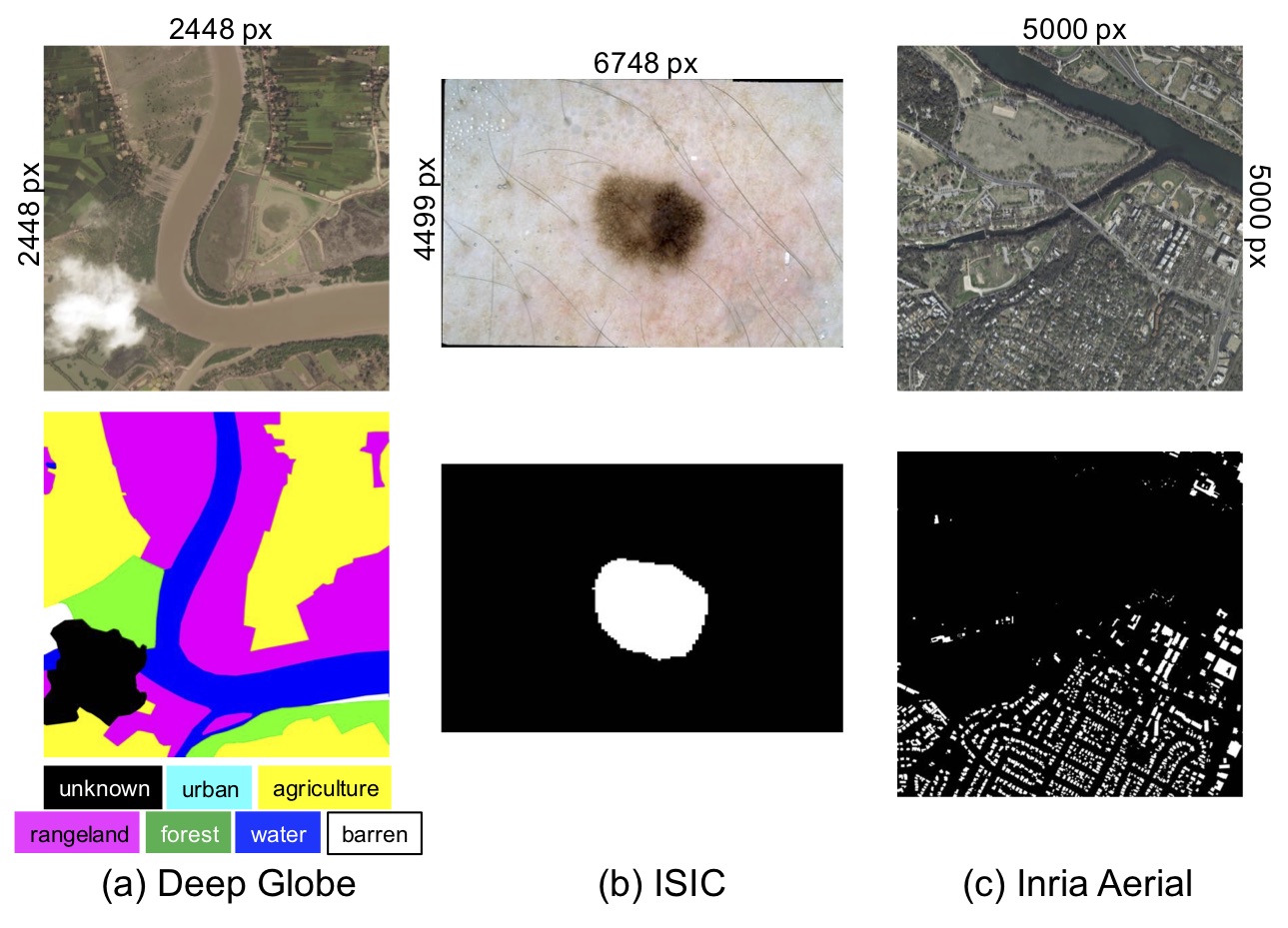
Ultra-high resolution Datasets: DeepGlobe, ISIC, Inria Aerial

Methods
GLNet
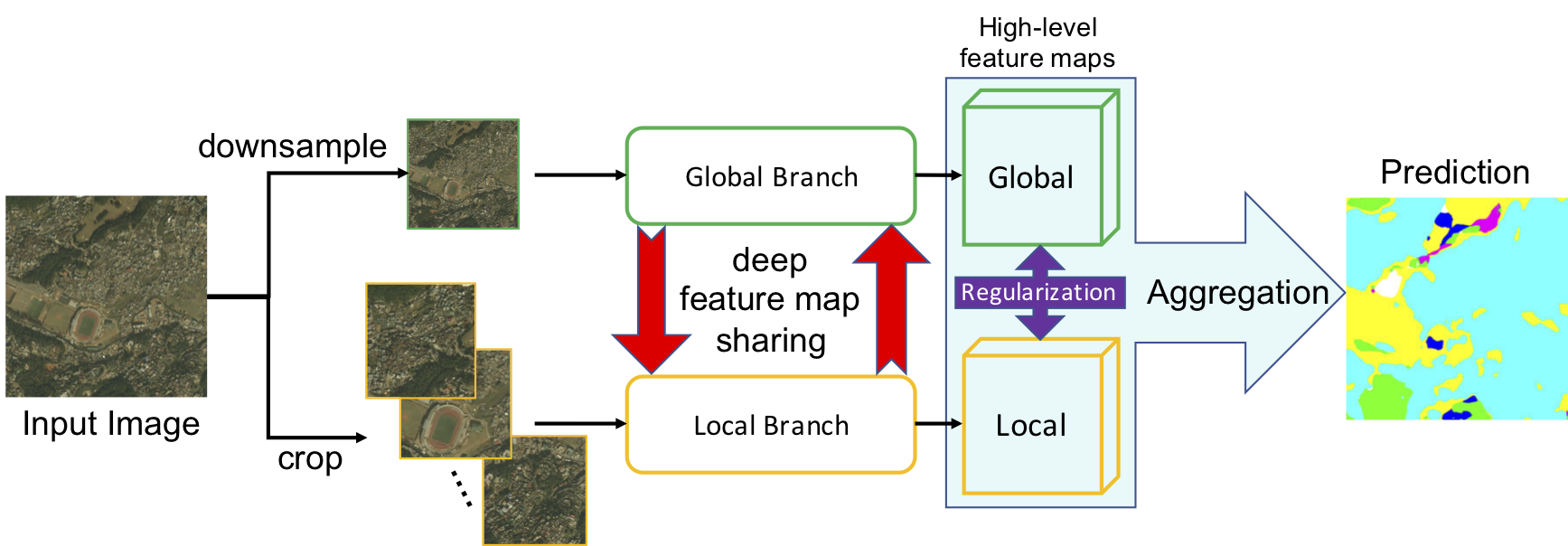
GLNet: the global and local branch takes downsampled and cropped images, respectively. Deep feature map sharing and feature map regularization enforce our global-local collaboration. The final segmentation is generated by aggregating high-level feature maps from two branches.
GLNet
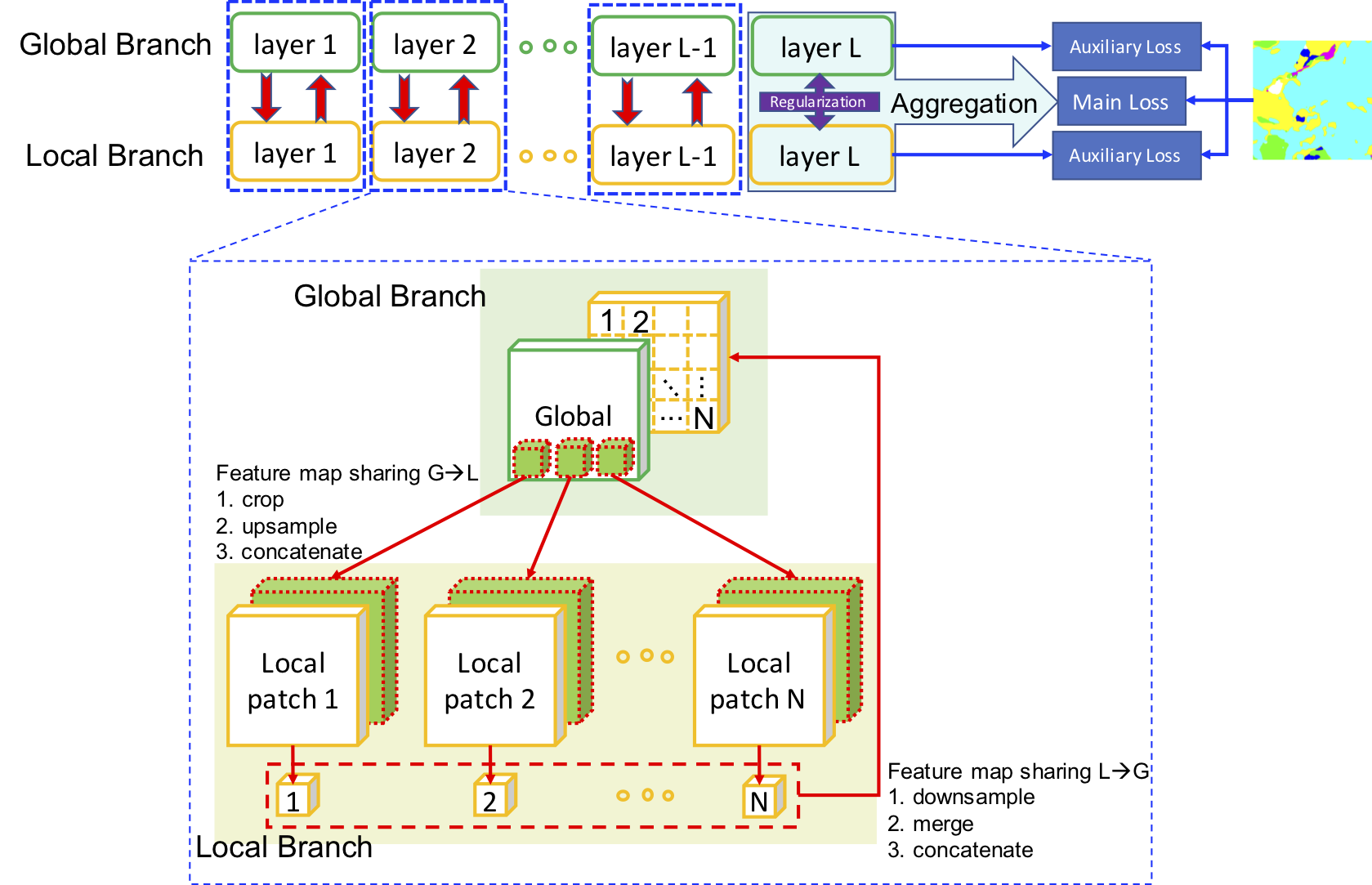
Deep feature map sharing: at each layer, feature maps with global context and ones with local fine structures are bidirectionally brought together, contributing to a complete patch-based deep global-local collaboration.

Training

Current this code base works for Python version >= 3.5.

Please install the dependencies: pip install -r requirements.txt

First, you could register and download the Deep Globe "Land Cover Classification" dataset here: https://competitions.codalab.org/competitions/18468

Then please sequentially finish the following steps:

  1. ./train_deep_globe_global.sh
  2. ./train_deep_globe_global2local.sh
  3. ./train_deep_globe_local2global.sh

The above jobs complete the following tasks:

  • create folder "saved_models" and "runs" to store the model checkpoints and logging files (you could configure the bash scrips to use your own paths).
  • step 1 and 2 prepare the trained models for step 2 and 3, respectively. You could use your own names to save the model checkpoints, but this requires to update values of the flag path_g and path_g2l.

Evaluation

  1. Please download the pre-trained models for the Deep Globe dataset and put them into folder "saved_models":
  1. Download (see above "Training" section) and prepare the Deep Globe dataset according to the train.txt and crossvali.txt: put the image and label files into folder "train" and folder "crossvali"
  2. Run script ./eval_deep_globe.sh

Citation

If you use this code for your research, please cite our paper.

@inproceedings{chen2019GLNET,
  title={Collaborative Global-Local Networks for Memory-Efficient Segmentation of Ultra-High Resolution Images},
  author={Chen, Wuyang and Jiang, Ziyu and Wang, Zhangyang and Cui, Kexin and Qian, Xiaoning},
  booktitle={Proceedings of the IEEE Conference on Computer Vision and Pattern Recognition},
  year={2019}
}

Acknowledgement

We thank Prof. Andrew Jiang and Junru Wu for helping experiments.

Owner
VITA
Visual Informatics Group @ University of Texas at Austin
VITA
audioLIME: Listenable Explanations Using Source Separation

audioLIME This repository contains the Python package audioLIME, a tool for creating listenable explanations for machine learning models in music info

Institute of Computational Perception 27 Dec 01, 2022
DeepDiffusion: Unsupervised Learning of Retrieval-adapted Representations via Diffusion-based Ranking on Latent Feature Manifold

DeepDiffusion Introduction This repository provides the code of the DeepDiffusion algorithm for unsupervised learning of retrieval-adapted representat

4 Nov 15, 2022
Unofficial pytorch implementation of 'Arbitrary Style Transfer in Real-time with Adaptive Instance Normalization'

pytorch-AdaIN This is an unofficial pytorch implementation of a paper, Arbitrary Style Transfer in Real-time with Adaptive Instance Normalization [Hua

Naoto Inoue 873 Jan 06, 2023
SegNet-Basic with Keras

SegNet-Basic: What is Segnet? Deep Convolutional Encoder-Decoder Architecture for Semantic Pixel-wise Image Segmentation Segnet = (Encoder + Decoder)

Yad Konrad 81 Jun 30, 2022
ALBERT: A Lite BERT for Self-supervised Learning of Language Representations

ALBERT ***************New March 28, 2020 *************** Add a colab tutorial to run fine-tuning for GLUE datasets. ***************New January 7, 2020

Google Research 3k Jan 01, 2023
Variational autoencoder for anime face reconstruction

VAE animeface Variational autoencoder for anime face reconstruction Introduction This repository is an exploratory example to train a variational auto

Minzhe Zhang 2 Dec 11, 2021
Deep Learning as a Cloud API Service.

Deep API Deep Learning as Cloud APIs. This project provides pre-trained deep learning models as a cloud API service. A web interface is available as w

Wu Han 4 Jan 06, 2023
This is the implementation of "SELF SUPERVISED REPRESENTATION LEARNING WITH DEEP CLUSTERING FOR ACOUSTIC UNIT DISCOVERY FROM RAW SPEECH" submitted to ICASSP 2022

CPC_DeepCluster This is the implementation of "SELF SUPERVISED REPRESENTATION LEARNING WITH DEEP CLUSTERING FOR ACOUSTIC UNIT DISCOVERY FROM RAW SPEEC

LEAP Lab 2 Sep 15, 2022
SberSwap Video Swap base on deep learning

SberSwap Video Swap base on deep learning

Sber AI 431 Jan 03, 2023
Efficient Training of Visual Transformers with Small Datasets

Official codes for "Efficient Training of Visual Transformers with Small Datasets", NerIPS 2021.

Yahui Liu 112 Dec 25, 2022
Tensorflow Implementation of the paper "Spectral Normalization for Generative Adversarial Networks" (ICML 2017 workshop)

tf-SNDCGAN Tensorflow implementation of the paper "Spectral Normalization for Generative Adversarial Networks" (https://www.researchgate.net/publicati

Nhat M. Nguyen 248 Nov 25, 2022
Collect some papers about transformer with vision. Awesome Transformer with Computer Vision (CV)

Awesome Visual-Transformer Collect some Transformer with Computer-Vision (CV) papers. If you find some overlooked papers, please open issues or pull r

dkliang 2.8k Jan 08, 2023
PASSL包含 SimCLR,MoCo,BYOL,CLIP等基于对比学习的图像自监督算法以及 Vision-Transformer,Swin-Transformer,BEiT,CVT,T2T,MLP_Mixer等视觉Transformer算法

PASSL Introduction PASSL is a Paddle based vision library for state-of-the-art Self-Supervised Learning research with PaddlePaddle. PASSL aims to acce

186 Dec 29, 2022
This is a repository of our model for weakly-supervised video dense anticipation.

Introduction This is a repository of our model for weakly-supervised video dense anticipation. More results on GTEA, Epic-Kitchens etc. will come soon

2 Apr 09, 2022
Sinkformers: Transformers with Doubly Stochastic Attention

Code for the paper : "Sinkformers: Transformers with Doubly Stochastic Attention" Paper You will find our paper here. Compat This package has been dev

Michael E. Sander 31 Dec 29, 2022
Data cleaning, missing value handle, EDA use in this project

Lending Club Case Study Project Brief Solving this assignment will give you an idea about how real business problems are solved using EDA. In this cas

Dhruvil Sheth 1 Jan 05, 2022
ManimML is a project focused on providing animations and visualizations of common machine learning concepts with the Manim Community Library.

ManimML ManimML is a project focused on providing animations and visualizations of common machine learning concepts with the Manim Community Library.

259 Jan 04, 2023
A curated list of awesome deep long-tailed learning resources.

A curated list of awesome deep long-tailed learning resources.

vanint 210 Dec 25, 2022
DeepRec is a recommendation engine based on TensorFlow.

DeepRec Introduction DeepRec is a recommendation engine based on TensorFlow 1.15, Intel-TensorFlow and NVIDIA-TensorFlow. Background Sparse model is a

Alibaba 676 Jan 03, 2023
A human-readable PyTorch implementation of "Self-attention Does Not Need O(n^2) Memory"

memory_efficient_attention.pytorch A human-readable PyTorch implementation of "Self-attention Does Not Need O(n^2) Memory" (Rabe&Staats'21). def effic

Ryuichiro Hataya 7 Dec 26, 2022