Boosting Monocular Depth Estimation Models to High-Resolution via Content-Adaptive Multi-Resolution Merging

Overview

Boosting Monocular Depth Estimation Models to High-Resolution via Content-Adaptive Multi-Resolution Merging

This repository contains an implementation of our CVPR2021 publication:

Boosting Monocular Depth Estimation Models to High-Resolution via Content-Adaptive Multi-Resolution Merging. S. Mahdi H. Miangoleh, Sebastian Dille, Long Mai, Sylvain Paris, Yağız Aksoy. Main pdf, Supplementary pdf, Project Page.
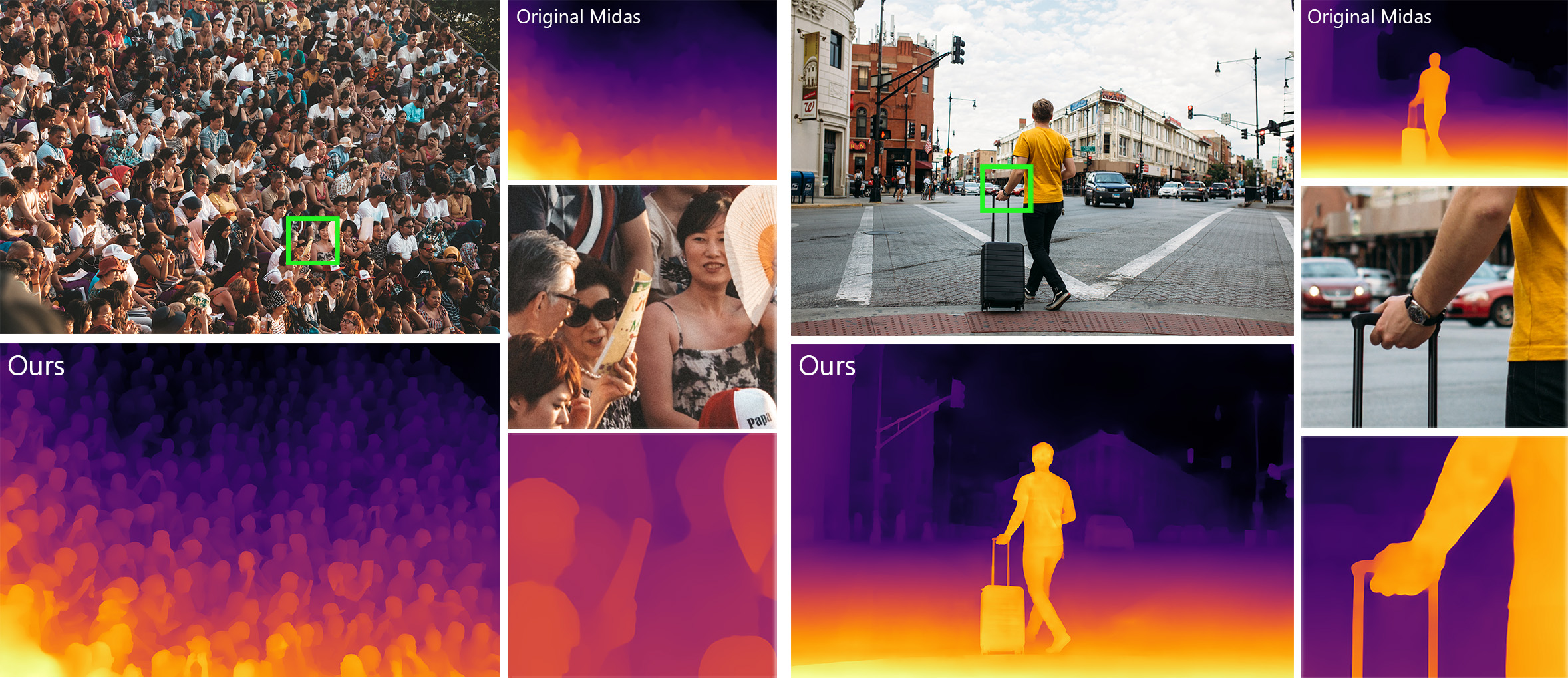
Teaserimage

Change log:

Setup

We Provided the implementation of our method using MiDas-v2 and SGRnet as the base.

Environments

Our mergenet model is trained using torch 0.4.1 and python 3.6 and is tested with torch<=1.8.

Download our mergenet model weights from here and put it in

.\pix2pix\checkpoints\mergemodel\latest_net_G.pth

To use MiDas-v2 as base: Install dependancies as following:

conda install pytorch torchvision opencv cudatoolkit=10.2 -c pytorch
conda install matplotlib
conda install scipy
conda install scikit-image

Download the model weights from MiDas-v2 and put it in

./midas/model.pt

activate the environment
python run.py --Final --data_dir PATH_TO_INPUT --output_dir PATH_TO_RESULT --depthNet 0

To use SGRnet as base: Install dependancies as following:

conda install pytorch=0.4.1 cuda92 -c pytorch
conda install torchvision
conda install matplotlib
conda install scikit-image
pip install opencv-python

Follow the official SGRnet repository to compile the syncbn module in ./structuredrl/models/syncbn. Download the model weights from SGRnet and put it in

./structuredrl/model.pth.tar

activate the environment
python run.py --Final --data_dir PATH_TO_INPUT --output_dir PATH_TO_RESULT --depthNet 1

Different input arguments can be used to generate R0 and R20 results as discussed in the paper.

python run.py --R0 --data_dir PATH_TO_INPUT --output_dir PATH_TO_RESULT --depthNet #[0or1]
python run.py --R20 --data_dir PATH_TO_INPUT --output_dir PATH_TO_RESULT --depthNet #[0or1]

Evaluation

Fill in the needed variables in the following matlab file and run:

./evaluation/evaluatedataset.m

  • estimation_path : path to estimated disparity maps
  • gt_depth_path : path to gt depth/disparity maps
  • dataset_disp_gttype : (true) if ground truth data is disparity and (false) if gt depth data is depth.
  • evaluation_matfile_save_dir : directory to save the evalution results as .mat file.
  • superpixel_scale : scale parameter to run the superpixels on scaled version of the ground truth images to accelarate the evaluation. use 1 for small gt images.

Training

Navigate to dataset preparation instructions to download and prepare the training dataset.

python ./pix2pix/train.py --dataroot DATASETDIR --name mergemodeltrain --model pix2pix4depth --no_flip --no_dropout
python ./pix2pix/test.py --dataroot DATASETDIR --name mergemodeleval --model pix2pix4depth --no_flip --no_dropout

Citation

This implementation is provided for academic use only. Please cite our paper if you use this code or any of the models.

@INPROCEEDINGS{Miangoleh2021Boosting,
author={S. Mahdi H. Miangoleh and Sebastian Dille and Long Mai and Sylvain Paris and Ya\u{g}{\i}z Aksoy},
title={Boosting Monocular Depth Estimation Models to High-Resolution via Content-Adaptive Multi-Resolution Merging},
journal={Proc. CVPR},
year={2021},
}

Credits

The "Merge model" code skeleton (./pix2pix folder) was adapted from the pytorch-CycleGAN-and-pix2pix repository.

For MiDaS and SGR inferences we used the scripts and models from MiDas-v2 and SGRnet respectively (./midas and ./structuredrl folders).

Thanks to k-washi for providing us with a Google Colaboratory notebook implementation.

Owner
Computational Photography Lab @ SFU
Computational Photography Lab at Simon Fraser University, lead by @yaksoy
Computational Photography Lab @ SFU
Deep Learning for Morphological Profiling

Deep Learning for Morphological Profiling An end-to-end implementation of a ML System for morphological profiling using self-supervised learning to di

Danielh Carranza 0 Jan 20, 2022
StackNet is a computational, scalable and analytical Meta modelling framework

StackNet This repository contains StackNet Meta modelling methodology (and software) which is part of my work as a PhD Student in the computer science

Marios Michailidis 1.3k Dec 15, 2022
CSPML (crystal structure prediction with machine learning-based element substitution)

CSPML (crystal structure prediction with machine learning-based element substitution) CSPML is a unique methodology for the crystal structure predicti

8 Dec 20, 2022
Auto HMM: Automatic Discrete and Continous HMM including Model selection

Auto HMM: Automatic Discrete and Continous HMM including Model selection

Chess_champion 29 Dec 07, 2022
[ICCV 2021] Released code for Causal Attention for Unbiased Visual Recognition

CaaM This repo contains the codes of training our CaaM on NICO/ImageNet9 dataset. Due to my recent limited bandwidth, this codebase is still messy, wh

Wang Tan 66 Dec 31, 2022
A Low Complexity Speech Enhancement Framework for Full-Band Audio (48kHz) based on Deep Filtering.

DeepFilterNet A Low Complexity Speech Enhancement Framework for Full-Band Audio (48kHz) based on Deep Filtering. libDF contains Rust code used for dat

Hendrik Schröter 292 Dec 25, 2022
Official code for Spoken ObjectNet: A Bias-Controlled Spoken Caption Dataset

Official code for our Interspeech 2021 - Spoken ObjectNet: A Bias-Controlled Spoken Caption Dataset [1]*. Visually-grounded spoken language datasets c

Ian Palmer 3 Jan 26, 2022
The implementation for paper Joint t-SNE for Comparable Projections of Multiple High-Dimensional Datasets.

Joint t-sne This is the implementation for paper Joint t-SNE for Comparable Projections of Multiple High-Dimensional Datasets. abstract: We present Jo

IDEAS Lab 7 Dec 18, 2022
PyTorch Implementation of VAENAR-TTS: Variational Auto-Encoder based Non-AutoRegressive Text-to-Speech Synthesis.

VAENAR-TTS - PyTorch Implementation PyTorch Implementation of VAENAR-TTS: Variational Auto-Encoder based Non-AutoRegressive Text-to-Speech Synthesis.

Keon Lee 67 Nov 14, 2022
Implementation of paper "Decision-based Black-box Attack Against Vision Transformers via Patch-wise Adversarial Removal"

Patch-wise Adversarial Removal Implementation of paper "Decision-based Black-box Attack Against Vision Transformers via Patch-wise Adversarial Removal

4 Oct 12, 2022
Pytorch Implementation of "Contrastive Representation Learning for Exemplar-Guided Paraphrase Generation"

CRL_EGPG Pytorch Implementation of Contrastive Representation Learning for Exemplar-Guided Paraphrase Generation We use contrastive loss implemented b

YHR 25 Nov 14, 2022
Python and C++ implementation of "MarkerPose: Robust real-time planar target tracking for accurate stereo pose estimation". Accepted at LXCV @ CVPR 2021.

MarkerPose: Robust real-time planar target tracking for accurate stereo pose estimation This is a PyTorch and LibTorch implementation of MarkerPose: a

Jhacson Meza 47 Nov 18, 2022
Tracking Progress in Question Answering over Knowledge Graphs

Tracking Progress in Question Answering over Knowledge Graphs Table of contents Question Answering Systems with Descriptions The QA Systems Table cont

Knowledge Graph Question Answering 47 Jan 02, 2023
Deep Reinforcement Learning based Trading Agent for Bitcoin

Deep Trading Agent Deep Reinforcement Learning based Trading Agent for Bitcoin using DeepSense Network for Q function approximation. For complete deta

Kartikay Garg 669 Dec 29, 2022
Crowd-Kit is a powerful Python library that implements commonly-used aggregation methods for crowdsourced annotation and offers the relevant metrics and datasets

Crowd-Kit: Computational Quality Control for Crowdsourcing Documentation Crowd-Kit is a powerful Python library that implements commonly-used aggregat

Toloka 125 Dec 30, 2022
🌾 PASTIS 🌾 Panoptic Agricultural Satellite TIme Series

🌾 PASTIS 🌾 Panoptic Agricultural Satellite TIme Series (optical and radar) The PASTIS Dataset Dataset presentation PASTIS is a benchmark dataset for

86 Jan 04, 2023
OcclusionFusion: realtime dynamic 3D reconstruction based on single-view RGB-D

OcclusionFusion (CVPR'2022) Project Page | Paper | Video Overview This repository contains the code for the CVPR 2022 paper OcclusionFusion, where we

Wenbin Lin 193 Dec 15, 2022
OpenVisionAPI server

🚀 Quick start An instance of ova-server is free and publicly available here: https://api.openvisionapi.com Checkout ova-client for a quick demo. Inst

Open Vision API 93 Nov 24, 2022
Vanilla and Prototypical Networks with Random Weights for image classification on Omniglot and mini-ImageNet. Made with Python3.

vanilla-rw-protonets-project Vanilla Prototypical Networks and PNs with Random Weights for image classification on Omniglot and mini-ImageNet. Made wi

Giovani Candido 8 Aug 31, 2022