
Source code for the GPT-2 story generation models in the EMNLP 2020 paper "STORIUM: A Dataset and Evaluation Platform for Human-in-the-Loop Story Generation"

Overview

Storium GPT-2 Models

This is the official repository for the GPT-2 models described in the EMNLP 2020 paper [STORIUM: A Dataset and Evaluation Platform for Machine-in-the-Loop Story Generation]. It has all the code necessary to reproduce the models and analysis from the paper.

Overview
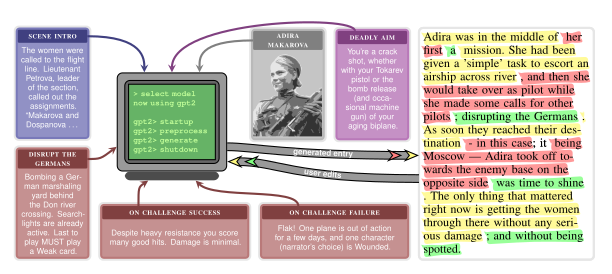
A high-level outline of our dataset and platform. In this example from a real STORIUM game, the character ADIRA MAKAROVA uses the strength card DEADLY AIM to DISRUPT THE GERMANS, a challenge card. Our model conditions on the natural language annotations in the scene intro, challenge card, strength card, and character, along with the text of the previous scene entry (not shown) to generate a suggested story continuation. Players may then edit the model output, by adding or deleting text, before publishing the entry. We collect these edits, using the matched text as the basis of our USER metric. New models can be added to the platform by simply implementing four methods: startup, shutdown, preprocess, and generate.

Deployment

This repository contains the code that makes our GPT-2 story generation models deployable on our evaluation platform, so it serves as a great template for how to structure your code. Please see the file figmentate.py for the simple API required for making your model deployable on our platform. You will also need to provide a json file with any properties needed to pass to your startup method. See for example the properties below:

{
  "scene_entry":
  {
    "properties": {
      "checkpoint_path": "/var/lib/figmentator/checkpoint",
      "sample": {
	"top_p": 0.9,
	"temperature": 0.9,
	"repetition_penalty": 1.2
      }
    },
    "requires": ["torch==1.3.0", "transformers==2.2.0", "kiwisolver==1.1.0"],
    "cls": "model=figmentate:GPT2Figmentator"
  }
}

The key scene_entry defines the type of model being created. Currently, we only support models that generate the text of a scene entry, though we might support other types of prediction models in the future, like suggesting cards or narrator actions.

The properties object will be passed to your startup method. It allows for defining any parameters needed for sampling from your model.

The requires list, is simply a list of python packages that need to be installed for your model to run. These will be automatically installed when your model is deployed. If you notice, we specify the deep learning package torch as a requirement. That's because our code is agnostic to the underlying deep learning framework being used by your model. That means it should support models using other frameworks like tensorflow or jax.

Finally, the cls string is the class that wraps your model. It is specified using Python's entry points syntax.

Cite

@inproceedings{akoury2020storium,
  Author = {Nader Akoury, Shufan Wang, Josh Whiting, Stephen Hood, Nanyun Peng and Mohit Iyyer},
  Booktitle = {Empirical Methods for Natural Language Processing},
  Year = "2020",
  Title = {{STORIUM}: {A} {D}ataset and {E}valuation {P}latform for {S}tory {G}eneration}
}
Owner
Nader Akoury
CS PhD Student
Nader Akoury
moving object detection for satellite videos.

DSFNet: Dynamic and Static Fusion Network for Moving Object Detection in Satellite Videos Algorithm Introduction DSFNet: Dynamic and Static Fusion Net

xiaochao 39 Dec 16, 2022
Adversarial Autoencoders

Adversarial Autoencoders (with Pytorch) Dependencies argparse time torch torchvision numpy itertools matplotlib Create Datasets python create_datasets

Felipe Ducau 188 Jan 01, 2023
Using knowledge-informed machine learning on the PRONOSTIA (FEMTO) and IMS bearing data sets. Predict remaining-useful-life (RUL).

Knowledge Informed Machine Learning using a Weibull-based Loss Function Exploring the concept of knowledge-informed machine learning with the use of a

Tim 43 Dec 14, 2022
Learning from Guided Play: A Scheduled Hierarchical Approach for Improving Exploration in Adversarial Imitation Learning Source Code

Learning from Guided Play: A Scheduled Hierarchical Approach for Improving Exploration in Adversarial Imitation Learning Trevor Ablett*, Bryan Chan*,

STARS Laboratory 8 Sep 14, 2022
MIMIC Code Repository: Code shared by the research community for the MIMIC-III database

MIMIC Code Repository The MIMIC Code Repository is intended to be a central hub for sharing, refining, and reusing code used for analysis of the MIMIC

MIT Laboratory for Computational Physiology 1.8k Dec 26, 2022
This is a GUI interface which can process forest fire detection, smoke detection and fire segmentation

This is a GUI interface which can process forest fire detection, smoke detection and fire segmentation. Yolov5 is used to detect fire and smoke and unet is used to segment fire.

7 Jan 08, 2023
Only works with the dashboard version / branch of jesse

Jesse optuna Only works with the dashboard version / branch of jesse. The config.yml should be self-explainatory. Installation # install from git pip

Markus K. 8 Dec 04, 2022
This package contains deep learning models and related scripts for RoseTTAFold

RoseTTAFold This package contains deep learning models and related scripts to run RoseTTAFold This repository is the official implementation of RoseTT

1.6k Jan 03, 2023
PyTorch implementation of our paper: Decoupling and Recoupling Spatiotemporal Representation for RGB-D-based Motion Recognition

Decoupling and Recoupling Spatiotemporal Representation for RGB-D-based Motion Recognition, arxiv This is a PyTorch implementation of our paper. 1. Re

DamoCV 11 Nov 19, 2022
Code for our TKDE paper "Understanding WeChat User Preferences and “Wow” Diffusion"

wechat-wow-analysis Understanding WeChat User Preferences and “Wow” Diffusion. Fanjin Zhang, Jie Tang, Xueyi Liu, Zhenyu Hou, Yuxiao Dong, Jing Zhang,

18 Sep 16, 2022
Dialect classification

Dialect-Classification This repository presents the data that was used in a talk at ICKL-5 (5th International Conference on Kurdish Linguistics) at th

Kurdish-BLARK 0 Nov 12, 2021
*ObjDetApp* deploys a pytorch model for object detection

*ObjDetApp* deploys a pytorch model for object detection

Will Chao 1 Dec 26, 2021
Differentiable Optimizers with Perturbations in Pytorch

Differentiable Optimizers with Perturbations in PyTorch This contains a PyTorch implementation of Differentiable Optimizers with Perturbations in Tens

Jake Tuero 54 Jun 22, 2022
Unofficial implementation of HiFi-GAN+ from the paper "Bandwidth Extension is All You Need" by Su, et al.

HiFi-GAN+ This project is an unoffical implementation of the HiFi-GAN+ model for audio bandwidth extension, from the paper Bandwidth Extension is All

Brent M. Spell 134 Dec 30, 2022
Advanced yabai wooting scripts

Yabai Wooting scripts Installation requirements Both https://github.com/xiamaz/python-yabai-client and https://github.com/xiamaz/python-wooting-rgb ne

Max Zhao 3 Dec 31, 2021
Interactive web apps created using geemap and streamlit

geemap-apps Introduction This repo demostrates how to build a multi-page Earth Engine App using streamlit and geemap. You can deploy the app on variou

Qiusheng Wu 27 Dec 23, 2022
Leaf: Multiple-Choice Question Generation

Leaf: Multiple-Choice Question Generation Easy to use and understand multiple-choice question generation algorithm using T5 Transformers. The applicat

Kristiyan Vachev 62 Dec 20, 2022
Implemenets the Contourlet-CNN as described in C-CNN: Contourlet Convolutional Neural Networks, using PyTorch

C-CNN: Contourlet Convolutional Neural Networks This repo implemenets the Contourlet-CNN as described in C-CNN: Contourlet Convolutional Neural Networ

Goh Kun Shun (KHUN) 10 Nov 03, 2022
The missing CMake project initializer

cmake-init - The missing CMake project initializer Opinionated CMake project initializer to generate CMake projects that are FetchContent ready, separ

1k Jan 01, 2023
Equivariant Imaging: Learning Beyond the Range Space

[Project] Equivariant Imaging: Learning Beyond the Range Space Project about the

Georges Le Bellier 3 Feb 06, 2022