PIFuHD: Multi-Level Pixel-Aligned Implicit Function for High-Resolution 3D Human Digitization (CVPR 2020)


News:
- [2020/06/15] Demo with Google Colab (incl. visualization) is available! Please check out #pifuhd on Twitter for many results tested by users!
This repository contains a pytorch implementation of "Multi-Level Pixel-Aligned Implicit Function for High-Resolution 3D Human Digitization".
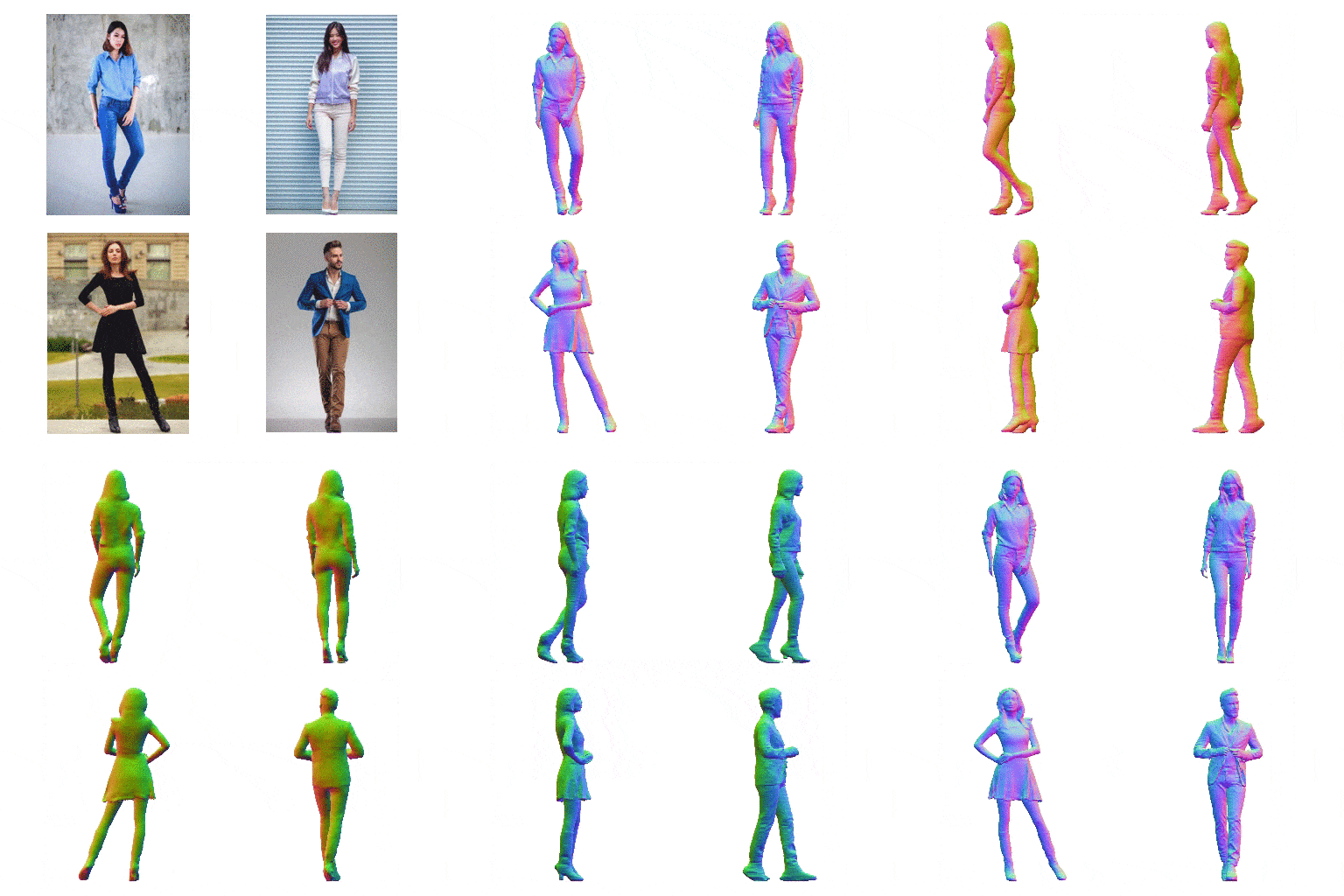
This codebase provides:
- test code
- visualization code
Demo on Google Colab
In case you don't have an environment with GPUs to run PIFuHD, we offer Google Colab demo. You can also upload your own images and reconstruct 3D geometry together with visualization. Try our Colab demo using the following notebook:
Requirements
- Python 3
- PyTorch tested on 1.4.0, 1.5.0
- json
- PIL
- skimage
- tqdm
- cv2
For visualization
- trimesh with pyembree
- PyOpenGL
- freeglut (use
sudo apt-get install freeglut3-devfor ubuntu users) - ffmpeg
Note: At least 8GB GPU memory is recommended to run PIFuHD model.
Run the following code to install all pip packages:
pip install -r requirements.txt
Download Pre-trained model
Run the following script to download the pretrained model. The checkpoint is saved under ./checkpoints/.
sh ./scripts/download_trained_model.sh
A Quick Testing
To process images under ./sample_images, run the following code:
sh ./scripts/demo.sh
The resulting obj files and rendering will be saved in ./results. You may use meshlab (http://www.meshlab.net/) to visualize the 3D mesh output (obj file).
Testing
- run the following script to get joints for each image for testing (joints are used for image cropping only.). Make sure you correctly set the location of OpenPose binary. Alternatively colab demo provides more light-weight cropping rectange estimation without requiring openpose.
python apps/batch_openpose.py -d {openpose_root_path} -i {path_of_images} -o {path_of_images}
- run the following script to run reconstruction code. Make sure to set
--input_pathtopath_of_images,--out_pathto where you want to dump out results, and--ckpt_pathto the checkpoint. Note that unlike PIFu, PIFuHD doesn't require segmentation mask as input. But if you observe severe artifacts, you may try removing background with off-the-shelf tools such as removebg. If you have{image_name}_rect.txtinstead of{image_name}_keypoints.json, add--use_rectflag. For reference, you can take a look at colab demo.
python -m apps.simple_test
- optionally, you can also remove artifacts by keeping only the biggest connected component from the mesh reconstruction with the following script. (Warning: the script will overwrite the original obj files.)
python apps/clean_mesh.py -f {path_of_objs}
Visualization
To render results with turn-table, run the following code. The rendered animation (.mp4) will be stored under {path_of_objs}.
python -m apps.render_turntable -f {path_of_objs} -ww {rendering_width} -hh {rendering_height}
# add -g for geometry rendering. default is normal visualization.
Citation
@inproceedings{saito2020pifuhd,
  title={PIFuHD: Multi-Level Pixel-Aligned Implicit Function for High-Resolution 3D Human Digitization},
  author={Saito, Shunsuke and Simon, Tomas and Saragih, Jason and Joo, Hanbyul},
  booktitle={CVPR},
  year={2020}
}
Relevant Projects
Monocular Real-Time Volumetric Performance Capture (ECCV 2020)
Ruilong Li*, Yuliang Xiu*, Shunsuke Saito, Zeng Huang, Kyle Olszewski, Hao Li
The first real-time PIFu by accelerating reconstruction and rendering!!
PIFu: Pixel-Aligned Implicit Function for High-Resolution Clothed Human Digitization (ICCV 2019)
Shunsuke Saito*, Zeng Huang*, Ryota Natsume*, Shigeo Morishima, Angjoo Kanazawa, Hao Li
The original work of Pixel-Aligned Implicit Function for geometry and texture reconstruction, unifying sigle-view and multi-view methods.
Learning to Infer Implicit Surfaces without 3d Supervision (NeurIPS 2019)
Shichen Liu, Shunsuke Saito, Weikai Chen, Hao Li
We answer to the question of "how can we learn implicit function if we don't have 3D ground truth?"
SiCloPe: Silhouette-Based Clothed People (CVPR 2019, best paper finalist)
Ryota Natsume*, Shunsuke Saito*, Zeng Huang, Weikai Chen, Chongyang Ma, Hao Li, Shigeo Morishima
Our first attempt to reconstruct 3D clothed human body with texture from a single image!
Other Relevant Works
ARCH: Animatable Reconstruction of Clothed Humans (CVPR 2020)
Zeng Huang, Yuanlu Xu, Christoph Lassner, Hao Li, Tony Tung
Learning PIFu in canonical space for animatable avatar generation!
Robust 3D Self-portraits in Seconds (CVPR 2020)
Zhe Li, Tao Yu, Chuanyu Pan, Zerong Zheng, Yebin Liu
They extend PIFu to RGBD + introduce "PIFusion" utilizing PIFu reconstruction for non-rigid fusion.
Deep Volumetric Video from Very Sparse Multi-view Performance Capture (ECCV 2018)
Zeng Huang, Tianye Li, Weikai Chen, Yajie Zhao, Jun Xing, Chloe LeGendre, Linjie Luo, Chongyang Ma, Hao Li
Implict surface learning for sparse view human performance capture!
License
CC-BY-NC 4.0. See the LICENSE file.

 4 Jun 16, 2021
 593 Jan 03, 2023
 7 Dec 17, 2022
 145 Jan 05, 2023
 104 Nov 25, 2022
 425 Dec 23, 2022
 968 Dec 28, 2022
 254 Dec 27, 2022
 1.1k Jan 03, 2023
 1 Nov 16, 2021
 9 Mar 03, 2022
 17 Nov 10, 2022
 64 Nov 22, 2022
 33 Dec 15, 2022
 1 Feb 15, 2022
 758 Dec 25, 2022
 4 Nov 02, 2022
 77 Dec 26, 2022
 1.1k Dec 16, 2022
 398 Dec 30, 2022