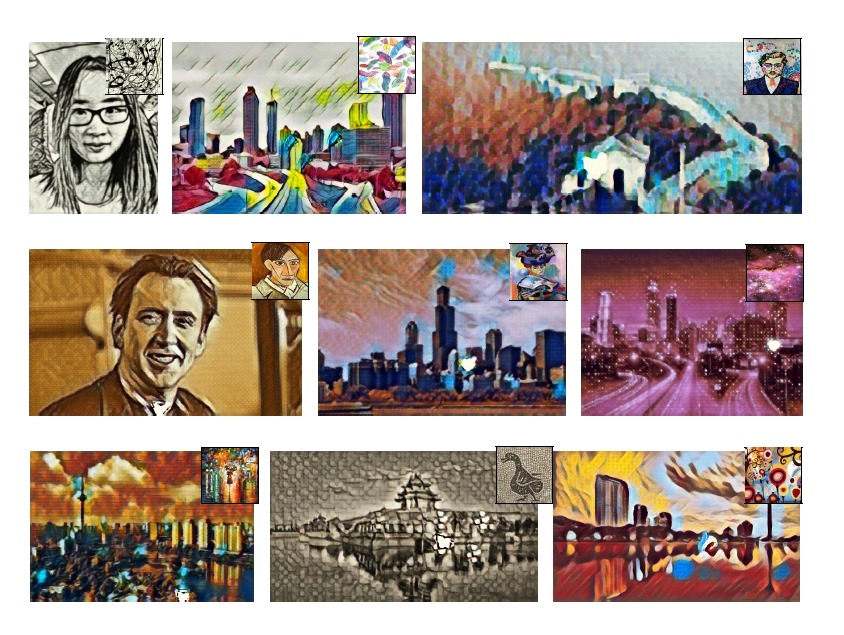
Neural Style and MSG-Net

Overview

PyTorch-Style-Transfer

This repo provides PyTorch Implementation of MSG-Net (ours) and Neural Style (Gatys et al. CVPR 2016), which has been included by ModelDepot. We also provide Torch implementation and MXNet implementation.

Tabe of content

MSG-Net

Multi-style Generative Network for Real-time Transfer [arXiv] [project]
Hang Zhang, Kristin Dana
@article{zhang2017multistyle,
	title={Multi-style Generative Network for Real-time Transfer},
	author={Zhang, Hang and Dana, Kristin},
	journal={arXiv preprint arXiv:1703.06953},
	year={2017}
}

Stylize Images Using Pre-trained MSG-Net

  1. Download the pre-trained model
    git clone [email protected]:zhanghang1989/PyTorch-Style-Transfer.git
    cd PyTorch-Style-Transfer/experiments
    bash models/download_model.sh
  2. Camera Demo
    python camera_demo.py demo --model models/21styles.model
  3. Test the model
    python main.py eval --content-image images/content/venice-boat.jpg --style-image images/21styles/candy.jpg --model models/21styles.model --content-size 1024
  • If you don't have a GPU, simply set --cuda=0. For a different style, set --style-image path/to/style. If you would to stylize your own photo, change the --content-image path/to/your/photo. More options:

    • --content-image: path to content image you want to stylize.
    • --style-image: path to style image (typically covered during the training).
    • --model: path to the pre-trained model to be used for stylizing the image.
    • --output-image: path for saving the output image.
    • --content-size: the content image size to test on.
    • --cuda: set it to 1 for running on GPU, 0 for CPU.

Train Your Own MSG-Net Model

  1. Download the COCO dataset
    bash dataset/download_dataset.sh
  2. Train the model
    python main.py train --epochs 4
  • If you would like to customize styles, set --style-folder path/to/your/styles. More options:
    • --style-folder: path to the folder style images.
    • --vgg-model-dir: path to folder where the vgg model will be downloaded.
    • --save-model-dir: path to folder where trained model will be saved.
    • --cuda: set it to 1 for running on GPU, 0 for CPU.

Neural Style

Image Style Transfer Using Convolutional Neural Networks by Leon A. Gatys, Alexander S. Ecker, and Matthias Bethge.

python main.py optim --content-image images/content/venice-boat.jpg --style-image images/21styles/candy.jpg
  • --content-image: path to content image.
  • --style-image: path to style image.
  • --output-image: path for saving the output image.
  • --content-size: the content image size to test on.
  • --style-size: the style image size to test on.
  • --cuda: set it to 1 for running on GPU, 0 for CPU.

Acknowledgement

The code benefits from outstanding prior work and their implementations including:

Comments
  • training new model

    training new model

    @zhanghang1989 I trained a model with three style images. Now, I see eight .model files. Can you please tell me which .model file to use OR how to integrate them to single model file.

    Thanks Akash

    opened by akashdexati 7
  • Unable to resume training

    Unable to resume training

    Hey,

    So I started training a model, but seeing how long it was going to take I wanted to double check I could successfully resume training.

    I ran: python3 main.py train --epochs 4 --style-folder images/xmas-styles/ --save-model-dir trained_models/ until it generated the first checkpoint, then I ran python3 main.py train --epochs 4 --style-folder images/xmas-styles/ --save-model-dir trained_models/ --resume trained_models/Epoch_0iters_8000_Sat_Dec__9_18\:10\:43_2017_1.0_5.0.model and waiting for the first feedback report, which was Sat Dec 9 18:17:09 2017 Epoch 1: [2000/123287] content: 254020.831359 style: 1666218.549250 total: 1920239.380609 so it appeared to not have resumed at all.

    Also slight side question... Say I train with --epochs 4 til I get final model... If I were to use the last checkpoint before final to resume, but set --epochs 5 or higher, would that work correctly and just keep going through to 5 epochs before generating another final, and have no issues etc?

    opened by pingu2k4 6
  • Temporal coherence?

    Temporal coherence?

    Have you tried some technique for temporal coherence? If not, would you mind if I ask which one would you recommend or would like to try.

    Keep up the good work.

    opened by rraallvv 3
  • vgg16.t7 unhashable type: 'numpy.ndarray'

    vgg16.t7 unhashable type: 'numpy.ndarray'

    It's been a while since the last vgg16 issue i found on this "Issues".

    So i download the vgg16.t7 from the paper quoted in this github. And i run this command "python main.py train --epochs 4 --style-folder images/ownstyles --save-model-dir own_models --cuda 1" i have put the vgg16.t7 into models folder, it's been detected correctly. However, the following problem happened.

    Traceback (most recent call last):
      File "main.py", line 295, in <module>
        main()
      File "main.py", line 41, in main
        train(args)
      File "main.py", line 135, in train
        utils.init_vgg16(args.vgg_model_dir)
      File "C:\Users\user\Prepwork\Cap Project\PyTorch-Multi-Style-Transfer\experiments\utils.py", line 100, in init_vgg16
        vgglua = load_lua(os.path.join(model_folder, 'vgg16.t7'))
      File "C:\Users\user\anaconda3\envs\FTDS\lib\site-packages\torchfile.py", line 424, in load
        return reader.read_obj()
      File "C:\Users\user\anaconda3\envs\FTDS\lib\site-packages\torchfile.py", line 370, in read_obj
        obj._obj = self.read_obj()
      File "C:\Users\user\anaconda3\envs\FTDS\lib\site-packages\torchfile.py", line 385, in read_obj
        k = self.read_obj()
      File "C:\Users\user\anaconda3\envs\FTDS\lib\site-packages\torchfile.py", line 386, in read_obj
        v = self.read_obj()
      File "C:\Users\user\anaconda3\envs\FTDS\lib\site-packages\torchfile.py", line 370, in read_obj
        obj._obj = self.read_obj()
      File "C:\Users\user\anaconda3\envs\FTDS\lib\site-packages\torchfile.py", line 387, in read_obj
        obj[k] = v
    TypeError: unhashable type: 'numpy.ndarray'
    

    Is there anyway i can fix this? i found in other thread they said replace with another one, but i could not find another one other than from stanford.

    Thanks!

    opened by fuddyduddy 2
  • Fix colab notebook

    Fix colab notebook

    Hi. Made some changes to notebook:

    • fixed RuntimeError #21, #32, that was fixed in #31 and #37, but not for msgnet.ipynb;
    • removed unused import torch.nn.functional;
    • prettified according to pep8;
    • changed os.system('wget ...') to direct calling !wget ... without importing os module.

    Tested in colab (run all), the notebook works as expected without errors.

    opened by amrzv 1
  • Establish Docker directory

    Establish Docker directory

    What: Establishes a Docker directory with Dockerfile and run script

    Why: The original repo was written for an outdated version of PyTorch, which makes it hard to run on modern systems without conflicting with updated versions of the dependencies.

    Build the container with

    cd Docker
    docker build -t style-transfer .
    
    opened by ss32 1
  • Fix compatibility issues with torch==1.1.0

    Fix compatibility issues with torch==1.1.0

    RuntimeError: Error(s) in loading state_dict for Net:
    	Unexpected running stats buffer(s) "model1.1.running_mean" and "model1.1.running_var" for InstanceNorm2d with track_running_stats=False. If state_dict is a checkpoint saved before 0.4.0, this may be expected because InstanceNorm2d does not track running stats by default since 0.4.0. Please remove these keys from state_dict. If the running stats are actually needed, instead set track_running_stats=True in InstanceNorm2d to enable them. See the documentation of InstanceNorm2d for details.
    
    opened by jianchao-li 1
  • set default values

    set default values

    Hi,

    I try run the camera.py with the arguments discribed in the docs , but fail because inside the code dont have values for args.demo_size and img.copy too Whats the default values for set these variables?

    Thank you

    opened by gledsoul 1
  • Super Slow at optim on linux Mint

    Super Slow at optim on linux Mint

    Have this on a fresh install of linux Mint. I'm running the example, 'python main.py optim --content-image images/content/venice-boat.jpg --style-image images/21styles/candy.jpg' and its taking FOREVER to do anything. I used to have it working at a decent speed on Ubuntu on the same hardware.

    When inspecting GPU and CPU usage, I see it start off with minimal GPU usage, and huge CPU usage. it slowly increases GPU usage over time until it has enough and then completes the rest in around the same time as before. As an example, it takes around 8 minutes to figure out that there isn't enough VRAM for the selected image size, whereas previously on my Ubuntu installation that would take a matter of seconds. Any idea why it would take so much longer on Mint? And what I can do to remedy this?

    opened by pingu2k4 1
  • "TypeError: 'torch.FloatTensor' object is not callable" running demo on CPU

    Sorry if I'm missing something, I'm unfamiliar with PyTorch. I'm running the demo on CPU on a Mac and getting the following error:

      File "camera_demo.py", line 93, in <module>
        main()
      File "camera_demo.py", line 90, in main
        run_demo(args, mirror=True)
      File "camera_demo.py", line 60, in run_demo
        simg = style_v.data().numpy()
    TypeError: 'torch.FloatTensor' object is not callable
    

    Thanks.

    opened by Carmezim 1
  • optim with normal RAM?

    optim with normal RAM?

    Hi,

    So I spent around 24 hours so far training a model on my style images, got the results out by using the model on eval and so far they're not great. When I use the optim function with the styles however the results are pretty decent, however I am limited by my VRAM which is 6GB as to what size images I can output. Having a lot more RAM available, I was hoping I could do pretty decently sized images, but it seems that I can only get much larger images with eval. Does eval use normal RAM instead of VRAM?

    I will continue training my model so that I can use eval in the future, whether I can do larger images with optim or not, but no idea how much more training is required to make it anywhere near a respectable result.

    What sort of overall loss value should I be aiming for? Does the number of style images make a difference to what I should expect?

    opened by pingu2k4 1
  • Error Training TypeError: 'NoneType' object is not callable

    Error Training TypeError: 'NoneType' object is not callable

    I was able to get my environment setup successfully to run eval; however, now, trying train I'm running into an issue. Not sure if it's a syntax issues or if something else is going on? You help is greatly appreciated.

    
    #!/bin/bash
    #SBATCH --job-name=train-pytorch
    #SBATCH --mail-type=END,FAIL
    #SBATCH [email protected]
    #SBATCH --ntasks=1
    #SBATCH --time=00:10:00
    #SBATCH --mem=8000
    #SBATCH --gres=gpu:p100:2
    #SBATCH --cpus-per-task=6
    #SBATCH --output=%x_%j.log
    #SBATCH --error=%x_%j.err
    
    source ~/scratch/moldach/PyTorch-Style-Transfer/experiments/venv/bin/activate
    
    python main.py train \
      --epochs 4 \
      --style-folder /scratch/moldach/PyTorch-Style-Transfer/experiments/images/9styles \
      --vgg-model-dir vgg-model/ \
      --save-model-dir checkpoint/
    
    
    /scratch/moldach/first-order-model/venv/lib/python3.6/site-packages/torchvision/transforms/transforms.py:188: UserWarning: The use of the transforms.Scale transform is deprecated, please use transforms.Resize instead.
      "please use transforms.Resize instead.")
    Traceback (most recent call last):
      File "main.py", line 295, in <module>
        main()
      File "main.py", line 41, in main
        train(args)
      File "main.py", line 135, in train
        utils.init_vgg16(args.vgg_model_dir)
      File "/scratch/moldach/PyTorch-Style-Transfer/experiments/utils.py", line 102, in init_vgg16
        for (src, dst) in zip(vgglua.parameters()[0], vgg.parameters()):
    TypeError: 'NoneType' object is not callable


    pip freeze:

    $ pip freeze
    -f /cvmfs/soft.computecanada.ca/custom/python/wheelhouse/nix/avx2
    -f /cvmfs/soft.computecanada.ca/custom/python/wheelhouse/nix/generic
    -f /cvmfs/soft.computecanada.ca/custom/python/wheelhouse/generic
    cffi==1.11.5
    cloudpickle==0.5.3
    cycler==0.10.0
    dask==0.18.2
    dataclasses==0.8
    decorator==4.4.2
    future==0.18.2
    imageio==2.9.0
    imageio-ffmpeg==0.4.3
    kiwisolver==1.3.1
    matplotlib==3.3.4
    networkx==2.5
    numpy==1.19.1
    pandas==0.23.4
    Pillow==8.1.2
    pycparser==2.18
    pygit==0.1
    pyparsing==2.4.7
    python-dateutil==2.8.1
    pytz==2018.5
    PyWavelets==1.1.1
    PyYAML==5.1
    scikit-image==0.17.2
    scikit-learn==0.19.2
    scipy==1.4.1
    six==1.15.0
    tifffile==2020.9.3
    toolz==0.9.0
    torch==1.7.0
    torchfile==0.1.0
    torchvision==0.2.1
    tqdm==4.24.0
    typing-extensions==3.7.4.3
    
    opened by moldach 4
  • Color produced by eval doesn't match demo

    Color produced by eval doesn't match demo

    Hi ! Thanks for sharing the code. I've ran the eval program using the defaults provided and I noticed the color tends to be much dimmer than what is shown on the homepage here. Is there something that I am missing? The command I used was

    python main.py --style-image ./images/21styles/udnie.jpg --content-image ./images/content/venice-boat.jpg

    out

    opened by clarng 1
  • struct.error: unpack requires a buffer of 4 bytes

    struct.error: unpack requires a buffer of 4 bytes

    Dear author, Thank you so much for sharing a useful code. I able to run your evaluation code, but face the following error during runing of training code: File "main.py", line 41, in main train(args) File "main.py", line 135, in train utils.init_vgg16(args.vgg_model_dir) File "/home2/st118370/models/PyTorch-Multi-Style-Transfer/experiments/utils.py", line 100, in init_vgg16 vgglua = load_lua(os.path.join(model_folder, 'vgg16.t7')) File "/home2/st118370/anaconda3/envs/pytorch-py3/lib/python3.7/site-packages/torchfile.py", line 424, in load return reader.read_obj() File "/home2/st118370/anaconda3/envs/pytorch-py3/lib/python3.7/site-packages/torchfile.py", line 310, in read_obj typeidx = self.read_int() File "/home2/st118370/anaconda3/envs/pytorch-py3/lib/python3.7/site-packages/torchfile.py", line 277, in read_int return self._read('i')[0] File "/home2/st118370/anaconda3/envs/pytorch-py3/lib/python3.7/site-packages/torchfile.py", line 271, in _read return struct.unpack(fmt, self.f.read(sz)) struct.error: unpack requires a buffer of 4 bytes

    how can i resolve this problem? kindly guide. thanks

    opened by MFarooqAit 1
  • vgg16.t7  unhashable type: 'numpy.ndarray

    vgg16.t7 unhashable type: 'numpy.ndarray

    hi

    I have put the vgg16.t7 into models folder, it's been detected correctly. However, the following problem happened.

    Traceback (most recent call last): File "main.py", line 295, in main() File "main.py", line 41, in main train(args) File "main.py", line 135, in train utils.init_vgg16(args.vgg_model_dir) File "C:\Users\user\Prepwork\Cap Project\PyTorch-Multi-Style-Transfer\experiments\utils.py", line 100, in init_vgg16 vgglua = load_lua(os.path.join(model_folder, 'vgg16.t7')) File "C:\Users\user\anaconda3\envs\FTDS\lib\site-packages\torchfile.py", line 424, in load return reader.read_obj() File "C:\Users\user\anaconda3\envs\FTDS\lib\site-packages\torchfile.py", line 370, in read_obj obj._obj = self.read_obj() File "C:\Users\user\anaconda3\envs\FTDS\lib\site-packages\torchfile.py", line 385, in read_obj k = self.read_obj() File "C:\Users\user\anaconda3\envs\FTDS\lib\site-packages\torchfile.py", line 386, in read_obj v = self.read_obj() File "C:\Users\user\anaconda3\envs\FTDS\lib\site-packages\torchfile.py", line 370, in read_obj obj._obj = self.read_obj() File "C:\Users\user\anaconda3\envs\FTDS\lib\site-packages\torchfile.py", line 387, in read_obj obj[k] = v TypeError: unhashable type: 'numpy.ndarray'

    It does't work for pytorch-1.0.0 and 1.4.0, and giving the same error, how to deal with it? thanks !

    opened by Gavin-Evans 13
  • Different brush stroke size

    Different brush stroke size

    In your paper you wrote about the ability to train the model with different sizes of the style images to later get control over the brush stroke size. Did you implement this in either the pytorch or torch implementation? Greetings and keep up the great work

    opened by lpiribauer 0
Releases(v0.1)
DeepMind Alchemy task environment: a meta-reinforcement learning benchmark

The DeepMind Alchemy environment is a meta-reinforcement learning benchmark that presents tasks sampled from a task distribution with deep underlying structure.

DeepMind 188 Dec 25, 2022
A set of tests for evaluating large-scale algorithms for Wasserstein-2 transport maps computation.

Continuous Wasserstein-2 Benchmark This is the official Python implementation of the NeurIPS 2021 paper Do Neural Optimal Transport Solvers Work? A Co

Alexander 22 Dec 12, 2022
This repository stores the code to reproduce the results published in "TiWS-iForest: Isolation Forest in Weakly Supervised and Tiny ML scenarios"

TinyWeaklyIsolationForest This repository stores the code to reproduce the results published in "TiWS-iForest: Isolation Forest in Weakly Supervised a

2 Mar 21, 2022
Tightness-aware Evaluation Protocol for Scene Text Detection

TIoU-metric Release on 27/03/2019. This repository is built on the ICDAR 2015 evaluation code. If you propose a better metric and require further eval

Yuliang Liu 206 Nov 18, 2022
Pytorch implementation of the paper "Topic Modeling Revisited: A Document Graph-based Neural Network Perspective"

Graph Neural Topic Model (GNTM) This is the pytorch implementation of the paper "Topic Modeling Revisited: A Document Graph-based Neural Network Persp

Dazhong Shen 8 Sep 14, 2022
Code for our paper "Sematic Representation for Dialogue Modeling" in ACL2021

AMR-Dialogue An implementation for paper "Semantic Representation for Dialogue Modeling". You may find our paper here. Requirements python 3.6 pytorch

xfbai 45 Dec 26, 2022
How to Leverage Multimodal EHR Data for Better Medical Predictions?

How to Leverage Multimodal EHR Data for Better Medical Predictions? This repository contains the code of the paper: How to Leverage Multimodal EHR Dat

13 Dec 13, 2022
Supplementary materials for ISMIR 2021 LBD paper "Evaluation of Latent Space Disentanglement in the Presence of Interdependent Attributes"

Evaluation of Latent Space Disentanglement in the Presence of Interdependent Attributes Supplementary materials for ISMIR 2021 LBD submission: K. N. W

Karn Watcharasupat 2 Oct 25, 2021
Official repository for "On Improving Adversarial Transferability of Vision Transformers" (2021)

Improving-Adversarial-Transferability-of-Vision-Transformers Muzammal Naseer, Kanchana Ranasinghe, Salman Khan, Fahad Khan, Fatih Porikli arxiv link A

Muzammal Naseer 47 Dec 02, 2022
CLIP+FFT text-to-image

Aphantasia This is a text-to-image tool, part of the artwork of the same name. Based on CLIP model, with FFT parameterizer from Lucent library as a ge

vadim epstein 690 Jan 02, 2023
IEGAN — Official PyTorch Implementation Independent Encoder for Deep Hierarchical Unsupervised Image-to-Image Translation

IEGAN — Official PyTorch Implementation Independent Encoder for Deep Hierarchical Unsupervised Image-to-Image Translation Independent Encoder for Deep

30 Nov 05, 2022
NuPIC Studio is an all­-in-­one tool that allows users create a HTM neural network from scratch

NuPIC Studio is an all­-in-­one tool that allows users create a HTM neural network from scratch, train it, collect statistics, and share it among the members of the community. It is not just a visual

HTM Community 93 Sep 30, 2022
Official repository of PanoAVQA: Grounded Audio-Visual Question Answering in 360° Videos (ICCV 2021)

Pano-AVQA Official repository of PanoAVQA: Grounded Audio-Visual Question Answering in 360° Videos (ICCV 2021) [Paper] [Poster] [Video] Getting Starte

Heeseung Yun 9 Dec 23, 2022
Transfer Learning library for Deep Neural Networks.

Transfer and meta-learning in Python Each folder in this repository corresponds to a method or tool for transfer/meta-learning. xfer-ml is a standalon

Amazon 245 Dec 08, 2022
A list of all papers and resoureces on Semantic Segmentation

Semantic-Segmentation A list of all papers and resoureces on Semantic Segmentation. Dataset importance SemanticSegmentation_DL Some implementation of

Alan Tang 1.1k Dec 12, 2022
Instantaneous Motion Generation for Robots and Machines.

Ruckig Instantaneous Motion Generation for Robots and Machines. Ruckig generates trajectories on-the-fly, allowing robots and machines to react instan

Berscheid 374 Dec 23, 2022
Supplementary code for TISMIR paper "Sliding-Window Pitch-Class Histograms as a Means of Modeling Musical Form"

Sliding-Window Pitch-Class Histograms as a Means of Modeling Musical Form This is supplementary code for the TISMIR paper Sliding-Window Pitch-Class H

1 Nov 27, 2021
Reinforcement Learning with Q-Learning Algorithm on gym's frozen lake environment implemented in python

Reinforcement Learning with Q Learning Algorithm Q learning algorithm is trained on the gym's frozen lake environment. Libraries Used gym Numpy tqdm P

1 Nov 10, 2021
Reimplementation of Dynamic Multi-scale filters for Semantic Segmentation.

Paddle implementation of Dynamic Multi-scale filters for Semantic Segmentation.

Hongqiang.Wang 2 Nov 01, 2021
A PyTorch Toolbox for Face Recognition

FaceX-Zoo FaceX-Zoo is a PyTorch toolbox for face recognition. It provides a training module with various supervisory heads and backbones towards stat

JDAI-CV 1.6k Jan 06, 2023