End-to-End Optimization of Scene Layout
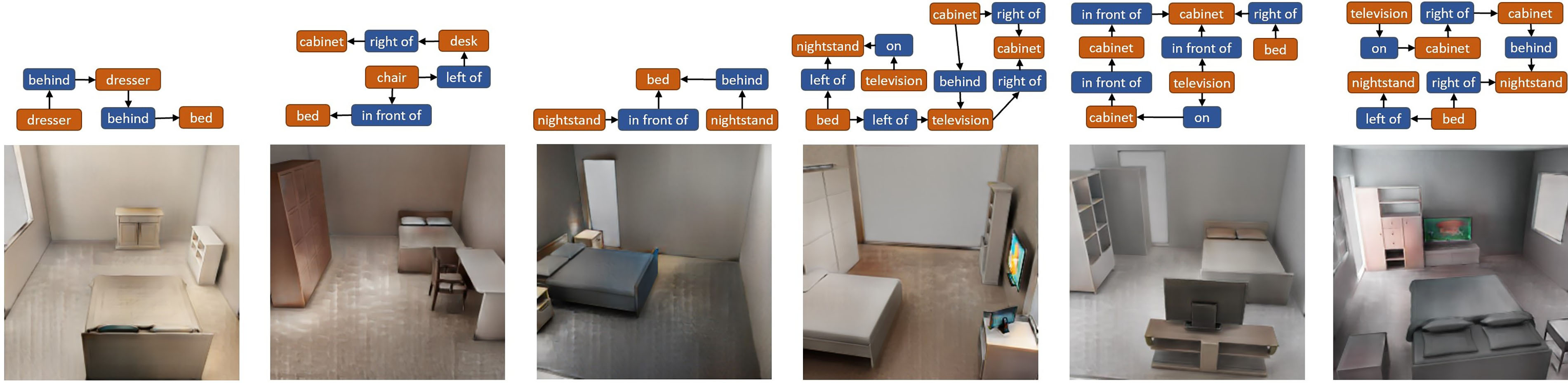 Code release for: End-to-End Optimization of Scene Layout CVPR 2020 (Oral)
For help contact afluo [a.t] andrew.cmu.edu or open an issue
-
Requirements
- Pytorch 1.2 (for everything)
- Neural 3D Mesh Renderer - daniilidis version (for scene refinement only) For numerical stability, please modify projection.py to remove the multiplication by 0. After the change
L33, L34looks like:
x__ = x_ y__ = y_- Blender 2.79 (for 3D rendering of rooms only)
- Please install numpy in Blender
- matplotlib
- numpy
- skimage (for SPADE based shading)
- imageio (for SPADE based shading)
- shapely (eval only)
- PyWavefront (for scene refinement only, loading of 3d meshes)
- PyMesh (for scene refnement only, remeshing of SUNCG objects)
- 1 Nvidia GPU
Download checkpoints here, download metadata here
Project structure
|-3d_SLN
  |-data
    |-suncg_dataset.py
      # Actual definition for the dataset object, makes batches of scene graphs
  |-metadata
    # SUNCG meta data goes here
    |-30_size_info_many.json
      # data about object size/volume, for 30/70 cutoff
    |-data_rot_train.json
      # Normalized object positions & rotations for training
    |-data_rot_val.json
      # For testing
    |-size_info_many.json
      # data about object size/volume, different cutoff
    |-valid_types.json
      # What object types we should use for making the scene graph
      # Caution when editing this, quite a bit is hard coded elsewhere
  |-models
    |-diff_render.py
      # Uses the Neural Mesh Renderer (Pytorch Version) to refine object positions
    |-graph.py
      # Graph network building blocks
    |-misc.py
      # Misc helper functions for the diff renderer
    |-Sg2ScVAE_model.py
      # Code to construct the VAE-graph network
    |-SPADE_related.py
      # Tools to construct SPADE VAE GAN (inference only)
  |-options
    # Global options
  |-render
    # Contains various "profiles" for Blender rendering
  |-testing
    # You must call batch_gen in test.py at least once
    # It will call into get_layouts_from_network in test_VAE.py
    # this will compute the posterior mean & std and cache it
    |-test_acc_mean_std.py
      # Contains helper functions to measure acc/l1/std
    |-test_heatmap.py
      # Contains the functions *produce_heatmap* and *plot_heatmap*
      # The first function takes as input a verbally defined scene graph
        # If not provided, it uses a default scene graph with 5 objects
        # It will load weights for a VAE-graph network
        # Then load the computed posterior mean & std
        # And repeatedly sample from the given scene graph
        # Saves the results to a .pkl file
      # The second function will load a .pkl and plot them as heatmaps
    |-test_plot2d.py
      # Contains a function that uses matplotlib
      # Does NOT require SUNCG
      # Plots the objects using colors provided by ScanNet
    |-test_plot3d.py
      # Calls into the blender code in the ../render folder
      # Requires the SUNCG meshes
      # Requires Blender 2.79
      # Either uses the CPU (Blender renderer)
      # Or uses the GPU (Cycles renderer)
      # Loads a HDR texture (from HDRI Haven) for background
    |-test_SPADE_shade.py
      # Loads semantic maps & depth map, and produces RGB images using SPADE
    |-test_utils.py
      # Contains helper functions for testing
        # Of interest is the *get_sg_from_words* function
    |-test_VAE.py
  |-build_dataset_model.py
     # Constructs dataset & dataloader objects
     # Also constructs the VAE-graph network
  |-test.py
     # Provides functions which performs the following:
       # generation of layouts from scene graphs under the *batch_gen* argument
       # measure the accuracy of l1 loss, accuracy, std under the *measure_acc_l1_std* argument
       # draw the topdown heatmaps of layouts with a single scene graph under the *heat_map* argument
       # plot the topdown boxes of layouts with under the *draw_2d* argument
       # plot the viewer centric layouts using suncg meshes under the *draw_3d* argument
       # perform SPADE based shading of semantic+depth maps under the *gan_shade* argument
  |-train.py
     # Contains the training loop for the VAE-graph network
  |-utils.py
     # Contains various helper functions for:
       # managing network losses
       # make scene graphs from bounding boxes
       # load/write jsons
       # misc other stuff
-
Training the VAE-graph network (limited to 1 GPU):
python train.py -
Testing the VAE-graph network:
First runpython test.py --batch_genat least once. This computes and caches a posterior for future sampling using the training set. It also generates a bunch of layouts using the test set. -
To generate a heatmap:
python test.py --heat_map
You can either define your own scene graph (see theproduce_heatmapfunction intesting/test_heatmap.py), if you do not provide one it will use the default one. The function will convert scene graphs defined using words into a format usable by the network. -
To compute STD/L1/Acc:
python test.py --measure_acc_l1_std -
To plot the scene from a top down view with ScanNet colors (doesn't requrie SUNCG):
python test.py --draw_2d
Please provide a (O+1 x 6) tensor of bounding boxes, and a (O+1,) tensor of rotations. The last object should be the bounding box of the room -
To plot 3D
python test.py --draw_3d
This calls intotest_plot3d.py, which in turn launched Blender, and executesrender_caller.py, you can put in specific rooms by editing this file. The full rendering function is located inrender_room_color.py. -
To use a neural renderer to refine a room
python test.py --fine_tunePlease select the indexes of the room intest.py. This will call intotest_render_refine.pywhich uses the differentiable renderer located indiff_render.py. Learning rate, and loss types/weightings can be set intest_render_refine.py.
We set a manual seed for demonstration purposes, in practice please remove this. -
To use SPADE to generate texture/shading/lighting for a room from semantic + depth
python test.py --gan_shadeThis will first call intosemantic_depth_caller.pyto produce the semantic and depth maps, then use SPADE to generate RGB images.
Citation
If you find this repo useful for your research, please consider citing the paper
@inproceedings{luo2020end,
  title={End-to-End Optimization of Scene Layout},
  author={Luo, Andrew and Zhang, Zhoutong and Wu, Jiajun and Tenenbaum, Joshua B},
  booktitle={Proceedings of the IEEE/CVF Conference on Computer Vision and Pattern Recognition},
  pages={3754--3763},
  year={2020}
}

 113 Dec 17, 2022
 1.3k Jan 02, 2023
 93 Oct 04, 2022
 5 Jan 03, 2023
 273 Dec 26, 2022
 50 Nov 12, 2022
 89 Dec 22, 2022
 5 Nov 11, 2022
 4 Oct 31, 2022
 208 Dec 20, 2022
 862 Jan 01, 2023
 2 Dec 27, 2022
 944 Jan 07, 2023
 2.8k Dec 29, 2022
 2 Jan 10, 2022
 41 Dec 31, 2022
 47 Nov 02, 2022
 904 Dec 21, 2022
 215 Jan 06, 2023
 1 Jan 16, 2022