Multi agent DDPG algorithm written in Python + Pytorch

Overview

Project 3: Collaboration and Competition

Project Details

For this project, you will work with the Tennis environment.

Trained Agent

In this environment, two agents control rackets to bounce a ball over a net. If an agent hits the ball over the net, it receives a reward of +0.1. If an agent lets a ball hit the ground or hits the ball out of bounds, it receives a reward of -0.01. Thus, the goal of each agent is to keep the ball in play.

The observation space consists of 8 variables corresponding to the position and velocity of the ball and racket. Each agent receives its own, local observation. Two continuous actions are available, corresponding to movement toward (or away from) the net, and jumping.

The task is episodic, and in order to solve the environment, your agents must get an average score of +0.5 (over 100 consecutive episodes, after taking the maximum over both agents). Specifically,

  • After each episode, we add up the rewards that each agent received (without discounting), to get a score for each agent. This yields 2 (potentially different) scores. We then take the maximum of these 2 scores.
  • This yields a single score for each episode.

The environment is considered solved, when the average (over 100 episodes) of those scores is at least +0.5.

Getting Started

Dependencies

To set up your python environment to run the code in the notebook, follow the instructions below.

  1. Create (and activate) a new environment with Python 3.6.

    • Linux or Mac:
    conda create --name drlnd python=3.6
    source activate drlnd
    • Windows:
    conda create --name drlnd python=3.6 
    activate drlnd
  2. Clone the repository, and navigate to the python/ folder. Then, install several dependencies.

git clone https://github.com/udacity/deep-reinforcement-learning.git
cd deep-reinforcement-learning/python
pip install .

Note: You may encounter issues with installing Pytorch 0.4.0. In that case, please replace the file python/requirements.txt with the file requirements.txt inside this project.

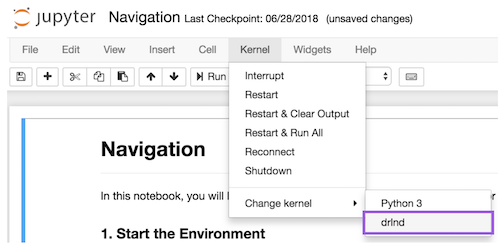
  1. Create an IPython kernel for the drlnd environment.
python -m ipykernel install --user --name drlnd --display-name "drlnd"
  1. Before running code in a notebook, change the kernel to match the drlnd environment by using the drop-down Kernel menu.

Kernel

Instructions

  1. Download the environment from one of the links below. You need only select the environment that matches your operating system:

    (For Windows users) Check out this link if you need help with determining if your computer is running a 32-bit version or 64-bit version of the Windows operating system.

    (For AWS) If you'd like to train the agent on AWS (and have not enabled a virtual screen), then please use this link to obtain the "headless" version of the environment. You will not be able to watch the agent without enabling a virtual screen, but you will be able to train the agent. (To watch the agent, you should follow the instructions to enable a virtual screen, and then download the environment for the Linux operating system above.)

  2. Place the extracted files in the same folder as the notebook Tennis.ipynb.

  3. Load the notebook with Jupyter notebook. (The command to start Jupyter notebook is jupyter notebook)

  4. Follow further instructions in the notebook.

You might also like...
Implementation of EMNLP 2017 Paper
Implementation of EMNLP 2017 Paper "Natural Language Does Not Emerge 'Naturally' in Multi-Agent Dialog" using PyTorch and ParlAI

Language Emergence in Multi Agent Dialog Code for the Paper Natural Language Does Not Emerge 'Naturally' in Multi-Agent Dialog Satwik Kottur, José M.

Implementation of EMNLP 2017 Paper
Implementation of EMNLP 2017 Paper "Natural Language Does Not Emerge 'Naturally' in Multi-Agent Dialog" using PyTorch and ParlAI

Language Emergence in Multi Agent Dialog Code for the Paper Natural Language Does Not Emerge 'Naturally' in Multi-Agent Dialog Satwik Kottur, José M.

Pytorch modules for paralel models with same architecture. Ideal for multi agent-based systems

WideLinears Pytorch parallel Neural Networks A package of pytorch modules for fast paralellization of separate deep neural networks. Ideal for agent-b

A lightweight Python-based 3D network multi-agent simulator. Uses a cell-based congestion model. Calculates risk, loudness and battery capacities of the agents. Suitable for 3D network optimization tasks.

AMAZ3DSim AMAZ3DSim is a lightweight python-based 3D network multi-agent simulator. It uses a cell-based congestion model. It calculates risk, battery

Spatial Intention Maps for Multi-Agent Mobile Manipulation (ICRA 2021)

spatial-intention-maps This code release accompanies the following paper: Spatial Intention Maps for Multi-Agent Mobile Manipulation Jimmy Wu, Xingyua

Rethinking the Importance of Implementation Tricks in Multi-Agent Reinforcement Learning

RIIT Our open-source code for RIIT: Rethinking the Importance of Implementation Tricks in Multi-AgentReinforcement Learning. We implement and standard

Official source code to CVPR'20 paper,
Official source code to CVPR'20 paper, "When2com: Multi-Agent Perception via Communication Graph Grouping"

When2com: Multi-Agent Perception via Communication Graph Grouping This is the PyTorch implementation of our paper: When2com: Multi-Agent Perception vi

Multi Agent Path Finding Algorithms

MATP-solver Simulator collision check path step random initial states or given states Traditional method Seperate A* algorithem Confict-based Search S

A parallel framework for population-based multi-agent reinforcement learning.

MALib: A parallel framework for population-based multi-agent reinforcement learning MALib is a parallel framework of population-based learning nested

Releases(v1.0.0)
Owner
Rogier Wachters
Rogier Wachters
Pytorch Implementation of paper "Noisy Natural Gradient as Variational Inference"

Noisy Natural Gradient as Variational Inference PyTorch implementation of Noisy Natural Gradient as Variational Inference. Requirements Python 3 Pytor

Tony JiHyun Kim 119 Dec 02, 2022
use tensorflow 2.0 to tell a dog and cat from a specified picture

dog_or_cat use tensorflow 2.0 to tell a dog and cat from a specified picture This is one of the classic experiments for the introduction of deep learn

你这个代码我看不懂 1 Oct 22, 2021
This repository contains the PyTorch implementation of the paper STaCK: Sentence Ordering with Temporal Commonsense Knowledge appearing at EMNLP 2021.

STaCK: Sentence Ordering with Temporal Commonsense Knowledge This repository contains the pytorch implementation of the paper STaCK: Sentence Ordering

Deep Cognition and Language Research (DeCLaRe) Lab 23 Dec 16, 2022
This repository contains the implementation of the paper Contrastive Instance Association for 4D Panoptic Segmentation using Sequences of 3D LiDAR Scans

Contrastive Instance Association for 4D Panoptic Segmentation using Sequences of 3D LiDAR Scans This repository contains the implementation of the pap

Photogrammetry & Robotics Bonn 40 Dec 01, 2022
Code for "ATISS: Autoregressive Transformers for Indoor Scene Synthesis", NeurIPS 2021

ATISS: Autoregressive Transformers for Indoor Scene Synthesis This repository contains the code that accompanies our paper ATISS: Autoregressive Trans

138 Dec 22, 2022
Drone-based Joint Density Map Estimation, Localization and Tracking with Space-Time Multi-Scale Attention Network

DroneCrowd Paper Detection, Tracking, and Counting Meets Drones in Crowds: A Benchmark. Introduction This paper proposes a space-time multi-scale atte

VisDrone 98 Nov 16, 2022
Towards End-to-end Video-based Eye Tracking

Towards End-to-end Video-based Eye Tracking The code accompanying our ECCV 2020 publication and dataset, EVE. Authors: Seonwook Park, Emre Aksan, Xuco

Seonwook Park 76 Dec 12, 2022
This solves the autonomous driving issue which is supported by deep learning technology. Given a video, it splits into images and predicts the angle of turning for each frame.

Self Driving Car An autonomous car (also known as a driverless car, self-driving car, and robotic car) is a vehicle that is capable of sensing its env

Sagor Saha 4 Sep 04, 2021
This is the repository for The Machine Learning Workshops, published by AI DOJO

This is the repository for The Machine Learning Workshops, published by AI DOJO. It contains all the workshop's code with supporting project files necessary to work through the code.

AI Dojo 12 May 06, 2022
Transfer Reinforcement Learning for Differing Action Spaces via Q-Network Representations

Transfer-Learning-in-Reinforcement-Learning Transfer Reinforcement Learning for Differing Action Spaces via Q-Network Representations Final Report Tra

Trung Hieu Tran 4 Oct 17, 2022
Learned Initializations for Optimizing Coordinate-Based Neural Representations

Learned Initializations for Optimizing Coordinate-Based Neural Representations Project Page | Paper Matthew Tancik*1, Ben Mildenhall*1, Terrance Wang1

Matthew Tancik 127 Jan 03, 2023
retweet 4 satoshi ⚡️

rt4sat retweet 4 satoshi This bot is the codebase for https://twitter.com/rt4sat please feel free to create an issue if you saw any bugs basically thi

6 Sep 30, 2022
Semi-supervised Domain Adaptation via Minimax Entropy

Semi-supervised Domain Adaptation via Minimax Entropy (ICCV 2019) Install pip install -r requirements.txt The code is written for Pytorch 0.4.0, but s

Vision and Learning Group 243 Jan 09, 2023
links and status of cool gradio demos

awesome-demos This is a list of some wonderful demos & applications built with Gradio. Here's how to contribute yours! 🖊️ Natural language processing

Gradio 96 Dec 30, 2022
Pre-trained NFNets with 99% of the accuracy of the official paper

NFNet Pytorch Implementation This repo contains pretrained NFNet models F0-F6 with high ImageNet accuracy from the paper High-Performance Large-Scale

Benjamin Schmidt 133 Dec 09, 2022
This project deals with the detection of skin lesions within the ISICs dataset using YOLOv3 Object Detection with Darknet.

This work is licensed under a Creative Commons Attribution-NonCommercial 4.0 International License. Skin Lesion detection using YOLO This project deal

Lalith Veerabhadrappa Badiger 1 Nov 22, 2021
Author: Wenhao Yu ([email protected]). ACL 2022. Commonsense Reasoning on Knowledge Graph for Text Generation

Diversifying Commonsense Reasoning Generation on Knowledge Graph Introduction -- This is the pytorch implementation of our ACL 2022 paper "Diversifyin

DM2 Lab @ ND 61 Dec 30, 2022
A machine learning library for spiking neural networks. Supports training with both torch and jax pipelines, and deployment to neuromorphic hardware.

Rockpool Rockpool is a Python package for developing signal processing applications with spiking neural networks. Rockpool allows you to build network

SynSense 21 Dec 14, 2022
Geometric Deep Learning Extension Library for PyTorch

Documentation | Paper | Colab Notebooks | External Resources | OGB Examples PyTorch Geometric (PyG) is a geometric deep learning extension library for

Matthias Fey 16.5k Jan 08, 2023
Python library for tracking human heads with FLAME (a 3D morphable head model)

Video Head Tracker 3D tracking library for human heads based on FLAME (a 3D morphable head model). The tracking algorithm is inspired by face2face. It

61 Dec 25, 2022